


Industrial Lubricants Market Size and overview
The global Industrial Lubricants market reached an estimated US$ 76.4 billion in 2025 and is expected to reach US$ 111.2 billion by 2035, growing with a CAGR of 3.82% during the forecast period 2026-2035. Demand is supported by installed industrial machinery, manufacturing output, mining and construction activity, power generation, process-industry operations and increasing emphasis on equipment reliability. The market is shifting toward premium synthetic fluids, longer drain intervals, energy-efficient formulations and condition-monitoring programs that improve equipment uptime and reduce unplanned maintenance.
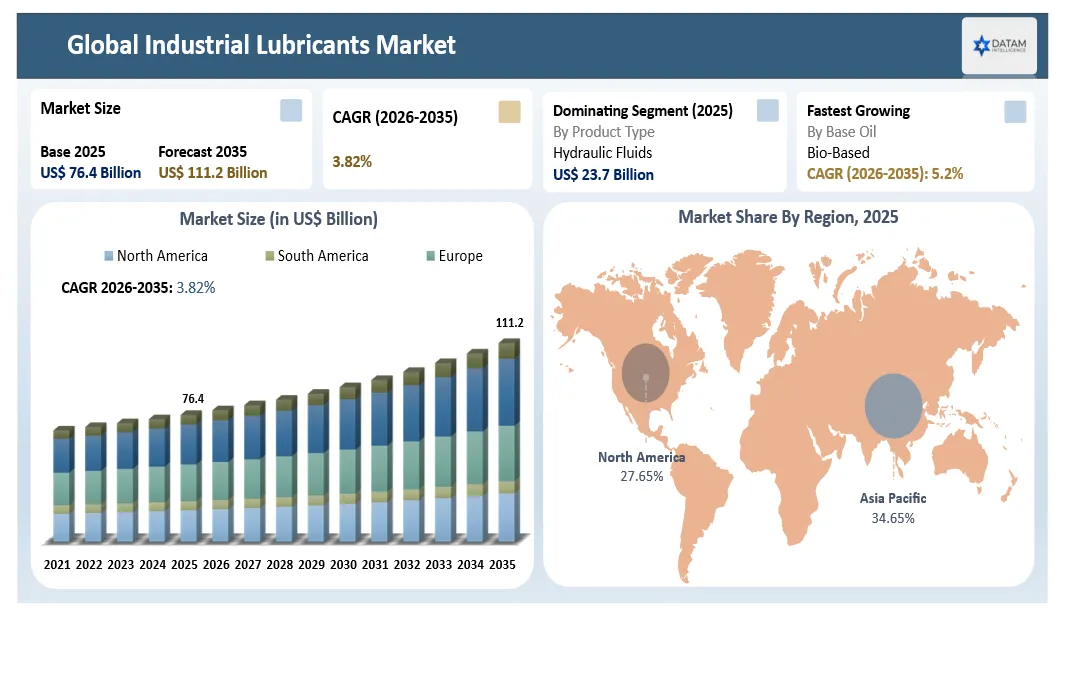
Hydraulic fluids remain the largest product category because hydraulic power systems are used broadly in manufacturing machinery, material handling, mining equipment, construction systems and mobile industrial assets. Metalworking fluids, industrial gear oils, compressor oils, turbine oils and greases create additional recurring demand across discrete and process manufacturing. Although mineral oil remains the volume leader, synthetic and semi-synthetic products are gaining value share where temperature stability, oxidation resistance, cleanliness, fire resistance or extended service life justify a higher upfront price.
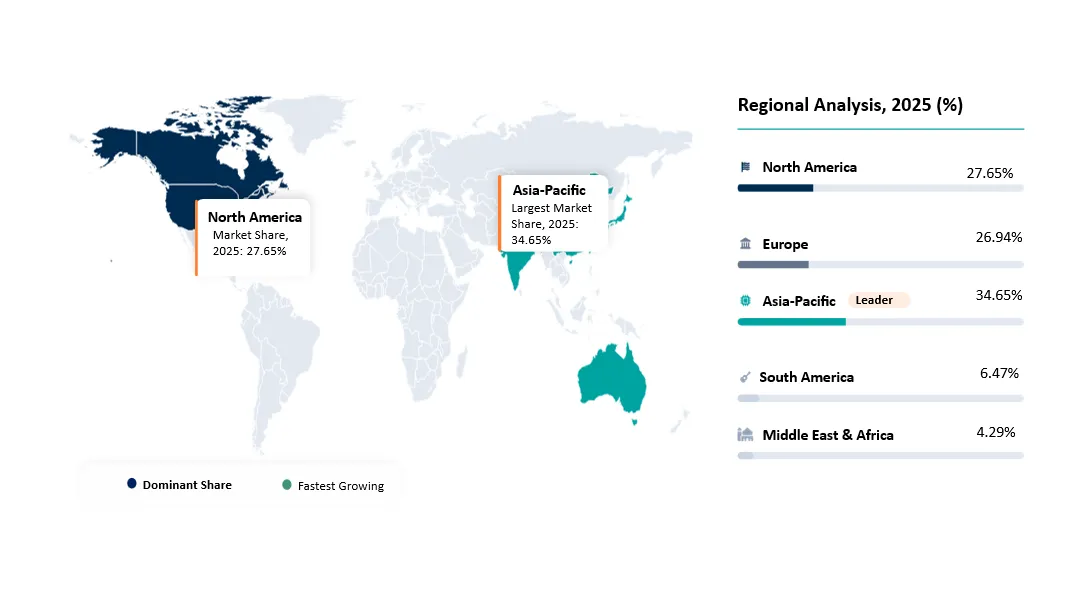
Asia-Pacific is the largest regional market, driven by China, India, Japan, South Korea and Southeast Asian manufacturing clusters. North America and Europe remain high-value markets because of mature installed equipment, strong OEM specifications, advanced maintenance practices and higher penetration of synthetic lubricants. Growth through 2035 will increasingly reflect value per liter rather than volume alone, as customers prioritize longer service life, energy efficiency, lower waste generation and digitally supported lubrication management.
| Metric | Details |
| 2025 Market Size | US$ 76.4 Billion |
| 2035 Projected Market Size | US$ 111.2 Billion |
| CAGR (2026-2035) | 3.82% |
| Largest Market | Asia-Pacific |
| Fastest Growing Market | Asia-Pacific |
| Dominating Product Type | Hydraulic Fluids |
| Fastest-Growing Base Oil | Synthetic and Bio-Based |
| Primary Growth Theme | Reliability, premiumization and energy efficiency |
| Report Insights Covered | Market Size, Share, Growth, Pricing, Trade, Ecosystem, Competitive Landscape and Company Profiles |
Industrial Lubricants Market Key Takeaways
- Asia-Pacific holds the largest market share because it combines the world’s largest manufacturing base with mining, infrastructure, steel, chemicals and power-generation demand.
- Hydraulic fluids remain the largest product segment, while premium synthetic compressor, gear, turbine and specialty fluids are expected to grow faster in value terms.
- Synthetic lubricants gain share where higher thermal stability, oxidation resistance and longer drain intervals can reduce downtime and maintenance labor.
- Industrial customers increasingly evaluate lubricant suppliers on total cost of ownership, OEM approvals, technical service, oil analysis and supply reliability rather than unit price alone.
- Bio-based and environmentally acceptable lubricants are expanding from niche applications into forestry, marine, hydropower, food processing and environmentally sensitive operations.
- Digital condition monitoring, used-oil analysis and predictive maintenance are changing the commercial model from product supply toward lubrication-as-a-service and reliability partnerships.
Industrial Lubricants Industry Trends and Strategic Insights
- Premiumization is increasing as equipment operates at higher loads, temperatures and duty cycles, particularly in automated production and high-throughput process plants.
- Customers are consolidating suppliers and using multi-site contracts that combine lubricants, technical service, inventory management and condition monitoring.
- Re-refined base oils, circular packaging and longer drain intervals are becoming measurable sustainability levers because they reduce lifecycle waste and purchased-material emissions.
- Electrical equipment growth creates opportunities in transformer fluids, thermal-management fluids and specialty greases, while conventional automotive lubricant exposure becomes less central to industrial portfolios.
- Raw-material and geopolitical disruptions increase the value of regional blending capacity, dual sourcing and flexible formulation capability.
Why does this report matter in 2026?
The year 2026 is an important decision point for industrial lubricant suppliers because customers are simultaneously managing industrial re-shoring, automation, high energy costs, supply-chain risk and decarbonization targets. Lubricants are a small share of operating cost but a critical determinant of equipment availability. As a result, procurement teams are increasingly willing to pay for formulations and service programs that extend component life, reduce electricity consumption, improve cleanliness or prevent unplanned outages.
The market is also being affected by volatility in crude-derived feedstocks, additives and logistics. Manufacturers with integrated base-oil access or diversified supplier networks can respond more effectively to rapid changes in availability and pricing. At the same time, high-performance suppliers are differentiating through laboratory services, remote monitoring, OEM approvals, specialty formulations and on-site reliability engineering.
This report therefore connects market sizing with the commercial variables that matter to suppliers and buyers in 2026: product mix, synthetic penetration, industrial production, regional capacity, distributor economics, digital services, regulatory requirements and the performance of major public companies during the current reporting cycle.
Industrial Lubricants Market White Space & Investment Opportunities
- Bio-based hydraulic fluids and environmentally acceptable lubricants for marine, forestry, hydropower and sensitive industrial locations.
- High-performance compressor, turbine and gear oils designed for longer drains, higher temperatures and lower varnish formation.
- Food-grade lubricants for food, beverage, pharmaceutical and packaging plants requiring NSF H1 or equivalent compliance.
- Digital lubrication management that combines sensors, oil analysis, automated lubrication and predictive-maintenance analytics.
- Re-refined and circular lubricant models that use reclaimed base oil, returnable packaging and used-oil collection to reduce lifecycle emissions.
- Localized blending and distribution in India, Southeast Asia, the Middle East and Africa where industrial capacity is expanding faster than specialist lubricant infrastructure.
Industrial Lubricants Future Market Transformation
The market is expected to evolve from a volume-led consumables business toward a performance and service model. Improved formulations will reduce consumption per machine through longer drain intervals, but revenue can continue to grow because customers pay higher prices for synthetic chemistry, specialized additive systems, condition monitoring and reliability services. This creates a value-shift in which the supplier’s contribution to uptime and energy efficiency becomes more important than liters sold.
Automation will reinforce this transition. Automated lubrication systems, connected sensors and laboratory analytics will detect contamination, viscosity changes, wear metals and oxidation before failure. Suppliers that connect lubricant selection with digital monitoring can improve retention and create recurring service revenue. OEM approvals, technical field teams and data integration will therefore become strategic barriers to entry in high-value applications.
Industrial Lubricants Market Buyer Decision-Making Criteria
Industrial buyers assess lubricants on equipment protection, OEM approvals, drain interval, viscosity stability, oxidation control, water separation, anti-wear performance, filterability, cleanliness and compatibility with seals or process materials. Price remains important, but the relevant economic benchmark is total cost of ownership. A lubricant that reduces gearbox temperature, compressor deposits or hydraulic-valve sticking can justify a substantial price premium if it prevents lost production.
Supply reliability is equally important for large plants. Buyers prefer suppliers that can maintain local inventory, provide emergency delivery, support multi-site contracts and offer consistent formulation quality. Technical services such as used-oil analysis, root-cause troubleshooting, lubrication surveys and operator training influence long-term supplier selection, particularly in mining, metals, chemicals, power and other downtime-sensitive industries.
Industrial Lubricants Market Economic & Investment Analysis
Industrial lubricant economics depend on base-oil and additive costs, blending utilization, packaging, freight, distributor margins and price realization. Feedstock volatility can compress margins when customer contracts reprice slowly, while premium specialty products provide greater margin resilience through technical differentiation. Scale is valuable in procurement and distribution, but local blending and service capability remain important because many industrial customers require rapid supply and technical support.
Investment is moving toward synthetic chemistry, bio-based formulations, specialty greases, transformer and thermal-management fluids, automated blending, laboratory capability and digital condition monitoring. Strategic acquisitions often target regional distribution, specialty formulation expertise or industrial customer access rather than commodity volume alone. Investors should therefore distinguish between bulk industrial lubricant exposure and specialty portfolios with defensible application know-how.
Industrial Lubricants Investment Trends in the Market
- Expansion of blending, warehousing and technical-service capacity in fast-growing Asian and Middle Eastern manufacturing hubs.
- Acquisition of specialty formulators and distributors to increase share in metalworking, food-grade, mining, power and synthetic-lubricant niches.
- Investment in used-oil collection, re-refining and circular packaging to support customer decarbonization targets.
- Growth of digital oil-analysis platforms and condition-monitoring partnerships that create recurring service revenue.
- R&D spending on lower-friction, energy-efficient and longer-life fluids to reduce operating cost and Scope 3 emissions for industrial customers.
Strategic Indicators For Industrial Lubricants Market
High Regulation Impact
Industrial lubricants are influenced by REACH, TSCA, worker exposure rules, wastewater limits, food-contact requirements, biodegradability standards and marine environmental rules. Compliance increases formulation and documentation costs but creates barriers to entry for specialist approved products.
High Investment Activity
Investment is concentrated in synthetic lubricants, specialty greases, bio-based products, digital reliability services, local blending and circularity infrastructure. Large suppliers are also expanding service and distributor networks.
Supply Chain Disruption
Base oils, additive packages, specialty esters, thickeners and packaging can be exposed to refinery outages, sanctions, trade restrictions and shipping disruptions. Multi-sourcing and regional inventory are increasingly important.
Pricing Volatility
Industrial lubricant pricing responds to crude-derived feedstocks, Group II/III base-oil balances, PAO and ester costs, additives, energy, packaging and freight. Specialty products generally retain better pricing power than commodity hydraulic or circulating oils.
Procurement Pressure
Large manufacturers are consolidating supplier panels and demanding documented cost savings, sustainability metrics and service-level commitments. This favors suppliers with technical teams and multi-region capabilities.
New Technology Adoption
Digital oil analysis, connected lubrication systems, AI-supported predictive maintenance, low-friction formulations and advanced synthetic base stocks are changing purchasing criteria and service models.
Regional Expansion Opportunity
India, Southeast Asia and the Middle East combine industrial investment with relatively low penetration of premium lubricants, creating room for local blending, distribution and technical-service expansion.
Government Policy Support
Industrial policy, manufacturing incentives, infrastructure investment and energy-efficiency regulations indirectly support lubricant demand, while environmental policies accelerate bio-based and lower-waste solutions.
Pricing Intelligence
Bulk hydraulic and circulating oils remain price-sensitive, while synthetic compressor, turbine, gear, food-grade and fire-resistant products command premiums based on performance, OEM approvals and service life.
Disruption Analysis of Industrial Lubricants Market
Industrial lubricants are being disrupted by three simultaneous changes: machinery efficiency, digital maintenance and sustainability. More efficient equipment and extended drain intervals can reduce volume consumed per operating hour, but the same changes increase demand for higher-quality lubricants with tighter cleanliness, oxidation and compatibility requirements. This shifts value from commodity fluids toward premium formulations and service.
Digital monitoring is also changing supplier relationships. Used-oil analysis has evolved from periodic laboratory sampling toward connected sensors, automated alerts and integrated maintenance platforms. Suppliers able to interpret lubricant data and recommend operating actions can become embedded in plant reliability processes, raising switching costs and reducing the importance of simple price comparisons.
Industrial Lubricants Market BCG Matrix: Company Evaluation
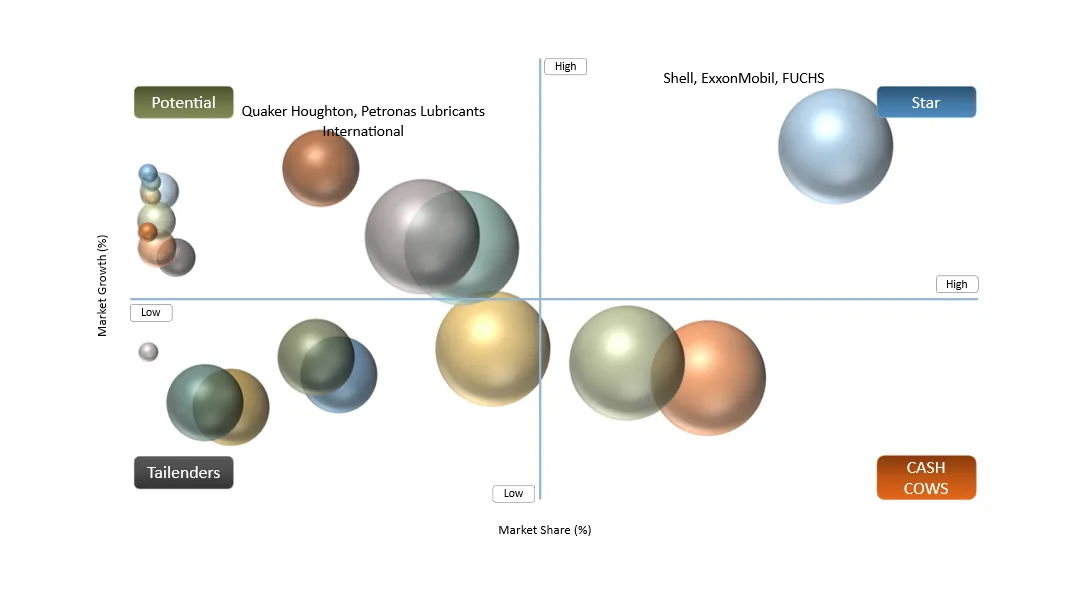
STAR
Shell, ExxonMobil, FUCHS, TotalEnergies and Chevron are positioned as leading players because they combine large-scale industrial lubricant portfolios with global distribution, technical service, OEM relationships and established brands. FUCHS has particularly high exposure to specialty lubricants, while the integrated energy majors benefit from access to base oils, manufacturing scale and broad industrial customer relationships.
POTENTIAL
Quaker Houghton, Petronas Lubricants International, Idemitsu, ENEOS and selected regional specialists represent high-potential players in applications where formulation expertise, metalworking capability, industrial OEM relationships or regional manufacturing strength can offset lower global scale.
Industrial Lubricants Market Dynamics
Driver Impact Analysis
| Driver | Market Growth Impact | Demand Concentration | Impacted Use Case | Strategic Impact |
| Industrial automation and higher equipment utilization | High | Manufacturing and logistics | Hydraulics, gears, bearings, compressors | Raises reliability requirements and supports premium products. |
| Synthetic lubricant adoption | High | Power, chemicals, mining, advanced manufacturing | High-temperature and extended-drain systems | Increases value per liter and service differentiation. |
| Predictive maintenance and oil analysis | Medium-High | Large industrial plants | Critical rotating and hydraulic equipment | Strengthens service-led supplier relationships. |
| Growth in emerging industrial economies | Medium-High | Asia-Pacific and Middle East | Factories, mining, infrastructure and energy | Expands addressable equipment base and distribution need. |
Driver: Rising Industrial Automation and Equipment Utilization
Factories are using more automated machinery, servo-hydraulic systems, high-speed gearboxes, compressors, robotics and continuous-process equipment. Higher utilization increases the cost of unplanned downtime and makes lubricant performance more critical. This supports demand for products with strong oxidation stability, cleanliness, wear protection and predictable long-term behavior.
Restraint Impact Analysis
| Restraint | Drag on Market Growth | Primary Impact Area | Impacted Use Case | Strategic Impact |
| Base oil and additive price volatility | High | Manufacturing margin | Broad portfolio | Increases repricing frequency and working-capital exposure. |
| Extended drain intervals | Medium-High | Volume consumption | Premium equipment | Reduces liters consumed despite higher product value. |
| Slow industrial production in mature markets | Medium | Demand growth | General manufacturing | Limits volume growth and intensifies share competition. |
| Environmental disposal requirements | Medium | Compliance and lifecycle cost | Metalworking and process fluids | Accelerates waste minimization and recyclable formulations. |
Restraint: Raw Material Volatility and Demand Efficiency
Industrial lubricant suppliers face two countervailing pressures. Base-oil and additive volatility can raise production costs rapidly, while customers increasingly seek longer drains and lower lubricant consumption. Suppliers therefore need disciplined pricing, differentiated formulations and service offerings that allow revenue to grow even as lubricant volume per machine becomes more efficient.
Industrial Lubricants Market Segment Analysis
The global Industrial Lubricants market is segmented based on Product Type, Base Oil, Form, Performance Class, Application, End Use Industry, Distribution Channel, Packaging Type and region.
By Product Type
Hydraulic Fluids Will Remain the Largest Product Category
Hydraulic fluids account for the largest share because hydraulic systems are pervasive across manufacturing machinery, presses, injection molding, material handling, construction and mining equipment. Premium growth will come from zinc-free, ashless, fire-resistant and energy-efficient hydraulic fluids that improve cleanliness, filter life and equipment efficiency.
By Base Oil
Synthetic Lubricants Will Record the Fastest Value Growth
Mineral oil remains the dominant base because of availability and cost effectiveness. Synthetic products based on PAO, esters, PAG and other specialty chemistries grow faster where long drain intervals, low-temperature flow, high-temperature stability, lower friction or fire resistance are required. Bio-based products expand from a small base in environmentally sensitive operations.
By Form
Liquid Oils and Fluids Will Continue to Dominate
Most industrial lubrication is delivered through liquid oils because hydraulic, gear, compressor, turbine and circulating systems require pumpable fluids. Greases remain essential where retention, sealing and long relubrication intervals are needed, especially in bearings, mining, steel, construction and electric motors.
By Performance Class
High-Performance and Extended-Drain Products Gain Share
Customers are increasingly selecting premium products that extend service intervals and reduce deposits, varnish, wear and energy consumption. Food-grade, fire-resistant and environmentally acceptable classes remain smaller but strategically attractive because compliance requirements create defensible pricing.
By Application
Hydraulic Systems Lead Installed-Base Demand
Hydraulic systems generate broad recurring demand, while compressors, industrial gears and turbines create attractive premium niches. Metal cutting and forming remains a technically intensive segment because fluid chemistry affects tool life, cooling, corrosion, worker exposure and downstream cleaning.
By End Use Industry
Manufacturing Remains the Largest End-Use Industry
General and advanced manufacturing account for the largest demand pool because lubricants are consumed across machine tools, conveyors, presses, compressors, hydraulic systems and facility equipment. Mining, metals and power generation have lower equipment counts but high lubricant intensity and strong demand for severe-duty products.
By Distribution Channel
Direct Sales Lead Large Strategic Accounts
Large plants typically buy directly or through structured distributor agreements because they require technical support, inventory planning and multi-site contracts. Industrial distributors are essential for fragmented small and mid-sized customers and provide local availability, credit and service.
By Packaging Type
Bulk and IBC Supply Dominate Large Industrial Sites
Large users prefer bulk tanker deliveries or IBCs to reduce packaging cost and handling. Drums and pails remain important for dispersed equipment and specialty products, while cartridges and smaller packs are common for greases and maintenance applications.
Industrial Lubricants Market Geographical Penetration
U.S. Industrial Lubricants Market Landscape
The U.S. market is supported by a large installed manufacturing base, oil and gas production, chemicals, power generation, mining, food processing and logistics. Re-shoring and data-center infrastructure add demand for industrial equipment and power systems. The market has high penetration of synthetic lubricants, used-oil analysis and supplier-managed lubrication programs. Growth is driven more by premiumization and reliability services than by underlying lubricant volume.
Germany Industrial Lubricants Market Outlook
Germany is a high-value European market centered on machinery, automotive manufacturing, chemicals, metals and precision engineering. Buyers place strong emphasis on OEM approvals, energy efficiency, worker safety and environmental performance. Metalworking fluids, gear oils, compressor lubricants and specialty greases have significant technical intensity, favoring suppliers with application engineering capabilities.
Japan Industrial Lubricants Market Outlook
Japan combines mature lubricant consumption with demanding machinery, electronics, automotive and industrial-equipment applications. High-quality synthetic fluids, low-noise greases, metalworking lubricants and long-life products are important. Growth is supported by premium formulations, export-oriented machinery production and maintenance requirements for an aging industrial asset base.
China Industrial Lubricants Market Trends
China is the largest national industrial lubricant market because of its manufacturing scale, steel and metals output, chemicals, mining, machinery production and infrastructure. Domestic suppliers are expanding quality and specialty capability, while global suppliers compete in premium OEM-approved applications. The market is shifting from volume growth toward higher-performance products, cleaner operations and localized technical service.
India Industrial Lubricants Market Outlook
India is among the fastest-growing markets, supported by manufacturing investment, infrastructure, mining, steel, cement, power and industrial localization. Premium lubricant penetration remains below mature-market levels, creating an upgrade opportunity as equipment sophistication increases. Local blending, distributor reach and OEM partnerships are central to capturing growth.
Middle East and Africa Industrial Lubricants Market Outlook
Demand is concentrated in oil and gas, petrochemicals, mining, power, construction, metals, cement and large infrastructure projects. Gulf countries are investing in industrial diversification and manufacturing, increasing opportunities for premium lubricants and local blending. Africa offers long-term growth but remains fragmented, making distribution and counterfeit control important commercial issues.
Industrial Lubricants Market Competitive Landscape
- The market combines integrated energy majors, dedicated lubricant specialists, metalworking-fluid companies, national oil companies and regional blenders.
- Competitive advantage is shifting from brand and base-oil scale toward application engineering, OEM approvals, specialty chemistry, technical service, oil analysis and supply-chain resilience.
- Large customers increasingly award regional or global contracts that bundle lubricants with inventory management, reliability services and sustainability metrics.
- FUCHS and Quaker Houghton are more directly exposed to specialty industrial lubrication, while Shell, ExxonMobil, TotalEnergies, Chevron and BP combine large industrial lubricant portfolios with integrated feedstock and global customer relationships.
- Sustainability competition centers on longer drain intervals, energy efficiency, bio-based formulations, re-refined base oils, used-oil collection and packaging circularity.
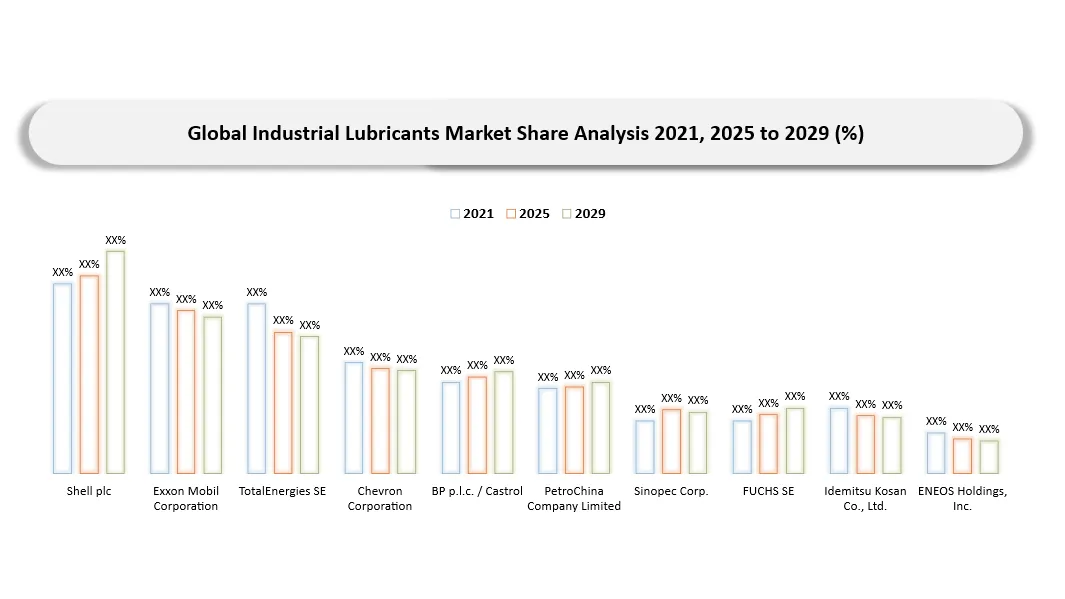
Key Companies
- Shell plc
- Exxon Mobil Corporation
- FUCHS SE
- TotalEnergies SE
- Chevron Corporation
- BP p.l.c. / Castrol
- Quaker Houghton
- Idemitsu Kosan Co., Ltd.
- ENEOS Holdings, Inc.
- Phillips 66
- PetroChina Company Limited
- Sinopec Corp.
- Petronas Lubricants International
- Valvoline Global Operations
- Klüber Lubrication / Freudenberg
Public Company Q1-Q2 2026 Performance Comparison
The table below compares five publicly listed companies with material industrial lubricant exposure. Because integrated energy companies generally do not disclose industrial-lubricant revenue separately, company-wide or relevant segment indicators are shown and should be interpreted as context for financial capacity, operating momentum and commercial investment rather than direct market-share measures.
| Public Company | Q1-Q2 2026 Performance Indicator | Industrial Lubricants Exposure | Factors Supporting Growth |
| FUCHS SE | H1 2026 preliminary sales €2.003 billion vs. €1.804 billion in H1 2025; EBIT €260 million vs. €209 million. Q2 EBIT €135 million. | Pure-play / highly concentrated exposure to lubricants and related specialties. | Organic growth, strong Q2 sales, pre-buying linked to Middle East conflict, competitor supply constraints, pricing and specialty portfolio. Company raised 2026 EBIT outlook. |
| TotalEnergies SE | Q2 2026 adjusted net income approximately US$6.0 billion; H1 supported by integrated portfolio and strong cash generation. | TotalEnergies Lubrifiants serves industrial and automotive applications globally. | Integrated base-oil/feedstock position, global distribution, industrial customer relationships, premium products and capital strength. |
| Exxon Mobil Corporation | Q1 2026 earnings US$4.2 billion; company entered Q2 reporting with continued focus on high-value products and specialty products portfolio. | Mobil industrial lubricants and ExxonMobil Specialty Products, including lubricant basestocks. | High-value product sales, advantaged basestock production, global OEM relationships, Singapore specialty-products investments and integrated supply chain. |
| Chevron Corporation | Q1 2026 earnings US$2.2 billion; adjusted earnings US$2.8 billion. | Chevron Lubricants markets industrial oils, greases and specialty products through global and regional channels. | Industrial demand, brand portfolio, distributor network, integrated refining position and cross-selling to energy/mining customers. |
| Shell plc | Q1 2026 results reflected resilient integrated operations; company launched a US$3.0 billion buyback and increased dividend 5%. | Shell Lubricants is a major global supplier of industrial oils, greases and specialty fluids. | Global customer base, technical services, premium synthetic portfolio, OEM relationships and scale in industrial and mobility lubricants. |
Source note: FUCHS SE H1 2026 preliminary results (22 July 2026); TotalEnergies Q2/H1 2026 results (23 July 2026); ExxonMobil Q1 2026 results and Q2 earnings considerations; Chevron Q1 2026 results; Shell Q1 2026 results and investor disclosures. Industrial lubricant revenue is not separately disclosed by most integrated companies.
Market Ecosystem Analysis
| Value Chain Sector | Role in Industrial Lubricants Market | Representative Companies / Organizations |
| Feedstock & Base Oil Suppliers | Supply Group I, II, III, naphthenic, PAO, ester and specialty base stocks. | ExxonMobil, Shell, Chevron, SK Enmove, Neste, PetroChina, Sinopec, Phillips 66 |
| Additive Suppliers | Provide anti-wear, detergency, dispersancy, antioxidants, EP chemistry, VI improvers and specialty additive systems. | Lubrizol, Infineum, Afton Chemical, Chevron Oronite, BASF, Evonik |
| Lubricant Formulators & Blenders | Develop, blend and market industrial oils, greases, metalworking fluids and specialty lubricants. | FUCHS, Shell, ExxonMobil, TotalEnergies, Chevron, BP/Castrol, Quaker Houghton, Petronas Lubricants |
| Specialty Lubrication Providers | Serve high-temperature, food-grade, compressor, vacuum, specialty grease and precision applications. | Klüber Lubrication, FUCHS, Nye Lubricants, ROCOL, Whitmore, CONDAT |
| Packaging & Logistics | Provide drums, pails, IBCs, bulk transport, warehousing and delivery services. | Greif, Mauser Packaging Solutions, Schütz, regional bulk logistics providers |
| Industrial Distributors | Provide local inventory, technical support, credit and fragmented account coverage. | Brenntag, Univar Solutions, RelaDyne, Motion, regional lubricant distributors |
| OEM & Equipment Partners | Set lubricant specifications and approvals for machinery, bearings, gears, compressors and hydraulic systems. | Siemens, SKF, Bosch Rexroth, Caterpillar, Komatsu, Atlas Copco, Flender |
| Condition Monitoring & Oil Analysis | Test lubricant condition, contamination and wear; increasingly integrate digital monitoring. | SGS, Intertek, ALS, Bureau Veritas, Spectro Scientific / AMETEK, supplier laboratories |
| Industrial End Users | Consume lubricants across production and maintenance systems. | Steelmakers, miners, chemical producers, food processors, power utilities, manufacturers, cement producers |
| Used-Oil Collection & Re-Refining | Collect used oils, recover base stocks and support circular lubricant models. | Safety-Kleen / Clean Harbors, Avista Oil, Puraglobe, regional re-refiners |
| Regulators & Standards Bodies | Define chemical safety, environmental, performance and food-contact requirements. | EPA, ECHA, OSHA, NSF, ISO, DIN, ASTM, API and national authorities |
Company Profiles
Shell plc
Shell is one of the world’s largest lubricant suppliers, with industrial products spanning hydraulic fluids, gear oils, compressor lubricants, turbine oils, greases and specialty fluids. Its competitive advantages include global distribution, OEM relationships, technical service, oil analysis and integrated access to base-oil and specialty feedstocks. The company positions premium products around equipment protection, energy efficiency and extended drain intervals.
Competitive priorities include product performance, application engineering, OEM approvals, regional supply, sustainability and digitally supported reliability services. Recent strategy across the industry increasingly combines premium formulations with technical field support, laboratory analysis and customer-specific optimization.
Exxon Mobil Corporation
ExxonMobil participates through Mobil-branded industrial lubricants and its broader Specialty Products organization. The portfolio includes hydraulic, gear, compressor, circulating and turbine oils as well as greases and high-performance synthetic products. Scale in lubricant basestocks, integrated manufacturing and a global industrial customer base support its competitive position.
Competitive priorities include product performance, application engineering, OEM approvals, regional supply, sustainability and digitally supported reliability services. Recent strategy across the industry increasingly combines premium formulations with technical field support, laboratory analysis and customer-specific optimization.
FUCHS SE
FUCHS is one of the largest independent lubricant specialists and has high direct exposure to industrial applications. Its portfolio includes metalworking fluids, hydraulic oils, greases, industrial oils, specialty lubricants and application engineering. The company’s 2026 performance reflects strong specialty positioning and active portfolio expansion, including completion of the OPET FUCHS joint-venture acquisition.
Competitive priorities include product performance, application engineering, OEM approvals, regional supply, sustainability and digitally supported reliability services. Recent strategy across the industry increasingly combines premium formulations with technical field support, laboratory analysis and customer-specific optimization.
TotalEnergies SE
TotalEnergies markets industrial lubricants across manufacturing, mining, power, transport and process industries. Its integrated energy and refining position supports supply reliability, while premium industrial products and regional distribution provide growth opportunities in emerging markets.
Competitive priorities include product performance, application engineering, OEM approvals, regional supply, sustainability and digitally supported reliability services. Recent strategy across the industry increasingly combines premium formulations with technical field support, laboratory analysis and customer-specific optimization.
Chevron Corporation
Chevron Lubricants supplies industrial oils and greases through brands and channels that serve mining, power, manufacturing, construction and heavy-duty equipment. Integration with Chevron’s refining and base-oil businesses provides feedstock and supply advantages.
Competitive priorities include product performance, application engineering, OEM approvals, regional supply, sustainability and digitally supported reliability services. Recent strategy across the industry increasingly combines premium formulations with technical field support, laboratory analysis and customer-specific optimization.
BP p.l.c. / Castrol
BP participates through Castrol, which offers industrial lubricants and metalworking-related solutions alongside mobility products. Castrol’s strengths include brand recognition, technical expertise, industrial customer relationships and digital service initiatives.
Competitive priorities include product performance, application engineering, OEM approvals, regional supply, sustainability and digitally supported reliability services. Recent strategy across the industry increasingly combines premium formulations with technical field support, laboratory analysis and customer-specific optimization.
Quaker Houghton
Quaker Houghton is a specialist in industrial process fluids with strong positions in metalworking, steel, aluminum, automotive and specialty manufacturing. Its differentiation is based on application expertise, on-site service and process-fluid management rather than commodity lubricant scale.
Competitive priorities include product performance, application engineering, OEM approvals, regional supply, sustainability and digitally supported reliability services. Recent strategy across the industry increasingly combines premium formulations with technical field support, laboratory analysis and customer-specific optimization.
Idemitsu Kosan Co., Ltd.
Idemitsu supplies industrial oils, hydraulic fluids, greases and specialty lubricants with strong exposure to Japan and Asia. The company benefits from refining integration, OEM relationships and technical product development.
Competitive priorities include product performance, application engineering, OEM approvals, regional supply, sustainability and digitally supported reliability services. Recent strategy across the industry increasingly combines premium formulations with technical field support, laboratory analysis and customer-specific optimization.
ENEOS Holdings, Inc.
ENEOS is a major Japanese energy and lubricant supplier serving industrial and mobility applications. Its industrial portfolio supports machinery, hydraulic, metalworking and specialty uses with strong domestic distribution.
Competitive priorities include product performance, application engineering, OEM approvals, regional supply, sustainability and digitally supported reliability services. Recent strategy across the industry increasingly combines premium formulations with technical field support, laboratory analysis and customer-specific optimization.
Phillips 66
Phillips 66 participates in base oils and finished lubricants, giving it exposure to industrial fluids and specialty products. Integration with refining and midstream assets supports supply and logistics capabilities.
Competitive priorities include product performance, application engineering, OEM approvals, regional supply, sustainability and digitally supported reliability services. Recent strategy across the industry increasingly combines premium formulations with technical field support, laboratory analysis and customer-specific optimization.
PetroChina Company Limited
PetroChina is a major Chinese integrated energy company with large-scale lubricant and base-oil activities. Its domestic network supports industrial demand across manufacturing, mining, infrastructure and power generation.
Competitive priorities include product performance, application engineering, OEM approvals, regional supply, sustainability and digitally supported reliability services. Recent strategy across the industry increasingly combines premium formulations with technical field support, laboratory analysis and customer-specific optimization.
Sinopec Corp.
Sinopec is a major producer and marketer of base oils and finished lubricants in China. The company benefits from integrated refining, national distribution and access to fast-growing industrial customers.
Competitive priorities include product performance, application engineering, OEM approvals, regional supply, sustainability and digitally supported reliability services. Recent strategy across the industry increasingly combines premium formulations with technical field support, laboratory analysis and customer-specific optimization.
Petronas Lubricants International
Petronas Lubricants International supplies industrial and automotive lubricants globally, with a strong position in Asia and selected emerging markets. Product development emphasizes fluid technology, thermal management and equipment performance.
Competitive priorities include product performance, application engineering, OEM approvals, regional supply, sustainability and digitally supported reliability services. Recent strategy across the industry increasingly combines premium formulations with technical field support, laboratory analysis and customer-specific optimization.
Valvoline Global Operations
Valvoline Global Operations, owned by Aramco, supplies lubricant products across mobility and selected industrial applications. Its strengths include formulation, brand reach and access to Aramco’s broader base-oil and energy platform.
Competitive priorities include product performance, application engineering, OEM approvals, regional supply, sustainability and digitally supported reliability services. Recent strategy across the industry increasingly combines premium formulations with technical field support, laboratory analysis and customer-specific optimization.
Klüber Lubrication / Freudenberg
Klüber Lubrication specializes in high-performance specialty lubricants for demanding industrial equipment. The company competes on application engineering, long service life and niche formulations used where downtime or contamination risk is costly.
Competitive priorities include product performance, application engineering, OEM approvals, regional supply, sustainability and digitally supported reliability services. Recent strategy across the industry increasingly combines premium formulations with technical field support, laboratory analysis and customer-specific optimization.
Industrial Lubricants Market Major Pain Points
- Volatility in base oils, additives, energy and packaging costs.
- Long customer qualification cycles and strict OEM approval requirements.
- Extended drain intervals reduce volume consumption even when value per liter increases.
- Counterfeit or substandard products in fragmented emerging markets.
- Complex wastewater and worker-exposure requirements for metalworking fluids.
- Difficulty proving energy-efficiency and lifecycle benefits consistently across equipment fleets.
- Supply-chain concentration for specialty additives, esters and synthetic base stocks.
- Need to balance global formulations with local raw-material availability and regulatory rules.
Industrial Lubricants Market Recent Developments
- July 2026: FUCHS reported preliminary first-half 2026 sales of €2.003 billion and EBIT of €260 million and raised its full-year EBIT outlook after strong second-quarter performance.
- April 2026: FUCHS completed the full acquisition of the OPET FUCHS joint venture, strengthening its position in Turkiye and adjacent markets.
- 2026: Major lubricant suppliers continued expanding digital oil-analysis, condition-monitoring and reliability-service offerings as industrial customers increased predictive-maintenance adoption.
- 2025-2026: Integrated suppliers continued investment in higher-value base stocks and specialty-products capacity, supporting synthetic and extended-drain industrial lubricant formulations.
- 2025-2026: Sustainability programs across the industry increasingly emphasized re-refined base oils, used-oil collection, packaging circularity and lower-friction formulations that can reduce energy use.
Analyst View / Opinion on Industrial Lubricants Market
- The Industrial Lubricants market is expected to grow steadily through 2035, with value growth exceeding volume growth as customers migrate toward premium synthetic and application-specific formulations.
- Asia-Pacific will remain the largest market, while India and Southeast Asia provide particularly attractive opportunities for local blending, distribution and technical-service expansion.
- Hydraulic fluids will continue to lead in volume, but synthetic compressor oils, gear oils, turbine oils, specialty greases and food-grade products offer stronger margin and differentiation potential.
- Extended drain intervals are not simply a restraint; they are also a premiumization mechanism because suppliers can capture more value when longer service life produces measurable maintenance savings.
- Industrial lubrication is becoming part of the predictive-maintenance stack. Suppliers that integrate products, laboratory analysis, sensors and reliability engineering should achieve higher customer retention.
- Long-term winners will combine secure raw-material sourcing, local supply capability, strong technical service, OEM approvals and credible sustainability benefits.
Industrial Lubricants Market Target Audience
| INDUSTRY | WHO SHOULD BUY THIS REPORT? | REASON TO BUY THIS REPORT |
| Lubricant Manufacturers | Strategy, product, sales and business development teams | Benchmark product categories, regional opportunities, competitors and premiumization trends. |
| Base Oil & Additives | Refiners, additive companies and specialty-chemical suppliers | Assess downstream demand, formulation migration and customer concentration. |
| Industrial OEMs | Equipment manufacturers and engineering teams | Understand lubricant technology, approval requirements and service partnerships. |
| Manufacturing & Process Industries | Plant managers, procurement, maintenance and reliability teams | Evaluate supplier landscape, pricing drivers and technology trends affecting operating cost. |
| Distributors | Industrial distributors and lubricant marketers | Identify high-growth sectors, portfolio gaps and regional demand opportunities. |
| Investors & Consulting | Private equity, institutional investors and strategy consultants | Support investment screening, competitive benchmarking and M&A evaluation. |
| Re-Refining & Sustainability | Used-oil collectors, re-refiners and circular-economy teams | Evaluate demand for re-refined base oils, collection partnerships and ESG-linked offerings. |
Why Choose DATAM?
- Data-driven insights combining market sizing, product segmentation, pricing, trade, competitive analysis and buyer behavior.
- Post-purchase analyst consultations for market entry, portfolio strategy, supplier benchmarking and custom segmentation.
- Annual updates covering major capacity changes, pricing, acquisitions, product launches and competitive developments.
- Specialized focus on emerging industrial markets rather than generalized regional summaries.
- Actionable analysis linking lubricant chemistry and product performance to procurement, maintenance and equipment reliability.
What DATAM Uniquely Provides
- Ten-year forecasts across eight segmentation categories and five major regions.
- Value-chain analysis covering base oils, additives, blending, distribution, OEM influence, condition monitoring and used-oil re-refining.
- Public-company Q1-Q2 2026 performance context for five listed companies with material lubricant exposure.
- A market ecosystem table mapping representative companies across each sector of the industrial lubricant value chain.
- Buyer-focused analysis of OEM approvals, total cost of ownership, service requirements and supply reliability.
- Country-level views connecting industrial output, manufacturing investment and premium lubricant adoption.





























































