


Health Information Exchange Market Size
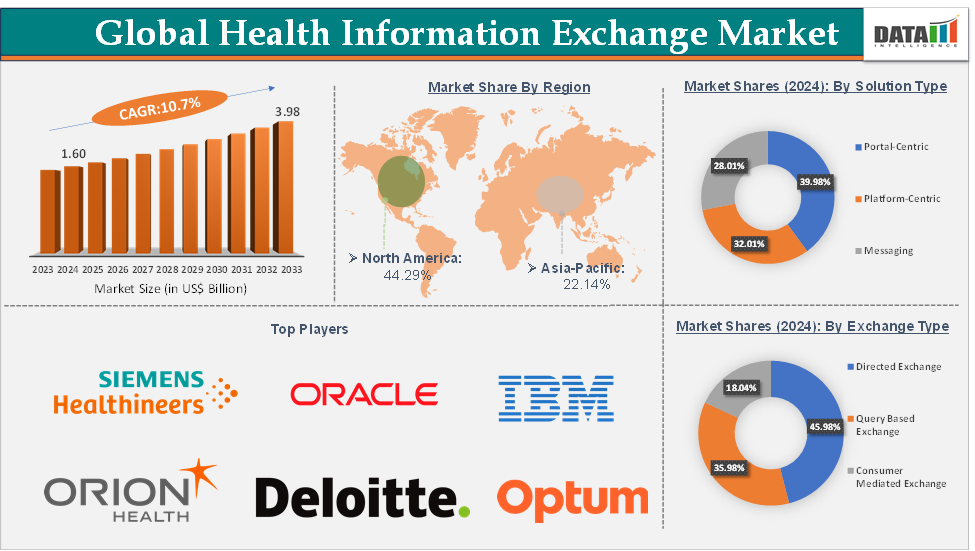
Health Information Exchange market size reached US$ 1.77 billion in 2025 and is expected to reach US$ 4.89 billion by 2035, growing at a CAGR of 10.7% during the forecast period 2026-2035.
The health information exchange market is experiencing significant growth, driven by the increasing need for efficient healthcare data management and the adoption of digital health solutions. The purpose of health information exchange is to ensure that the right health information is available at the right time to the right healthcare provider, enabling more informed decision-making, better coordination of care, and improved patient outcomes.
Health Information Exchange Market Key Takeaways
- The health information exchange market is valued at US$ 1.77 billion in 2025 and could reach US$ 4.89 billion by 2035.
- The market's 10.7% CAGR reflects sustained demand for interoperable healthcare information, cloud connectivity, and digitally enabled care coordination.
- Portal-centric solutions accounted for 39.98% of the market in 2025, highlighting the commercial importance of accessible, patient- and provider-facing information environments.
- North America represented 42.7% of the market in 2025, supported by established digital health infrastructure, healthcare IT adoption, and interoperability initiatives.
- Asia-Pacific held 22.14% of the market in 2025 and represents a significant expansion opportunity as India, China, Japan, and other countries strengthen healthcare digitization.
- Security remains a major purchasing consideration because HIE platforms handle highly sensitive patient information and must balance accessibility with privacy protection.
- Companies including Oracle, Siemens Healthineers AG, IBM, Orion Health, Deloitte, Optum Inc., Veradigm LLC, Chetu Inc., Infor, and Meditab are competing across different layers of healthcare data exchange and interoperability.
Health Information Exchange Market Scope
| Metric | Details |
| Market Size, 2025 | US$ 1.77 billion |
| Market Size, 2035 | US$ 4.89 billion |
| CAGR | 10.70% |
| Historic Years | 2023-2024 |
| Base Year | 2025 |
| Forecast Period | 2026-2035 |
| 2024 Market Size | US$ 1.60 billion |
| 2033 Market Size | US$ 3.98 billion |
| Segments Covered | Exchange Type, Implementation Model, Setup Type, Solution Type, Application, End-User, Region |
| Leading Region | North America |
| Fastest Growing Region | Asia-Pacific |
Executive Summary
For more details on this report – Request for Sample
Health Information Exchange Market Dynamics: Drivers & Restraints
Rising advancements in health information exchange technology are significantly driving the market growth
Advancements in interoperability standards like HL7, FHIR (Fast Healthcare Interoperability Resources), and CCD (Continuity of Care Documents) have made it easier for different healthcare systems to communicate and share patient data. For instance, in May 2024, the Union Health Ministry is setting up a National Health Claim Exchange (NHCX) platform to make the process of submitting health insurance claims easier. The payer and the service provider will communicate via the National Health Exchange platform. The National Health Authority (NHA) created this platform to guarantee interoperability and quicker processing of insurance claims.
Cloud computing has become a game-changer in health information exchange. By storing patient data on secure cloud platforms, healthcare organizations can access real-time data remotely, improving care delivery and reducing delays. Cloud-based health information exchange technologies allow healthcare providers to access centralized patient information without being tied to physical infrastructure.
For instance, in October 2024, Oracle introduced Oracle Health Clinical Data Exchange, a cloud-based technology that helps payers and healthcare providers exchange medical claims data more efficiently. Operating on Oracle Cloud Infrastructure, the platform seeks to replace the present manual medical record transmission procedures with a centralized, automated network. It is anticipated that this invention would speed up claims and payment processing, lessen administrative responsibilities, and expedite patient service approvals.
Data security and privacy concerns are hampering the growth of the health information exchange market
Data security and privacy concerns are significant barriers to the growth of the health information exchange market. The sensitive nature of healthcare data makes it a prime target for cyberattacks, and any breach or unauthorized access can undermine trust in these systems, slowing their adoption. HIE systems handle large volumes of personal and sensitive health information. A security breach can expose confidential patient records, leading to severe consequences such as identity theft, fraud, and privacy violations.
For instance, according to the HIPAA Journal, in 2024, the protected health information of 276,775,457 individuals was exposed or stolen. On average, that is 758,288 records per day. In March 2025, 1,754,097 individuals had their protected health information exposed, stolen, or impermissibly disclosed in a healthcare data breach.
Health Information Exchange Market Segment Analysis
The global health information exchange market is segmented based on exchange type, implementation model, setup type, solution type, application, end-user, and region.
The portal-centric segment from solution type is expected to hold 39.98% of the market share in 2025 in the health information exchange market
Portal-centric health information exchange systems are web-based platforms that allow users (healthcare providers, patients, and administrators) to access patient data from any location, using a computer or mobile device. This flexibility ensures that healthcare professionals can make timely, informed decisions, even when they are not physically present at the healthcare facility. Portal-centric HIEs enhance patient engagement by allowing individuals to take control of their health information. This improves transparency and empowers patients to make informed decisions about their care.
For instance, in December 2024, Medsynaptic launched ImageDoot, a revolutionary medical image exchange and patient engagement portal. ImageDoot is a cutting-edge, cloud-based platform designed to transform the secure exchange, access, and portability of medical images and records. With ImageDoot, Medsynaptic aims to bridge the communication gap between healthcare providers and patients, paving the way for a more connected and efficient healthcare ecosystem.
Portal-centric HIEs enhance patient engagement by allowing individuals to take control of their health information. Patients can review their medical history, lab results, and medication lists, and communicate directly with healthcare providers. This improves transparency and empowers patients to make informed decisions about their care. For Instance, the MyChart patient portal, developed by Epic Systems, allows patients to view test results, request prescription refills, and schedule appointments. MyChart has millions of users, further validating the growing popularity of portal-centric solutions.
Health Information Exchange Market Geographical Analysis
North America is dominating the global health information exchange market with a 42.7% share in 2025
North America, especially the United States government, played a crucial role in the adoption of health information exchange systems through supportive policies and regulations. Key initiatives, such as the Health Information Technology for Economic and Clinical Health (HITECH) Act and the American Recovery and Reinvestment Act (ARRA), incentivized healthcare providers to adopt electronic health records (EHRs) and HIE systems. This has accelerated the growth of HIE in North America.
North America is a global leader in healthcare technology innovation, providing a strong foundation for the growth of health information exchange systems. The region's healthcare providers are early adopters of cutting-edge technologies, including cloud-based and cutting-edge solutions, all of which are increasingly integrated into HIE systems to improve data exchange, security, and interoperability.
For instance, in August 2024, MEDITECH unveiled Traverse Exchange, a cutting-edge national health information exchange network for US customers. This Traverse Exchange Canada solution will allow participating MEDITECH customers to safely and easily share health information with other MEDITECH customers as well as with organizations that use other vendor EHRs and exchange networks that adhere to interoperability standards. By connecting to the Health Gorilla QHIN, the solution puts MEDITECH and its clients in a good position for TEFCA and expands QHIN services across its network.
Asia-Pacific is growing at the fastest pace in the health information exchange market, holding 22.14% of the market share
Many Asia-Pacific countries have been adopting national healthcare IT policies to promote digital health transformation, including the integration of Health Information Exchange systems. Governments are investing in eHealth infrastructure, aiming to improve healthcare delivery and reduce costs. For instance, in China, the government has launched initiatives such as the National Health Information Platform, which promotes the integration of healthcare data across various regions and healthcare providers, facilitating seamless data exchange and improving healthcare accessibility.
Many countries in APAC, such as India, China, and Japan, are rapidly digitalizing their healthcare sectors. The adoption of Electronic Health Records (EHR), telemedicine, and cloud computing has created a conducive environment for the growth of HIE solutions, which enable seamless data exchange across different healthcare systems. Thus, many market players and emerging players in the region are focusing on the development of HIE platforms.
Health Information Exchange Market Major Players
The major global players in the health information exchange market include Siemens Healthineers AG, Oracle, IBM, Orion Health group of companies, Deloitte, Optum Inc., Veradigm LLC, Chetu Inc., Infor, Meditab and among others.
Health Information Exchange Market Key Developments
August 2026: In North America, HIE adoption continued advancing through stronger interoperability requirements and nationwide data-sharing initiatives, with Epic Systems, Oracle, Veradigm, and CareEvolution among notable technology providers.
July 2026: In Asia-Pacific, HIE expansion continued across India, China, Japan, South Korea, and Australia, supported by digital health investments, interoperability programs, and growing demand for coordinated patient-data exchange. Oracle, Philips, Siemens Healthineers, and IBM are among active technology companies.
June 2026: In Europe, healthcare organizations continued prioritizing interoperable digital-health infrastructure, secure data sharing, and cross-provider information exchange, while vendors increasingly integrated cloud-based platforms and advanced analytics.
May 2026: North American HIE platforms increasingly incorporated AI, machine learning, and predictive analytics to improve clinical data exchange and decision support. Orion Health continued developing health-data platforms and interoperability solutions.
April 2026: Globally, the industry increasingly focused on FHIR-based interoperability, cloud HIE platforms, cybersecurity, AI-enabled data exchange, and hybrid architectures. Asia-Pacific is emerging as one of the fastest-growing regions as healthcare systems accelerate digital transformation.
Target Audience
- Healthcare IT companies and HIE solution providers
- Hospitals and healthcare networks
- Specialty clinics
- Health insurance companies and payers
- Public health organizations
- EHR and clinical software vendors
- Cloud technology providers
- Healthcare data management companies
- Healthcare technology investors
- Procurement and sourcing teams
- Healthcare strategy and transformation teams
- Technology consultants and system integrators
- Product managers developing interoperability solutions
Health Information Exchange Market Outlook Through 2035
Health information exchange is becoming an increasingly important component of connected healthcare infrastructure as providers, payers, and patients require faster access to reliable information. The market's progression from US$ 1.60 billion in 2024 to an estimated US$ 1.77 billion in 2025 and approximately US$ 4.89 billion by 2035, using the source CAGR of 10.7%, indicates a substantial long-term commercial opportunity.
The most important growth considerations will extend beyond simply increasing the volume of exchanged data. Buyers will increasingly assess interoperability quality, cloud economics, workflow integration, patient accessibility, security, and the ability to connect healthcare organizations across different technology environments.
North America's existing infrastructure gives established vendors a strong commercial base, while Asia-Pacific offers an important avenue for future expansion as healthcare systems invest in digital infrastructure. At the company level, providers that combine interoperability with practical applications such as claims exchange, patient portals, clinical workflows, and specialized data services can differentiate more effectively.
For healthcare organizations, investors, and technology suppliers, the key issue through 2035 will be determining where HIE can deliver measurable operational value while maintaining the security and governance standards required for sensitive health information. That balance between connectivity, efficiency, and data protection will remain central to purchasing decisions across the market.




























































