


Explosion-Proof Equipment Market Size and Forecast
The global Explosion-Proof Equipment market reached an estimated US$ 8.42 billion in 2025 and is expected to reach US$ 15.76 billion by 2035, growing with a CAGR of 6.46% during the forecast period 2026-2035. The market is supported by strict hazardous-location regulation, modernization of process plants, rising investment in oil & gas, chemicals, mining and energy infrastructure and the expansion of digital monitoring in explosive atmospheres.
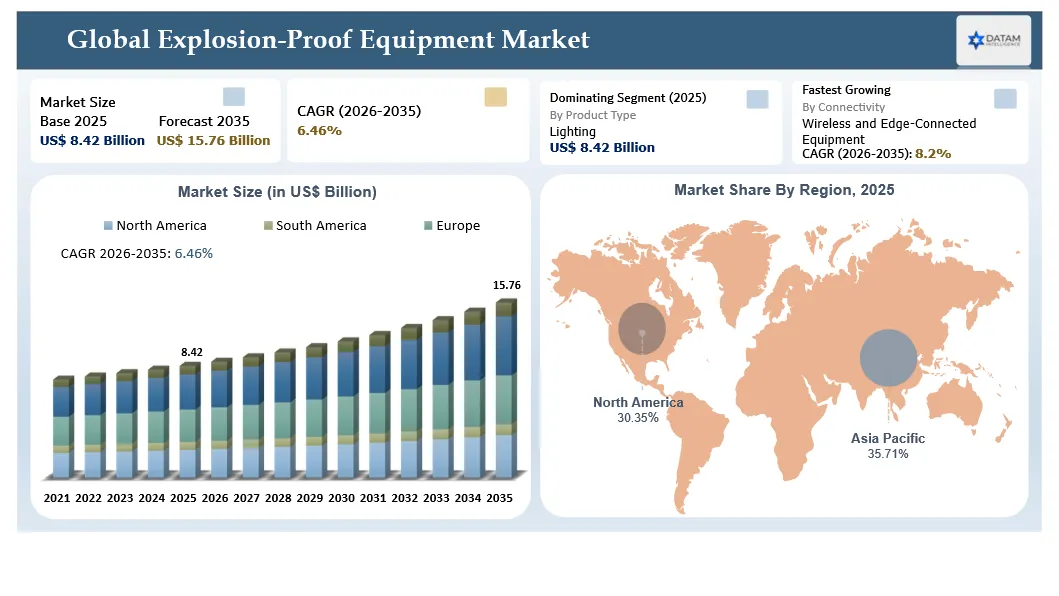
Lighting, motors, enclosures, junction boxes and process instrumentation form the largest revenue pools because they are deployed repeatedly across new projects and brownfield upgrades. Connected cameras, wireless access points, edge computers, intrinsically safe mobile devices and smart sensors are growing faster as operators seek real-time visibility without compromising ignition protection.
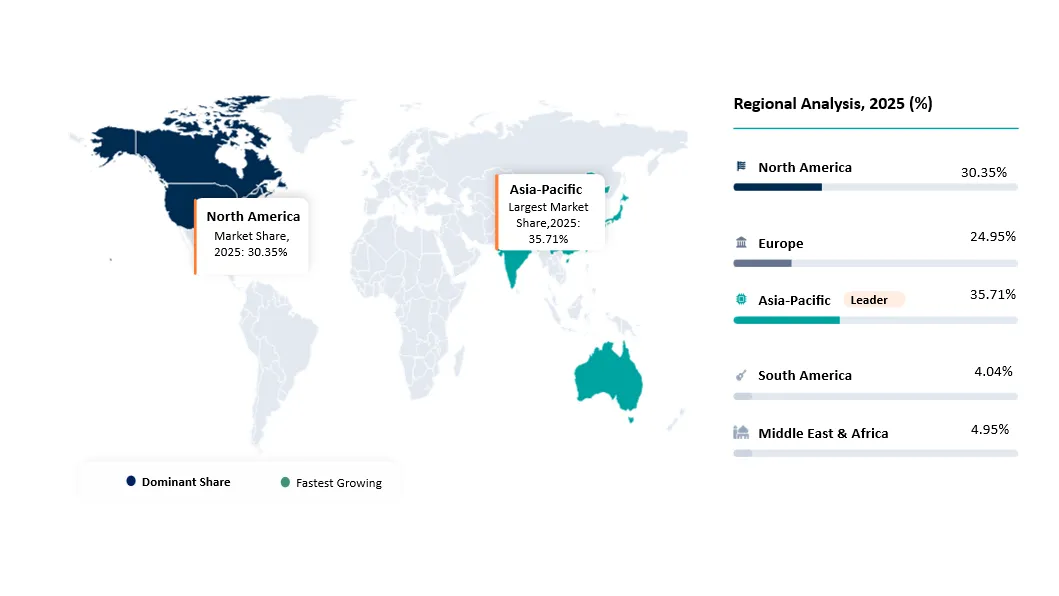
Oil & gas remains the largest end-use industry, but chemicals, pharmaceuticals, food processing, battery manufacturing, hydrogen, biogas and advanced warehousing are widening the addressable market. Asia-Pacific is the largest and fastest-growing region due to industrial investment, manufacturing expansion and increasing enforcement of hazardous-area standards.
| Market Indicator | 2025 Position |
| Estimated Market Size | US$ 8.42 Billion |
| Projected 2035 Market Size | US$ 15.76 Billion |
| Forecast CAGR | 6.46% |
| Largest Product Category | Lighting, Motors and Enclosures |
| Largest End Use | Oil & Gas |
| Largest Region | Asia-Pacific |
| Fastest-Growing Technology | Wireless and Edge-Connected Equipment |
| Primary Purchase Trigger | Safety compliance and lifecycle reliability |
Explosion-Proof Equipment Market Key Takeaways
- Asia-Pacific held the largest share in 2025 due to large oil, gas, chemical, mining, pharmaceutical and manufacturing investments across China, India, Southeast Asia and Australia.
- Flameproof and explosion-proof equipment remains the largest protection-method segment because it is widely specified for motors, lighting, enclosures, switches and instrumentation in high-risk areas.
- Intrinsic safety is expanding rapidly in low-power sensing, communication, mobile computing and process instrumentation because it simplifies maintenance and enables connected operations.
- Zone 1 and Class I Division 1 applications represent the largest value pool, while Zone 2 and Division 2 equipment is growing quickly as digital devices move closer to field operations.
- Wireless, edge computing, thermometric imaging and connected-worker devices are creating a higher-growth layer above conventional electrical hardware.
- Certification breadth across IECEx, ATEX, UL, CSA, PESO and regional regimes is a decisive competitive advantage for global suppliers.
- Stainless steel and engineered polymer enclosures gain share in corrosive, offshore, pharmaceutical and food-processing environments.
- Future leadership will depend on combining certified hardware with diagnostics, cybersecurity, remote configuration and lifecycle services.
Explosion-Proof Equipment Industry Trends and Strategic Insights
- Hazardous-area digitalization is moving from isolated sensors toward integrated wireless networks, edge analytics, machine vision and mobile workforce platforms.
- LED lighting replacement continues because it lowers energy consumption, maintenance frequency and heat generation while improving illumination quality.
- Global customers increasingly request multi-certified products that can be deployed across IEC zone and North American division systems without redesign.
- Equipment manufacturers are expanding local certification, assembly and service capabilities in India, the Middle East and Southeast Asia.
- Combustible-dust protection is gaining visibility in food, grain, wood, pharmaceutical, recycling and battery-material facilities.
- Cybersecurity and secure device management are becoming part of hazardous-area procurement as connected equipment enters plant networks.
Explosion-Proof Equipment Market Scope
| Metrics | Details |
| 2025 Market Size | US$ 8.42 Billion |
| 2035 Projected Market Size | US$ 15.76 Billion |
| CAGR (2026-2035) | 6.46% |
| Largest Market | Asia-Pacific |
| Fastest Growing Market | Asia-Pacific |
| By Product Type | Lighting, Motors and Drives, Enclosures and Junction Boxes, Control Stations and Switchgear, Instrumentation and Sensors, Cameras and Communication Devices, Cable Glands and Accessories, Other Equipment |
| By Protection Method | Flameproof / Explosion-Proof, Intrinsic Safety, Increased Safety, Pressurization and Purging, Non-Incendive / Non-Sparking, Encapsulation and Other Methods |
| By Classification | Zone 0 / Class I Division 1 High-Risk Applications, Zone 1 / Class I Division 1, Zone 2 / Class I Division 2, Dust Zones 20, 21 and 22 / Class II, Hybrid and Multi-Certified Areas |
| By Connectivity | Wired, Wireless, Hybrid and Edge-Connected |
| By Enclosure Material | Aluminum, Stainless Steel, Cast Iron, Glass-Reinforced Polyester and Engineering Polymers, Others |
| By Application | Power and Motion, Lighting and Signaling, Process Measurement and Control, Communication and Surveillance, Material Handling and Mobile Operations, Fire and Gas Detection, Others |
| By End Use Industry | Oil & Gas, Chemicals and Petrochemicals, Mining and Metals, Pharmaceuticals, Food and Beverage, Energy and Utilities, Marine and Shipbuilding, Manufacturing and Warehousing, Others |
| By Distribution Channel | Direct Sales, Authorized Distributors, EPC and System Integrators, Online and Digital Channels, Others |
| Report Insights Covered | Market size, share, growth, pricing, certification, technology, competitive landscape and country-level opportunity |
Why does this report matter in 2026?
The year 2026 is a critical planning point because industrial operators are simultaneously managing new capital projects, brownfield modernization, workforce constraints and stronger digital-safety expectations. Hazardous-area equipment is no longer purchased only as a compliance item. It is increasingly evaluated as infrastructure for predictive maintenance, remote operations, emissions control and operational resilience.
The market is also being reshaped by the growth of hydrogen, renewable fuels, battery production, carbon capture and high-purity manufacturing. These facilities create new gas, vapor and dust classifications and require equipment suppliers to translate existing protection technologies into new process environments. Companies that obtain certifications early and build application-specific engineering capability can influence specifications before projects reach procurement.
This report matters because equipment demand differs sharply by zone, protection concept, end use, regional code and project lifecycle. The study separates mature replacement demand from faster-growing digital and emerging-energy applications, allowing manufacturers, investors, distributors and EPC firms to prioritize portfolios and regions with the strongest risk-adjusted opportunity.
Explosion-Proof Equipment Market White Space & Investment Opportunities
- Certified Wi-Fi, private wireless, edge computing and machine-vision solutions for Zone 1 and Zone 2 facilities.
- Intrinsically safe mobile devices, wearable cameras and digital work-instruction systems for connected frontline workers.
- Combustible-dust monitoring and protection for battery materials, food, grain, recycling and additive manufacturing.
- Explosion-protected equipment for hydrogen production, storage, refueling and fuel-cell infrastructure.
- Localized certification, assembly and aftermarket service in India, the Middle East, Africa and Southeast Asia.
- Condition-monitoring packages that combine motors, sensors, gateways and predictive diagnostics under one certified architecture.
Explosion-Proof Equipment Future Market Transformation
The market will shift from standalone certified hardware toward connected hazardous-area ecosystems. Lighting, motors, sensors, cameras, analyzers and communication devices will share data through secure wired and wireless networks, allowing operators to monitor equipment condition, worker location, temperature, leaks and process deviation in real time. The value of software, diagnostics and services will therefore rise faster than the value of basic enclosures and fittings.
Product design will also become more modular. Manufacturers will use common certified platforms, interchangeable communication modules and configurable enclosures to reduce engineering time. Multi-protocol and multi-certified equipment will simplify global project execution, while digital documentation and asset passports will improve inspection and compliance management.
By 2035, leading suppliers are expected to combine hardware, certification, application engineering, cybersecurity and lifecycle services. Customers will increasingly prefer fewer strategic vendors that can cover multiple product families and maintain consistent compliance across global sites.
Explosion-Proof Equipment Market Buyer Decision-Making Criteria
Buyers prioritize certification validity, suitability for the precise gas or dust group, temperature class, zone or division and ambient conditions. Mechanical robustness, ingress protection, corrosion resistance, maintainability, documentation quality and availability of replacement parts are critical. A lower purchase price is rarely sufficient when failure can stop production or create a safety incident.
Project buyers also assess engineering support, lead time, global approvals, customization, interoperability with control systems and the supplier’s ability to support audits and inspections. For connected equipment, cybersecurity, firmware support, data ownership and remote-management capability are becoming formal procurement criteria.
Explosion-Proof Equipment Market Economic & Investment Analysis
The market benefits from mandatory compliance and a large installed base, giving it relatively resilient replacement demand. Economic performance is linked to oil and gas capital expenditure, chemical and mining projects, industrial construction, regional safety enforcement and the pace of brownfield modernization. Premium pricing is supported by certification cost, specialized materials, limited supplier pools and high consequences of failure.
Investment is moving toward product platforms that can serve multiple standards and end uses. Companies with strong certification engineering, modular designs and local service networks can improve return on R&D by extending the same core platform across motors, lighting, control stations, sensors and communication devices. Acquisitions are likely where larger automation suppliers seek niche hazardous-area expertise or regional access.
Margins are strongest in high-specification products, engineered packages, digital equipment and lifecycle services. Commodity cable accessories and basic enclosures face more price pressure, particularly from regional manufacturers. Investors should therefore separate volume growth from value growth and examine the share of revenue tied to certified electronics, software and recurring service.
Explosion-Proof Equipment Investment Trends in the Market
- Capacity expansion and local assembly in Asia-Pacific and the Middle East to reduce lead times and meet local-content requirements.
- Investment in IECEx, ATEX, UL, CSA, PESO and other certification programs for common global product platforms.
- R&D spending on wireless communication, edge AI, thermal imaging, smart sensing and remote diagnostics.
- Expansion of corrosion-resistant stainless steel and glass-reinforced polymer portfolios for offshore and chemical environments.
- Acquisition and partnership activity linking automation companies with specialist hazardous-area manufacturers and distributors.
- Digital service investments in asset registers, inspection workflows, predictive maintenance and compliance documentation.
Strategic Indicators For Explosion-Proof Equipment Market
High Regulation Impact
The market is strongly shaped by IEC 60079-based standards, ATEX, IECEx, NEC/CEC hazardous-location rules, UL and CSA certifications and national approval regimes. Product design, documentation, quality systems and manufacturing changes must remain within certification boundaries, increasing barriers to entry and extending development cycles.
High Investment Activity
Investment is concentrated in digital hazardous-area devices, multi-certified platforms, local manufacturing and emerging applications such as hydrogen, battery production and connected worker systems. Major automation suppliers continue to broaden portfolios through internal development and specialist partnerships.
Supply Chain Disruption
Specialized castings, stainless steel, electronic components, seals, cable glands and certified subassemblies can create bottlenecks. Any component substitution may require engineering review or certification updates, making supply continuity more complex than in standard industrial equipment.
Pricing Volatility
Prices are influenced by aluminum, copper, stainless steel, electronic components, freight and certification costs. Project-specific engineering and low-volume configurations can create wide pricing differences between nominally similar products.
Procurement Pressure
Customers seek shorter lead times, global approvals, lower total cost of ownership and vendor consolidation. Procurement teams increasingly use framework agreements, approved-vendor lists and standard specifications across multiple sites.
New Technology Adoption
Wireless, edge computing, thermal imaging, digital gas detection, smart lighting and remote condition monitoring are expanding. Adoption is fastest where technology reduces routine exposure of workers to hazardous areas or prevents unplanned shutdowns.
Regional Expansion Opportunity
India, the Middle East, Southeast Asia and selected African markets offer strong growth as refining, petrochemicals, mining, pharmaceuticals and infrastructure expand. Success requires local certification knowledge, distribution and service capability.
Government Policy Support
Industrial safety rules, energy investment, local manufacturing programs and infrastructure spending support demand. Enforcement quality and inspection frequency materially influence adoption in emerging markets.
Pricing Intelligence
Standard lighting and accessories are increasingly competitive, while engineered control systems, certified electronics and stainless-steel products command premiums. Customers accept higher pricing when suppliers demonstrate lower maintenance, faster installation and stronger lifecycle support.
Disruption Analysis of Explosion-Proof Equipment Market
Digitalization is disrupting the market by moving computing, sensing and communication closer to hazardous operations. Explosion-protected cameras, wireless access points, tablets, edge computers and thermal devices allow inspection and analytics without removing equipment to safe areas. This expands the market beyond conventional electrical protection and brings new competitors from industrial networking, machine vision and rugged computing.
The energy transition creates another disruption. Hydrogen, renewable fuels, carbon capture, biogas and battery-material production generate new hazardous-area requirements. Established suppliers can reuse protection expertise, but they must understand different gas groups, dust risks, corrosion environments and process architectures. Meanwhile, low-cost regional suppliers are increasing price pressure in standard hardware, forcing global companies to differentiate through certification, digital capability and service.
Explosion-Proof Equipment Market BCG Matrix: Company Evaluation
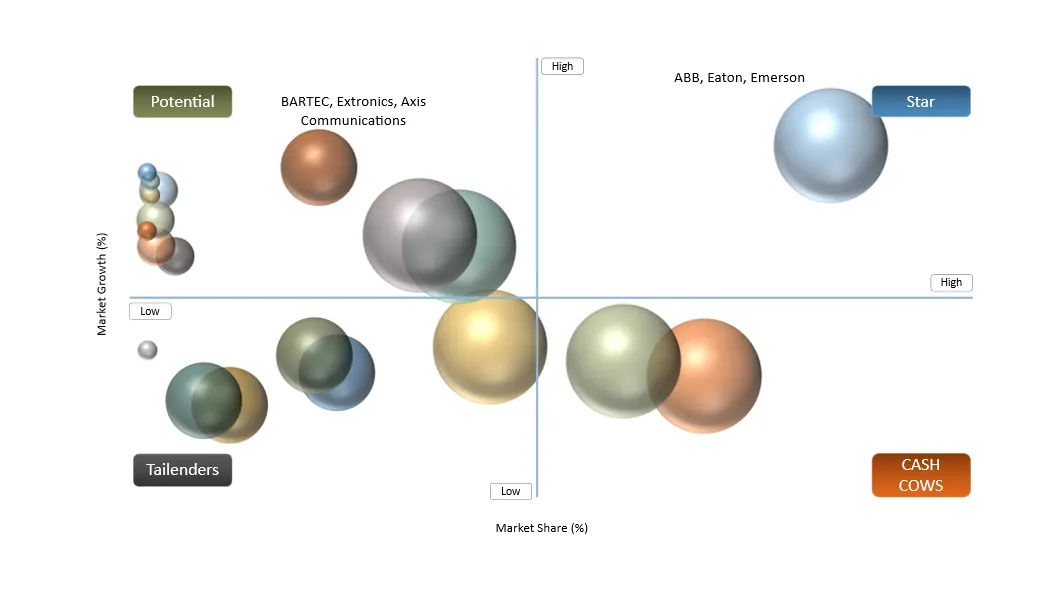
STAR
ABB, Eaton, Emerson, Pepperl+Fuchs and R. STAHL are positioned as Star participants because they combine broad certified portfolios, international sales coverage, engineering depth and strong exposure to process industries. Their competitive strength comes from product breadth across motors, lighting, enclosures, instrumentation, control and digital solutions.
POTENTIAL
BARTEC, Extronics, Axis Communications, Warom, Cortem and specialist connected-device suppliers represent Potential players. They can gain share through focused innovation in wireless networking, rugged mobile devices, thermometric imaging, hazardous-area computing and regionally competitive manufacturing.
Explosion-Proof Equipment Market Dynamics
Driver Impact Analysis
| Driver | Market Growth Impact | Demand Concentration | Impacted Use Case | Strategic Impact |
Stricter safety and compliance requirements | High | Global process industries | Certified equipment replacement and new projects | Sustains mandatory demand and raises certification barriers |
Industrial digitalization | High | Oil & gas, chemicals and mining | Sensors, cameras, wireless and edge devices | Expands market beyond conventional electrical hardware |
Energy and infrastructure investment | Medium-High | Asia-Pacific and Middle East | Motors, lighting, enclosures and control systems | Supports project-driven volume growth |
Hydrogen, battery and dust-hazard applications | Medium | Emerging energy and manufacturing | Gas and dust protected equipment | Creates new specifications and early-mover opportunity |
Driver: Expansion of Hazardous Industrial Infrastructure and Digital Safety
New refineries, chemical plants, LNG facilities, mines, pharmaceutical plants and manufacturing facilities require large quantities of certified electrical and instrumentation equipment. Brownfield facilities also replace legacy products to improve efficiency, communication and compliance. Digital safety investments add incremental demand for networked sensing, surveillance and worker communication.
Restraint Impact Analysis
| Restraint | Drag on Market Growth | Primary Impact Area | Impacted Use Case | Strategic Impact |
High certification and engineering cost | High | Product development and project pricing | Specialized low-volume equipment | Favors scaled suppliers with reusable platforms |
| Complex regional standards | Medium-High | Global product deployment | Multi-country projects | Requires broad certification portfolios and local expertise |
Long lead times and component qualification | Medium | Project execution | Custom enclosures and electronics | Encourages inventory planning and modular design |
| Limited skilled personnel | Medium | Installation and maintenance | Inspection, repair and compliance | Increases demand for training and service contracts |
Restraint: High Certification Cost and Complex Regional Requirements
Explosion-protected products require specialized design, testing, documentation and quality control. Certification changes can be triggered by component substitutions or manufacturing updates, reducing flexibility. Different regional classification systems and approval bodies create additional cost for suppliers and confusion for end users, especially in multinational projects.
Explosion-Proof Equipment Market Segmentation Analysis
The global Explosion-Proof Equipment market is segmented based on Product Type, Protection Method, Hazardous-Area Classification, Connectivity, Enclosure Material, Application, end-use industry, distribution channel, and region.
By Product Type
Lighting, Motors and Enclosures Will Continue to Lead
Lighting, motors, enclosures and junction boxes account for a large share because they are required throughout hazardous facilities and experience regular replacement. Instrumentation, cameras and communication devices will grow faster as plants digitize operations and expand remote monitoring.
By Protection Method
Flameproof and Explosion-Proof Protection Will Remain the Largest Segment
Flameproof and explosion-proof construction is widely used for motors, lighting, switches, cameras and control equipment in high-risk locations. Intrinsic safety is expected to record faster growth in low-power instrumentation and communication because it supports live maintenance and lighter field devices.
By Hazardous-Area Classification
Zone 1 and Class I Division 1 Will Lead Market Value
Zone 1 and Division 1 areas combine high safety requirements with broad equipment demand. Zone 2 and Division 2 applications will grow quickly because lower-risk areas are adopting more connected devices, cameras and edge systems.
By Connectivity
Wireless and Hybrid Equipment Will Record the Fastest Growth
Wired products remain dominant in fixed infrastructure, but wireless access points, sensors, cameras and mobile devices are growing as operators seek flexible data collection and reduced cabling. Hybrid architectures will connect certified field devices to secure plant networks.
By Enclosure Material
Aluminum Will Remain Largest While Stainless Steel Gains in Harsh Environments
Aluminum offers favorable weight, cost and heat-dissipation characteristics. Stainless steel gains share in offshore, marine, chemical, food and pharmaceutical applications where corrosion resistance and hygienic performance are critical.
By Application
Process Measurement and Control Will Be the Largest Application
Transmitters, analyzers, sensors, control stations and signaling systems are central to continuous operation and process safety. Communication and surveillance will grow fastest through hazardous-area cameras, thermal devices, Wi-Fi and edge computing.
By End Use Industry
Oil & Gas Will Remain the Largest End Use
Upstream, midstream, refining and LNG assets contain extensive classified areas and high equipment density. Chemicals, mining, pharmaceuticals and emerging hydrogen and battery facilities provide diversified growth.
By Distribution Channel
Direct Sales and Authorized Distributors Will Dominate
Large projects are supplied directly or through EPC partners, while distributors support local availability, certification guidance and replacement demand. Digital channels will expand for standardized accessories but remain limited for engineered systems.
Explosion-Proof Equipment Market Geographical Penetration
U.S. Explosion-Proof Equipment Market Landscape
The U.S. market is supported by extensive oil and gas, refining, chemical, grain, food-processing and manufacturing infrastructure. NEC division classifications, UL and CSA approvals and strong liability awareness sustain replacement demand. Growth is concentrated in LNG, petrochemicals, connected worker systems, hazardous-location cameras and modernization of legacy motors and lighting.
Germany Explosion-Proof Equipment Market Outlook
Germany is a leading European market through chemical, pharmaceutical, machinery and process-industry demand. Strong engineering standards and ATEX compliance support premium certified equipment. German suppliers also export hazardous-area technologies globally, creating a dense ecosystem of manufacturers, test bodies and system integrators.
China Explosion-Proof Equipment Market Trends
China is the largest manufacturing and consumption market in Asia-Pacific, supported by chemicals, coal mining, oil and gas, pharmaceuticals, batteries and industrial expansion. Domestic suppliers compete strongly in standard enclosures, lighting and motors, while multinational companies retain advantages in complex automation and global certification.
India Explosion-Proof Equipment Market Outlook
India is a fast-growing market because of refining, petrochemicals, pharmaceuticals, specialty chemicals, mining and infrastructure investment. PESO certification, local-content preferences and expansion of domestic manufacturing influence supplier strategy. Demand is increasing for flameproof motors, control equipment, lighting and gas detection.
Middle East Explosion-Proof Equipment Market Outlook
The Gulf region has high equipment density in oil, gas, refining, petrochemicals, LNG and hydrogen projects. Customers prioritize global certification, corrosion resistance, high-temperature performance and strong local service. Localization programs create opportunities for regional assembly and partnerships.
South America Explosion-Proof Equipment Market Outlook
Brazil, Argentina and mining economies generate demand through offshore oil, refining, chemicals, mining and food processing. Market growth is constrained by project cycles and import costs but supported by modernization of energy and industrial assets.
Explosion-Proof Equipment Market Competitive Landscape
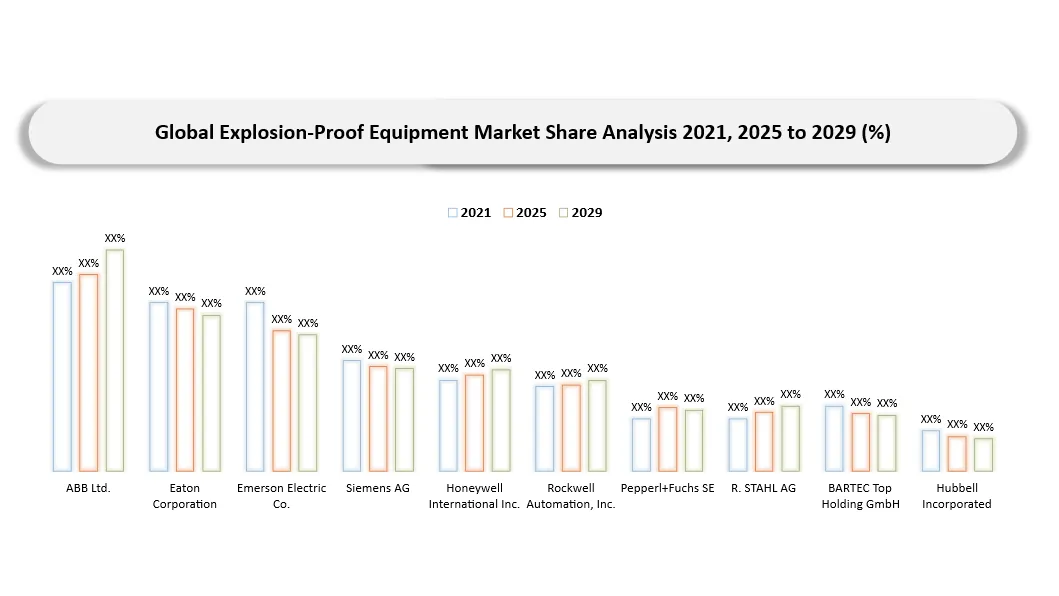
- Competition is led by diversified automation and electrical groups with broad certification portfolios, alongside specialist hazardous-area suppliers with deep application expertise.
- ABB, Eaton and Emerson compete across motors, lighting, enclosures, instrumentation and control, while Pepperl+Fuchs, R. STAHL and BARTEC have strong specialist positions in intrinsic safety, interfaces, enclosures and mobile equipment.
- Axis Communications, Extronics and rugged-computing suppliers are expanding the digital layer through cameras, wireless networks, edge devices and connected-worker solutions.
- Chinese manufacturers such as Warom compete on cost, breadth and regional availability, increasing price pressure in standard product categories.
- Differentiation depends on certification coverage, engineering support, lead time, lifecycle service, product interoperability and the ability to support global projects.
Key Companies
- ABB Ltd.
- Eaton Corporation
- Emerson Electric Co.
- Rockwell Automation
- Siemens AG
- Honeywell International
- Pepperl+Fuchs
- R. STAHL AG
- BARTEC Top Holding GmbH
- Hubbell Incorporated
- Phoenix Contact
- Warom Technology
- Cortem Group
- Extronics Ltd.
- Axis Communications
Company Profiles
ABB Ltd.
ABB offers explosion-proof motors, drives, electrical distribution and automation equipment for oil & gas, chemical, mining and industrial applications. Its strength lies in global certification, motor technology, channel coverage and integration with automation and condition-monitoring systems.
Eaton Corporation
Eaton has a broad Crouse-Hinds hazardous-area portfolio covering lighting, enclosures, cable glands, control stations, signaling and electrical distribution. The company competes through installed-base strength, North American code expertise and global project coverage.
Emerson Electric Co.
Emerson combines Rosemount instrumentation, gas and flame detection, TopWorx position sensing and control technologies with hazardous-location approvals. Its portfolio is positioned around process measurement, digital plant architecture and lifecycle services.
Pepperl+Fuchs
Pepperl+Fuchs is a major supplier of intrinsic-safety barriers, remote I/O, purge and pressurization systems, mobile devices and hazardous-area human-machine interfaces. It benefits from deep process-automation expertise and broad IECEx and ATEX coverage.
R. STAHL AG
R. STAHL specializes in explosion-protected electrical products, lighting, control, distribution, signaling and automation. Its strong European engineering base and comprehensive zone-certified portfolio support complex chemical, pharmaceutical and energy projects.
BARTEC Top Holding GmbH
BARTEC supplies explosion-protected electrical equipment, mobile devices, measurement systems and heat-tracing solutions. Its strategic position is strongest where customers require specialist hazardous-area engineering and connected-worker products.
Hubbell Incorporated
Hubbell participates through Killark and related hazardous-location electrical products, including lighting, enclosures, fittings and plugs. The company has strong access to industrial distribution and North American infrastructure markets.
Axis Communications
Axis has expanded explosion-protected network cameras, thermal imaging and audio devices for hazardous locations. Its growth opportunity is tied to remote surveillance, thermometric monitoring and integration with industrial security networks.
Explosion-Proof Equipment Market Major Pain Points
- Complex interpretation of zone, division, gas group, dust group and temperature-class requirements.
- High cost and long lead time for certified low-volume or customized products.
- Limited flexibility to substitute components without certification review.
- Shortage of skilled hazardous-area design, inspection and maintenance personnel.
- Fragmented installed bases with inconsistent documentation and asset registers.
- Corrosion, vibration, dust, temperature and washdown conditions that shorten equipment life.
- Cybersecurity and interoperability risks as connected devices enter plant networks.
- Price pressure in standard hardware while customers still demand global approvals and local service.
Explosion-Proof Equipment Market Recent Developments
- July 2026: Emerson announced a flameproof model of the Rosemount 965 flame detector, adding hazardous-location certification and QuadSense technology for hydrocarbon fire detection.
- February 2026: Asahi Kasei Engineering introduced the EXAP-500 explosion-proof Wi-Fi 6E access point for hazardous-area digital transformation, mesh networking and connected field operations.
- November 2025: ONERugged highlighted a portfolio of ATEX-certified intrinsically safe rugged tablets and smartphones for oil & gas, chemical and mining field operations.
- September 2025: Neousys announced explosion-proof and extreme edge-AI platforms designed for C1D2 and ATEX hazardous locations.
- June 2025: Crowcon reported UL 1203 and UL 60079-29-1 certification for the Xgard Bright fixed gas detector, extending its use in Class I and II Division 1 hazardous areas.
- June 2025: AMETEK Process Instruments announced additional ATEX, IECEx and North American hazardous-area certifications for its 993X analyzer series.
- February 2025: ABB India extended its low-voltage flameproof motor range to 37 kW-500 kW for oil & gas, chemicals, pharmaceuticals and food and beverage applications.
- January 2025: LGM Products launched ATEX and IECEx Zone 1 certified addressable explosion-proof heat detector and manual call-point products.
Analyst View / Opinion on Explosion-Proof Equipment Market
- The market will sustain long-term growth because hazardous-location compliance is mandatory and the installed base requires continuous replacement, inspection and modernization.
- Digital equipment will create the fastest value growth, but conventional lighting, motors, enclosures and control systems will remain the revenue foundation.
- Asia-Pacific will lead both manufacturing and demand, while the Middle East will remain a premium project market supported by oil, gas, petrochemicals and emerging hydrogen investments.
- Multi-certified platforms and modular product architecture will be essential for controlling development cost and serving global EPC projects.
- Companies that combine certified hardware with connectivity, diagnostics and lifecycle services will capture higher margins and stronger customer retention.
- Combustible dust, hydrogen, battery materials and connected worker applications are the most important adjacent growth areas through 2035.
Explosion-Proof Equipment Market Target Audience
| Industry | Who Should Buy This Report? | Reason to Buy This Report |
| Electrical and Automation | Manufacturers, product managers and business development teams | Assess product demand, certification gaps and portfolio priorities. |
| Oil & Gas and Chemicals | Plant owners, EPCs, engineering teams and safety managers | Plan hazardous-area investment, replacement and vendor strategy. |
| Mining and Metals | Mine operators, equipment suppliers and integrators | Evaluate gas and dust protection, communications and mobile equipment. |
| Pharmaceuticals and Food | Facility engineers, compliance teams and procurement | Understand hygienic, dust-hazard and corrosion-resistant requirements. |
| Distributors and Integrators | Authorized distributors, panel builders and system integrators | Identify fast-growing categories, regions and service opportunities. |
| Investors and Consulting | Private equity, venture capital, strategy teams and consultants | Evaluate market size, competition, M&A and emerging technology. |
| Government and Certification | Regulators, test bodies and industrial safety organizations | Assess standards, adoption gaps and policy implications. |
Why Choose DATAM?
- Data-driven insights combining market sizing, certification analysis, project demand, pricing and competitive benchmarking.
- Post-purchase analyst consultations for product strategy, market entry, channel development and investment assessment.
- Annual updates covering certifications, launches, industrial projects, partnerships and competitive changes.
- Specialized focus on emerging markets and country-level industrial infrastructure rather than generalized regional summaries.
- Actionable analysis that connects safety regulation, technology adoption, procurement behavior and commercial opportunity.
What DATAM Uniquely Provides
- Ten-year forecasts across product type, protection method, classification, connectivity, material, application, end use and distribution channel.
- Certification-focused analysis of IECEx, ATEX, North American division systems and regional approval requirements.
- Technology coverage spanning conventional electrical hardware, wireless networks, edge computing, cameras and connected-worker devices.
- Country-level views linking industrial investment, code enforcement, project activity and channel structure.
- Strategic recommendations for portfolio expansion, local certification, partnerships, service and market entry.



























































