


Bluetooth Controller Market Size
Bluetooth controllers are semiconductor devices that enable short-range wireless communication between electronic systems. They manage Bluetooth radio communication, data transfer, pairing, security, low-power operation and protocol handling across smartphones, wearables, headphones, gaming controllers, smart home devices, automotive infotainment systems, medical devices, industrial sensors and IoT equipment.
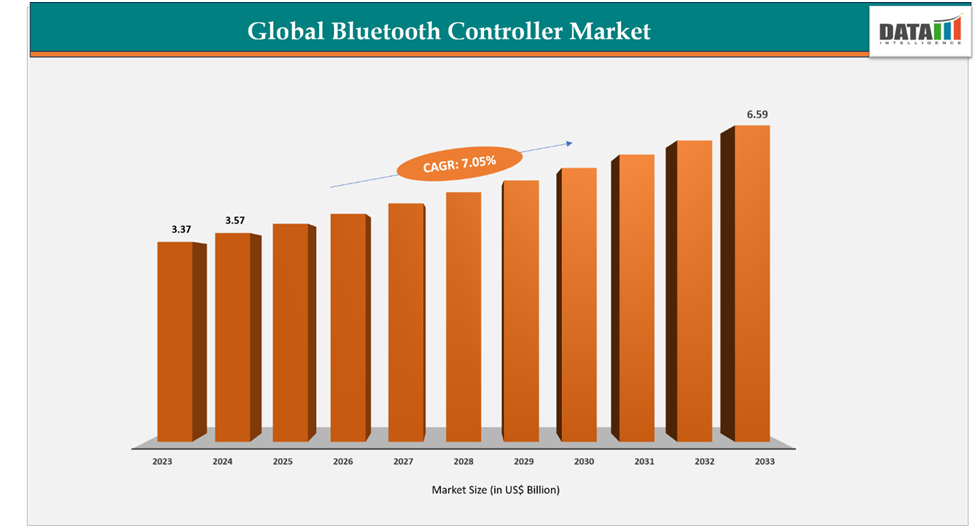
Bluetooth Controller Market is valued at approximately US$ 3.82 billion in 2025 and is projected to reach US$ 7.55 billion by 2035, growing at a CAGR of 7.05% during 2026–2035.
Investment timing is attractive because Bluetooth controllers sit inside several high-volume semiconductor demand pools, including consumer electronics, automotive connectivity, industrial IoT, healthcare wearables, gaming, smart homes, telecom devices and edge hardware. Growth is supported by Bluetooth Low Energy, LE Audio, mesh networking, low-latency communication, secure wireless control and AI-powered power optimization. However, adoption barriers remain around manufacturing cost, R&D intensity, certification complexity, foundry dependence, node migration, wafer supply and competition from Wi-Fi, UWB, Zigbee and proprietary wireless protocols.
Key Takeaways
- The Bluetooth Controller market size 2026 is estimated at US$ 4.09 billion, supported by demand from consumer electronics, automotive systems, wearables, gaming devices and industrial IoT.
- The Bluetooth Controller market forecast 2035 is projected at US$ 7.55 billion, reflecting steady growth in low-power wireless semiconductor demand.
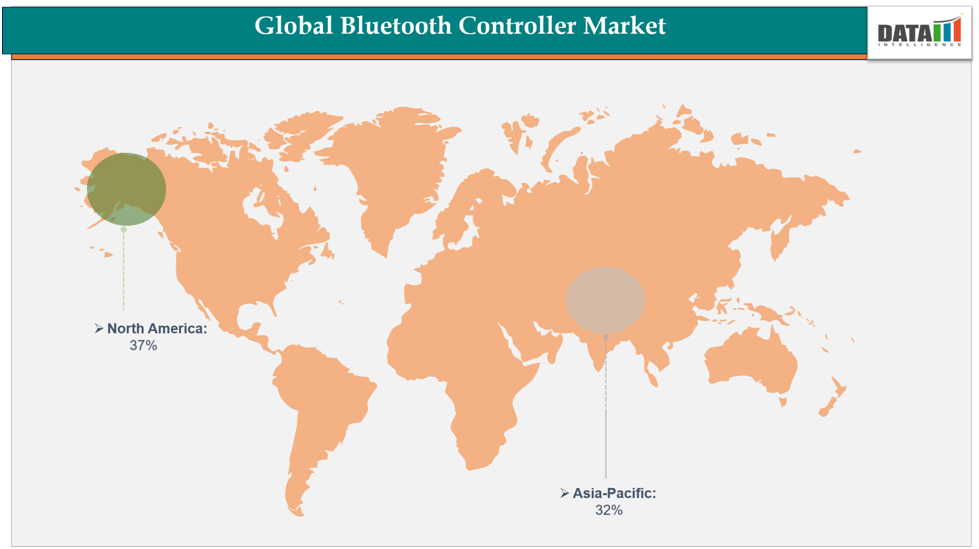
- North America accounted for approximately 37% of the global market in 2024, supported by strong semiconductor R&D, consumer electronics adoption and major chip companies.
- Asia-Pacific accounted for approximately 32% of the market in 2024 and is expected to be the fastest-growing region due to electronics manufacturing scale, smartphone penetration and automotive connectivity growth.
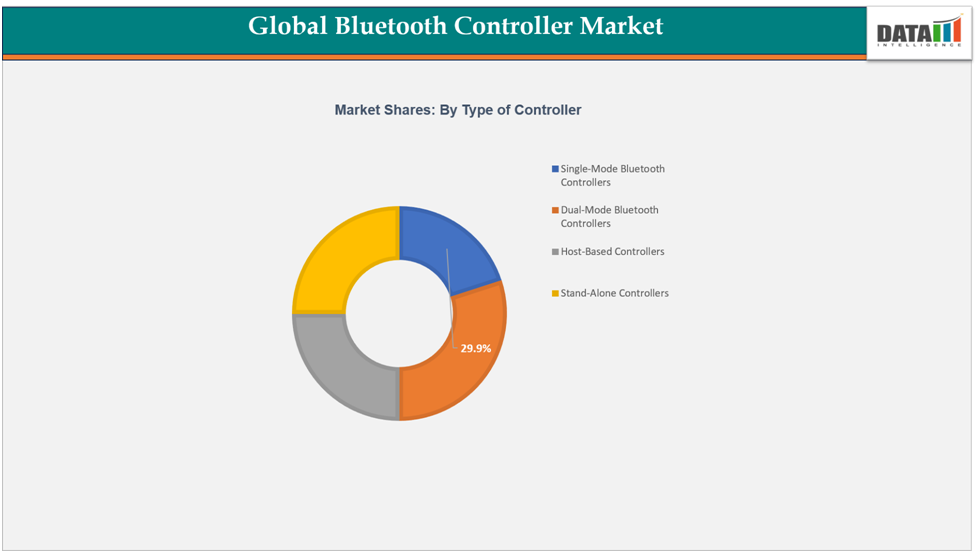
- Dual-mode Bluetooth controllers hold an estimated 29.2% share due to support for both Classic Bluetooth and Bluetooth Low Energy.
- Bluetooth Low Energy, LE Audio and mesh networking are reshaping controller design by increasing demand for low-power, secure and multi-device connectivity.
- Manufacturing cost, compliance testing, semiconductor node decisions and foundry capacity remain key adoption and margin constraints.
Market Scope
| Metrics | Details |
| Market Size in 2025 | US$ 3.82 Billion |
| Market Size by 2035 | US$ 7.55 Billion |
| CAGR | 7.05% |
| Historic Years | 2023-2024 |
| Base Year | 2024 |
| Forecast Period | 2025-2035 |
| Segments Covered | Type of Controller, Technology, Connectivity Range, End User and Region |
| Largest Region | North America |
| Fastest Growing Region | Asia-Pacific |
Bluetooth Controller Growth Drivers
Consumer Electronics Adoption Is Expanding Volume Demand
Consumer electronics remain the largest demand base for Bluetooth controllers. Smartphones, tablets, laptops, headphones, speakers, keyboards, smartwatches, gaming controllers, smart TVs and home automation devices require low-power wireless connectivity.
Bluetooth controllers are especially important in devices where power efficiency, fast pairing, secure communication and low-latency data transfer are essential. Growth in wearables and wireless audio continues to support high-volume semiconductor demand.
Automotive Connectivity Is Increasing Bluetooth Content
Automotive applications are becoming an important growth driver. Bluetooth controllers support in-vehicle infotainment, hands-free communication, digital keys, wireless diagnostics, audio streaming, rear-seat entertainment, tire pressure sensors and connected cabin devices.
Electric vehicles and software-defined vehicles are also increasing demand for low-power wireless controllers used in cabin connectivity, device pairing and short-range sensor communication.
Bluetooth Low Energy Is Supporting IoT Growth
Bluetooth Low Energy is expanding adoption across IoT devices, medical wearables, asset trackers, industrial sensors, smart locks, lighting systems and retail beacons. BLE supports long battery life, low-cost connectivity and reliable device-to-device communication.
Bluetooth mesh networking is also increasing relevance in smart buildings, industrial automation and connected lighting.
LE Audio and Low-Latency Applications Are Driving Upgrades
LE Audio is creating replacement and upgrade demand in audio devices, hearing aids, headsets and smart entertainment products. Demand for low-latency wireless communication is also increasing in gaming accessories, AR devices, automotive infotainment and professional audio applications.
Integration and Miniaturization Are Improving OEM Adoption
Highly integrated Bluetooth systems-on-chip and modules reduce device footprint, bill-of-material cost and design complexity. Infineon’s AIROC CYW20829 Bluetooth Low Energy 5.4 microcontroller family demonstrates how vendors are improving integration, security, power optimization and development support for consumer, industrial and automotive applications.
Supply Chain Map
The Bluetooth Controller supply chain spans IP, EDA tools, wafer fabrication, packaging, module assembly, device OEMs and end-user markets.
| Supply Chain Layer | Market Role |
| Semiconductor IP Providers | Provide Bluetooth protocol, RF and security IP blocks |
| EDA Tool Providers | Support chip design, verification and testing |
| Fabless Chip Designers | Design Bluetooth controller ICs and SoCs |
| Foundries | Manufacture wafers using RF CMOS and mixed-signal processes |
| Wafer Suppliers | Provide silicon wafers and specialty materials |
| OSAT Providers | Package, assemble and test Bluetooth chips |
| Module Makers | Integrate Bluetooth chips with antennas, RF components and firmware |
| Device OEMs | Use controllers in electronics, vehicles, medical devices and IoT products |
| Certification Bodies | Support Bluetooth SIG and regional compliance requirements |
| Distributors | Supply chips and modules to small and mid-sized manufacturers |
| End-User Industries | Consumer electronics, automotive, healthcare, telecom, industrial and defense |
Companies with strong IP, foundry partnerships, integrated modules and certification support are better positioned to serve high-volume OEMs.
Wafer and Material Bottlenecks
Bluetooth controllers are generally manufactured using mature and specialty semiconductor processes, but the market still faces bottlenecks linked to wafer availability, RF performance and qualification needs.
| Bottleneck Area | Market Impact |
| Mature-Node Capacity | Bluetooth controllers often use mature RF CMOS and mixed-signal nodes |
| RF Process Availability | Wireless performance depends on stable RF process capability |
| Silicon Wafer Supply | Wafer availability affects production lead times |
| Analog and Mixed-Signal Capacity | Power management and RF front-end integration require specialized processes |
| Automotive Qualification | Increases testing, validation and production control requirements |
| Industrial Reliability | Demands wider temperature range and longer lifecycle support |
| Bluetooth SIG Certification | Adds compliance time and cost |
| Module Component Supply | Antennas, crystals and passives can create supply constraints |
| Test Equipment Capacity | RF testing and validation can limit throughput |
| Geopolitical Supply Risk | Foundry and packaging concentration can affect supply continuity |
Bluetooth controller shortages are less extreme than leading-edge compute chips, but mature-node and RF capacity constraints can still affect OEM production schedules.
Advanced Packaging and Node Migration
Bluetooth controller design is shaped by low power, compact size, low cost and RF performance rather than leading-edge compute density.
| Technology Area | Market Relevance |
| RF CMOS Nodes | Core manufacturing base for Bluetooth controllers |
| 40 nm to 22 nm Nodes | Used for integrated low-power wireless SoCs |
| Mature Nodes | Remain important for cost-sensitive controllers |
| System-in-Package | Integrates controller, RF, memory and passives |
| Wafer-Level Chip-Scale Packaging | Supports compact wearables and earbuds |
| Fan-Out Packaging | Relevant for miniaturized premium devices |
| Embedded Antenna Modules | Reduces design complexity for OEMs |
| Multi-Chip Modules | Combines Bluetooth with Wi-Fi, GNSS or MCU functionality |
| Automotive-Grade Packaging | Supports temperature, vibration and reliability requirements |
| Low-Power Design Optimization | Improves battery life in wearables and IoT devices |
Node migration is gradual because Bluetooth controllers prioritize cost, power efficiency, RF stability and integration. Advanced packaging demand is strongest in wearables, earbuds, gaming accessories, medical devices and compact IoT modules.
Foundry and OSAT Landscape
Foundry Landscape
Bluetooth controller manufacturers rely on foundries that can support RF CMOS, mixed-signal integration, embedded memory and low-power semiconductor processes. TSMC is relevant due to Apple’s planned in-house Bluetooth and Wi-Fi chip, Proxima, which is expected to be manufactured by TSMC from 2025. This reflects the strategic shift toward in-house wireless chip design and supply chain control.
Foundry selection is based on RF performance, cost, process maturity, power efficiency, yield, production scale and long-term supply assurance.
IDM and Fabless Landscape
Broadcom, MediaTek, Nordic Semiconductor, Infineon Technologies, STMicroelectronics and Realtek are important Bluetooth controller suppliers. Some operate as fabless companies using external foundries, while others combine internal design with broader semiconductor manufacturing and module partnerships.
OSAT Landscape
OSAT providers support packaging, assembly and RF testing. Bluetooth controller packaging requires reliable RF performance, small footprint, thermal stability and cost efficiency. For automotive and industrial use, testing requirements are stricter because devices must operate reliably over wider conditions.
End-Market Demand Signals
Consumer Electronics
Consumer electronics remain the largest demand driver. Smartphones, wireless earbuds, smart speakers, laptops, wearables, keyboards, remotes and gaming controllers create high-volume Bluetooth controller demand.
Electric Vehicles
EVs require Bluetooth controllers for digital keys, infotainment, device pairing, wireless diagnostics, cabin sensors, charging accessories and user personalization. As EVs become more software-defined, short-range wireless connectivity becomes more important inside the vehicle ecosystem.
Telecom and Connected Infrastructure
Telecom demand comes from Bluetooth-enabled routers, gateways, headsets, service devices, IoT access equipment and connected home systems. Bluetooth also supports provisioning and local control for network devices.
Defense and Aerospace
Defense and aerospace applications use Bluetooth selectively in rugged peripherals, maintenance tools, secure short-range devices, wearables and training systems. Adoption depends on security, certification and electromagnetic compatibility requirements.
Data Centers
Data center demand is indirect but growing through Bluetooth-enabled commissioning tools, sensor networks, asset tracking, maintenance wearables and local diagnostics. Bluetooth controllers can support low-power asset visibility and device management in complex infrastructure environments.
Healthcare and Medical Devices
Medical devices and health wearables use Bluetooth controllers for patient monitoring, glucose meters, hearing aids, smart patches and home health equipment. Reliability, security and low power consumption are critical.
Industrial IoT
Industrial applications use Bluetooth for sensors, predictive maintenance, asset tracking, worker devices and machine configuration. Bluetooth mesh and BLE improve value in smart factories and warehouses.
Pricing and Adoption Trends
Bluetooth Controller pricing and adoption trends are shaped by integration level, technology standard, power efficiency, qualification, volume, module design and application requirements.
| Pricing Factor | Buyer Impact |
| Bluetooth Standard | Bluetooth 5.0 and above supports premium pricing |
| Dual-Mode Capability | Higher value due to Classic and BLE support |
| LE Audio Support | Adds value in audio and hearing devices |
| Mesh Networking | Supports smart building and IoT applications |
| Automotive Qualification | Raises cost due to reliability testing |
| Industrial Temperature Range | Adds cost for rugged applications |
| Integrated MCU | Reduces external component needs |
| Security Features | Secure boot and cryptography support premium applications |
| Module Certification | Reduces OEM design burden but raises module cost |
| High-Volume Contracts | Consumer electronics scale reduces unit pricing |
Adoption is strongest where Bluetooth controllers reduce device power consumption, improve interoperability and simplify product design. Price-sensitive device makers prefer integrated modules and mature-node chips, while automotive and medical buyers prioritize reliability and qualification.
Adoption Barriers
High Manufacturing and R&D Cost
Advanced Bluetooth controllers require investment in RF design, low-power architecture, protocol compliance, security and testing. Support for Bluetooth 5.4, LE Audio and mesh networking increases design complexity.
Certification and Compliance Burden
Bluetooth SIG qualification, regional radio certification and end-device testing add time and cost. Automotive, healthcare and industrial products require additional validation.
Competitive Wireless Alternatives
Bluetooth competes with Wi-Fi, UWB, Zigbee, Thread, NFC and proprietary wireless solutions. Application requirements determine which protocol is preferred.
Foundry and Supply Chain Dependence
Bluetooth controller suppliers depend on foundry capacity, OSAT availability, RF testing equipment and module component supply. Disruptions can affect delivery timelines.
Security and Privacy Concerns
Connected devices require secure pairing, encryption, firmware updates and protection against unauthorized access.
Segmentation Analysis
Segmented by Type of Controller (Single-Mode Bluetooth Controllers, Dual-Mode Bluetooth Controllers, Host-Based Controllers and Stand-Alone Controllers), by Technology (Bluetooth Classic, Bluetooth Low Energy, Bluetooth 5.0 and Above), by Connectivity Range (Short-Range below 10 meters, Medium-Range 10 to 50 meters and Long-Range above 50 meters), by End User (Consumer Electronics, Automotive and Transportation, Healthcare and Medical Devices, IT and Telecommunications, Industrial and Manufacturing, Retail and Logistics, Defense and Aerospace), and by Region - Share, Trends and Forecast to 2035.
By Type of Controller
Dual-mode Bluetooth controllers hold the largest share, estimated at 29.2% in 2024. They support both Classic Bluetooth and Bluetooth Low Energy, making them suitable for smartphones, laptops, audio devices, wearables and automotive infotainment systems.
Single-mode BLE controllers are important in low-power IoT devices, medical sensors and wearables. Host-based controllers are used where the main processor handles part of the protocol stack. Stand-alone controllers are used when independent Bluetooth operation is required.
By Technology
Bluetooth Classic remains important for audio and higher-throughput applications. Bluetooth Low Energy is expanding rapidly in wearables, IoT, healthcare and industrial devices. Bluetooth 5.0 and above supports higher speed, longer range, improved broadcast capacity and better power performance.
By Connectivity Range
Short-range controllers are widely used in wearables, earbuds, peripherals and smart home devices. Medium-range controllers support home automation, industrial sensors and retail applications. Long-range Bluetooth is growing in logistics, asset tracking and industrial IoT.
By End User
Consumer electronics remains the largest end-user segment due to high-volume devices. Automotive and transportation are growing due to infotainment, digital keys and connected cabin systems. Healthcare is expanding through wearables and medical monitoring devices. Industrial and manufacturing applications are growing through sensors, asset tracking and wireless machine configuration.
Bluetooth Controller Regional Analysis
North America
North America is the largest region, accounting for approximately 37% of the global market in 2024. Growth is supported by strong consumer electronics adoption, semiconductor R&D, automotive technology development, IoT adoption and the presence of leading chip companies.
The U.S. leads the regional market due to major semiconductor players, strong product innovation and Apple’s planned in-house Proxima Bluetooth and Wi-Fi chip initiative.
Asia-Pacific
Asia-Pacific accounted for approximately 32% of the market in 2024 and is expected to be the fastest-growing region. Growth is driven by smartphone manufacturing, consumer electronics production, gaming devices, automotive electronics and industrial IoT adoption across China, Japan, South Korea, Taiwan and India.
Japan is emerging as an important innovation market through standardization participation and focus on LE Audio, mesh networking and improved audio-visual synchronization.
Europe
Europe is an important Bluetooth controller market due to automotive electronics, industrial automation, medical devices, smart buildings and consumer electronics. Germany, the UK, France, Italy and the Nordics are key markets.
Automotive use cases and industrial IoT are important regional demand drivers.
South America
South America offers moderate growth through smartphones, consumer electronics, retail devices, automotive infotainment and logistics applications. Brazil is the key regional market.
Middle East and Africa
The Middle East and Africa are emerging markets. Growth will be linked to smart devices, telecom equipment, retail IoT, healthcare devices and connected infrastructure.
Competitive Landscape and Bluetooth Controller Top Companies
The Bluetooth Controller top companies include Broadcom, Dell Inc., Samsung, 8BitDo, Cosmic Byte, MediaTek, Nordic Semiconductor ASA, Infineon Technologies, STMicroelectronics and Realtek Semiconductor Corp.
Broadcom is a leading semiconductor supplier with strong Bluetooth controller capability across consumer, automotive, industrial and IoT applications. MediaTek and Realtek are important in wireless connectivity chips for consumer devices. Nordic Semiconductor is strong in BLE and low-power IoT. Infineon and STMicroelectronics are relevant in industrial, automotive and embedded wireless controller markets. Samsung participates through consumer electronics and connected device ecosystems. 8BitDo and Cosmic Byte are important Bluetooth controller device brands in gaming peripherals. Dell is relevant through PC and connected device ecosystems.
Vendor Comparison
| Company | Strategic Positioning | Competitive Strength |
| Broadcom | High-performance Bluetooth and wireless chips | Low power, throughput and broad OEM relationships |
| MediaTek | Consumer electronics connectivity chips | Scale in mobile, smart devices and wireless SoCs |
| Nordic Semiconductor ASA | BLE and low-power wireless | Strong IoT, wearables and embedded development ecosystem |
| Infineon Technologies | Bluetooth MCUs and secure embedded solutions | AIROC portfolio, security and industrial support |
| STMicroelectronics | Embedded wireless and MCU platforms | Industrial, IoT and automotive-grade semiconductor capability |
| Realtek Semiconductor Corp. | Wireless connectivity ICs | Cost-competitive consumer device integration |
| Samsung | Consumer electronics ecosystem | Device integration and connected hardware scale |
| Dell Inc. | PC and device ecosystem | Enterprise and consumer connected device demand |
| 8BitDo | Bluetooth gaming controllers | Cross-platform gaming accessory strength |
| Cosmic Byte | Gaming and consumer accessories | Affordable wireless peripheral positioning |
Competitive differentiation depends on power efficiency, protocol support, dual-mode capability, security, integration, RF performance, certification support, pricing and software development tools.
Recent Developments and Market Signals
- May 2026 – Nordic Semiconductor ASA expands ultra-low-power Bluetooth LE controller solutions
Nordic Semiconductor introduced next-generation Bluetooth® Low Energy (LE) controller technologies featuring improved power efficiency, enhanced security, and support for Bluetooth Channel Sounding and advanced IoT connectivity applications, targeting wearables, medical devices, and smart home products. - May 2026 – MediaTek strengthens Bluetooth connectivity platform for AI-enabled consumer devices
MediaTek expanded its wireless connectivity portfolio by integrating advanced Bluetooth controller technologies into chipsets for smartphones, PCs, and IoT devices, improving audio quality, low-latency performance, and energy efficiency. - April 2026 – Broadcom enhances Bluetooth controller solutions for Wi-Fi and Bluetooth coexistence
Broadcom advanced integrated wireless connectivity solutions supporting faster Bluetooth communication, improved interference management, and seamless operation across smartphones, laptops, networking equipment, and enterprise devices. - April 2026 – Infineon Technologies advances secure Bluetooth controller technologies for IoT applications
Infineon expanded its Bluetooth-enabled microcontroller portfolio with enhanced security features, low-power operation, and robust connectivity designed for industrial IoT, healthcare, and smart home ecosystems. - March 2026 – STMicroelectronics strengthens Bluetooth Low Energy (BLE) microcontroller portfolio
STMicroelectronics introduced enhanced wireless microcontrollers integrating Bluetooth LE connectivity, improved processing capabilities, and optimized power consumption for wearable electronics, asset tracking, and industrial automation applications. - March 2026 – Realtek Semiconductor expands Bluetooth audio controller solutions
Realtek strengthened its Bluetooth controller portfolio with new wireless audio chipsets supporting next-generation earbuds, headphones, gaming accessories, and multimedia devices featuring lower latency and improved audio quality. - February 2026 – Samsung Electronics enhances Bluetooth connectivity across Galaxy ecosystem
Samsung expanded Bluetooth controller integration across smartphones, tablets, wearables, and consumer electronics to improve multi-device connectivity, intelligent device switching, and power efficiency within its connected ecosystem.
Market Opportunities
For semiconductor companies, the strongest opportunities lie in dual-mode controllers, BLE 5.4 devices, LE Audio, integrated Bluetooth and Wi-Fi chips, automotive-qualified Bluetooth controllers and low-power IoT SoCs.
For foundries, opportunities exist in RF CMOS, mixed-signal mature nodes, embedded memory processes and high-volume wireless connectivity chips.
For OSAT providers, growth opportunities are emerging in wafer-level packaging, compact SiP modules, RF testing and automotive-grade packaging.
For device OEMs, Bluetooth controllers support product differentiation in wearables, audio devices, gaming accessories, smart homes, vehicles and medical devices.
For investors, the market provides exposure to wireless semiconductors, low-power IoT, automotive connectivity, gaming peripherals, healthcare wearables and semiconductor supply chain localization.
Report Benefits
The report helps Bluetooth controller manufacturers evaluate market size, technology trends, end-user demand and regional growth opportunities. Foundries can assess mature-node and RF process demand. OSAT providers can identify advanced packaging and RF testing opportunities. Device OEMs can benchmark controller adoption, pricing trends and wireless protocol competition. Investors can evaluate market forecast, adoption barriers, supply-chain risks and competitive positioning. Strategy teams can assess Bluetooth Controller growth drivers, wafer capacity trends, material bottlenecks, foundry ecosystem, advanced packaging demand and end-market demand through 2035.
Target Audience
- Bluetooth controller manufacturers
- Semiconductor companies
- Semiconductor foundries
- OSAT (Outsourced Semiconductor Assembly and Test) providers
- Consumer electronics brands
- Automotive electronics suppliers
- Wearable device companies
- Gaming accessory brands
- Medical device manufacturers
- Industrial IoT companies
- Telecom device manufacturers
- Defense electronics firms
- Distributors and channel partners
- Investors in semiconductor and wireless connectivity sector
- Procurement heads
- Product development teams
- Strategy and planning departments




























































