


Early Life Nutrition Market Size
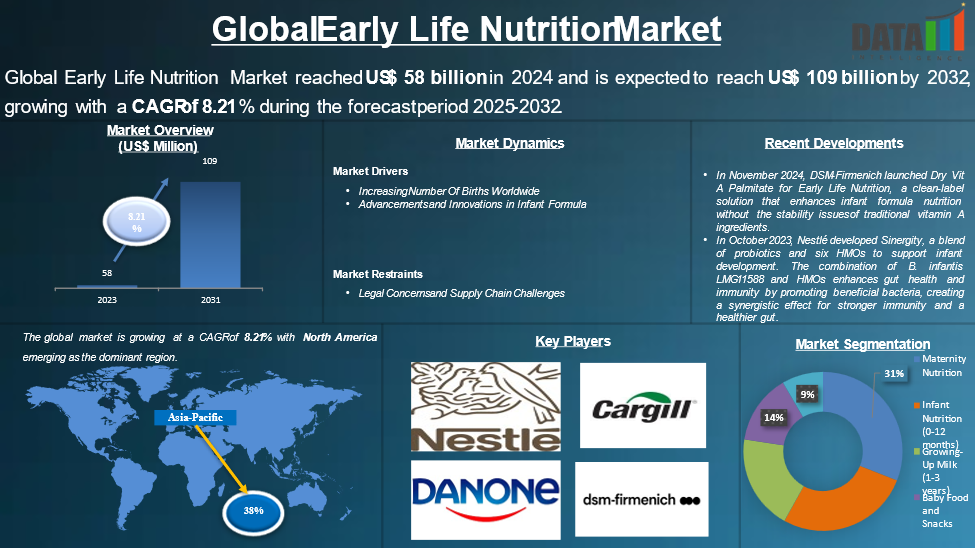
Global Early Life Nutrition Market reached US$ 62.76 Billion in 2025 and is expected to reach US$ 117.95 Billion by 2033, growing with a CAGR of 8.21% during the forecast period 2026-2033.
Factors driving the growth of the early life nutrition market include an increase in the number of working mothers, increased spending on newborn health, and rising demand for organic baby food. The number of young working mothers has grown significantly in recent years. For instance, in the UK, the number of working mothers has reached a record high in recent decades.
Executive Summary
For more details on this report – Request for Sample
Market Scope
| Metrics | Details |
| CAGR | 8.21% |
| Size Available for Years | 2025-2033 |
| Forecast Period | 2026-2033 |
| Data Availability | Value (US$) |
| Segments Covered | Product, Form, Distribution Channel and Region |
| Regions Covered | North America, Europe, Asia-Pacific, South America and Middle East & Africa |
| Fastest Growing Region | North America |
| Largest Region | Asia-Pacific |
| Report Insights Covered | Competitive Landscape Analysis, Company Profile Analysis, Market Size, Share, Growth, Demand, Recent Developments, Mergers and Acquisitions, New Product Launches, Growth Strategies, Revenue Analysis, Porter’s Analysis, Pricing Analysis, Regulatory Analysis, Supply-Chain Analysis and Other key Insights. |
Market Dynamics
The early life nutrition market is experiencing strong growth, driven by increasing awareness of infant and toddler health, along with rising demand for scientifically formulated nutritional products. Parents are increasingly prioritizing proper nutrition during the first years of life to support cognitive development, immunity, and overall growth. Products such as infant formula, follow-on milk, baby cereals, and nutritional supplements are widely adopted, particularly in urban areas with higher disposable incomes. Additionally, factors such as rising birth rates in emerging economies, an increasing number of working mothers, and greater access to pediatric healthcare guidance are further supporting market expansion.
Key market trends highlight a strong shift toward premium, organic, and specialized nutrition solutions. Manufacturers are focusing on formulations enriched with probiotics, prebiotics, DHA, and essential vitamins to closely mimic the nutritional profile of breast milk and support infant development. The growing demand for clean-label, allergen-free, and plant-based products is also shaping innovation in the market. Furthermore, advancements in nutritional science and personalized nutrition approaches are gaining traction, alongside the expansion of e-commerce and direct-to-consumer channels. However, the market faces challenges such as stringent regulatory requirements, high product costs, and increasing scrutiny over marketing practices. Even with these limitations, the early life nutrition market is expected to grow in the long term because of ongoing product innovation, growing health awareness, and better access to good nutrition.
Market Segment Analysis
We segment the global early life nutrition market based on product, form, distribution channel, and region.
Awareness of Early Childhood Nutrition And Advancements in Technology
The rising demand for specialized formulas & products, awareness of early childhood nutrition, and advancements in technology are driving the infant nutrition segment as a leading factor in the early life nutrition market. E-commerce platforms provide parents with a broad selection of infant nutrition products, encompassing diverse brands, formulations, and specialized items. From the comfort of their homes, parents can conveniently explore various options to find products tailored to their child's specific needs.
Moreover, key players’ strategies, such as partnerships, collaborations, and innovative product launches, would propel this segment’s growth. For instance, in April 2024, Lallemand Health Solutions and DSM-Firmenich announced a collaboration to create new synergistic synbiotic solutions that combine human milk oligosaccharides (HMOs) and probiotics, specifically targeting early-life nutrition.
Major Global Players
The major global players in the market include Cargill, Incorporated; Nestlé S.A.; Danone S.A.; Abbott Laboratories; Mead Johnson Nutrition (Reckitt Benckiser Group); Arla Foods; Perrigo Company plc; Hipp GmbH & Co. Vertrieb KG; Else Nutrition USA Inc.; and Kabrita.
Consumer Analysis
Parents are highly focused on product safety and quality, expecting brands to comply with global health regulations like FDA, EFSA and ISO standards. Certifications from reputable organizations such as USDA Organic or Non-GMO Project are crucial for parents seeking high-quality products. These certifications not only assure safety but also align with parents’ preferences for products that support their values, such as organic or non-GMO ingredients.
Additionally, parents trust brands that partner with healthcare professionals, such as doctors and dietitians. Expert-backed educational content, including product instructions and nutritional information, helps build trust and loyalty. Moreover, there is a growing demand for customizable products that cater to specific dietary needs, such as age, health conditions or allergies, as parents seek tailored nutrition solutions for their children.
Early Stage Innovations
Early stage innovations in infant nutrition include personalized nutrition tailored to individual needs, plant-based proteins for alternative dietary options, sustainable packaging to reduce environmental impact, enhanced iron bioavailability for better absorption and using HMOs to replicate breast milk's immune and gut health benefits. HMOs are complex carbohydrates found in breast milk that support immune development and gut health by promoting beneficial bacteria. Their inclusion in infant formula aims to more closely replicate the nutritional profile of breast milk.
Recent Developments
In March 2026, Nestlé S.A. expanded its infant formula and nutrition portfolio across the Asia Pacific, driven by rising demand for scientifically formulated early life nutrition products.
In February 2026, Danone S.A. strengthened its specialized nutrition segment in Europe and North America, focusing on advanced pediatric and toddler nutrition solutions.
In January 2026, Abbott Laboratories increased innovation in pediatric nutrition products across North America, supported by growing awareness of early childhood health and development.
Targeting high-growth emerging markets, Reckitt Benckiser Group increased the range of formula milk products it offered in Asia and Latin America in November 2025.
In October 2025, Arla Foods focused on organic nutrition solutions in Europe, aligning with increasing demand for clean-label and natural infant products.
In September 2025, HiPP GmbH & Co. enhanced its baby food portfolio across Europe, emphasizing sustainable sourcing and high-quality early-life nutrition products.
Why Purchase the Report?
- To visualize the global early life nutrition market segmentation based on product, form, function, application, distribution channel and region, as well as understand key commercial assets and players.
- Identify commercial opportunities by analyzing trends and co-development.
- Excel data sheet with numerous data points of the early life nutrition market with all segments.
- PDF report consists of a comprehensive analysis after exhaustive qualitative interviews and an in-depth study.
- Product mapping available as excel consisting of key products of all the major players.
The global early life nutrition market report would provide approximately 62 tables, 56 figures and 201 pages.
Target Audience 2026
- Manufacturers/ Buyers
- Industry Investors/Investment Bankers
- Research Professionals
- Emerging Companies



























































