


Autogenous Vaccines Market Size& Industry Outlook
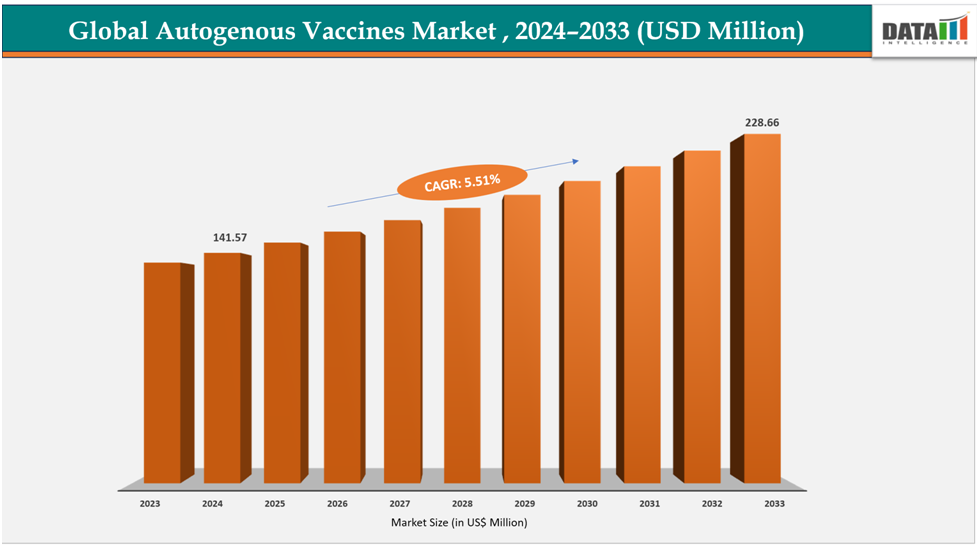
The global autogenous vaccines market size reached US$ 134.74Million with a rise of US$141.57Million in 2024 and is expected to reach US$ 228.66Million by 2033, growing at a CAGR of 5.51%during the forecast period 2025-2033.
The market for autogenous vaccines is expanding gradually due to the need for specialized solutions in the field of animal medicine. These vaccines effectively prevent sickness because they are designed to target particular pathogens that are common in particular farms or geographical areas. The use of vaccinations as a safer substitute for animals has grown as worries about antibiotic resistance have grown. The efficiency of vaccine development has increased due to technological developments in pathogen identification and diagnosis.
For instance, AviPro Autogenous Vaccine is a vaccination designed specifically for chickens raised on a particular farm using a strain of Salmonella that was isolated from the flock there. Unlike commercial vaccinations that cover broader strains, it offers tailored protection against the disease because it is created from the particular pathogen infecting the animals on that farm.
Key Takeaways
- North America dominates the autogenous vaccines market with the largest revenue share of 43.5% in 2024.
- The Asia Pacific is the fastest-growing region and is expected to grow at the fastest CAGR of7.1% over the forecast period.
- Based on pathogen source, the bacterial vaccines segment led the market with the largest revenue share of 56.3% in 2024.
- Top companies in the autogenous vaccines market include Merck & Co., Inc., Vaxxinova International BV, Bimeda Biologicals, HYGIEIA BIOLOGICAL LABORATORIES, Phibro Animal Health Corporation, ACE Laboratory Services, Elanco, Cambridge Technologies, and Dophavacc, among others.
Market Scope
| Metrics | Details | |
| CAGR | 5.51% | |
| Market Size Available for Years | 2022-2033 | |
| Estimation Forecast Period | 2025-2033 | |
| Revenue Units | Value (US$ Mn) | |
| Segments Covered | Pathogen Source | Bacterial Vaccines, Viral Vaccines |
| Animal Type | Livestock, Poultry, Aquaculture, Companion Animals, Swine and Others | |
| End User | Veterinary Clinics & Hospitals, Livestock Farms, Aquaculture Farms, Poultry Farms | |
| Regions Covered | North America, Europe, Asia-Pacific, South America and the Middle East & Africa | |
Market Dynamics
Drivers: Emerging/localized pathogens &diseases are significantly driving the autogenous vaccines market growth
The global market for autogenous vaccines is largely driven by emerging and localized infections because commercial vaccinations frequently do not cover unusual or region-specific strains. In intensive poultry, swine, or aquaculture farms, outbreaks brought on by distinct variants can spread quickly and result in significant productivity and financial losses. Directly derived from isolates particular to a farm, autogenous vaccines offer quick, strain-matched protection to stop these outbreaks. They also lessen the need for antibiotics, which is in line with antimicrobial resistance regulations, and provide specialized disease control that is adapted to local difficulties and agricultural requirements.
For instance, Vaxxinova's E. coli SRP vaccine uses autogenous bacterial extracts to prevent poultry from contracting E. coli peritonitis. It provides wide protection by focusing on conserved surface proteins (SRPs) found in different strains of E. coli, which lowers mortality and increases egg production. It is prepared in accordance with USDA rules and customized for each operation.
Restraints: Regulatory complexity and variation are hampering the growth of the autogenous vaccines market
The market for autogenous vaccines is hampered by regulatory complexity and variation, which result in uneven approval requirements throughout nations and postpone market access. Long approval processes make it more difficult to react swiftly to epidemics, and specialist facilities' high production costs restrict accessibility. When taken as a whole, these factors limit market expansion and the successful implementation of customized vaccines for animal health.
For instance, farm-specific E. coli vaccines in poultry. Every vaccination needs to be created using strains that were directly isolated from the afflicted flock and authorized by regional regulatory bodies. Disease management may be hampered in areas with stringent or inconsistent rules because approval may be delayed, production costs may increase, and smaller poultry farms may find it difficult to obtain the vaccine in a timely manner.
Segmentation Analysis
The global autogenous vaccines market is segmented based on pathogen source, animal type, end user, and region.
Pathogen Source:
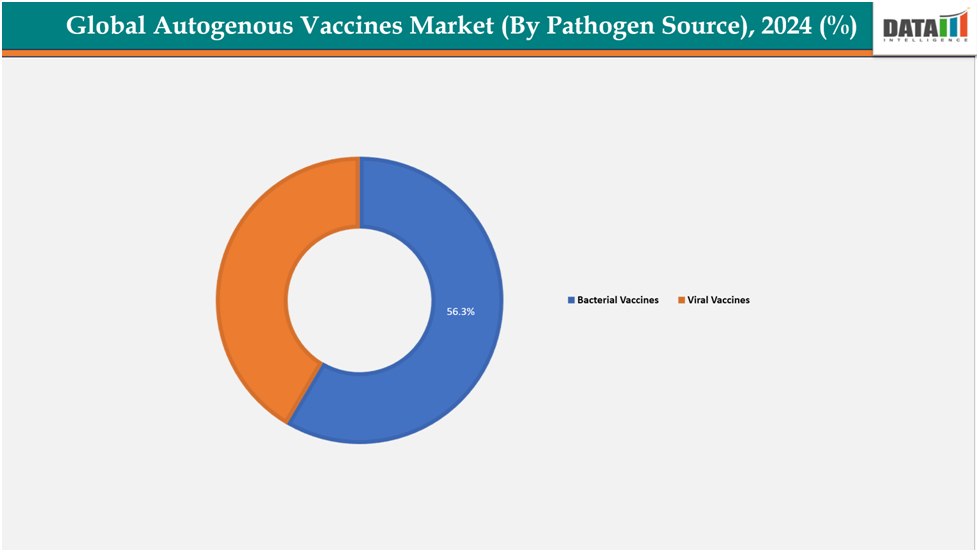
The bacterial vaccines from pathogen source segment is dominating the autogenous vaccines market with a 56.3% share in 2024
The market for autogenous vaccines is being dominated by bacterial vaccines from the pathogen source sector because bacterial illnesses in poultry and livestock, including Salmonella, Clostridium, and E. coli, are common and frequently farm-specific. In order to provide specific, targeted protection, autogenous bacterial vaccines are made from pathogens that have been directly isolated from impacted farms. In addition to being more affordable and easier to produce than viral vaccines, they also have less complicated regulatory restrictions, which allows for a quicker response to outbreaks and broader use in animal health management.
For instance, in June 2025, Dophavacc is an autogenous bacterial vaccine. These swine-specific vaccinations, which are made by Dophavacc, are designed to prevent illnesses like pleuropneumonia, meningitis, and newborn diarrhea.
Animal Type: The live stock segment is estimated to have a 31.1% of the autogenous vaccines market share in 2024
The livestock segment, which mostly consists of cattle, sheep, and goats, controls the global markets for autogenous vaccinations as well as animal health. High food production demand, growing meat consumption, and the necessity for biosecurity and disease protection in huge herds are the main factors driving its leadership. Autogenous vaccines are crucial for preventing farm-specific illnesses including Salmonella, Clostridium, and E. coli. They offer tailored protection, enable prompt outbreak response, and protect the financial gains from the production of meat, milk, and wool.
Geographical Analysis
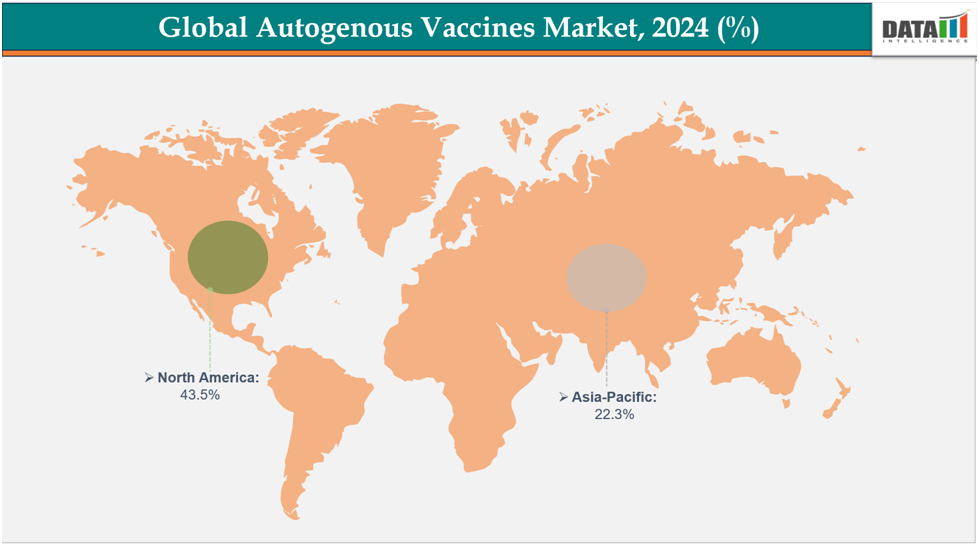
North America is expected to dominate the global autogenous vaccines market with a 43.5% in 2024.
North America's sophisticated and intensive swine, poultry, and animal farming sectors are predicted to drive the global demand for autogenous vaccines. The region's large farms are more vulnerable to bacterial and viral outbreaks that are peculiar to their farms, which increases the need for tailored autogenous vaccinations that offer precise protection and quick reaction. Strong regulatory frameworks, the broad use of contemporary veterinary procedures, and the existence of significant vaccine producers like Vaxxinova, Elanco, and Ceva further facilitate the efficient and convenient delivery of autogenous vaccines. Farmers are further encouraged to engage in disease prevention due to the economic significance of producing animal protein, which strengthens North America's position as the market leader.
The market for autogenous vaccines is anticipated to be led by the United States because of its extensive cattle, poultry, and swine farming, which frequently results in farm-specific bacterial and viral illnesses such Salmonella, Clostridium, and E. coli. Market developments for autogenous vaccines underscore important developments in the aquaculture and terrestrial animal health domains.
In December 2024, an experimental autogenous vaccine against avian metapneumovirus (aMPV) type B was administered to more than 6 million fowl in the United States. This project, which was created by Cambridge Technologies and Merck Animal Health, highlights the increasing need on customized vaccines for quick disease management in chicken production.
Europe is the second region after North America which is expected to dominate the global autogenous vaccines market with a 34.5% in 2024.
The global market for autogenous vaccines is expanding rapidly in Europe, which is dominated by nations like Germany, the UK, and France. High adoption rates of farm-specific autogenous vaccinations, established veterinary services, and sophisticated livestock, poultry, and swine farming businesses are important drivers. Demand for specialized vaccinations is further increased throughout the region by regulatory support and directives from agencies such as the European Medicines Agency (EMA), which place an emphasis on biosecurity, disease prevention, and quick outbreak control.
Germany's sophisticated cattle and poultry sectors, where bacterial and viral illnesses particular to farms are common, are the main drivers of this rise. The adoption of customized autogenous vaccines is further encouraged by the nation's strict regulatory structure, which places a strong emphasis on biosecurity and the prevention of antibiotic resistance. In Germany, the Federal Office of Consumer Protection and Food Safety (BVL) also carry out a number of initiatives and regulatory actions pertaining to autogenous vaccinations.
For instance, In Germany, the Streptococcus suis autogenous vaccine targets bacterial strains that cause meningitis, septicemia, and respiratory illnesses in pigs that are particular to farms. Produced under BVL supervision, it guarantees quality and safety while offering specialized protection to contain epidemics and reduce financial losses.
The Asia Pacific region is the fastest-growing region in the global autogenous vaccines market, with a CAGR of 7.1% in 2024.
The market for autogenous vaccines is expanding significantly in the Asia-Pacific area, which includes nations like China, India, Japan, and South Korea. This is because farm-specific bacterial and viral illnesses are becoming more common, and cattle, poultry, and swine production is expanding quickly. Adoption of vaccines is fueled in Japan by government-sponsored biosecurity programs and sophisticated veterinary procedures. Growing awareness of animal health management and better veterinary infrastructure are driving greater demand for targeted vaccines in China and India to control disease outbreaks.
Since China's extensive cattle, poultry, and swine sectors are vulnerable to farm-specific bacterial and viral outbreaks including E. coli, Salmonella, and avian influenza, the country's autogenous vaccines market is expanding significantly. Increased understanding of biosecurity controls, better veterinary infrastructure, and growing demand for animal protein are all factors propelling adoption.
Competitive Landscape
Top companies in the autogenous vaccines market include Merck & Co., Inc.,Vaxxinova International BV, Bimeda Biologicals, HYGIEIA BIOLOGICAL LABORATORIES, Bimeda, Phibro Animal Health Corporation, ACE Laboratory Services, Elanco, Cambridge Technologies, and Dophavacc, among others.
Merck & Co., Inc.: Merck & Co., Inc. (MSD Animal Health) is a global leader in animal health, offering vaccines, pharmaceuticals, and services to veterinarians, farmers, and pet owners. It excels in autogenous vaccines, partnering with Cambridge Technologies to provide farm-specific poultry vaccines. The company invests heavily in manufacturing and R&D, including an $895 million facility expansion in Kansas, reinforcing its leadership in innovative animal health solutions worldwide.
Key Developments:
- In August 2024, Merck Animal Health, a division of Merck & Co., Inc, announced that the USDA has approved the manufacturing and sale of Cambridge Technology’s experimental autogenous vaccine in the U.S. for the emerging and deadly avian metapneumovirus type B, impacting broilers, broiler breeders, layers, and turkey breeders.
The global autogenous vaccines market report delivers a detailed analysis with 62 key tables, more than 57visually impactful figures, and 159 pages of expert insights, providing a complete view of the market landscape.
Suggestions for Related Report
For more veterinary health related reports, please click here




























































