


Animal Health Market Size & Industry Outlook
The global animal health market size reached US$ 67.39 billion in 2025 and is expected to reach US$ 138.90 billion by 2035, growing at a CAGR of 7.5% during the forecast period 2026-2035.
The animal health market is experiencing strong growth due to rising pet ownership and the increasing humanization of pets, which drives demand for preventive care, diagnostics, vaccines, and advanced treatments. The market for companion animal products is strong because pet owners are prepared to make investments to ensure the longevity and well-being of their animals. The need for vaccinations, biologics, and treatments to prevent disease and sustain productivity has increased as a result of the expansion of livestock production brought about by the rising demand for animal-protein foods such as fish, chicken, cattle, and pig on a worldwide scale. The global market for animal health is growing as a result of these combined dynamics.
Animal Health Market Key Takeaways
- The global animal health market is valued at US$ 67.39 billion in 2025 and is projected to reach US$ 138.90 billion by 2035, based on recalculation using the source CAGR of 7.5%.
- North America accounted for 43.5% of the market in 2025, supported by established veterinary infrastructure, substantial livestock populations, companion animal spending, and technology adoption.
- Asia-Pacific is identified as the fastest-growing region, with the source reporting a 7.4% growth rate, supported by expanding livestock production, improving veterinary infrastructure, and increasing awareness of preventive animal healthcare.
- Biologics held a 30.3% share in 2025, reflecting the commercial importance of vaccines and other preventive solutions.
- Production animals represented 60.3% of the market in 2025, demonstrating the scale of demand generated by poultry, swine, cattle, sheep, goats, and fish.
- Disease prevention is becoming a procurement priority as avian influenza, swine fever, rabies, mastitis, and other animal diseases create risks for productivity and public health.
- High prices for advanced vaccines, biologics, diagnostics, specialist treatments, and emerging monitoring technologies remain a material constraint, particularly for small-scale farmers and price-sensitive markets.
Animal Health Market Scope
| Metric | Details |
| Market Size, 2025 | US$ 67.39 billion |
| Market Size, 2035 | US$ 138.90 billion |
| CAGR | 7.50% |
| Historic Years | 2023-2024 |
| Base Year | 2025 |
| Forecast Period | 2026-2035 |
| Segments Covered | Animal Type, Product Type, Distribution Channel, Region |
| Animal Types | Production Animals, Companion Animals |
| Product Types | Biologics, Pharmaceuticals, Feed Additives, Diagnostics, Supplements and Others |
| Distribution Channels | Hospital, E-Commerce, Retail and Others |
| Regions Covered | North America, Europe, Asia-Pacific, South America, Middle East & Africa |
| Leading Region | North America |
| Fastest-Growing Region | Asia-Pacific |
Animal Health Market Dynamics
Drivers: The prevalence of zoonotic and chronic animal diseases is significantly driving the animal health market growth
The rising prevalence of zoonotic and chronic animal diseases is significantly driving the animal health market. Outbreaks of avian influenza, swine fever, rabies, mastitis, and other infectious and chronic conditions pose serious threats to livestock productivity and public health. This promotes the use of vaccines, treatments, and preventative healthcare practices, such as routine diagnostics, herd management, and biosecurity initiatives, by farmers and veterinarians. Through immunization campaigns and regulatory actions, governments also aid in the management of illness. As a result, rising disease burdens drive demand for veterinary care, feed additives, biologics, and improved diagnostics, spurring innovation and expansion in the global animal health industry.
For instance, according to the CDC, since January 2022, more than 17,000 HPAI A(H5N1) outbreaks have been reported across 80 countries, affecting wild birds, poultry, and mammals. In the United States, between January 2022 and December 2023, over 8,500 wild birds and more than 1,000 commercial and backyard flocks were infected, impacting approximately 77.9 million birds across 47 states.
Restraints: High cost of products and veterinary treatments are hampering the growth of the animal health market
The high cost of animal health products and veterinary treatments is restraining market growth. The high cost of advanced vaccines, biologics, and specialist medications, as well as diagnostic procedures and expert veterinary care, frequently restricts access, particularly in developing nations. Product uptake may be lowered by low-income pet owners and small-scale farmers who choose less expensive alternatives or forgo preventive care. Innovative technologies like cell-cultured feed, novel biologics, and intelligent monitoring systems are also difficult to catch on due to their high costs. Therefore, limiting market penetration, especially in low- and middle-income areas, price sensitivity and affordability obstacles limit the possibility for total growth.
For more details on this report, see Request for Sample
Animal Health Market Segmentation Analysis
The global animal health market is segmented based on animal type, product type, distribution channel, region
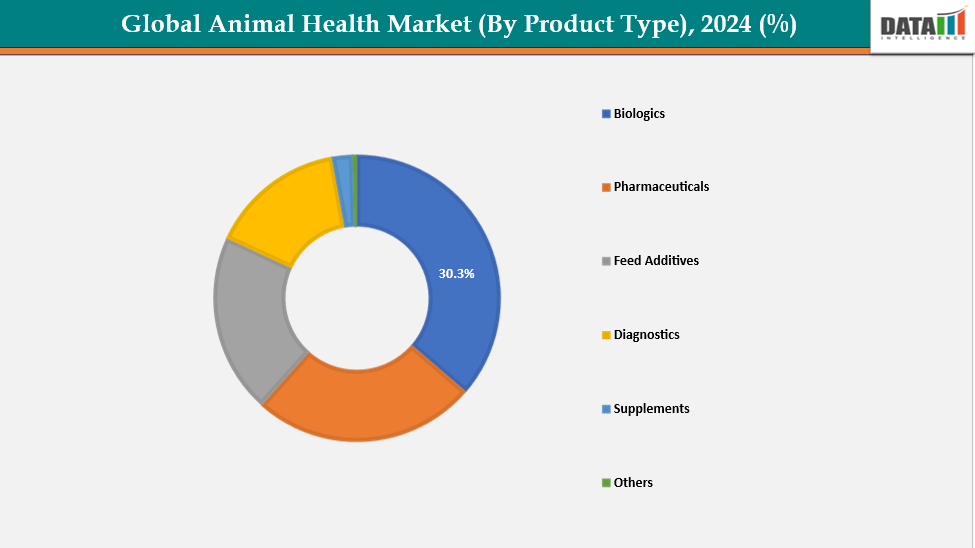
By Product Type:The biologics segment from product type is dominating the animal health market with a 30.3% share in 2025
The biologics segment, including vaccines such as attenuated, inactivated, autogenous, and other types of vaccines, dominates the global animal health market due to its preventive and cost-effective nature. Large populations of fish, cattle, pigs, and poultry are protected against infectious diseases by vaccines, which lower mortality and increase productivity. The focus has switched from medicinal medications to immunization campaigns due to tighter regulations and growing worries about antimicrobial resistance. Recombinant and vector-based vaccinations benefit from technological advancements that improve both immunity and administration simplicity. Programs for mass immunization are cost-effective; they reduce outbreak expenses while maintaining food safety. Because of these considerations, biologics—especially vaccines—are the veterinary health product category that generates the most income globally.
For instance, AviPro Autogenous Vaccine is a vaccination designed specifically for chickens raised on a particular farm using a strain of Salmonella that was isolated from the flock there. Unlike commercial vaccinations that cover broader strains, it offers tailored protection against the disease because it is created from the particular pathogen infecting the animals on that farm.
By Animal Type: The production animal segment from animal type is dominating the animal health market with a 60.3% share in 2025
The production-animal segment, such as poultry, swine, cattle, sheep, goats, and fish, dominates the global animal health market due to its scale and economic importance. Growing worldwide demand for meat, milk, eggs, and seafood requires huge livestock populations. To keep output high and avoid expensive losses, farmers make significant investments in biosecurity, diagnostics, vaccines, and anti-parasites. In addition to being more economical than treatment, preventive care supports laws that reduce antibiotic residues while yet satisfying consumer demands for safe food. While pigs and cattle produce substantial profits from pork, meat, and dairy, poultry leads by volume due to its quick production cycles. The fastest-growing subsegment is aquaculture, while sheep and goats continue to hold a considerable regional market share, supporting the dominance of producing animals.
For instance, according to a February 2025 analysis from Our World in Data and the Sentience Institute, the United States had already confined an estimated 9.2 billion chickens, about 260 million turkeys, roughly 73 million pigs, and around 380 million egg-laying hens in factory-farming systems.
Animal Health Market Geographical Analysis
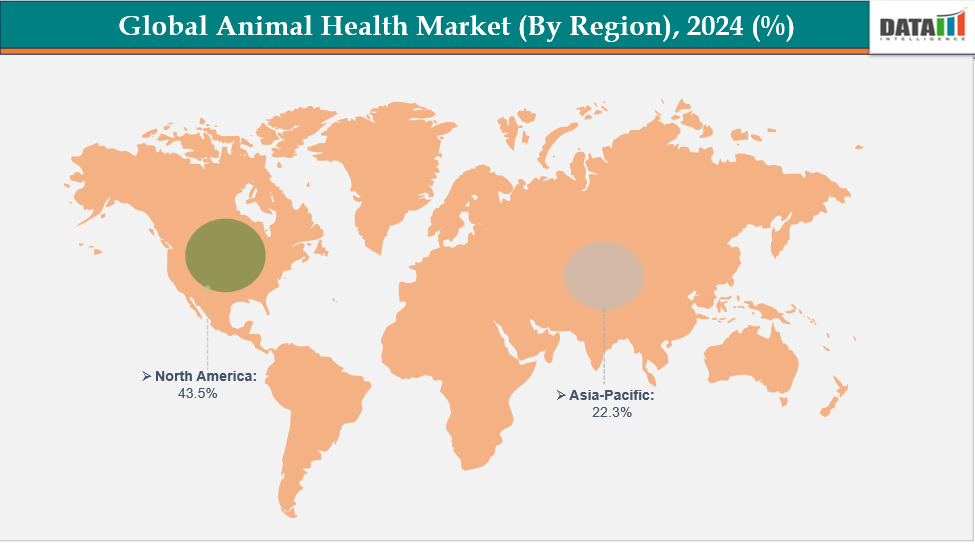
North America is expected to dominate the global animal health market with a 43.5% in 2024
North America is expected to dominate the global animal health market due to its large livestock and companion-animal populations, which drive high demand for vaccines, biologics, and pharmaceuticals. The region benefits from advanced veterinary infrastructure, strong research and development, and rapid adoption of innovative technologies, including diagnostics and therapeutics. Additionally, high disposable incomes and increasing pet ownership fuel spending on companion animal health.
The U.S. animal health market is expected to dominate due to its large livestock and companion animal populations, which create strong demand for vaccines, biologics, and pharmaceuticals. The country benefits from advanced veterinary infrastructure, significant investment in research and development, and rapid adoption of innovative technologies, including diagnostics, therapeutics, and preventive solutions.
Owing to factors like large livestock and companion-animal populations, for instance, according to the U.S. Department of Agriculture’s National Agricultural Statistics Service (NASS), as of July 1, 2025, the United States had a total cattle and calf inventory of 94.2 million head. Of these, 38.1 million were cows and heifers that had calved, including 28.7 million beef cows and 9.45 million milk cows. The U.S. calf crop was estimated at 33.1 million head, while 13.0 million cattle were on feed for beef production. These figures reflect the scale of the U.S. cattle industry and its substantial contribution to both beef and dairy production.
Europe is the second region after North America which is expected to dominate the global animal health market with a 34.5% in 2025
The global animal health market is expanding rapidly in Europe, led by countries such as Germany, the UK, and France. High adoption of farm-specific vaccines, well-established veterinary services, and advanced livestock, poultry, and swine farming operations are key growth drivers. Regulatory support and guidance from agencies like the European Medicines Agency (EMA) further boost demand, emphasizing biosecurity, disease prevention, and rapid outbreak control.
Germany’s advanced cattle and poultry industries, where farm-specific bacterial and viral diseases are prevalent, are driving growth in the animal health market. The adoption of customized vaccines and biologics is further supported by strict regulations emphasizing biosecurity and the prevention of antibiotic resistance. The Federal Office of Consumer Protection and Food Safety (BVL) implement various initiatives and regulatory measures for autogenous vaccinations, reinforcing Germany’s leadership in preventive animal health solutions.
Owing to factors such as strong regulatory support for approvals, HIPRA launched ICHTIOVAC ERM in April 2025, its first inactivated vaccine for Atlantic salmon against Yersiniosis, designed for immersion administration during the freshwater phase. The launch event, held in Castell de Peralada (Girona), gathered key representatives from the European salmon industry to highlight the vaccine’s role in combating the disease and advancing aquaculture health management.
The Asia Pacific region is the fastest-growing region in the global animal health market, with a CAGR of 7.4% in 2025.
The animal health market in the Asia-Pacific region, including countries such as China, India, Japan, and South Korea, is expanding rapidly. Growth is driven by the increasing prevalence of farm-specific bacterial and viral diseases alongside the rapid expansion of cattle, poultry, and swine production. In Japan, adoption is supported by government-backed biosecurity programs and advanced veterinary practices. In China and India, rising awareness of animal health management and improvements in veterinary infrastructure are boosting demand for targeted vaccines, diagnostics, and therapeutics to prevent disease outbreaks and ensure productivity in livestock and poultry sectors.
China’s animal health market has been expanding significantly due to its large cattle, poultry, and swine sectors, which are vulnerable to farm-specific bacterial and viral diseases such as E. coli, Salmonella, and avian influenza. Growing awareness of biosecurity measures, improvements in veterinary infrastructure, poultry health, and rising demand for animal protein have driven increased adoption of animal health products.
For instance, on July 18, 2024, China’s Ministry of Agriculture approved Pyrroloquinoline Quinone Disodium, produced using the FINU-R8 strain of Pseudomonas desmolyticum. Applied for by Guangdong Wens Dahuanong Biotechnology Co., Ltd., the product enhances antioxidant capacity in animals and is intended for use in broilers.
Animal Health Market Competitive Landscape
Top companies in the animal health market include Zoetis, Boehringer Ingelheim International GmbH, Elanco, Merck & Co., Ceva, Virbac, Vetoquinol, Dechra, Phibro Animal Health Corporation, and Bimeda US, among others.
Zoetis: Zoetis Inc., headquartered in New Jersey, is the world’s leading animal health company, specializing in vaccines, medicines, diagnostics, and precision health technologies for livestock and companion animals. Founded in 1952 and independent since 2013, it operates in over 100 countries, generating $9.3 billion in revenue in 2024, driven by innovation and global presence.
Animal Health Market Key Developments
August 2026: In North America, animal-health companies increasingly focused on preventive care, diagnostics, and companion-animal therapeutics. Zoetis lowered its annual outlook after weaker U.S. pet-health demand and increased competition affected second-quarter performance.
July 2026: In Europe, veterinary healthcare continued emphasizing preventive medicine, regulatory modernization, and advanced therapeutics. Zoetis, Boehringer Ingelheim Animal Health, MSD Animal Health, Elanco, and Ceva Santé Animale remained key companies in the region.
June 2026: In Asia-Pacific, animal-health adoption continued expanding alongside rising pet ownership, livestock production, and veterinary-care access. Zoetis remained a leading player in regional parasiticide and preventive-health solutions.
May 2026: Boehringer Ingelheim advanced livestock health innovation with Lenzelta, a vaccine designed to help prevent mastitis in dairy cattle, highlighting continued development of preventive solutions for production animals.
April 2026: Globally, the industry increasingly focused on AI, veterinary diagnostics, preventive healthcare, companion-animal medicine, 6, and digital veterinary services, with companies such as Zoetis, Elanco, Merck Animal Health, Boehringer Ingelheim, and Bayer strengthening their portfolios.
The Global Animal Health Market report delivers a detailed analysis with 62 key tables, more than 57 visually impactful figures, and 159 pages of expert insights, providing a complete view of the market landscape.
Target Audience
The report is relevant to:
- Animal health pharmaceutical and biologics manufacturers
- Veterinary vaccine developers
- Veterinary diagnostic companies
- Companion animal healthcare providers
- Livestock and aquaculture companies
- Feed additive and animal nutrition companies
- Veterinary hospitals and healthcare networks
- Animal health distributors and retailers
- E-commerce animal health platforms
- Investors and private equity firms
- Procurement and sourcing teams
- Corporate strategy and business development teams
- Veterinary technology companies
- Government and animal disease-control organizations
- Research and product development teams
Animal Health Market Outlook to 2035
The animal health industry has a strong commercial foundation because its products address two economically important priorities: protecting companion animal well-being and maintaining the productivity of animals entering the food supply. With the market estimated at US$ 67.39 billion in 2025 and projected to reach US$ 138.90 billion by 2035 based on the source CAGR, the scale of future demand provides room for pharmaceutical companies, biologics developers, diagnostic providers, veterinary service organizations, and specialized technology suppliers.
The opportunity is not evenly distributed. North America's existing scale and veterinary infrastructure support its leading position, while Asia-Pacific offers a particularly important growth pathway through expanding livestock production and improving animal health systems. Biologics and production-animal solutions remain central to the market, while companion animal care adds a higher-value consumer-driven demand layer.
Through 2035, competitive performance will depend on more than expanding product volumes. Suppliers will need to demonstrate disease-prevention value, manage affordability, navigate regulatory requirements, strengthen distribution, and tailor solutions to specific species and production environments. For business decision-makers, tracking vaccine development, diagnostic adoption, livestock health risks, veterinary infrastructure, companion animal spending, and regional disease-control priorities now can provide a clearer basis for investment and procurement decisions.
Suggestions for Related Report
For more veterinary health-related reports, please click here


























































