


Market Overview
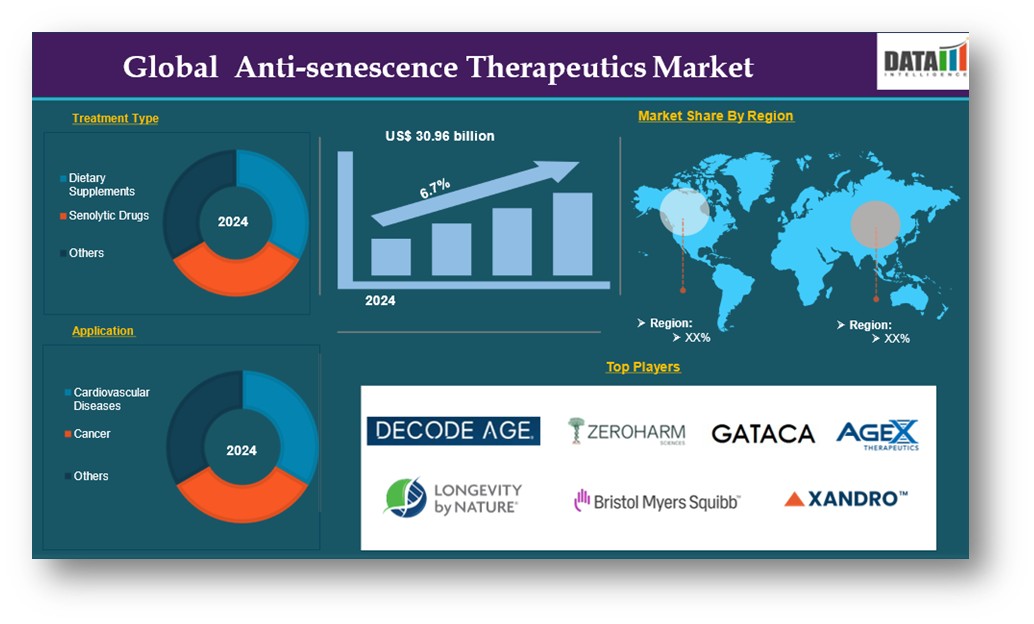
The global anti-senescence therapeutics market reached US$ 33.03 billion in 2025 and is expected to reach US$ 53.39 billion by 2033, growing at a CAGR of 6.7 % during the forecast period 2026-2033.
Anti-senescence therapeutics refer to a category of medical interventions aimed at delaying or reversing the biological processes associated with aging, particularly cellular senescence. Cellular senescence is characterized by the gradual deterioration of cellular function and increased resistance to apoptosis (programmed cell death), which contributes to age-related diseases. The goal of these therapies is to enhance longevity and improve health span the period of life spent in good health by targeting the underlying mechanisms of aging.
Cellular senescence this process is marked by a permanent halt in cell division, often triggered by factors such as DNA damage, oxidative stress, or telomere shortening. Senescent cells can secrete inflammatory factors that disrupt tissue function and promote further aging. These factors have driven the global anti-senescence therapeutics market expansion.
Executive Summary
Market Dynamics: Drivers & Restraints
The anti-senescence therapeutics market is witnessing strong growth driven by the rising global aging population and the increasing burden of age-related chronic diseases such as cardiovascular disorders, neurodegenerative conditions, cancer, and metabolic diseases. As life expectancy increases, there is a growing demand for therapies that not only extend lifespan but also improve healthspan by targeting the root biological mechanisms of aging. Advances in cellular biology, genomics, and regenerative medicine have significantly accelerated the development of innovative therapies such as senolytics, gene therapies, and stem cell-based interventions. Additionally, growing awareness of preventive healthcare and longevity-focused treatments, along with rising investments from pharmaceutical companies and biotech firms, is further fueling market expansion.
A major driver shaping the market is the rapid expansion of the clinical pipeline and technological innovation. Increasing research into cellular senescence mechanisms, along with the integration of artificial intelligence in drug discovery, is enabling faster identification of therapeutic targets and shortening development timelines. The market is also benefiting from the growing adoption of repurposed drugs such as metformin, rapamycin, and NAD+ boosters for managing age-related conditions. Furthermore, rising interest in precision medicine and biomarker-based diagnostics, including epigenetic clocks and proteomic profiling, is supporting more personalized and effective treatment strategies.
However, the market faces notable restraints that limit its growth potential. One of the key challenges is the lack of regulatory clarity and limited product approvals, as many anti-senescence therapies are still in early-stage clinical trials and require extensive safety and efficacy data. The complexity of aging as a biological process makes clinical validation difficult, leading to longer development timelines and higher costs. Additionally, the overlap between wellness products and regulated therapeutics creates ambiguity in regulatory pathways. High treatment costs, limited reimbursement frameworks, and ethical concerns surrounding anti-aging interventions further hinder widespread adoption.
On the opportunity front, the market holds significant potential with the emergence of next-generation therapies and expanding applications across multiple disease areas. The growing focus on senolytic drugs that selectively eliminate senescent cells, along with advancements in gene editing, telomere extension, and cellular reprogramming, is expected to transform the treatment landscape. Increasing government support, rising funding for geroscience research, and expanding clinical trials are creating a favorable environment for innovation. Moreover, the shift toward preventive and personalized healthcare, coupled with rising demand in emerging markets, is expected to unlock new growth avenues and drive long-term market expansion.
For more details on this report – Request for Sample
Segment Analysis
The global anti-senescence therapeutics market is segmented based on treatment type, application, distribution channel, and region.
Treatment Type:
The senolytic drugs segment is expected to dominate the global anti-senescence therapeutics market share
The senolytic drugs segment holds a major portion of the global anti-senescence therapeutics market share and is expected to continue to hold a significant portion of the global anti-senescence therapeutics market share during the forecast period. Senolytic drugs are a category of therapeutic agents designed to specifically target and eliminate senescent cells cells that have stopped dividing but remain metabolically active and contribute to aging and various age-related diseases. By removing these senescent cells, senolytic drugs aim to enhance healthspan and potentially extend lifespan.
Natural senolytics compounds are derived from natural sources like plants. Notable examples include quercetin, fisetin, and curcumin. Due to their availability and perceived safety, natural senolytics are expected to hold a significant portion of the market. These are chemically engineered compounds, such as navitoclax, dasatinib, and FOXO4-DRI. Synthetic senolytics are projected to see considerable growth, driven by advances in biotechnology and pharmaceutical development.
Senolytic drugs may play a role in treating age-related cardiovascular conditions like atherosclerosis and hypertension by reducing the inflammation and vascular stiffening caused by senescent cells in blood vessels. Neurological disorders like Alzheimer's and Parkinson's, linked to the accumulation of senescent cells in the brain and nervous system, may benefit from senolytic therapies.
Osteoarthritis these drugs could be used to manage osteoarthritis by targeting inflammation and tissue degeneration caused by senescent cells in joint tissues. In cancer senolytic drugs may help improve cancer treatments by eliminating therapy-induced senescent cells, which contribute to cancer recurrence and resistance, thus potentially enhancing treatment outcomes and reducing side effects.
Furthermore, key players in the industry innovative launches that would drive this global anti-senescence therapeutics market growth. For instance, in January 2023, Seragon Biosciences, Inc. launched RESTORIN, an advanced nutraceutical designed to promote healthy aging. This product incorporates a variety of patented technologies developed in collaboration with esteemed institutions such as Harvard University, Mayo Clinic, and Scripps Research.
RESTORIN features a unique blend of senolytic agents, NAD+ precursors, and sirtuin-activating compounds (STACs). Senolytics are specialized molecules that target and eliminate senescent cells-those that accelerate aging and contribute to the decline of organ function. NAD+ is a crucial coenzyme that supports cellular energy production, DNA repair, and overall cellular health, serving as the essential fuel for sirtuins, proteins that play a key role in longevity and maintaining cellular vitality. These factors have solidified the segment's position in the global anti-senescence therapeutics market.
Key Developments
February 2026: Increasing focus on cellular aging mechanisms and rising prevalence of age-related diseases accelerated demand for anti-senescence therapeutics across North America and Europe, driven by strong biotech innovation and aging population demographics.
January 2026: Advancements in senolytic and senomorphic therapies gained traction in the United States and United Kingdom, improving research outcomes in targeting senescent cells to delay or reverse biological aging processes.
December 2025: Leading companies such as Unity Biotechnology (United States), AgeX Therapeutics (United States), Calico Life Sciences (United States), and Altos Labs (United States) expanded investments in longevity biotech and cellular rejuvenation platforms.
November 2025: Rising clinical adoption of senolytic drug combinations (such as dasatinib + quercetin) boosted demand across North America and Europe, particularly for applications in neurodegenerative and metabolic diseases.
October 2025: Rapid expansion of longevity research ecosystems in Asia-Pacific, especially in Japan, China, and South Korea, strengthened early-stage clinical trials and academic-industry collaborations in anti-aging therapeutics.
September 2025: Increasing regulatory focus on aging-related indications in the United States and European Union supported a growing pipeline of clinical trials targeting cellular senescence, with more than 100 active programs globally.
August 2025: Expanding investments from venture capital firms and pharmaceutical companies across Europe and North America accelerated R&D in gene therapy, NAD+ modulation, and epigenetic reprogramming approaches.
The market is rapidly evolving toward disease-modifying and cellular rejuvenation therapies, where North America leads in innovation and funding, Europe focuses on translational research and regulatory frameworks, and Asia-Pacific emerges as a fast-growing region driven by expanding biotech ecosystems, aging populations, and increased clinical research activity.
Competitive Landscape
The major global players in the anti-senescence therapeutics market include Decode Age, Zeroharm, Gataca, Longevity By Nature, ProHealth, Inc., Xandro Lab., NanoSPACE, AgeX Therapeutics, Inc., T.A. SCIENCES, Elysium Health, Inc., and Bristol-Myers Squibb Company among others.
| Metrics | Details | |
| CAGR | 6.7% | |
| Market Size Available for Years | 2023-2033 | |
| Estimation Forecast Period | 2026-2033 | |
| Revenue Units | Value (US$ Bn) | |
| Segments Covered | Treatment Type | Dietary Supplements, Senolytic Drugs, Others |
| Application | Cardiovascular Diseases, Cancer, Others | |
| Distribution Channel | Hospital Pharmacies, Retail Pharmacies, Online Pharmacies | |
| Regions Covered | North America, Europe, Asia-Pacific, South America, and Middle East & Africa | |
Why Purchase the Report?
- Pipeline & Innovations: Reviews ongoing clinical trials, and product pipelines, and forecasts upcoming advancements in medical devices and pharmaceuticals.
- Product Performance & Market Positioning: Analyzes product performance, market positioning, and growth potential to optimize strategies.
- Real-World Evidence: Integrates patient feedback and data into product development for improved outcomes.
- Physician Preferences & Health System Impact: Examines healthcare provider behaviors and the impact of health system mergers on adoption strategies.
- Market Updates & Industry Changes: Covers recent regulatory changes, new policies, and emerging technologies.
- Competitive Strategies: Analyzes competitor strategies, market share, and emerging players.
- Pricing & Market Access: Reviews pricing models, reimbursement trends, and market access strategies.
- Market Entry & Expansion: Identifies optimal strategies for entering new markets and partnerships.
- Regional Growth & Investment: Highlights high-growth regions and investment opportunities.
- Supply Chain Optimization: Assesses supply chain risks and distribution strategies for efficient product delivery.
- Sustainability & Regulatory Impact: Focuses on eco-friendly practices and evolving regulations in healthcare.
- Post-market Surveillance: Uses post-market data to enhance product safety and access.
- Pharmacoeconomics & Value-Based Pricing: Analyzes the shift to value-based pricing and data-driven decision-making in R&D.
The global anti-senescence therapeutics market report delivers a detailed analysis with 60+ key tables, more than 50 visually impactful figures, and 176 pages of expert insights, providing a complete view of the market landscape.
Target Audience
- Manufacturers: Pharmaceutical, Medical Device, Biotech Companies, Contract Manufacturers, Distributors, Hospitals.
- Regulatory & Policy: Compliance Officers, Government, Health Economists, Market Access Specialists.
- Technology & Innovation: AI/Robotics Providers, R&D Professionals, Clinical Trial Managers, Pharmacovigilance Experts.
- Investors: Healthcare Investors, Venture Fund Investors, Pharma Marketing & Sales.
- Consulting & Advisory: Healthcare Consultants, Industry Associations, Analysts.
- Supply Chain: Distribution and Supply Chain Managers.
- Consumers & Advocacy: Patients, Advocacy Groups, Insurance Companies.
- Academic & Research: Academic Institutions.



























































