


Global AI Trust, Risk and Security Management (AI TRiSM) Market Size
AI governance has moved from a compliance discussion to a core enterprise risk decision. As generative AI, large language models, automated decision systems and AI-enabled workflows become embedded in finance, healthcare, government, retail, telecom, manufacturing and energy operations, organizations need structured controls to manage model behavior, security exposure, bias, data leakage and regulatory accountability.
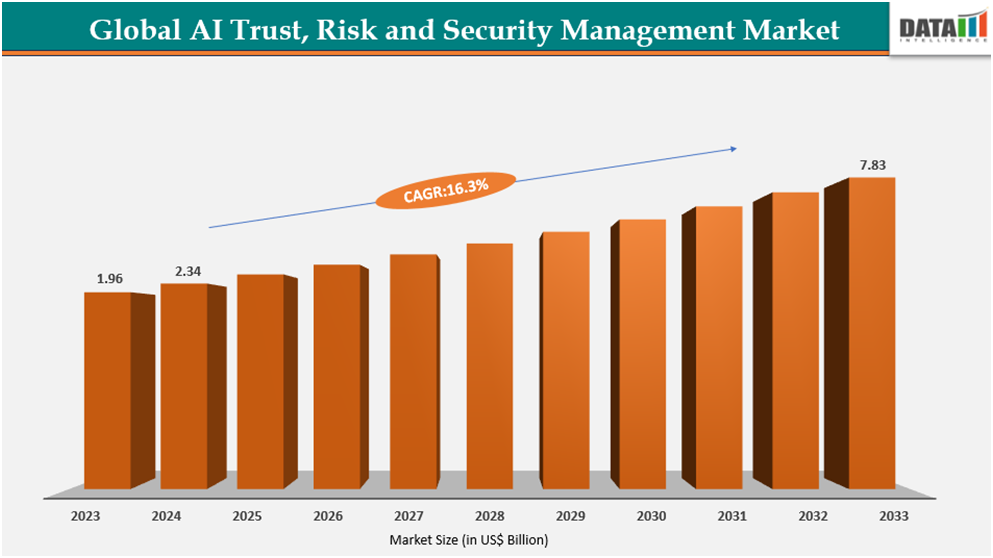
AI Trust, Risk and Security Management (AI TRiSM) Market is valued at US$ 2.72 billion in 2025 and is projected to reach US$ 12.33 billion by 2035, growing at a CAGR of 16.3% during 2026–2035.
This market matters now because enterprises are scaling AI faster than their governance functions were designed to handle. AI TRiSM platforms help organizations monitor model performance, detect bias, manage drift, protect AI systems from adversarial attacks, support explainability, automate compliance workflows and reduce legal and reputational exposure.
AI Trust, Risk and Security Management (AI TRiSM) Market: Key Takeaways
The AI Trust, Risk and Security Management (AI TRiSM) Market Forecast points to a rise from USD 2.72 billion in 2025 to USD 12.33 billion by 2035, showing that AI governance and AI security are becoming recurring enterprise software priorities.
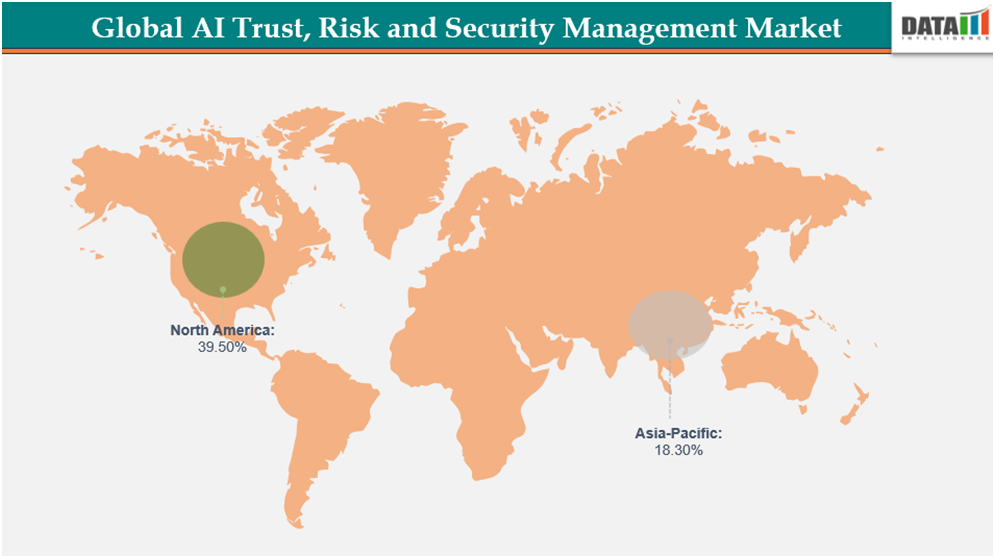
North America leads the AI Trust, Risk and Security Management (AI TRiSM) Market Share due to mature AI adoption, strong cybersecurity spending, regulatory guidance and high enterprise awareness of AI risk.
Asia-Pacific is the fastest-growing region as governments, banks, technology firms and industrial companies increase AI deployment while building formal AI governance structures.
Model monitoring and governance represent the dominant application area because every production AI system requires ongoing performance validation, drift detection and compliance reporting.
Adversarial defense and AI security are expanding quickly as enterprises become more concerned about data poisoning, model inversion, evasion attacks and unauthorized access to AI environments.
Cloud-based AI TRiSM platforms are gaining relevance because enterprises want faster integration with MLOps, DevOps, cloud AI services and governance workflows.
- The market remains moderately fragmented, with cloud providers, cybersecurity companies, enterprise software vendors and specialist AI governance startups competing on automation, compliance coverage and AI-specific security depth.
AI Trust, Risk and Security Management (AI TRiSM) Market Scope
Metric | Details |
| Market Size in 2025 | USD 2.72 billion |
| Market Size by 2035 | USD 12.33 billion |
| CAGR | 16.30% |
| Historic Years | 2023 to 2024 |
| Base Year | 2025 |
| Forecast Period | 2026 to 2035 |
| Segments Covered | Component, Deployment Mode, Application, Vertical and Region |
| Leading Region | North America |
| Fastest Growing Region | Asia-Pacific |
AI Trust, Risk and Security Management (AI TRiSM) Market Dynamics
Enterprise AI Scaling Is Creating a Governance Gap
The expansion of AI across the enterprise value chain is one of the primary forces behind AI Trust, Risk and Security Management (AI TRiSM) Market Growth. AI is no longer limited to experimentation or isolated analytics teams. It is being deployed across credit scoring, fraud detection, medical workflows, customer service automation, supply chain optimization, HR decisioning, manufacturing quality control and public-sector digital services.
This broader deployment increases exposure to model failures, biased outputs, poor explainability, sensitive data leakage and security attacks targeting AI systems. AI TRiSM platforms address these risks by giving organizations a governance layer around model development, deployment and monitoring. Their business value is strongest where AI decisions influence financial outcomes, patient care, customer access, regulatory obligations or operational continuity.
Regulatory Scrutiny Is Turning AI TRiSM Into a License-to-Operate Requirement
The regulatory environment is a central catalyst for AI TRiSM adoption. Frameworks and policies such as the EU AI Act, NIST AI Model Risk Management Framework and the White House Blueprint for an AI Bill of Rights are increasing expectations for transparency, accountability, fairness and risk controls in AI systems.
Enterprises are shifting from informal AI oversight to structured, continuous governance programs. Automated compliance monitoring, audit trails, bias detection, model documentation and explainability tools are becoming essential capabilities for regulated industries. For boards and executive teams, AI TRiSM investment reduces legal exposure, helps prepare for audits and protects brand equity as customers and regulators demand responsible AI behavior.
Generative AI and LLM Deployment Are Raising Security Requirements
The adoption of generative AI and large language models is adding new layers of risk. Enterprises using LLMs for customer support, clinical documentation, code generation, knowledge management, financial workflows and internal productivity tools need controls around prompt security, data exposure, hallucination risk, unauthorized model access and policy enforcement.
AI TRiSM solutions are increasingly being evaluated as part of enterprise AI architecture rather than as standalone compliance tools. Buyers want platforms that integrate into MLOps pipelines, DevOps workflows, cloud environments and existing cybersecurity stacks. This integration requirement is shaping vendor competition and product roadmaps.
Implementation Complexity and Capability Gaps Can Slow Adoption
AI TRiSM requires specialized expertise across AI engineering, cybersecurity, compliance, data governance and business risk. Many organizations lack mature AI inventories, model documentation, risk ownership structures and internal skills to operationalize TRiSM programs.
The cost of implementation can also be challenging. Enterprises must invest in software, services, policy design, data governance, security monitoring and staff training. Smaller organizations may face capability gaps, while large enterprises may struggle with fragmented AI systems across departments and geographies. Vendors that simplify deployment and provide measurable risk-reduction outcomes will be better positioned through 2035.
AI Trust, Risk and Security Management (AI TRiSM) Market Opportunities
For enterprise software and cybersecurity vendors, AI TRiSM presents an opportunity to extend governance and security platforms into AI-specific risk management. Buyers are looking for solutions that combine model observability, bias testing, explainability, compliance reporting and AI security controls within a single operating framework.
Cloud providers have a strong opportunity because many organizations are developing and deploying AI models on cloud infrastructure. Native AI governance tools that support policy enforcement, monitoring, auditability and secure deployment can become part of broader enterprise cloud contracts.
Specialist startups have room to differentiate in model transparency, fairness testing, drift detection, adversarial AI defense and automated governance workflows. Their opportunity is strongest where enterprises need capabilities that are deeper than broad governance platforms.
For investors, the market offers exposure to a software category tied to AI adoption, cybersecurity budgets and regulatory compliance. The most attractive companies are likely to be those that can show measurable ROI through faster compliant AI deployment, fewer model failures, lower audit burden and reduced risk of regulatory penalties.
Economic and Investment Analysis
Macroeconomic demand for AI TRiSM is linked to enterprise AI spending, digital transformation budgets, cybersecurity investment and regulatory compliance requirements. As organizations automate more workflows with AI, the cost of poor governance increases. A failed model, biased decision system, data leakage event or adversarial attack can create financial, legal and reputational consequences.
Investment is flowing into automated AI governance platforms, model risk management, AI security, explainable AI and compliance reporting. Capital expenditure is increasingly shifting toward subscription-based platforms, managed services and integrated cloud governance tools. This supports recurring revenue models for vendors.
ROI depends on reduced compliance effort, faster AI deployment approvals, lower risk of model incidents, stronger audit readiness and better trust in AI outputs. Economic risks include budget scrutiny, tool fragmentation, unclear internal ownership of AI risk and delayed enterprise procurement due to evolving regulations.
AI Trust, Risk and Security Management (AI TRiSM) Market Segmentation Analysis
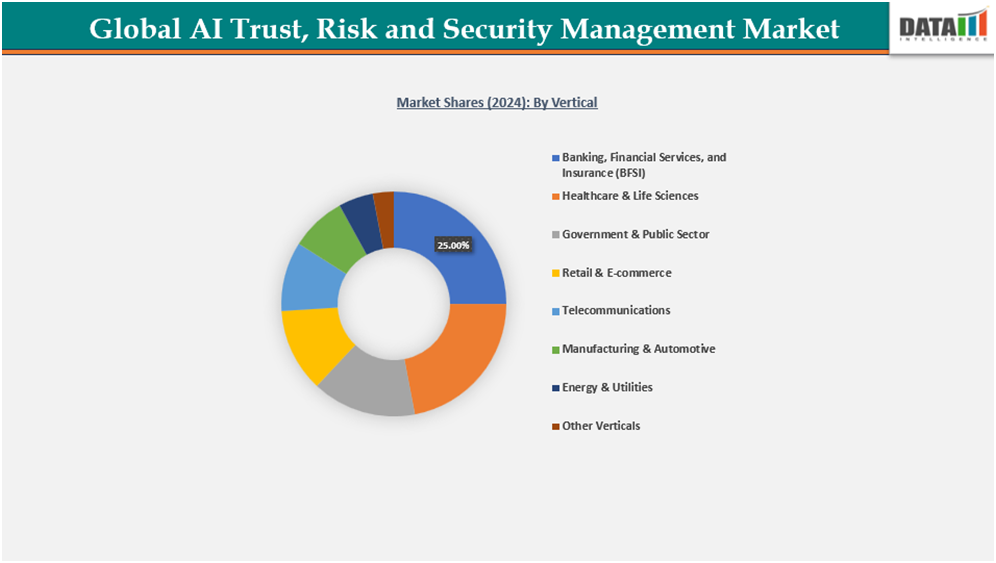
The AI Trust, Risk and Security Management (AI TRiSM) Market Report is segmented by Component (Software/Platforms, Services), by Deployment Mode (Cloud-based, On-premises), by Application (Model Explainability & Interpretability, Bias & Fairness Monitoring, Adversarial Attack Protection, Regulatory Compliance Management, Data Anonymization & Protection, Model Performance & Drift Monitoring), by Vertical (Banking, Financial Services, and Insurance, Healthcare & Life Sciences, Government & Public Sector, Retail & E-commerce, Telecommunications, Manufacturing & Automotive, Energy & Utilities, Other Verticals), and by Region - Share, Trends, and Forecast to 2035.
Component Outlook
Software and platforms form the core of AI TRiSM adoption because enterprises need automated tools for monitoring, policy enforcement, compliance reporting and model lifecycle governance. Services remain important because implementation requires advisory support, governance design, AI risk assessment, model validation and integration into existing technology environments.
The services opportunity is especially relevant for organizations that lack in-house AI governance maturity. Consulting, managed governance, security testing and compliance readiness services can help bridge internal capability gaps.
Deployment Mode Outlook
Cloud-based AI TRiSM solutions are gaining traction because enterprises want scalable platforms that integrate with cloud AI services, data platforms and MLOps environments. Cloud deployment also supports continuous monitoring, centralized governance and faster updates.
On-premises deployment remains relevant for organizations with strict data security, sovereignty or regulatory requirements, particularly in government, defense-adjacent operations, financial services and sensitive healthcare environments. Hybrid deployment models are likely to gain importance as organizations balance flexibility with control.
Application Outlook
Model monitoring and governance is the dominant application area because production AI systems require continuous oversight. This includes model performance tracking, drift detection, compliance reporting and validation against business rules.
Adversarial attack protection is the fastest-growing application area in the source outlook. As attackers target AI models through poisoning, evasion, model inversion and unauthorized access methods, enterprises are increasing investment in AI-specific security controls. This is particularly important for financial services, national security, healthcare and large-scale enterprise AI operations.
Bias and fairness monitoring, explainability, data anonymization and regulatory compliance management are also critical. These capabilities support responsible AI deployment, customer trust and audit readiness.
Vertical Outlook
BFSI is a high-priority vertical because banks, insurers and financial institutions use AI in risk scoring, fraud detection, customer onboarding, claims management and regulatory reporting. AI failures in this sector can create direct financial and compliance exposure.
Healthcare and life sciences require AI TRiSM to support clinical AI reliability, patient data protection, explainability and safety-sensitive decision support. Government and public sector adoption is tied to responsible use of automated decision systems, transparency requirements and citizen trust.
Retail, telecom, manufacturing, automotive, energy and utilities are also adopting AI TRiSM as AI moves into customer experience, predictive maintenance, industrial automation, network operations and asset optimization.
AI Trust, Risk and Security Management (AI TRiSM) Market Geographical Penetration
North America Leads the Global AI TRiSM Market
North America holds the leading position in the AI Trust, Risk and Security Management (AI TRiSM) Market Share. The region benefits from a mature technology ecosystem, strong cybersecurity budgets, high enterprise AI adoption and advanced regulatory guidance from organizations such as NIST.
The United States is the most mature country market. Demand is supported by large-scale enterprise AI deployment, strong BFSI and healthcare adoption, significant use of generative AI and LLMs, and rising litigation and regulatory risk. U.S. enterprises are investing in explainable AI, adversarial attack prevention, compliance automation and AI governance platforms to reduce exposure and accelerate controlled AI adoption.
Canada represents a high-value innovation market. Its AI TRiSM demand is supported by responsible AI policy focus, public-sector interest and a strong research ecosystem. Canadian companies and institutions are placing emphasis on algorithmic bias detection, privacy-preserving AI and governance platforms designed for ethical AI deployment.
Europe AI TRiSM Market: Advances Through Regulatory Pressure and Responsible AI Adoption
Europe’s market is shaped by strict data protection expectations and AI regulation. The EU AI Act is expected to increase demand for transparency, accountability, risk classification, documentation and governance capabilities across organizations deploying AI systems.
European buyers are likely to prioritize platforms that support explainability, audit trails, data protection, model documentation and regulatory compliance. BFSI, healthcare, public sector, telecom and industrial companies are expected to be important adopters. Vendor success in Europe will depend on compliance credibility, regional data governance support and ability to address multi-country regulatory complexity.
Asia-Pacific AI TRiSM Market: Fastest-Growing Market
Asia-Pacific is the fastest-growing regional market, supported by rapid digital transformation, government AI investment, expanding digital economies and rising enterprise AI adoption. The region’s growth is also shaped by evolving regulatory frameworks and the need to build trust in AI-enabled services.
India is one of the most dynamic growth markets. Digital India, a large startup ecosystem, expanding digital finance, healthcare technology adoption and AI use in sectors such as agriculture and public services are creating demand for AI governance, data privacy, model fairness and security controls. Anticipated data protection requirements are likely to accelerate formal AI governance adoption.
China dominates AI activity in the Asia-Pacific region, supported by state-led AI priorities and strong regulation around data security and algorithmic governance. Demand is concentrated in fintech, surveillance-related systems, industrial AI and large-scale digital platforms. Domestic technology firms are investing in compliant AI governance and security solutions for the local market.
Southeast Asia is developing as a growing opportunity due to digital economy expansion, manufacturing modernization and national AI strategy development. The challenge for vendors is navigating diverse regulatory maturity across countries while delivering practical AI risk management solutions.
Country-Level Market Analysis
The United States contributes the strongest country-level demand due to its enterprise AI scale, cybersecurity ecosystem, venture investment and sector-specific regulatory pressure in finance and healthcare. The main barriers include tool fragmentation, internal governance ownership gaps and the need to integrate TRiSM into complex enterprise AI environments.
Canada offers growth through public-sector responsible AI programs, research-led innovation and demand for privacy-focused AI governance. Country-specific opportunities exist in bias detection, privacy-preserving AI and public-sector decisioning systems.
India’s opportunity is tied to rapid AI adoption across financial services, agriculture, healthcare, digital platforms and government-backed digitization. The main barriers include uneven governance maturity, cost sensitivity and evolving regulatory requirements.
China’s market is driven by national AI policy, large technology platforms and algorithm governance requirements. Competitive dynamics are influenced by domestic technology ecosystems and strong policy direction.
In Europe, countries with mature financial services, healthcare digitization and industrial AI deployment are likely to be early adopters. The key barrier is compliance complexity across cross-border operations.
Regulatory and Policy Analysis
AI TRiSM is closely tied to regulatory and policy development. Key frameworks influencing the market include the EU AI Act, NIST AI Risk Management Framework and the White House Blueprint for an AI Bill of Rights. These frameworks are pushing enterprises to improve explainability, fairness, accountability, documentation, auditability and security controls.
Government initiatives around responsible AI are increasing demand for governance platforms that can demonstrate compliance and reduce risk. Environmental, safety and quality standards are also relevant where AI affects healthcare decisions, industrial safety, energy infrastructure, financial inclusion or public services.
Expected regulatory changes will likely increase the need for continuous AI monitoring, model documentation, risk classification and third-party audit readiness. Companies that delay AI TRiSM investment may face higher remediation costs as regulations become more formal and enforcement expectations rise.
AI Trust, Risk and Security Management (AI TRiSM) Market Competitive Landscape
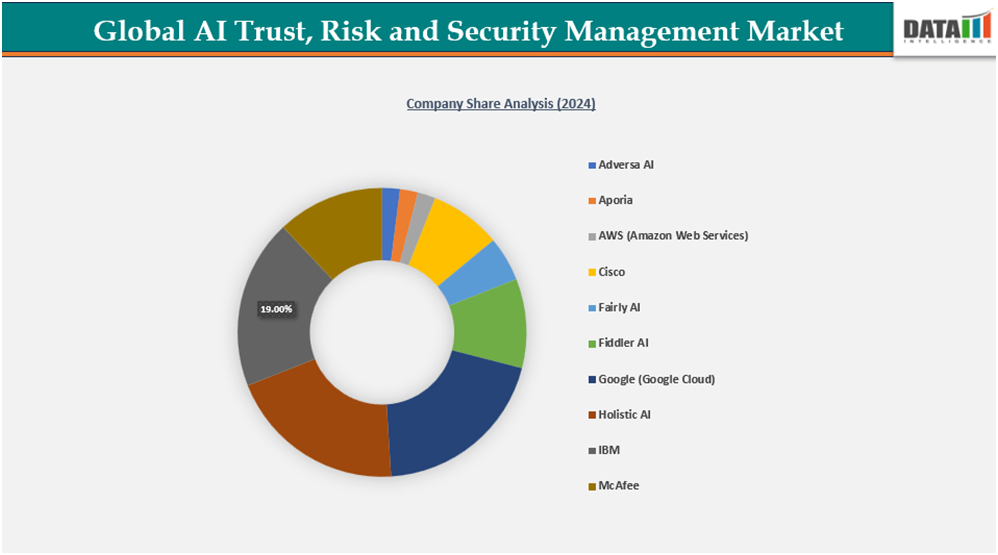
The AI TRiSM market is moderately fragmented, with competition across cloud providers, cybersecurity companies, enterprise technology vendors and specialized startups. Microsoft, Google Cloud and AWS are strengthening their enterprise AI governance platforms through model monitoring, policy enforcement, risk controls and responsible AI deployment capabilities. Their advantage lies in cloud infrastructure, enterprise relationships and native integration with AI development environments.
IBM and Oracle are positioned around AI compliance, explainability, audit solutions, bias detection and lifecycle risk management. Their enterprise software presence gives them relevance among large organizations with complex governance requirements.
Cisco and McAfee are expanding AI cybersecurity protections focused on model attacks, data leakage, adversarial threats and unauthorized access risks. Their opportunity is strongest where AI TRiSM overlaps with enterprise security operations.
Specialist companies such as Fiddler AI, Aporia, Holistic AI, Monitaur, Fairly AI and Adversa AI are competing on model observability, fairness testing, drift detection, transparency and automated governance workflows. These companies are important because enterprises often need deeper AI-specific functionality than traditional governance platforms provide.
Competitive differentiation is increasingly based on automation, integration into developer workflows, regulatory coverage, AI security depth, model explainability and measurable risk reduction. Vendors that can quantify the business value of AI TRiSM through fewer failures, faster approvals and stronger audit readiness will have a stronger commercial position.
Recent Developments in AI Trust, Risk and Security Management (AI TRiSM) Market
- June 2026 – Fiddler AI expands enterprise AI governance platform
Fiddler AI enhanced its AI observability and governance platform by introducing advanced model monitoring, explainability, automated risk detection, and compliance capabilities, helping enterprises manage AI trust, security, and regulatory requirements across production AI systems. - June 2026 – Holistic AI strengthens AI governance and compliance solutions
Holistic AI expanded its AI governance platform with enhanced model risk assessments, regulatory compliance automation, and continuous AI monitoring to support organizations in meeting evolving global AI governance standards. - May 2026 – Aporia advances AI guardrails and model observability
Aporia introduced enhanced AI guardrails, hallucination detection, prompt security, and real-time monitoring capabilities for large language models (LLMs), improving AI reliability, security, and operational governance. - April 2026 – Monitaur enhances responsible AI governance platform
Monitaur expanded its responsible AI platform with improved bias detection, model documentation, audit trails, and automated compliance workflows, enabling organizations to strengthen AI governance and risk management practices. - March 2026 – Fairly AI advances AI compliance automation
Fairly AI enhanced its governance platform by expanding automated AI risk assessments, policy management, and regulatory reporting capabilities to help enterprises operationalize responsible AI and meet emerging compliance requirements. - February 2026 – Adversa AI strengthens adversarial AI security testing
Adversa AI expanded its AI security portfolio with advanced adversarial testing, red teaming, and model vulnerability assessment capabilities, helping organizations identify and mitigate security risks in generative AI and machine learning systems.
Sustainability and Ethical AI Impact
AI TRiSM supports sustainable AI adoption by helping organizations deploy systems that are fair, transparent, secure and accountable. Its positive impact is strongest when it reduces harmful bias, improves explainability and protects users from unsafe or poorly governed AI decisions.
The capability gap is a significant concern. Robust AI TRiSM programs require expertise, investment and operational discipline. Organizations that treat AI ethics as a one-time policy exercise may struggle to manage real production risks. Industry leaders are therefore integrating governance into the AI lifecycle, from model development to deployment, monitoring and retirement.
Strategic Insights and Analyst Perspective
AI TRiSM is becoming a strategic control layer for enterprise AI. The market opportunity is not limited to compliance software. It includes AI security, model governance, explainability, privacy protection, drift monitoring and risk quantification.
For investors, the most attractive opportunities are likely to be vendors that combine AI-specific technical depth with enterprise-grade deployment. For technology companies, integration with MLOps, DevOps, cloud infrastructure and cybersecurity platforms will be critical. For procurement teams, vendor evaluation should focus on regulatory coverage, implementation complexity, integration depth, monitoring accuracy, audit readiness and proof of risk reduction.
The main risk is that buyers may face tool sprawl as multiple teams procure separate AI governance, security and compliance solutions. Vendors that consolidate workflows and provide clear enterprise operating models can reduce this friction.
Report Benefits
This AI Trust, Risk and Security Management (AI TRiSM) Market Report helps technology vendors assess product direction, application demand and competitive positioning. Investors can evaluate growth opportunities across AI governance, cybersecurity and compliance automation. Procurement teams can benchmark vendor capabilities, deployment models and risk-reduction potential. Strategy teams can assess regional demand, regulatory drivers and enterprise adoption barriers. Cybersecurity and AI leaders can use the report to align governance investments with AI deployment priorities.
Why Choose DataM?
- Data-Driven Insights: Dive into detailed analyses with granular insights such as pricing, market shares and value chain evaluations, enriched by interviews with industry leaders and disruptors.
- Post-Purchase Support and Expert Analyst Consultations: As a valued client, gain direct access to our expert analysts for personalized advice and strategic guidance, tailored to your specific needs and challenges.
- White Papers and Case Studies: Benefit quarterly from our in-depth studies related to your purchased titles, tailored to refine your operational and marketing strategies for maximum impact.
- Annual Updates on Purchased Reports: As an existing customer, enjoy the privilege of annual updates to your reports, ensuring you stay abreast of the latest market insights and technological advancements. Terms and conditions apply.
- Specialized Focus on Emerging Markets: DataM differentiates itself by delivering in-depth, specialized insights specifically for emerging markets, rather than offering generalized geographic overviews. This approach equips our clients with a nuanced understanding and actionable intelligence that are essential for navigating and succeeding in high-growth regions.
- Value of DataM Reports: Our reports offer specialized insights tailored to the latest trends and specific business inquiries. This personalized approach provides a deeper, strategic perspective, ensuring you receive the precise information necessary to make informed decisions. These insights complement and go beyond what is typically available in generic databases.
Target Audience
- AI governance platform providers
- Cybersecurity companies
- Cloud service providers (CSPs)
- Enterprise software vendors
- Model observability startups
- Compliance technology companies
- BFSI institutions
- Healthcare organizations
- Government agencies
- Telecom operators
- Manufacturing companies
- Energy companies
- Investors in AI governance and enterprise software sector
- Private equity firms
- Venture capital firms
- Chief Information Officers (CIOs)
- Chief Technology Officers (CTOs)
- Chief Information Security Officers (CISOs)
- Chief Risk Officers (CROs)
- Legal and compliance teams
- Procurement heads
- Corporate strategy teams



























































