


AI in Remote Patient Monitoring Market Size and Trends
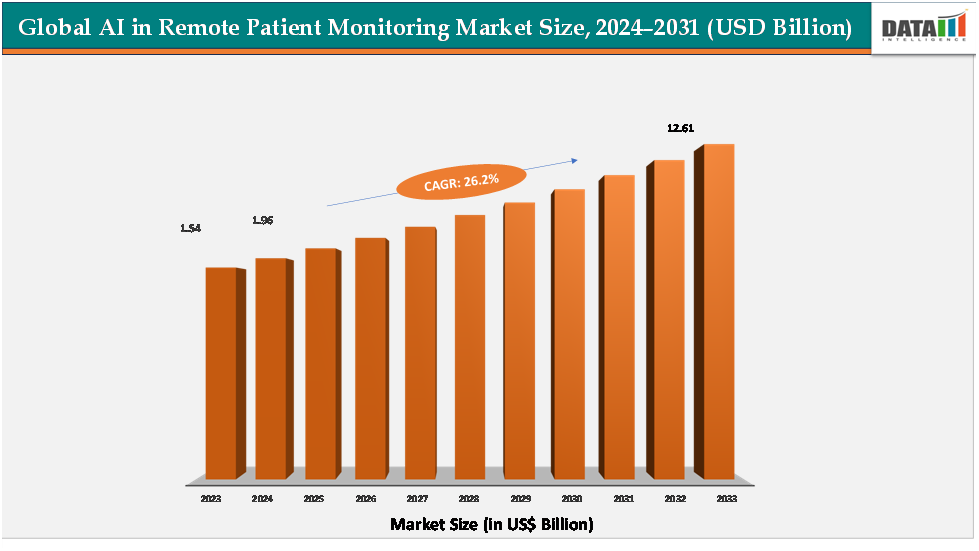
The global AI in remote patient monitoring market reached US$ 2.47 billion in 2025 and is expected to reach US$ 25.34 billion by 2035, growing at a CAGR of 26.2% during the forecast period 2026–2035.
The rapid adoption of AI-enhanced RPM technologies promises to revolutionize chronic disease management and personalized care through real-time data analytics and predictive interventions.
Key Market highlights
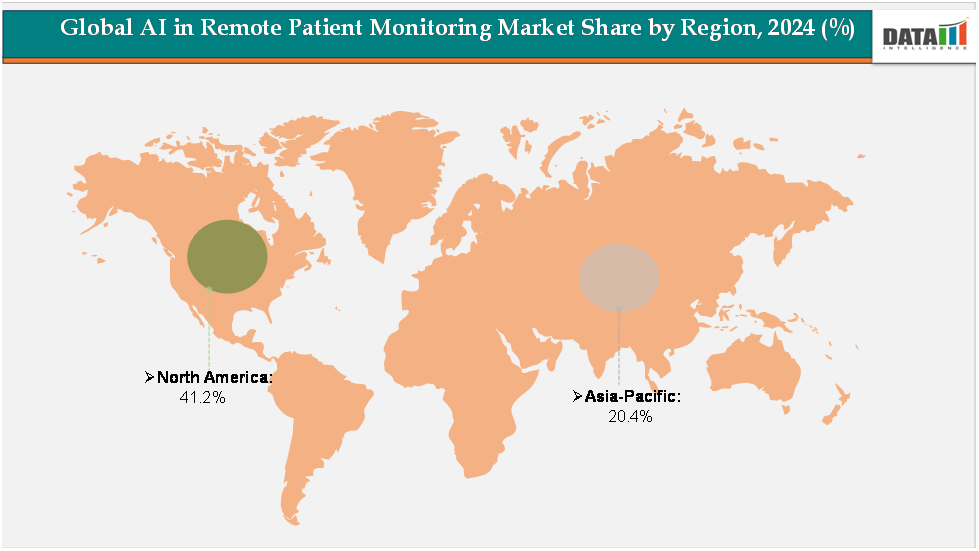
North America dominates the AI in RPM market with over 41.2% revenue share, supported by advanced healthcare IT infrastructure and early AI adoption.
Asia-Pacific is emerging as the fastest-growing region, fueled by expanding healthcare systems, increasing tech investments, and rising patient populations in countries like China and India.
The devices segment dominates the AI in remote patient monitoring market, accounting for 47.5% of the overall share, reflecting its critical role in real-time patient data collection and continuous health monitoring.
Drivers & Restraints
Driver : Increasing prevalence of chronic diseases
AI in remote patient monitoring (RPM) market is driven by the rapidly increasing prevalence of chronic diseases such as diabetes, cardiovascular disorders, hypertension, and respiratory illnesses worldwide. According to the World Health Organization (WHO), noncommunicable diseases account for nearly 74% of all global deaths, creating immense pressure on healthcare systems to provide long-term, cost-effective, and proactive care. Conventional in-hospital monitoring models are no longer sufficient, given the growing patient load, shortage of healthcare professionals, and escalating treatment costs.
AI-powered RPM technologies directly address these challenges by enabling continuous, real-time monitoring of patient health outside clinical settings, using advanced wearable sensors, continuous glucose monitors, and AI-enabled blood pressure monitors that provide predictive insights rather than reactive alerts.
For instance, AI algorithms integrated with continuous glucose monitoring systems can now predict hypoglycemic events hours before they occur, reducing emergency hospitalizations and improving patient safety. Similarly, AI-driven cardiac monitoring platforms can detect irregular heart rhythms early, allowing timely interventions for patients at risk of stroke or heart failure. The ability of AI-based RPM systems to transform raw patient data into actionable intelligence not only enhances clinical decision-making but also empowers patients to take charge of their health, ultimately driving adoption across hospitals, home-care providers, and telehealth platforms. This growing reliance on AI for chronic disease management is positioning RPM technologies as indispensable in modern healthcare delivery models.
Restraint: Data Privacy and Cybersecurity Risks
AI in remote patient monitoring market is a persistent concern around data privacy, cybersecurity, and regulatory compliance. AI-powered RPM solutions continuously collect, transmit, and analyze sensitive patient information such as blood glucose levels, heart rhythms, oxygen saturation, and blood pressure data, which are often stored on cloud-based platforms or transmitted via mobile applications. Any breach or misuse of this highly personal health information can have severe consequences, ranging from identity theft to loss of patient trust and potential legal actions against providers.
Segmentation Analysis
For more details on this report : Request for Sample
The global AI in remote patient monitoring market is segmented by product type, application, end-user, and region.
Product Type:
The devices segment is estimated to have 47.5% of the AI in remote patient monitoring market share.
The devices segment is expected to hold a dominant position in the AI in remote patient monitoring (RPM) market, driven by the rapid adoption of advanced connected health technologies and the growing need for real-time patient data collection. Wearable devices such as smartwatches, continuous glucose monitors, digital stethoscopes, pulse oximeters, and blood pressure monitors are increasingly integrated with AI algorithms to deliver actionable insights, enabling proactive disease management and reducing hospital readmissions.
The proliferation of IoT-enabled sensors, coupled with AI’s ability to analyze large volumes of patient data, strengthens the reliability and efficiency of these devices in chronic disease management. Moreover, the rising prevalence of lifestyle-related conditions like diabetes, cardiovascular disorders, and respiratory illnesses amplifies demand for device-based RPM solutions, holding their leading role in the overall market.
The software and platform segment is estimated to have 21.2% of the AI in remote patient monitoring market share.
The software and platform segment is emerging as the fastest-growing category in the AI in remote patient monitoring (RPM) market, fueled by the rising demand for advanced data analytics, interoperability, and seamless integration with electronic health records (EHRs). Unlike standalone devices, AI-enabled platforms empower healthcare providers to transform raw patient data into predictive insights, enabling early intervention and personalized care pathways. Cloud-based solutions, mobile health applications, and AI-driven dashboards are increasingly adopted for real-time monitoring, remote diagnostics, and population health management.
In addition, the growing emphasis on reducing clinician workload, enhancing patient engagement, and supporting value-based care models is accelerating investments in software-driven RPM ecosystems. This strong combination of data intelligence, scalability, and connectivity positions software and platforms as the fastest-growing segment within the market.
Geographical Analysis
The North America AI in remote patient monitoring market was valued at 41.2%market share in 2024
North America holds the dominant position in the AI in Remote Patient Monitoring market, driven by its strong technology adoption and high prevalence of chronic diseases such as diabetes, cardiovascular disorders, and respiratory illnesses. The region has been an early adopter of AI-powered RPM solutions, supported by favorable government policies, reimbursement frameworks, and rising telehealth adoption, especially after the COVID-19 pandemic accelerated the need for virtual care. Major medical device companies and startups, including Dexcom, Abbott, Medtronic, Omron, and iRhythm, are headquartered in North America, contributing to the rapid commercialization and deployment of AI-integrated monitoring systems such as continuous glucose monitors, cardiac rhythm monitors, and wearable blood pressure trackers.
Additionally, regulatory bodies like the FDA have been proactive in granting approvals and promoting innovation in digital health and AI-based medical devices, further strengthening the region’s leadership. The United States is the largest contributor within North America and plays a pivotal role in the dominance of the AI in Remote Patient Monitoring (RPM) market. The country benefits from advanced healthcare infrastructure, high healthcare expenditure, and strong adoption of digital health solutions. With over 34 million Americans living with diabetes and nearly half of the adult population having hypertension, the demand for continuous glucose monitors (CGMs) and blood pressure monitoring systems is exceptionally high. The U.S. has also been at the forefront of AI integration into RPM platforms, supported by the FDA’s digital health innovation action plans, which have accelerated the approval of AI-enabled monitoring devices and software.With a combination of high patient awareness, strong R&D funding, and widespread clinical acceptance, North America is expected to maintain its dominance as the largest and most technologically advanced market for AI in RPM over the coming years.
The Europe AI in Remote Patient Monitoring market was valued at 23.4% market share in 2024
Europe represents a mature and stable market for AI in Remote Patient Monitoring, supported by its strong regulatory environment, advanced healthcare infrastructure, and emphasis on quality and precision in patient care. Key markets such as Germany, the UK, and France lead adoption, driven by government initiatives promoting digital health, well-established pharmaceutical and medtech industries, and the rising prevalence of lifestyle-related chronic conditions. The European Union’s regulatory frameworks, particularly the Medical Device Regulation (MDR) and stringent data privacy standards under the General Data Protection Regulation (GDPR), ensure that AI-based RPM solutions prioritize patient safety and data security, which boosts long-term trust and adoption.
The Asia-Pacific AI in Remote Patient Monitoring market was valued at 20.4% market share in 2024
Asia-Pacific is the fastest-growing market for AI in Remote Patient Monitoring, fueled by its massive population base, rising healthcare expenditures, and growing burden of chronic diseases such as diabetes, hypertension, and cardiovascular disorders. Countries such as China, India, and Japan are at the forefront of this growth, with governments and private players investing heavily in digital health infrastructure and AI-enabled medical technologies.
The region is witnessing rapid adoption of wearable monitoring devices, telemedicine platforms, and AI-driven health analytics, supported by increasing smartphone penetration and expanding internet connectivity. China has been aggressively integrating AI into healthcare solutions through national initiatives, while India’s surge in telehealth platforms has accelerated the demand for low-cost, scalable RPM technologies. Japan, with its aging population, is also driving the adoption of AI-enabled remote monitoring for elderly care and chronic disease management. Moreover, Asia-Pacific’s lower healthcare professional-to-patient ratio is pushing healthcare providers to leverage AI and RPM solutions to manage large patient populations more efficiently. The rising involvement of local startups, partnerships with global medtech leaders, and government-backed health digitalization programs are reinforcing the region’s position as the fastest-growing hub for AI-enabled RPM solutions.
China stands out as the dominant country in the AI in Remote Patient Monitoring market, thanks to its massive population base, rapid healthcare digitalization, and aggressive national strategies to promote AI in healthcare. With more than 140 million people living with diabetes and a rapidly aging population, China has one of the largest target groups for RPM adoption worldwide. The government has been heavily investing in AI-driven healthcare initiatives under programs like “Healthy China 2030”, which emphasize chronic disease management, telemedicine, and remote monitoring.
Competitive Landscape
The major players in the AI in remote patient monitoring market include Abbott, Dexcom, Inc., Koninklijke Philips N.V., Medtronic, OMRON Healthcare, Inc., iRhythm Inc., Biobeat, AliveCor, Inc., Ascensia Diabetes Care Holdings AG, F. Hoffmann-La Roche Ltd, among others.
Abbott:
Abbott is one of the most prominent players in the AI-enabled remote patient monitoring (RPM) market, leveraging its strong presence in diagnostics, glucose monitoring, and connected healthcare solutions. The company has pioneered continuous glucose monitoring (CGM) systems, integrating artificial intelligence and data-driven insights to transform diabetes management. Its flagship FreeStyle Libre portfolio is among the most widely adopted CGM systems globally. The FreeStyle Libre 2 and the latest FreeStyle Libre 3 provide real-time glucose readings through a wearable sensor and transmit data to mobile devices via Bluetooth.
Market Scope
Metrics | Details | |
CAGR | 6.7% | |
Market Size Available for Years | 2022-2033 | |
Estimation Forecast Period | 2025-2033 | |
Revenue Units | Value (US $Bn) | |
Segments Covered | Product Type | Devices, Software & Platform, Services |
Application | Cardiovascular Monitoring, Anesthesiology, Post-operative & Home Recovery, Mental Health & Behavioral Monitoring, Diabetes Management, Neurology, Respiratory Management, Others | |
End-User | Hospitals, Home Healthcare Providers, Primary Care/Outpatient Clinics, Others | |
Regions Covered | North America, Europe, Asia-Pacific, South America, and the Middle East & Africa | |
The global AI in remote patient monitoring market report delivers a detailed analysis with 73 key tables, more than 76visually impactful figures, and 195 pages of expert insights, providing a complete view of the market landscape.



























































