


Aerospace Aluminum Market Size and Forecast
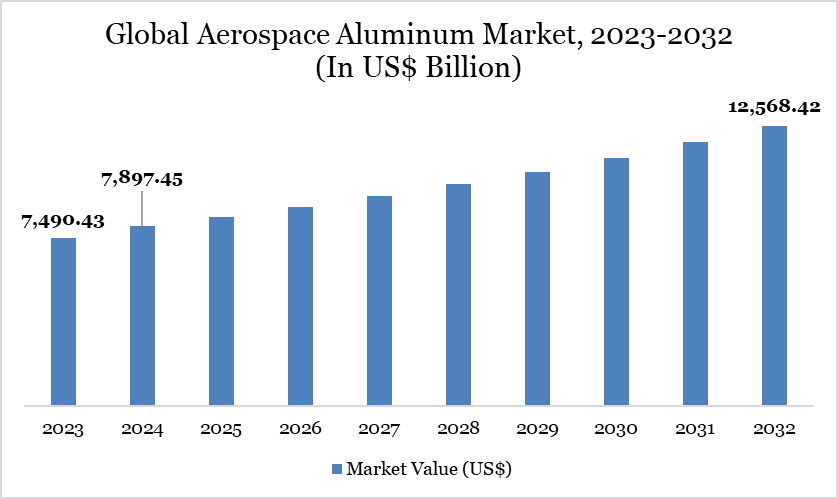
The aerospace aluminum market reached US$ 8,374.50 million in 2025 and is expected to reach US$ 15,119.60 million by 2035, growing at a CAGR of 6.04% during the forecast period 2026-2035.
The global aerospace aluminum market is being driven by the increasing demand for lightweight and high-strength materials in commercial and military aircraft, which enhances fuel efficiency and reduces carbon emissions. This growth is reinforced by the rapid expansion of international air travel, as reported by the International Air Transport Association (IATA), which noted a rise of 11.8% in premium-class passengers in 2024, indicating higher demand for advanced aircraft capable of supporting luxury and long-haul travel. Innovations in aluminum-lithium and other high-performance alloys are enabling manufacturers to produce lighter, stronger aircraft components, meeting the evolving needs of both premium and economy air travel.
The market is further supported by the growth of aerospace infrastructure in regions like Asia-Pacific, where economy class travel surged 28.6% to 500.8 million passengers, highlighting increased aircraft production and modernization. Europe continues to dominate premium travel with 39.3 million passengers, driving demand for robust aluminum components in commercial fleets. Meanwhile, the Middle East’s high share of premium travelers at 14.7% emphasizes the need for durable, lightweight materials in long-haul and luxury aircraft. Overall, rising air travel, technological advancements in alloys, and regional passenger growth are collectively fueling the steady expansion of the aerospace aluminum market.
Aerospace Aluminum Market Key Takeaways
- The market is expected to add more than USD 6.7 billion in new revenue opportunities between 2025 and 2035 due to expanding aircraft manufacturing and replacement programs.
- Commercial aviation remains the largest demand generator as aircraft manufacturers continue increasing the use of lightweight aluminum components in fuselage, wings, and structural assemblies.
- Advanced aluminum-lithium and high-strength alloys are receiving significant investment as aerospace manufacturers seek improved mechanical performance with lower aircraft weight.
- Sustainability initiatives, including recycled aluminum adoption and low-energy production techniques, are influencing procurement decisions across the aerospace value chain.
- Asia-Pacific maintains its leadership position owing to rapid passenger traffic growth, expanding airport infrastructure, and increasing regional aircraft manufacturing capabilities.
- Strategic partnerships between aluminum producers and aerospace companies are accelerating the commercialization of specialized alloys suitable for additive manufacturing and next-generation aircraft programs.
Aerospace Aluminum Market Trend
The aerospace aluminum market is witnessing a strong shift toward lightweight, high-strength alloys to improve fuel efficiency and reduce emissions, driven by increasing air travel demand and stricter environmental regulations. Advanced manufacturing techniques, such as additive manufacturing and precision casting, are gaining traction to enhance material performance and reduce production costs. Additionally, the integration of recycled aluminum and sustainable practices is becoming a key trend, as the industry focuses on circular economy principles. Strategic collaborations between aluminum producers and aerospace manufacturers are also on the rise to innovate next-generation alloys tailored for aerospace applications.
Unlock Key Insights with a Free Sample Aerospace Aluminum Market Report Gain instant access to market forecasts, material and application insights, regional growth opportunities, emerging trends, and competitive analysis. Request your free sample report today to uncover high-growth opportunities and make smarter strategic decisions.
Aerospace Aluminum Market Scope
| Metrics | Details |
| Market Size in 2025 | USD 8,374.50 million |
| Market Size by 2035 | USD 15,119.60 million |
| CAGR | 6.04% (2026-2035) |
| Historic Years | 2023-2024 |
| Base Year | 2025 |
| Forecast Period | 2026-2035 |
| Segments Covered | Alloy Type, Form, Process, End User, Region |
| Leading Region | Asia-Pacific |
| Fastest Growing Region | Asia-Pacific |
Aerospace Aluminum Market Dynamics
Demand for Lightweight Materials in Aircraft
The demand for lightweight materials in aircraft is a major driver of the aerospace aluminum market. Airlines and manufacturers are prioritizing fuel efficiency and emission reduction, which requires materials with a high strength-to-weight ratio. Aluminum alloys are ideal because they provide durability and corrosion resistance while keeping aircraft weight low.
This growing focus on lightweight design is particularly strong in commercial aviation, where every kilogram saved can reduce fuel consumption and operational costs. As new aircraft models are developed, aluminum continues to be preferred over heavier metals. Additionally, the push for greener aviation solutions further reinforces the adoption of aluminum alloys in structural components. This trend is expected to sustain strong market growth in the coming years.
High Production and Processing Costs
High production and processing costs significantly restrain the aerospace aluminum market by increasing the overall expenses for manufacturers. Aluminum alloys used in aerospace require advanced technologies, precision equipment, and skilled labor, all of which drive up operational costs.
These elevated costs limit the ability of smaller or emerging players to enter the market and compete effectively. Additionally, high production expenses can make end-products more expensive, reducing demand from cost-sensitive aerospace customers. As a result, growth in the aerospace aluminum sector may be slowed, especially in regions with price-sensitive markets.
Aerospace Aluminum Market Segment Analysis
The global aerospace aluminum market is segmented based on alloy type, form, process, end-user, and region.
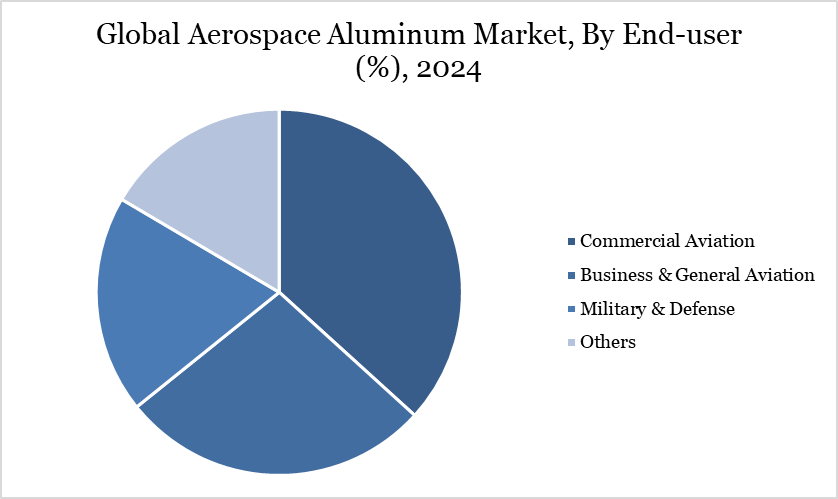
Commercial Aviation Drives Aerospace Aluminum Market for Lightweight, Fuel-Efficient Aircraft Structures
Commercial aviation holds a significant share in the aerospace aluminum market as passenger aircraft extensively rely on lightweight, high-strength aluminum alloys for fuselage, wings, and other structural components. Aluminum’s superior strength-to-weight ratio helps airlines improve fuel efficiency, reduce operating costs, and meet stringent safety standards, making it a preferred material in aircraft manufacturing.
The importance of commercial aviation is further highlighted by the high flight frequency observed from, 30th December 2024, to 17th August 2025, when a total of 24,104,736 one-way flights were scheduled, averaging 104,803 flights per day. This extensive operational demand drives continuous consumption of aerospace-grade aluminum, reinforcing the sector’s pivotal role in market growth and the sustained need for high-performance aluminum alloys.
Aerospace Aluminum Market Geographical Share
Asia-Pacific Dominates Aerospace Aluminum Market Due to Rapid Aviation Growth and Expanding Aircraft Manufacturing Hub
Asia-Pacific commands a significant share in the Aerospace Aluminum market due to its expanding aviation industry and growing investments in aircraft manufacturing. Countries like China, Japan, South Korea, and India are driving demand for lightweight, high-strength aluminum alloys to support both commercial and defense aircraft production. Rising passenger traffic and modernization programs across the region further boost the need for advanced aerospace materials.
According to the IEA, India’s aviation market is rapidly growing, with domestic and international travelers projected to exceed 500 million by 2030, making it a potential global leader by 2047. Passenger traffic surged in 2022, with domestic travel up nearly 50% and international travel over 150%, while the first half of 2023 saw a 32% year-on-year increase. The expansion of airports from 74 in 2014 to 147 in 2022, expected to reach 220 by 2025, highlights the region’s infrastructure development, further reinforcing Asia-Pacific’s strong role in the aerospace aluminum market.
Aerospace Aluminum Market Sustainability Analysis
The Aerospace Aluminum market is increasingly focusing on sustainability through the adoption of lightweight, fuel-efficient aluminum alloys that reduce aircraft emissions. Manufacturers are investing in recycling programs and secondary aluminum use to minimize environmental impact and conserve resources. Innovations in production processes, such as energy-efficient casting and extrusion techniques, further lower the carbon footprint of aluminum components. Regulatory pressures and industry standards are pushing aerospace companies toward greener supply chains and eco-friendly material sourcing.
Aerospace Aluminum Market Latest Trends and Insights
Lightweighting Remains the Primary Demand Driver
Aircraft manufacturers continue to prioritize weight reduction because lower structural weight can improve fuel efficiency, payload capability and operating economics.
Aluminum remains attractive because it provides a relatively favorable combination of weight, strength, manufacturability and cost. Its established joining, forming and repair infrastructure also gives it an advantage in high-volume aircraft programs.
Aluminum-Lithium Alloys Are Gaining Importance
Aluminum-lithium alloys are receiving increasing attention because they can provide lower density and higher stiffness than conventional aerospace aluminum grades.
The technology is particularly relevant for next-generation aircraft structures where manufacturers are looking for incremental weight reductions without moving completely toward composite-intensive designs.
DataM Intelligence identifies advanced aluminum-lithium and high-strength alloys as important areas of investment within the aerospace aluminum industry.
Aerospace Aluminum Is Competing More Directly With Composites
The material mix in aircraft is changing. Composite materials have captured substantial share in large aircraft programs such as the Airbus A350 and Boeing 787, while aluminum continues to retain an important position in smaller single-aisle aircraft.
Constellium has been investing in lighter aluminum alloys and recycling technologies partly in anticipation of future narrow-body aircraft programs. Industry analysis cited by Reuters projects approximately 8% annual growth in aerospace aluminum demand across Europe and North America from 2024 to 2029.
This creates an important competitive opportunity for aluminum producers to develop materials that narrow the weight-performance gap with composites while retaining aluminum's recyclability and established manufacturing ecosystem.
Recycling Is Becoming a Competitive Advantage
Sustainability is increasingly influencing aerospace material procurement. Aluminum has a major advantage because it can be recycled repeatedly, while recycling complex composite structures remains more challenging.
According to Reuters, recycling aluminum can require approximately 95% less energy than producing primary aluminum, strengthening the material's sustainability proposition.
Aerospace suppliers are consequently investing in improved scrap recovery, closed-loop recycling and the integration of recycled content into aerospace-grade products.
Additive Manufacturing Is Creating New Alloy Opportunities
Additive manufacturing is creating demand for aluminum powders and alloys specifically engineered for laser powder-bed fusion and other processes.
Research has demonstrated that computationally designed aluminum alloys can achieve high strength while overcoming some of the cracking and thermal-stability limitations associated with conventional high-strength alloys during additive manufacturing.
This could expand aerospace aluminum applications into lightweight brackets, ducts, structural components and geometrically complex parts.
Domestic Aerospace Material Supply Chains Are Gaining Strategic Importance
Governments and aerospace companies are increasingly focused on securing domestic supplies of strategically important metals.
A recent example is India's development of a high-strength aluminum alloy by IIT Gandhinagar, designed as a potential domestic alternative to imported AA6082 and aimed at reducing dependence on overseas supplies for strategic applications.
This trend could encourage additional investment in domestic alloy development, aerospace certification and localized processing capabilities.
Aerospace Aluminum Market Value Chain Analysis
The Aerospace Aluminum value chain begins with bauxite mining and alumina refining, followed by primary aluminum production and alloying.
Specialized aluminum producers then manufacture aerospace-grade material through melting, casting, rolling, extrusion, forging and heat treatment.
The next stage includes aerospace material processors and distributors that provide cutting, machining, surface treatment and other value-added services.
Tier-1 and Tier-2 aerospace suppliers convert aluminum into structural assemblies, aircraft components, extrusions, panels and forged parts.
Finally, aircraft OEMs, defense manufacturers and space companies integrate these components into aircraft and aerospace systems.
Recycling is becoming an increasingly important secondary loop in the value chain. Aerospace scrap can be recovered and processed into new aluminum products, supporting both material efficiency and lower-carbon manufacturing.
Aerospace Aluminum Market Investment and Strategic Collaboration Analysis
Investment is increasingly concentrated around high-performance alloys, aerospace plate and extrusion capacity, recycling and sustainable production.
Kaiser Aluminum reported stronger aerospace and high-strength aluminum shipments in Q1 2026, supported by recovering commercial aerospace demand and recently completed capacity-expansion projects. The company subsequently raised its 2026 aerospace outlook.
Constellium is also investing in lighter alloys and advanced recycling as it positions aluminum for future single-aisle aircraft. Its testing has included new alloys and friction-stir-welding approaches, with reported test-wing weight reductions of approximately 20%.
Strategic collaboration between aluminum producers, aircraft OEMs, component manufacturers and research institutions is becoming increasingly important because new aerospace alloys require extensive qualification and integration testing.
Aerospace Aluminum Market Emerging Technologies Analysis
Aluminum-Lithium Alloys: Lower-density materials are being developed to deliver additional weight savings while maintaining structural performance.
Advanced 7xxx-Series Alloys: Improved alloy chemistry and heat treatments are targeting higher strength, better fracture toughness and improved corrosion resistance.
Friction Stir Welding: This solid-state joining process can reduce the need for conventional fasteners and improve manufacturing efficiency for suitable aerospace structures.
Additive Manufacturing: Specialized aluminum powders are enabling complex geometries and lightweight structures that are difficult to manufacture through conventional processes.
AI-Assisted Alloy Design: Computational modeling and machine learning are increasingly being used to identify alloy compositions and optimize microstructures.
Closed-Loop Recycling: Aerospace producers are developing systems to recover manufacturing scrap and return it to the aluminum production cycle.
Aerospace Aluminum Market Major Players
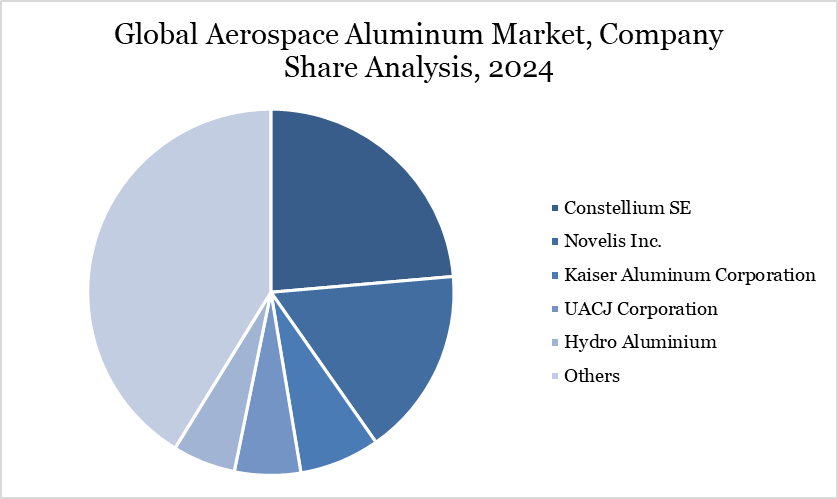
The major global players in the market include Constellium SE, Novelis Inc., Kaiser Aluminum Corporation, UACJ Corporation, Hydro Aluminium, China Zhongwang Holdings Limited, Arconic Corporation, SAPA Group, Gulf Extrusions Company, Alcoa Corporation.
Recent Developments in the Aerospace Aluminum Market:
- July 2026: Alcoa Corporation agreed to acquire South32’s bauxite, alumina and aluminum assets in a deal valued at up to US$5.6 billion, strengthening its vertically integrated aluminum portfolio and raw-material security.
- July 2026: Hydro Aluminium reported strong Q2 2026 operational performance, with adjusted EBITDA reaching NOK 8.923 billion, while continuing its focus on lower-carbon and more sustainable aluminum solutions.
- July 2026: Kaiser Aluminum Corporation reported record second-quarter 2026 financial results, supporting continued investment in its aerospace and high-performance aluminum businesses.
- June 2026: Hydro Aluminium announced plans to close two U.S. extrusion plants in 2027 as part of an operational optimization strategy, affecting approximately 350 jobs and addressing low capacity utilization.
- June 2026: Constellium SE received an improved 2026 outlook, with expectations for adjusted EBITDA of approximately US$900–940 million, reflecting stronger operational performance across its specialty aluminum businesses.
- May 2026: UACJ Corporation signed a strategic partnership with Safran Landing Systems focused initially on die-forged landing-gear wheels, with production scheduled to begin in 2026, strengthening its aerospace aluminum capabilities.
- April 2026: Novelis Inc. continued addressing production disruptions at its Oswego facility while maintaining aerospace shipments and its broader aerospace aluminum supply capabilities. Novelis supplies aerospace sheet and plate qualified for more than 90% of today's flying demand.
- April 2026: Arconic Corporation continued advancing its aerospace-focused growth strategy through investments in advanced aluminum alloys, casting capabilities and high-performance aerospace products.
- 2026: Gulf Extrusions Company continued expanding its aluminum extrusion and fabricated-component capabilities, supporting applications requiring lightweight and engineered aluminum solutions.
Why Choose DataM?
Data-Driven Insights: Dive into detailed analyses with granular insights such as pricing, market shares and value chain evaluations, enriched by interviews with industry leaders and disruptors.
Post-Purchase Support and Expert Analyst Consultations: As a valued client, gain direct access to our expert analysts for personalized advice and strategic guidance, tailored to your specific needs and challenges.
White Papers and Case Studies: Benefit quarterly from our in-depth studies related to your purchased titles, tailored to refine your operational and marketing strategies for maximum impact.
Annual Updates on Purchased Reports: As an existing customer, enjoy the privilege of annual updates to your reports, ensuring you stay abreast of the latest market insights and technological advancements. Terms and conditions apply.
Specialized Focus on Emerging Markets: DataM differentiates itself by delivering in-depth, specialized insights specifically for emerging markets, rather than offering generalized geographic overviews. This approach equips our clients with a nuanced understanding and actionable intelligence that are essential for navigating and succeeding in high-growth regions.
Value of DataM Reports: Our reports offer specialized insights tailored to the latest trends and specific business inquiries. This personalized approach provides a deeper, strategic perspective, ensuring you receive the precise information necessary to make informed decisions. These insights complement and go beyond what is typically available in generic databases.
Target Audience
Manufacturers/ Buyers
Industry Investors/Investment Bankers
Research Professionals
Emerging Companies



























































