


7MM Digital Therapeutics for Diabetes Market Size
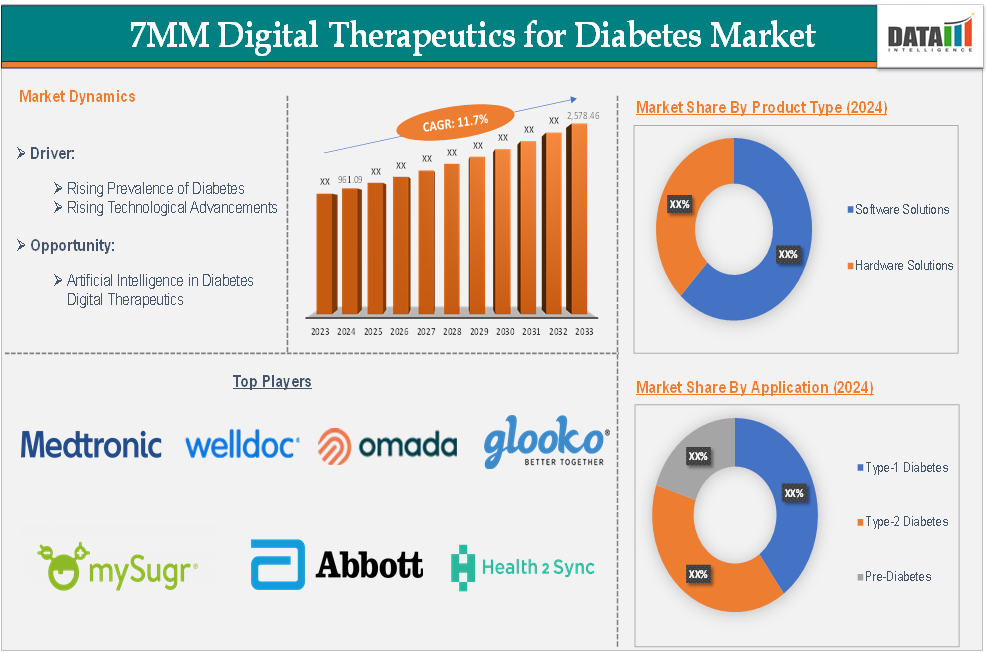
The 7MM Digital Therapeutics for Diabetes Market size reached US$ 961.09 million in 2024 and is expected to reach US$ 2,578.46 million by 2033, growing at a CAGR of 11.7% during the forecast period 2025-2033.
Digital therapeutics for diabetes refer to evidence-based, software-driven interventions designed to manage and treat diabetes through digital platforms. These therapeutics use advanced technologies like mobile apps, wearable devices, and cloud-based systems to deliver personalized, real-time treatment strategies and behavioral interventions. The goal is to improve diabetes management, enhance patient outcomes, and prevent complications by leveraging data-driven insights.
Digital therapeutics for diabetes use real-time data from wearables (e.g., continuous glucose monitors) and user inputs (e.g., diet and exercise) to provide personalized recommendations. This helps patients make informed decisions about medication, diet, and physical activity, optimizing their blood glucose levels and overall health.
7MM Digital Therapeutics for Diabetes Market Executive Summary
For more details on this report – Request for Sample
Key Takeaways
- North America accounts for approximately 45% of the market share, driven by widespread adoption of digital health technologies, favorable reimbursement policies, and increasing investments in diabetes management solutions.
- Software solutions contribute over 65% of total market revenue, owing to their scalability, accessibility, and ability to provide personalized diabetes management through mobile and cloud-based platforms.
- Type-2 diabetes applications account for nearly 60% of market demand, supported by the rising prevalence of diabetes and increasing adoption of remote patient monitoring technologies.
- Hospitals and specialty clinics collectively represent more than 55% of end-user adoption, leveraging digital therapeutics to improve patient engagement, treatment adherence, and clinical outcomes.
- AI-powered diabetes management platforms are witnessing adoption growth exceeding 20% annually, enabling real-time glucose monitoring, predictive analytics, and personalized treatment recommendations.
- Wearable device integration with digital therapeutics is growing rapidly, driven by increasing utilization of continuous glucose monitoring (CGM) systems and connected insulin delivery solutions.
- Strategic collaborations among healthcare providers, digital therapeutics developers, and pharmaceutical companies are accelerating market commercialization and expanding patient access.
- Japan is expected to register significant growth within the 7MM market, supported by increasing government initiatives promoting digital healthcare and rising adoption of personalized diabetes management technologies.
- Growing investments in AI-enabled digital health platforms, remote patient monitoring, and value-based diabetes care models are expected to drive long-term market expansion.
7MM Digital Therapeutics for Diabetes Market Dynamics: Drivers & Restraints
Rising technological advancements are driving the 7MM digital therapeutics for diabetes market growth
Artificial intelligence (AI) capabilities are being integrated into digital therapeutics to analyze vast amounts of patient data (e.g., glucose levels, activity, diet) in real-time for diabetes and associated chronic conditions. This enables the creation of highly personalized treatment plans that adapt to the individual’s specific needs, improving glycemic control and long-term health outcomes. Thus, the key market players are focusing on the advanced artificial intelligence capabilities in their diabetes digital therapeutics.
For instance, in February 2025, Byram Healthcare, a leader in home-based care and part of the Owens & Minor family, launched ByramConnect, a personalized digital health program powered by the Welldoc App. Using the Welldoc App’s advanced artificial intelligence capabilities, the program analyzes member data across six dimensions of health to help optimize outcomes for people with type 1 or type 2 diabetes and associated chronic conditions such as hypertension, weight management, and cardiovascular risk, providing Byram members with actionable insights and reports that can be shared with their providers and care teams.
Wearable devices, such as Continuous Glucose Monitors (CGMs), provide real-time, continuous tracking of glucose levels. This allows for better decision-making and timely interventions to prevent hypoglycemia or hyperglycemia. CGM systems that integrate with digital therapeutics platforms, provide continuous feedback to both patients and healthcare providers. This integration improves management efficiency, reduces emergency interventions, and enhances patient quality of life. These advanced CGM systems with advancements such as small sensors and smart transmitters becoming a key trend for market growth.
For instance, in October 2024, Ascensia Diabetes Care, launched the Eversense 365 continuous glucose monitoring (CGM) system, the world’s only One-year CGM, for people with diabetes in the U.S. Developed by Senseonics Holdings, Inc., Eversense 365 is the only CGM that provides one year of accurate monitoring with minimal disruptions, enabling confident decisions, long-term peace of mind and enhanced quality of life with just one CGM. Senseonics' CGM system Eversense 365 includes a small sensor inserted completely under the skin that communicates with a smart transmitter worn over the sensor. The glucose data are automatically sent every 5 minutes to a mobile app on the user's smartphone.
Data privacy and security concerns hamper the growth of digital therapeutics for the diabetes market
Digital therapeutics platforms collect vast amounts of sensitive personal health data. Patients are often reluctant to share this data if they are unsure about how securely it is stored or who can access it. This hesitation can delay or limit the adoption of digital health solutions. Digital therapeutics platforms must comply with stringent regulations like the Health Insurance Portability and Accountability Act (HIPAA) in the U.S., the General Data Protection Regulation (GDPR) in the EU, and similar regulations in other regions. The complex compliance requirements for handling patient data can be a significant barrier to market growth, especially for smaller companies or startups.
There is a lack of universal standards for data protection and security in the digital therapeutics sector. Inconsistent practices across different companies, apps, and devices can leave vulnerabilities that may expose patient information. Cybersecurity risks are a major concern, especially as digital health platforms and wearable devices become more interconnected. Hackers targeting health data can compromise patient safety and trust in digital therapeutics.
For instance, according to the HIPAA Journal, in August 2023, 23 million breached healthcare records are reported. Over the past 12 months, an average of 9,989,003 healthcare records were breached each month. In the year to August 31, 2024, there have been 491 data breaches of 500 or more records, and at least 58,668,002 records are known to have been breached. The average breach size in 2024 is currently 119,487 records, and the median breach size is 4,109 records.
7MM Digital Therapeutics for Diabetes Market Segment Analysis
The 7MM digital therapeutics for diabetes market is segmented based on product type, application, end-user, and country.
Product Type:
The software solutions in the product type segment are expected to dominate the 7MM digital therapeutics for diabetes market with the highest market share
Software solutions are highly scalable and can be accessed by a wide range of patients, regardless of location. They can be used on mobile phones, tablets, and computers, making them accessible to a larger population, including those in remote areas. Software solutions allow for the customization of diabetes care based on real-time data, such as blood glucose levels, exercise routines, and dietary habits.
The major market players are continuously focusing on software solutions, which further accelerates the market growth. For instance, in November 2024, Medtronic received U.S. Food and Drug Administration (FDA) clearance for its new InPen smartphone app and announced the launch of its new Smart MDI system. Smart MDI was designed to provide real-time insights to users on multiple daily injection (MDI) therapy. It includes the InPen smart insulin pen, the InPen app, and Medtronic’s disposable, all-in-one Simplera continuous glucose monitor (CGM), which received U.S. Food and Drug Administration approval
Software solutions enable continuous tracking of vital metrics like blood glucose levels, insulin usage and physical activity. This constant monitoring allows for immediate interventions and reduces the need for frequent in-person visits, thus enhancing patient engagement and improving long-term outcomes.
Investment Opportunity Analysis
The 7MM Digital Therapeutics for Diabetes Market presents substantial investment opportunities as healthcare systems increasingly prioritize personalized, cost-effective, and technology-enabled chronic disease management solutions. Rising diabetes prevalence, expanding reimbursement frameworks, and growing adoption of remote healthcare services are driving investments in software-based therapeutics, AI-powered analytics platforms, and connected medical devices. Pharmaceutical companies, healthcare providers, and digital health innovators are increasingly investing in integrated diabetes management ecosystems that combine digital therapeutics with wearable technologies and medication support services. Strategic investments are expected to accelerate product innovation and strengthen the market's long-term growth potential.
Market Drivers, Restraints, Opportunities, and Challenges (DROC Analysis)
The 7MM Digital Therapeutics for Diabetes Market is driven by increasing diabetes prevalence, technological advancements in digital health platforms, growing demand for remote patient monitoring, and rising adoption of AI-enabled personalized healthcare solutions. Digital therapeutics provide continuous disease management capabilities that improve treatment adherence and patient outcomes. However, reimbursement limitations across certain markets, data privacy concerns, regulatory complexities, and digital literacy challenges remain significant restraints. Opportunities are emerging through AI-driven predictive analytics, wearable device integration, value-based healthcare models, and expanding collaborations between healthcare providers and technology companies.
7MM Digital Therapeutics for Diabetes Market Major Players
The major players in the 7MM digital therapeutics for diabetes market include Welldoc, Inc., Omada Health Inc., Glooko, Inc., Azumio Inc., Abbott Laboratories, mySugr GmbH, Dexcom, Inc., Health2Sync, iHealth Labs Inc. and Medtronic plc and among others.
7MM Digital Therapeutics for Diabetes Market Scope
| Metrics | Details | |
| CAGR | 11.7% | |
| Market Size Available for Years | 2022-2033 | |
| Estimation Forecast Period | 2025-2033 | |
| Revenue Units | Value (US$ Mn) | |
| Segments Covered | Product Type | Software Solutions and Hardware Solutions |
| Application | Type-1 Diabetes, Type-2 Diabetes and Pre-Diabetes | |
| End-User | Hospitals, Specialty Clinics, Homecare Settings, Others | |
| Countries Covered | US, France, Germany, Italy, Spain, UK, and Japan | |
Who Should Buy This Report?
This report is designed for digital therapeutics companies, pharmaceutical manufacturers, healthcare technology providers, medical device companies, hospitals and specialty clinics, contract research organizations (CROs), health insurance providers, government healthcare agencies, telehealth service providers, academic and research institutions, institutional investors, venture capital firms, healthcare consultants, and market intelligence organizations. It provides valuable insights for stakeholders seeking to identify growth opportunities, strengthen digital healthcare strategies, evaluate investment prospects, and make informed business decisions across the diabetes management ecosystem.
Why Should You Buy This Report?
This report provides comprehensive market size estimates and forecasts through 2033, helping organizations identify high-growth opportunities across AI-enabled digital therapeutics, remote patient monitoring, personalized diabetes management, and connected healthcare solutions. It delivers detailed analysis of market drivers, restraints, opportunities, and challenges, along with country-level trends across the seven major markets supporting strategic planning. The report offers competitive intelligence covering company strategies, partnerships, acquisitions, product innovations, and regulatory developments. It also analyzes emerging technologies including continuous glucose monitoring integration, AI-powered treatment platforms, digital coaching solutions, and cloud-based healthcare ecosystems. Additionally, it supports investment planning, business expansion, competitive benchmarking, and market entry strategies while helping organizations capitalize on the rapidly evolving digital therapeutics landscape for diabetes management.
The 7MM digital therapeutics for diabetes market report delivers a detailed analysis with 39 key tables, more than 26 visually impactful figures and 158 pages of expert insights, providing a complete view of the market landscape.
Target Audience 2026
- Manufacturers: Pharmaceutical, Medical Device, Biotech Companies, Contract Manufacturers, Distributors, Hospitals.
- Regulatory & Policy: Compliance Officers, Government, Health Economists, Market Access Specialists.
- Technology & Innovation: AI/Robotics Providers, R&D Professionals, Clinical Trial Managers, Pharmacovigilance Experts.
- Investors: Healthcare Investors, Venture Fund Investors, Pharma Marketing & Sales.
- Consulting & Advisory: Healthcare Consultants, Industry Associations, Analysts.
- Supply Chain: Distribution and Supply Chain Managers.
- Consumers & Advocacy: Patients, Advocacy Groups, Insurance Companies.
- Academic & Research: Academic Institutions.




























































