


Introduction: Terafab Signals the Next Phase of America’s AI and Semiconductor Race
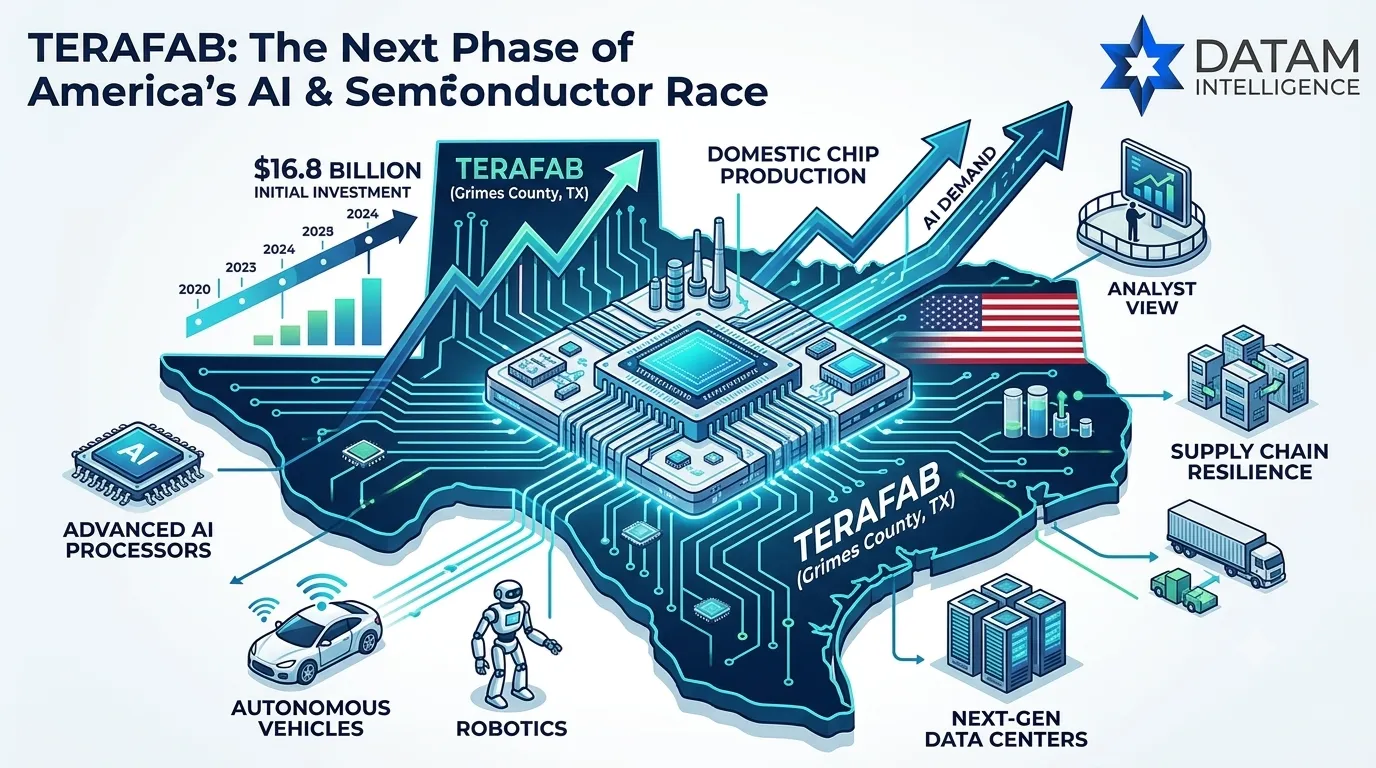
The global semiconductor industry has entered a new phase of expansion driven by artificial intelligence, autonomous systems, robotics, advanced computing, and next-generation data centers. Against this backdrop, SpaceX and Tesla have announced plans to build Terafab, a massive semiconductor manufacturing complex in Texas with an initial investment of approximately $16.8 billion. The project represents one of the largest technology manufacturing investments in the United States and highlights the growing urgency to secure domestic chip production capacity.
Located in Grimes County, Texas, the facility is expected to encompass nearly 100 million square feet and integrate semiconductor manufacturing, packaging, and testing operations within a single ecosystem. According to project details, the complex is designed to support future demand for advanced AI processors, autonomous vehicle chips, robotics processors, and computing infrastructure critical to SpaceX and Tesla's long-term technology roadmaps.
Why Terafab Matters for the Semiconductor Industry
The semiconductor sector continues to face growing pressure from increasing AI workloads, cloud computing expansion, and geopolitical efforts to localize chip supply chains. Demand for advanced chips is accelerating faster than global manufacturing capacity, creating strategic concerns for technology companies that rely heavily on specialized processors.
Terafab reflects a broader industry trend toward vertical integration, where technology companies seek greater control over semiconductor production, supply security, and innovation cycles. By bringing chip fabrication, packaging, and testing under one roof, the project aims to reduce supply chain complexity while improving manufacturing efficiency and scalability.
Industry analysts view the investment as a signal that future AI growth may increasingly depend on dedicated semiconductor infrastructure rather than relying solely on third-party foundries.
Texas Emerges as a Semiconductor Powerhouse
Texas has steadily strengthened its position as a major semiconductor manufacturing hub through investments from global chipmakers and technology firms. The state's business-friendly environment, engineering talent pool, infrastructure availability, and growing technology ecosystem continue to attract large-scale manufacturing projects.
The Terafab announcement further reinforces Texas' strategic role within the U.S. semiconductor landscape. The project is expected to generate thousands of high-skilled jobs while attracting suppliers, equipment manufacturers, advanced materials companies, and semiconductor ecosystem partners.
As governments worldwide prioritize semiconductor self-sufficiency, Texas is increasingly positioned as a key destination for next-generation chip manufacturing investment.
AI Computing Demand Is Driving a New Investment Cycle
Artificial intelligence has become one of the most powerful growth drivers in technology markets. Generative AI models, autonomous systems, industrial automation, robotics, and AI-powered data centers require unprecedented computing power.
According to project statements, Terafab is intended to support computing demand exceeding one terawatt, highlighting the scale of future AI infrastructure requirements envisioned by SpaceX and Tesla. This demand extends beyond consumer applications and includes robotics, autonomous transportation, aerospace technologies, and emerging AI-driven industrial systems.
The investment demonstrates how semiconductor manufacturing is increasingly becoming a strategic competitive advantage rather than simply a supply chain function.
Market Impact and Investment Outlook
The Terafab initiative is expected to create opportunities across multiple industries, including:
- Semiconductor equipment manufacturing
- Advanced packaging technologies
- AI accelerator chips
- Electronic materials and substrates
- Data center infrastructure
- Robotics hardware
- Autonomous vehicle technologies
- Industrial automation systems
The project may also accelerate investment in domestic semiconductor ecosystems as governments and corporations seek to reduce dependence on overseas production.
For investors, Terafab highlights the long-term growth potential of semiconductor manufacturing, AI infrastructure, advanced computing hardware, and next-generation technology supply chains. The announcement further underscores the strategic importance of semiconductor capacity as AI adoption continues to expand globally.
Analyst View
From a market intelligence perspective, Terafab represents more than a manufacturing facility it reflects the next evolution of AI infrastructure investment. As demand for AI computing, robotics, autonomous vehicles, and advanced data centers accelerates, control over semiconductor production capacity is becoming a critical competitive differentiator.
The project also aligns with broader industry efforts to strengthen domestic semiconductor manufacturing, improve supply chain resilience, and support national technology competitiveness. If successfully executed, Terafab could influence future investment strategies across the global semiconductor value chain and contribute to a new wave of large-scale chip manufacturing projects in North America.
Conclusion
The $16.8 billion Terafab investment signals a significant milestone for the U.S. semiconductor industry. By combining advanced manufacturing capabilities with the rapidly expanding demands of AI and advanced computing, the project has the potential to reshape domestic chip production and strengthen America's position in the global semiconductor race.
As AI-driven innovation accelerates, investments such as Terafab are expected to play an increasingly important role in defining the future of technology infrastructure, semiconductor manufacturing, and industrial competitiveness.
News source:
https://www.spacex.com/updates#terafab
https://www.usatoday.com/story/news/state/texas/2026/08/07/elon-musk-spacex-tesla-terafab-texas-16-billion-chip-factory-investment/91212702007/