


South Korea Eases Regulations to Unlock $3 Billion in Advanced Industry Investment
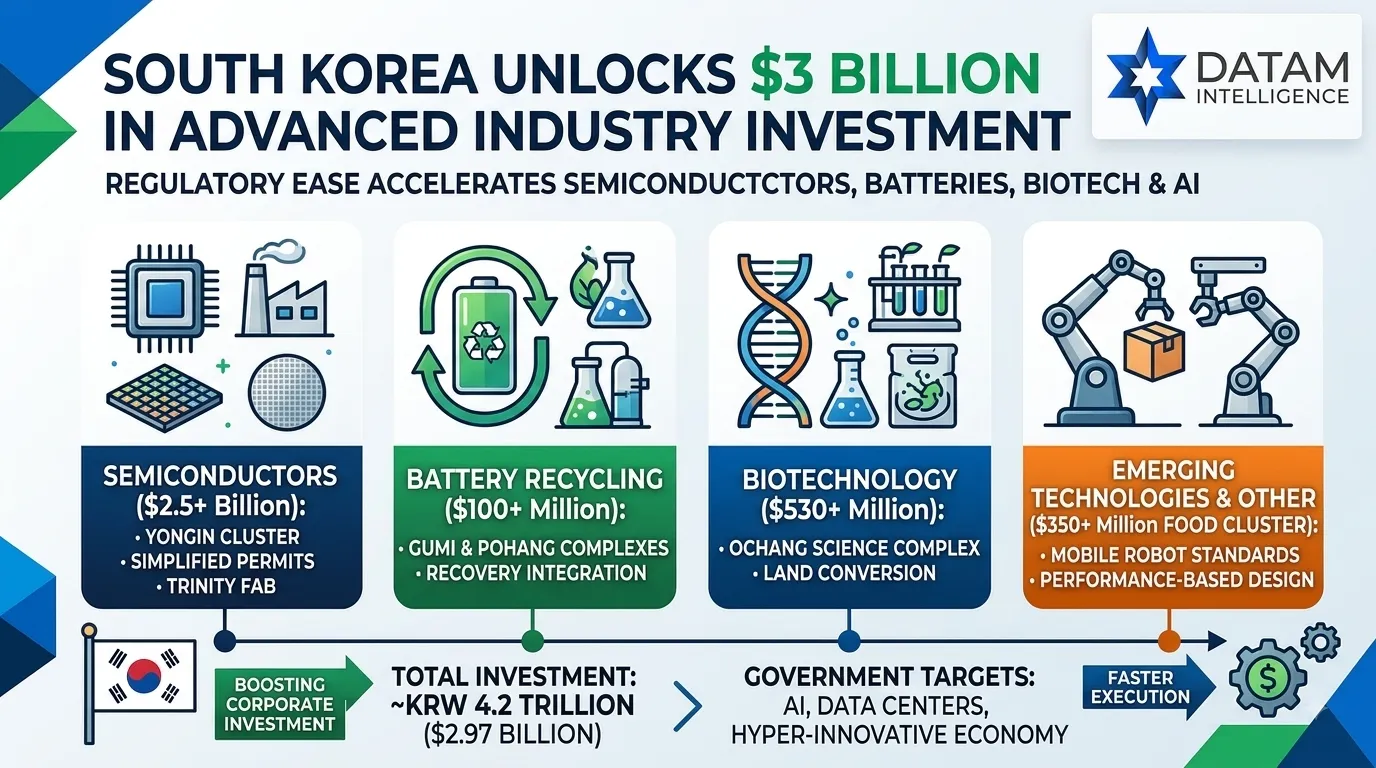
South Korea is easing regulations across strategic industries to accelerate corporate investment, with the first package of measures expected to unlock approximately KRW 4.2 trillion ($2.97 billion) in new investment. The reforms target semiconductors, secondary batteries, biotechnology and emerging industrial technologies, reinforcing Seoul’s strategy to strengthen domestic advanced manufacturing capacity.
Explore the AI Data Centers Market Report for Strategic Growth Insights
Discover comprehensive insights into the rapidly expanding AI Data Centers Market, including market size, growth trends, technology evolution, competitive landscape, regional opportunities, and key investment areas. Access detailed analysis to identify emerging opportunities across AI infrastructure, hyperscale data centers, cooling technologies, AI hardware, networking, and energy-efficient solutions.
Request a Sample Report Today and make informed decisions with actionable market intelligence through 2035.
South Korea Targets $3 Billion in Advanced Industry Investment
The South Korean government has introduced a new round of regulatory reforms designed to remove bottlenecks affecting large-scale industrial projects. The measures were announced on August 13, 2026, during an economic ministers’ meeting chaired by Deputy Prime Minister and Finance Minister Koo Yun-cheol.
The package forms part of the government's broader strategy to support three major national projects focused on semiconductors, physical AI and AI data centers. Rather than relying only on financial incentives, the government is prioritizing regulatory changes requested by companies to accelerate project execution and improve investment conditions.
Semiconductor Investment Receives Major Regulatory Push
Semiconductors are at the center of South Korea's industrial strategy. The government plans to simplify factory expansion procedures at the Yongin Semiconductor Cluster, allowing additional buildings in qualifying industrial complexes to obtain separate permits rather than requiring amendments to existing building permits.
The change is expected to bring forward approximately KRW 2.5 trillion in semiconductor-related investment. Seoul also plans to exempt certain assets contributed by semiconductor companies to Trinity Fab, a corporation supporting demonstration projects within the Yongin cluster, from gift taxes. That measure is expected to encourage another KRW 800 billion in semiconductor investment.
The regulatory push comes as South Korea accelerates semiconductor capacity expansion to meet rising demand from artificial intelligence and advanced computing. Earlier in August, the government announced a KRW 5 trillion ($3.52 billion) semiconductor fund for promising materials, parts, equipment and fabless companies, alongside another KRW 5 trillion in trade finance for suppliers.
Battery Recycling Moves Closer to the Manufacturing Ecosystem
South Korea is also changing industrial-complex rules for the secondary battery sector. Battery resource recovery and recycling businesses will be permitted at the Gumi and Pohang national industrial complexes.
Previously, occupancy rules primarily favored secondary battery manufacturing companies, creating barriers for recycling businesses because they were classified as waste-related operations. The government now views battery recycling as an integral component of the battery manufacturing value chain.
The change is expected to support approximately KRW 100 billion in new investment, while potentially strengthening the domestic battery materials recovery ecosystem.
Biotechnology and Food Manufacturing Capacity to Expand
Biotechnology is another beneficiary of the regulatory reforms. In Cheongju's Ochang Science Industrial Complex, government-owned green space will be converted into industrial land to enable construction of a new manufacturing facility connected to an existing plant. The change is expected to generate approximately KRW 530 billion in additional investment.
Separately, occupancy regulations at the national food cluster in Iksan will be relaxed. Underutilized land previously designated for beverage manufacturing can be converted for broader food and beverage manufacturing, supporting an estimated KRW 350 billion in new investment.
Korea Expands Regulatory Support for Emerging Technologies
Beyond individual projects, Seoul is planning broader reforms for advanced and emerging industries.
The government intends to establish safety standards aligned with international standards for new robot categories, including collaborative robots, while expanding the definition of industrial robots to cover mobile robots used in manufacturing and logistics.
For six advanced strategic industries, including semiconductors and secondary batteries, South Korea also plans to introduce performance-based design approaches that use computer simulations to provide greater flexibility in meeting safety requirements. In semiconductor fabs, safety inspections associated with city-gas facility expansions are expected to be shortened from seven days to three.
Industrial-complex rules are also being revised to support emerging industries and RE100-related investment. The government plans to increase the share of designated zones where businesses from any industry can operate from 30% to 50%, while easing requirements for establishing special industry zones.
Strategic Implications for South Korea's Semiconductor and Advanced Manufacturing Markets
The latest reforms indicate a shift from broad industrial policy toward execution-focused deregulation. For semiconductor manufacturers, faster permitting can shorten project timelines and improve capital deployment efficiency. For battery companies, integrating recycling operations into industrial clusters can strengthen domestic circular supply chains and improve access to recovered materials.
The measures are particularly significant as South Korea simultaneously scales semiconductor infrastructure to serve the global AI economy. Government plans call for major new chip manufacturing projects, with Samsung Electronics and SK hynix expected to participate alongside suppliers and local governments in investments exceeding $576 billion.
Infrastructure availability will remain critical. For the planned Gwangju–South Jeolla semiconductor cluster, authorities aim to secure approximately 650,000 metric tons of water per day by 2030, while the Yongin semiconductor cluster is planned to receive 14.7 GW of electricity by 2041.
Analyst View
From an industry perspective, South Korea's latest regulatory package is important because it addresses a key constraint facing capital-intensive advanced industries: the speed at which announced investments can move from planning to physical deployment.
For semiconductor manufacturers, simplified permitting and faster infrastructure approvals can improve the development cycle for fabs and supporting facilities. For battery manufacturers, allowing recycling companies into major industrial clusters could create a more integrated materials loop covering production, recovery and resource processing.
The broader implication is that regulatory agility is becoming a competitive factor alongside capital, technology and manufacturing scale. As AI-driven semiconductor demand, advanced packaging requirements, battery electrification and biotechnology manufacturing continue to expand, countries that can accelerate industrial project approvals may gain an advantage in attracting and retaining strategic investment.
What This Means for Industry Stakeholders
Semiconductor manufacturers: Faster permitting could accelerate fab expansions and supporting infrastructure investment.
Battery manufacturers and recyclers: Expanded industrial access could strengthen battery recycling and recovered-material supply chains.
Biotechnology companies: Additional industrial land may improve manufacturing expansion opportunities.
Industrial automation companies: New robot standards could support wider adoption of collaborative and mobile robots.
Investors: Regulatory reform provides additional visibility into where South Korea is directing strategic capital toward semiconductors, AI infrastructure, batteries and advanced manufacturing.
Outlook
South Korea's latest regulatory reforms represent another step in its effort to reinforce domestic advanced-industry competitiveness. The government has indicated that a second round of measures will focus on leading projects supporting what it describes as a hyper-innovative economy and green industries.
With semiconductor capacity, AI infrastructure, battery recycling, biotechnology and industrial automation all receiving policy support, South Korea is positioning regulatory reform as an important component of its broader investment strategy.
For businesses operating across advanced manufacturing and technology supply chains, the developments could create new opportunities in semiconductor equipment, materials, battery recycling, industrial automation, biotechnology manufacturing and supporting infrastructure.