


Robotics Industry Faces a Strategic Shift From Human-Like Machines to Purpose-Built Automation
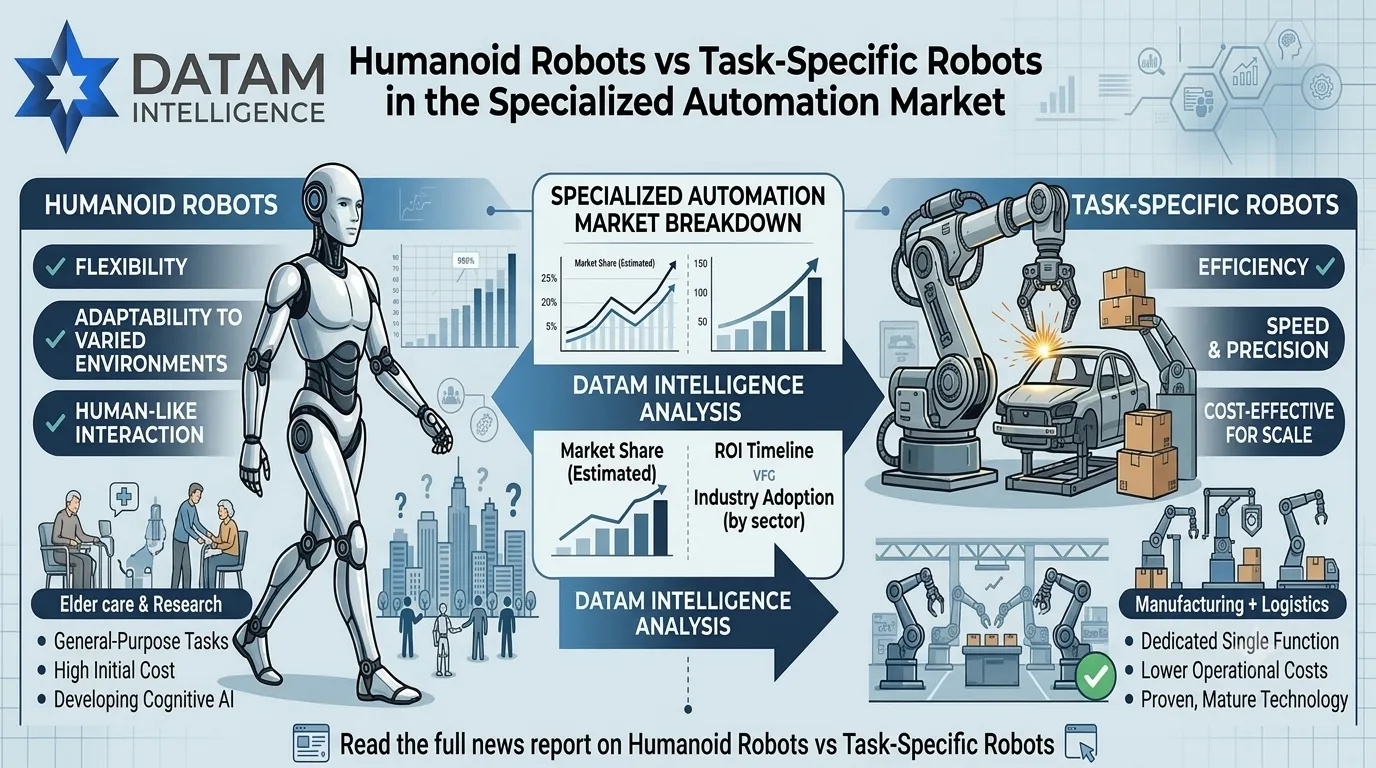
The global robotics industry is entering a critical phase as businesses move beyond technology demonstrations and focus on practical automation value. While humanoid robots continue to capture investor attention and public interest, task-specific robots designed for targeted industrial applications may become the faster path to commercial adoption.
Industry experts suggest that the future of robotics may not depend on creating machines that look like humans, but on developing intelligent systems that solve specific operational challenges with greater efficiency, reliability, and economic value.
For enterprises investing in automation, the key question is shifting from “Can robots replicate humans?” to “Can robots deliver measurable business outcomes?”
Unlock the Future of Intelligent Automation: Get the Humanoid Robot Market Report
The global humanoid robot market is projected to reach an astronomical US$ 58.93 billion by 2033, growing at a staggering CAGR of 43.83%. Equip your business with critical geographic insights, competitive landscape analysis, and technological milestones driving the next era of automation.Get Market Report Insights
Humanoid Robot Hype Accelerates, But Commercial Adoption Remains the Challenge
Humanoid robots have become one of the most visible areas of artificial intelligence innovation. Advances in AI models, sensors, computer vision, batteries, and robotic hardware are enabling machines that can walk, interact with environments, and perform increasingly complex tasks.
Technology companies and robotics startups are investing heavily in humanoid platforms because human-shaped robots could potentially operate in environments already designed for people, including warehouses, factories, hospitals, and service locations.
However, enterprise adoption depends on more than impressive demonstrations.
Companies evaluating humanoid robots must consider:
- Total cost of ownership
- Reliability during long-duration operations
- Maintenance requirements
- Safety compliance
- Energy efficiency
- Integration with existing workflows
- Return on investment
According to robotics industry analysts, pilot projects are important for testing these factors, but widespread deployment requires proof that humanoid robots can deliver consistent operational benefits at scale.
Task-Specific Robots Gain Advantage Through Practical Business Value
While humanoid robots represent the future vision of general-purpose automation, specialized robots are already delivering measurable value across industries.
Task-specific robots are designed around a particular workflow, allowing companies to optimize performance, reduce complexity, and improve productivity.
Examples include:
- Autonomous mobile robots (AMRs) for warehouses
- Robotic arms for manufacturing
- Automated picking and sorting systems
- Inspection robots
- Agricultural automation systems
- Healthcare assistance robots
These systems succeed because they are engineered around specific business problems rather than attempting to replicate human capabilities.
For many industrial environments, a robot does not need human-like movement. It needs to complete a defined task faster, safer, and at a lower cost.
Why Enterprises May Prefer Specialized Robotics Solutions
Enterprise adoption of robotics is increasingly driven by business outcomes rather than technological innovation alone. While humanoid robots represent an ambitious vision for the future of automation, many organizations are currently prioritizing specialized robotic systems that can address specific operational challenges with predictable performance, faster implementation, and measurable returns.
For enterprise buyers, the primary evaluation criteria include productivity improvements, operational efficiency, scalability, safety, and total cost of ownership. Task specific robotics solutions are designed around clearly defined workflows, allowing companies to achieve automation benefits without the complexity associated with developing fully general-purpose robotic systems.
1. Faster Deployment and Seamless Integration
One of the key advantages of specialized robotics solutions is their ability to be deployed quickly within existing business environments. Unlike general-purpose humanoid robots that may require extensive testing, adaptation, and infrastructure adjustments, task-specific robots are engineered for particular applications and operational conditions.
These systems can often integrate directly with existing:
- Manufacturing production lines
- Warehouse management systems
- Logistics operations
- Inspection processes
- Material handling workflows
Faster deployment allows enterprises to reduce implementation timelines, minimize operational disruption, and begin realizing automation benefits sooner.
2. Lower Operational Complexity
Specialized robots are designed with focused capabilities that match specific tasks, reducing the technical complexity involved in deployment and maintenance.
For example, a warehouse robot optimized for inventory movement does not require the advanced mobility, decision-making, and human-like adaptability expected from a humanoid platform. Similarly, an industrial robotic arm designed for precision assembly can perform repetitive operations with high accuracy without requiring unnecessary features.
This focused approach enables enterprises to benefit from:
- Simplified programming and management
- Easier workforce integration
- Reduced maintenance requirements
- More predictable operational performance
3. Clearer Return on Investment (ROI) Measurement
Enterprise technology investments are increasingly evaluated through measurable business impact. Task-specific robotics solutions provide clearer performance metrics because their objectives are directly linked to specific operational goals.
Businesses can assess improvements across key performance indicators, including:
Production Output:
Robots can increase throughput by performing repetitive tasks consistently with high precision and minimal interruptions.
Labor Efficiency:
Automation enables employees to focus on higher-value activities while robots handle repetitive, physically demanding, or time-sensitive operations.
Workplace Safety Improvements:
Robotic systems can reduce employee exposure to hazardous environments, heavy lifting, and repetitive strain activities.
Downtime Reduction:
Reliable automation systems help maintain consistent operations and reduce productivity losses caused by manual process limitations.
Cost Savings:
Improved efficiency, reduced errors, and optimized resource utilization can contribute to long-term operational savings.
4. Higher Reliability and Consistent Performance
Reliability remains one of the most important factors influencing enterprise robotics adoption. Industrial automation has achieved widespread success because machines are optimized to perform specific tasks repeatedly with accuracy and consistency.
Task-specific robots are built around controlled environments and predefined objectives, enabling them to deliver:
- High operational accuracy
- Consistent task execution
- Reduced process variation
- Improved quality control
- Long-term productivity benefits
While humanoid robots may eventually provide greater flexibility, specialized robotics systems currently offer enterprises a proven path toward automation by combining reliability with practical business value.
Enterprise Outlook
As the robotics market evolves, enterprises are likely to adopt a combination of specialized and humanoid robotic systems based on their operational requirements. In the near term, task-specific robots are positioned to lead commercial adoption because they provide immediate solutions to business challenges while delivering measurable efficiency gains and stronger ROI.
The Future Robotics Market May Become a Hybrid Ecosystem
The competition between humanoid robots and task specific robots may not result in a single winner.
Instead, the robotics market is likely to develop into a hybrid ecosystem where different robot types serve different purposes.
Humanoid robots may become valuable in environments requiring:
- Human like mobility
- Flexible manipulation
- Operation with existing tools
- Adaptation to changing environments
Meanwhile, specialized robots may continue dominating:
- Manufacturing
- Logistics
- Warehousing
- Agriculture
- Industrial inspection
The future of automation may depend on matching the right robot design with the right business requirement.
AI and Physical Robotics Create a New Automation Era
The combination of artificial intelligence and robotics is creating a new category known as physical AI intelligent machines capable of sensing, learning, and acting in real-world environments.
Unlike traditional automation systems that perform fixed programmed tasks, modern AI-powered robots are becoming increasingly adaptable through improved perception and learning capabilities.
This transformation could expand robotics beyond traditional factories into sectors including:
- Healthcare
- Retail
- Construction
- Logistics
- Consumer services
- Hazardous environments
Investment Focus Shifts From Robotics Demonstrations to Real-World Performance
Investors and enterprise customers are increasingly evaluating robotics companies based on practical deployment metrics rather than futuristic demonstrations.
The most important success factors include:
- Commercial scalability
- Hardware reliability
- Software intelligence
- Manufacturing capability
- Customer adoption
- Long-term economics
The robotics companies that succeed will likely be those that combine advanced AI capabilities with solutions that solve immediate operational challenges.
Are task-specific robots better than humanoid robots?
Task specific robots are currently better suited for many enterprise applications because they are designed for specific workflows, deliver higher reliability, and provide clearer ROI. Humanoid robots may become valuable for flexible environments in the future, but specialized robots are expected to lead near-term industrial automation adoption.
Why are task-specific robots gaining popularity over humanoid robots?
Task specific robots are gaining popularity because enterprises are prioritizing practical automation solutions that improve productivity, reduce operational costs, and deliver faster returns. Their focused design makes them easier to integrate, maintain, and scale compared with general-purpose humanoid robots.
Industry Analyst Perspective
The robotics market is moving from an era of technological experimentation toward an era of business-driven automation.
The winners will not necessarily be the companies building the most human-like robots. They will be the companies creating robotic systems that deliver measurable improvements in productivity, safety, and operational efficiency.
For enterprises, the future robotics strategy should focus on solving real-world problems rather than following technology trends alone.
Key Takeaways
- Humanoid robots represent the future vision of automation, offering potential for flexible, human-like interaction across multiple industries.
- Task specific robots may achieve faster market adoption because they deliver immediate business value through improved efficiency, reliability, and measurable ROI.
- Enterprise robotics decisions are shifting from technology hype to practical outcomes, with companies prioritizing productivity, cost reduction, and operational performance.
- Artificial intelligence advancements will accelerate robotics innovation, enabling smarter, more adaptive machines capable of handling complex real-world environments.
- The future robotics ecosystem will likely include both specialized robots and humanoid platforms, with each serving different industry needs and applications.
- Successful robotics companies will be those that combine AI capabilities with practical solutions that address real business challenges.
News source: https://www.forbes.com/sites/garydrenik/2026/07/09/humanoid-robots-get-the-hype-task-specific-robots-may-win-the-market/