


EU Announces $11.4 Billion AI Gigafactory Investment
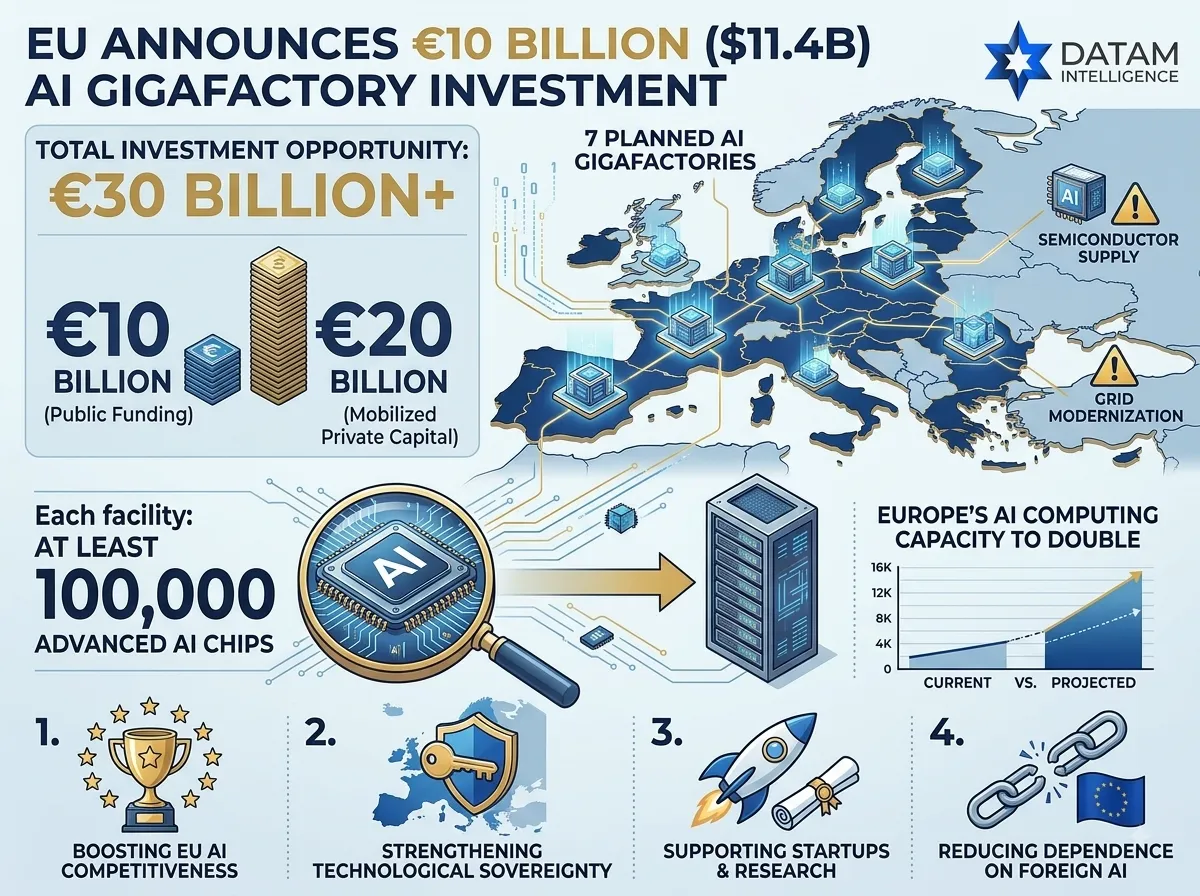
The European Union is stepping up its push to become a major global artificial intelligence infrastructure hub with a €10 billion ($11.4 billion) funding plan for up to seven AI gigafactories.
Announced by the European Commission on July 30, 2026, the initiative is designed to accelerate Europe’s access to large-scale computing infrastructure and strengthen its position in the global AI race against the United States and China. The Commission also expects the public funding to mobilize approximately €20 billion ($22.8 billion) in additional private investment, potentially taking the overall investment opportunity to around €30 billion.
Explore the AI Data Centers Market Report
Get actionable insights into market growth, emerging trends, investment opportunities, key players, and competitive dynamics through 2035. Explore the full AI Data Centers Market Report and Request a Sample Report Today!
The move represents a broader shift in European AI policy from supporting AI research and startups toward building the physical infrastructure required to train and deploy increasingly complex AI models.
What Are EU AI Gigafactories?
The planned AI gigafactories are large-scale computing facilities designed to provide the infrastructure required for advanced AI model development and deployment.
Each facility is expected to contain at least 100,000 advanced AI chips, making the planned installations roughly four times more powerful than the EU’s existing AI data-center infrastructure. Once all seven facilities are operational, Europe’s overall AI computing capacity is expected to more than double.
The European Commission defines an AI gigafactory as a large-scale facility capable of supporting the AI lifecycle from model development through large-scale inference with AI-optimized computing capacity, high-capacity storage and networking, secure cloud access and specialized AI support infrastructure.
This makes the initiative strategically important beyond conventional data-center expansion.
Why Is Europe Investing in AI Gigafactories?
Europe has been attempting to reduce its dependence on foreign technology providers while increasing domestic access to advanced computing resources.
The European Commission has identified large-scale AI computing as strategically important for maintaining competitiveness in critical industries and scientific research. Its AI infrastructure strategy is also intended to provide startups, researchers and industrial companies with access to computing resources that would otherwise be difficult or expensive to secure independently.
The latest gigafactory initiative therefore addresses several challenges simultaneously:
- Increasing access to frontier AI computing capacity
- Supporting European AI startups and enterprises
- Strengthening AI research infrastructure
- Reducing dependence on foreign AI infrastructure
- Attracting private investment into European AI
- Supporting Europe’s technology sovereignty
- Expanding the region’s AI data-center ecosystem
EU AI Infrastructure Investment Could Unlock Private Capital
The €10 billion public commitment is particularly significant because the European Commission expects it to attract an additional €20 billion in private investment.
This creates opportunities across the broader AI infrastructure value chain not only for AI model developers but also for semiconductor suppliers, data-center operators, networking companies, cloud infrastructure providers power-management companies, cooling technology providers and other infrastructure vendors.
For investors, the development signals that AI infrastructure is increasingly being treated as a strategic industrial asset rather than simply a technology-services category.
The investment model could also help reduce the capital burden associated with building frontier-scale AI computing facilities, where semiconductor procurement, power availability, networking, cooling and data-center construction can require substantial upfront investment.
Europe’s AI Competitiveness Challenge
The EU’s investment comes as Europe continues to face a significant infrastructure and investment gap relative to the United States and China.
The European Commission has highlighted the region’s dependence on foreign cloud and AI computing providers, while electricity and infrastructure costs remain important competitive considerations. The bloc’s five largest cloud service providers are all American, according to a European Commission report cited in recent reporting.
The challenge is therefore not simply about building more data centers.
Europe must also secure access to advanced AI accelerators, reliable energy, high-performance networking, storage, cooling systems and software ecosystems capable of supporting large-scale AI workloads.
This makes the gigafactory program part of a much broader competition over the AI infrastructure stack.
AI Chips Remain a Critical Dependency
Although the planned gigafactories are designed to strengthen European technological sovereignty, building computing facilities does not automatically eliminate dependence on non-European semiconductor suppliers.
Advanced AI accelerators remain concentrated among a relatively small group of global chip designers and manufacturers. Consequently, the success of Europe’s infrastructure strategy will depend not only on how many gigafactories are built but also on the availability, performance and supply-chain resilience of the chips deployed inside them.
This creates potential opportunities for European semiconductor development, AI accelerator innovation and advanced computing technologies over the longer term.
The January 2026 EU regulation establishing the framework for AI gigafactories explicitly links the facilities to strategic autonomy and places emphasis on secure, sustainable energy and water infrastructure.
Power and Energy Infrastructure Could Become a Major Bottleneck
The next phase of the AI infrastructure race will increasingly depend on access to electricity.
Large AI computing clusters require significant amounts of power, and their expansion can place additional pressure on electricity grids, transmission infrastructure and cooling systems.
For Europe, this creates a parallel investment opportunity in:
- Renewable power generation
- Grid modernization
- Energy storage
- Data-center cooling
- Power management
- High-voltage infrastructure
- Energy-efficient AI computing
- Sustainable data-center technologies
The location of future AI gigafactories could therefore become an important strategic consideration, with access to reliable and competitively priced electricity potentially influencing project economics as much as access to chips and connectivity.
What the EU AI Gigafactory Plan Means for Businesses
For businesses developing AI applications, greater access to large-scale computing could reduce one of the major barriers to AI development: access to high-performance infrastructure.
Startups and research organizations could gain access to computing capacity for training and deploying advanced models without having to independently finance entire large-scale infrastructure clusters.
For established enterprises, the expansion could increase opportunities to develop AI applications in sectors such as manufacturing, healthcare, financial services, automotive, energy, telecommunications and scientific research.
The initiative could also encourage partnerships between AI companies, semiconductor firms, cloud providers, universities, research institutions and infrastructure operators.
Investment Opportunities Across the AI Infrastructure Ecosystem
The EU’s AI gigafactory strategy could have implications well beyond AI software.
Potential beneficiaries of the broader investment cycle include:
AI accelerator and semiconductor companies: Demand for advanced computing processors could increase as European AI infrastructure expands.
Data-center infrastructure providers: Gigafactory construction could drive demand for servers, networking, storage, cooling and power-management systems.
Cloud and AI infrastructure companies: Additional computing capacity could support the expansion of AI-as-a-service and enterprise AI platforms.
Energy and utilities companies: Large-scale AI facilities could create additional demand for reliable power generation and grid capacity.
Cooling and thermal-management providers: High-density AI computing increases the importance of advanced cooling technologies.
AI software and model developers: Increased access to computing capacity could lower infrastructure barriers for training and deploying sophisticated models.
Europe’s AI Strategy Is Moving From Policy to Physical Infrastructure
The significance of the EU’s latest announcement lies in its scale.
Europe is no longer approaching AI competitiveness solely through regulation, research funding or startup support. The bloc is increasingly treating computing capacity, data centers, semiconductor access and energy infrastructure as strategic components of AI competitiveness.
The seven planned gigafactories are expected to more than double the EU’s existing AI computing capacity when completed.
However, the ultimate impact will depend on execution.
Building facilities is only one part of the equation. Europe will need to secure advanced chips, affordable electricity, efficient cooling, high-speed networking, skilled technical talent and sufficient demand from businesses and researchers.
Analyst View
The EU’s $11.4 billion AI gigafactory commitment represents a significant transition in the global AI infrastructure market.
The immediate opportunity is not limited to AI model development. It extends across semiconductors, data centers, cloud computing, energy infrastructure, cooling systems, networking, cybersecurity and AI services.
From an investment perspective, the planned €20 billion in additional private capital could be particularly important because it may accelerate the development of an interconnected European AI infrastructure ecosystem.
The key metric to watch will not simply be the number of gigafactories announced. It will be how quickly these facilities become operational, how effectively their computing capacity is utilized, and whether they generate sustainable commercial value for European businesses and AI developers.
If successfully implemented, the initiative could strengthen Europe’s position in the global AI infrastructure race and create a substantial new investment cycle across the region’s technology ecosystem.
Key Takeaways
- The EU plans to commit €10 billion ($11.4 billion) to support up to seven AI gigafactories.
- The European Commission aims to attract another €20 billion ($22.8 billion) in private investment.
- Each gigafactory is planned to contain at least 100,000 advanced AI chips.
- The seven facilities could more than double Europe’s existing AI computing capacity.
- The initiative is designed to strengthen Europe’s AI competitiveness and technological sovereignty.
- Semiconductor supply, electricity, cooling, networking and data-center infrastructure will remain critical to execution.
- The investment could create opportunities across the wider AI infrastructure and semiconductor ecosystem.
- Europe’s ability to convert new computing capacity into commercially useful AI applications will be a key measure of success.
Frequently Asked Questions
How much is the EU investing in AI gigafactories?
The EU is providing €10 billion, approximately $11.4 billion, in funding for up to seven AI gigafactories. The European Commission aims to attract another €20 billion from private investors.
How many AI gigafactories will Europe build?
The European Union plans to support up to seven AI gigafactories across the bloc.
How many AI chips will each gigafactory contain?
Each planned gigafactory is expected to have at least 100,000 advanced AI chips, making the facilities substantially larger than current EU AI data-center infrastructure.
Why is the EU building AI gigafactories?
The initiative aims to increase access to large-scale AI computing, strengthen European technological sovereignty, support AI startups and researchers, and improve Europe’s competitiveness with the United States and China.
What industries could benefit from EU AI infrastructure investment?
Potential beneficiaries include AI software companies, semiconductor manufacturers, cloud providers, data-center operators, networking companies, energy providers, cooling technology companies and enterprises developing AI applications.
What are the biggest challenges for European AI gigafactories?
Key challenges include access to advanced AI chips, electricity availability and cost, data-center construction, cooling, networking, supply-chain resilience, skilled talent and effective utilization of computing capacity.
News source: https://canada.constructconnect.com/dcn/news/technology/2026/08/eu-lays-out-11-4-billion-for-7-ai-gigafactories-as-it-aims-to-catch-up-with-us-and-china