


The global automotive semiconductor industry is undergoing a technological transformation, with semiconductors emerging as the critical enabler behind electric mobility, intelligent safety systems, vehicle connectivity, and software-defined architectures. As automakers race to deliver smarter and more efficient vehicles, semiconductor demand across the automotive value chain continues to accelerate.
Recent industry discussions highlighted how semiconductor technologies are driving innovation in electrification, advanced driver assistance systems (ADAS), digital vehicle platforms, and connected mobility ecosystems. Automotive chipmakers are increasingly focused on delivering high-performance computing, power management, sensing, and communication solutions that support the next generation of vehicles.
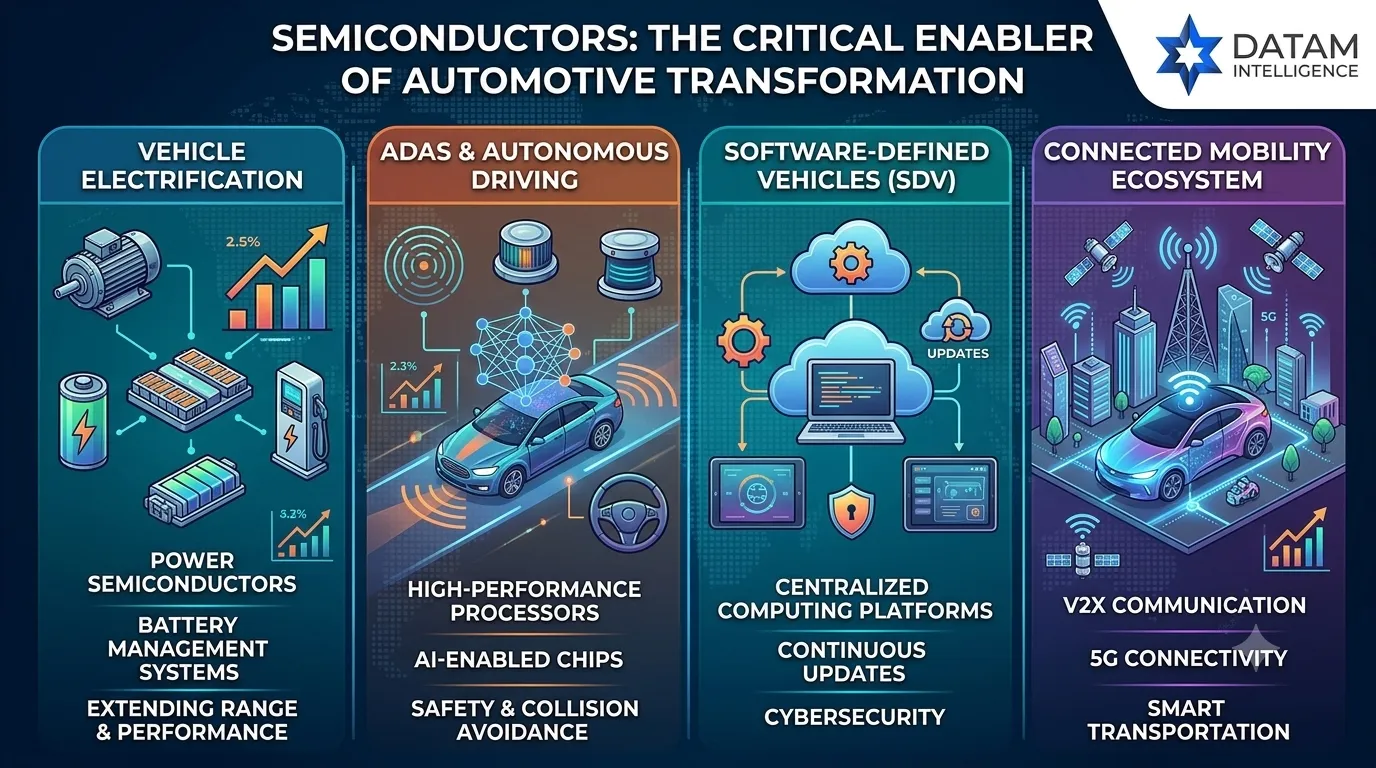
Semiconductors at the Core of Vehicle Electrification
Electric vehicles require significantly more semiconductor content than conventional internal combustion engine vehicles. Power semiconductors are essential for battery management systems, electric powertrains, onboard chargers, energy conversion, and thermal management functions.
As global EV adoption rises, automotive manufacturers are increasing investments in advanced semiconductor technologies that improve battery efficiency, extend driving range, and enhance charging performance. These innovations are helping manufacturers meet consumer expectations for performance while supporting sustainability goals.
The expansion of EV production facilities and battery manufacturing ecosystems is expected to create substantial opportunities for semiconductor suppliers serving automotive OEMs and Tier-1 component manufacturers.
ADAS and Autonomous Driving Increase Chip Demand
Advanced driver assistance systems have become a major growth driver for automotive semiconductors. Features such as adaptive cruise control, lane-keeping assistance, collision avoidance, driver monitoring, and automated parking rely on high-performance processors, sensors, and AI-enabled chips.
The growing shift toward autonomous and semi-autonomous driving is increasing the computational requirements inside vehicles. Modern vehicles require advanced semiconductor architectures capable of processing data from cameras, radar, lidar, and other sensors in real time.
As regulatory authorities and consumers prioritize vehicle safety, semiconductor-powered ADAS technologies are expected to become standard across passenger and commercial vehicle segments.
Rise of Software-Defined Vehicles
Software-defined vehicles (SDVs) represent one of the most significant shifts in automotive engineering. Unlike traditional vehicles, SDVs depend on centralized computing platforms and continuous software updates to improve functionality throughout a vehicle's lifecycle.
This transformation requires powerful automotive processors, connectivity modules, memory devices, and cybersecurity solutions. Semiconductor companies are increasingly collaborating with automakers to create scalable computing platforms capable of supporting evolving software ecosystems.
The transition toward SDVs is expected to reshape automotive electronics architecture and create new revenue opportunities across the semiconductor industry.
Connected Mobility Creates New Growth Opportunities
Connected vehicles are becoming integral to smart transportation ecosystems. Automotive semiconductors enable vehicle-to-vehicle (V2V), vehicle-to-infrastructure (V2I), infotainment, telematics, navigation, and over-the-air software updates.
The expansion of 5G networks and edge computing capabilities is accelerating connected car development, allowing vehicles to communicate more efficiently with surrounding infrastructure and cloud-based systems. These advancements are improving safety, traffic management, and user experiences.
As automotive connectivity becomes more sophisticated, demand for communication chipsets, sensors, processors, and cybersecurity technologies is expected to increase significantly.
Supply Chain Resilience Becomes Strategic Priority
The automotive chip shortages experienced in recent years exposed vulnerabilities within global semiconductor supply chains. Since then, governments and manufacturers have intensified efforts to localize semiconductor production and diversify sourcing strategies.
Several countries are investing in domestic semiconductor manufacturing capabilities to strengthen supply chain resilience and reduce dependency on external suppliers. These initiatives are expected to support long-term growth in the automotive semiconductor market while enhancing industry stability.
Analyst View
The convergence of electrification, autonomous driving, connected mobility, and software-defined vehicle technologies is positioning semiconductors as one of the most strategic components within the automotive industry. As vehicle intelligence continues to increase, semiconductor content per vehicle is expected to rise substantially, creating strong opportunities for chip manufacturers, automotive OEMs, technology providers, and investors.
With automakers prioritizing innovation, safety, and sustainability, the automotive semiconductor market is set to remain a critical growth segment within the broader mobility ecosystem over the coming decade.
Explore the Automotive Semiconductor Market
For deeper market insights, competitive analysis, growth forecasts, and investment opportunities, explore the Automotive Semiconductor Market research study from DataM Intelligence.
Request a sample report to evaluate Automotive Semiconductor Market size, technology trends, regional outlook, key players, and future growth opportunities in the automotive semiconductor industry.
News source: https://auto.economictimes.indiatimes.com/videos/how-semiconductors-are-powering-the-future-of-automotive-technology/132660194