


Healthcare AI Trends 2026: Predictive Analytics and Personalized Care Drive Industry Transformation
The healthcare industry is entering a new era where artificial intelligence is moving beyond experimental deployments to become a foundational component of patient care, clinical decision-making, and healthcare operations. As healthcare systems face growing pressure from aging populations, chronic disease burdens, workforce shortages, and rising operational costs, AI-powered technologies are emerging as a critical enabler of more efficient, personalized, and proactive care delivery.
Industry experts believe 2026 will mark a significant acceleration in the shift from reactive healthcare models toward prevention-focused, insight-driven patient care. Advanced analytics, predictive intelligence, and behavioral data are increasingly helping healthcare providers identify health risks earlier, improve patient engagement, and optimize resource allocation across healthcare networks.
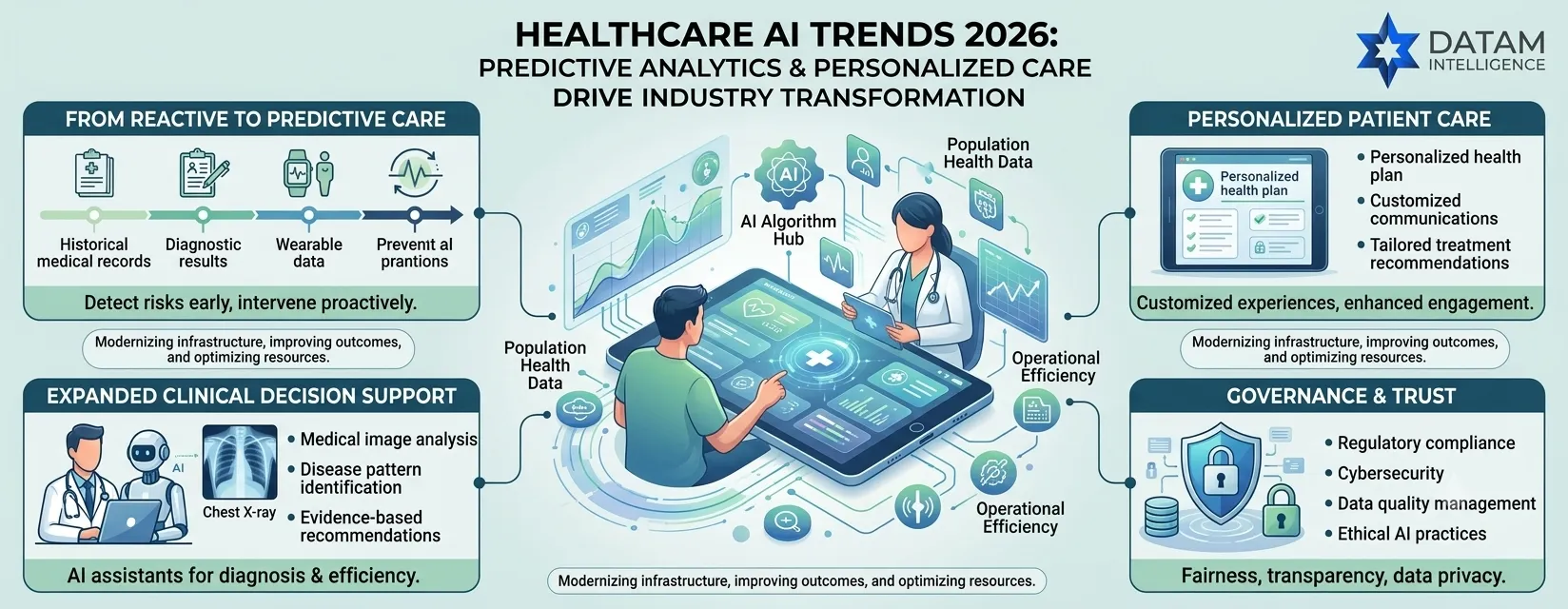
From Reactive Care to Predictive Healthcare
For decades, healthcare systems have largely operated by responding to illness after symptoms become severe. However, advancements in AI and predictive analytics are enabling providers to detect risk patterns earlier and intervene before conditions escalate.
Machine learning models can analyze vast amounts of patient data, including medical histories, diagnostic results, wearable device data, and population health information, to identify individuals at elevated risk of chronic diseases, cardiovascular events, and other health complications. This proactive approach supports earlier interventions and more effective preventive care strategies.
Healthcare leaders increasingly view predictive intelligence as a cornerstone of future care delivery, helping organizations improve outcomes while reducing long-term treatment costs.
Personalized Patient Care Becomes a Strategic Priority
The rise of consumer-driven healthcare is reshaping patient expectations. Patients increasingly demand healthcare experiences that mirror the convenience, personalization, and accessibility offered by digital-first industries.
AI-powered platforms are helping healthcare organizations deliver personalized communications, customized treatment recommendations, and tailored engagement strategies based on individual patient needs and behaviors. Predictive models can anticipate patient requirements, streamline appointment scheduling, and improve care coordination across multiple touchpoints.
As healthcare providers compete to improve patient satisfaction and retention, personalized digital experiences are becoming a key differentiator.
AI Expands Clinical Decision Support
Artificial intelligence is also strengthening clinical decision-making by providing healthcare professionals with data-driven insights at the point of care.
Modern AI systems can assist clinicians in analyzing medical images, identifying disease patterns, summarizing patient histories, and generating evidence-based recommendations. Rather than replacing healthcare professionals, these technologies are increasingly serving as intelligent assistants that enhance diagnostic accuracy and operational efficiency.
Healthcare experts emphasize that successful AI adoption depends on maintaining human oversight, transparency, and trust throughout clinical workflows.
Healthcare Organizations Focus on AI Governance and Trust
While AI adoption continues to accelerate, healthcare leaders recognize that technology alone cannot deliver sustainable transformation.
Organizations are investing heavily in governance frameworks, regulatory compliance, cybersecurity, data quality management, and ethical AI practices. Ensuring fairness, transparency, explain ability, and patient privacy remains essential for maintaining trust among clinicians, patients, and regulators.
Healthcare providers are increasingly prioritizing responsible AI deployment strategies that align innovation with patient safety and regulatory requirements.
Digital Transformation Drives Healthcare Modernization
The growing adoption of AI is also fueling broader healthcare modernization initiatives. Healthcare organizations are upgrading legacy systems, improving interoperability, and investing in data infrastructure capable of supporting advanced analytics and intelligent automation.
Industry analysts note that AI readiness depends on strong digital foundations, including secure data management, integrated healthcare records, and scalable cloud-based architectures.
These investments are expected to create long-term operational efficiencies while enabling future innovations in virtual care, precision medicine, genomics, and patient engagement technologies.
Outlook: AI Becomes Central to Healthcare's Future
As healthcare systems continue to evolve, AI is emerging as a strategic technology that extends far beyond automation. The convergence of predictive analytics, personalized medicine, behavioral intelligence, and digital engagement is creating a more proactive and patient-centered healthcare ecosystem.
Organizations that successfully balance innovation with governance, transparency, and trust are expected to lead the next phase of healthcare transformation. In 2026, AI is no longer viewed as a future possibility—it is becoming an essential driver of insight-driven patient care and sustainable healthcare delivery worldwide.
How is AI transforming healthcare in 2026?
Artificial intelligence is transforming healthcare in 2026 by enabling predictive analytics, personalized patient care, intelligent clinical decision support, and proactive disease prevention. Healthcare organizations are using AI to improve patient outcomes, optimize operations, enhance patient engagement, and support data-driven medical decisions while maintaining governance, transparency, and regulatory compliance.
Download the Full Healthcare AI Market Intelligence Report
Gain exclusive insights into AI adoption trends, predictive healthcare technologies, digital health transformation strategies, market opportunities, competitive analysis, and investment outlook shaping the future of healthcare.
News source: https://www.capgemini.com/gb-en/insights/expert-perspectives/trends-in-2026-for-healthcare-how-is-ai-making-insight-driven-patient-care-a-reality/