


The Real Race in Humanoid Robotics Is Happening Beneath the Surface
The global humanoid robot market is entering a transformative growth phase. While much of the public attention remains focused on robot manufacturers and high-profile demonstrations, the true value creation opportunity lies within the technologies that power these machines.
Humanoid robots are increasingly moving from pilot programs into manufacturing facilities, logistics centers, healthcare environments, retail operations, and commercial workplaces. As deployment scales, subsystem innovation is becoming the primary factor determining performance, reliability, safety, and cost competitiveness. According to DataM Intelligence analysis, the global humanoid robot market is expected to grow from US$3.22 billion in 2025 to US$58.93 billion by 2033, reflecting strong enterprise demand for intelligent automation solutions.
For investors, OEMs, technology providers, and enterprise adopters, understanding the evolution of humanoid robot subsystems is becoming essential for identifying future market leaders.
Tap into a $58B+ Market Opportunity
The humanoid robot market is explosive, expanding at a remarkable CAGR of 43.83%. Don't get left behind by the next wave of automation. Download the full 2026-2033 Market Forecast Report today to unlock crucial data on dominating segments, regional growth leaders, and key investment trends.
Access the 2026-2033 Market Report.
Why Subsystems Will Define the Next Generation of Humanoid Robots
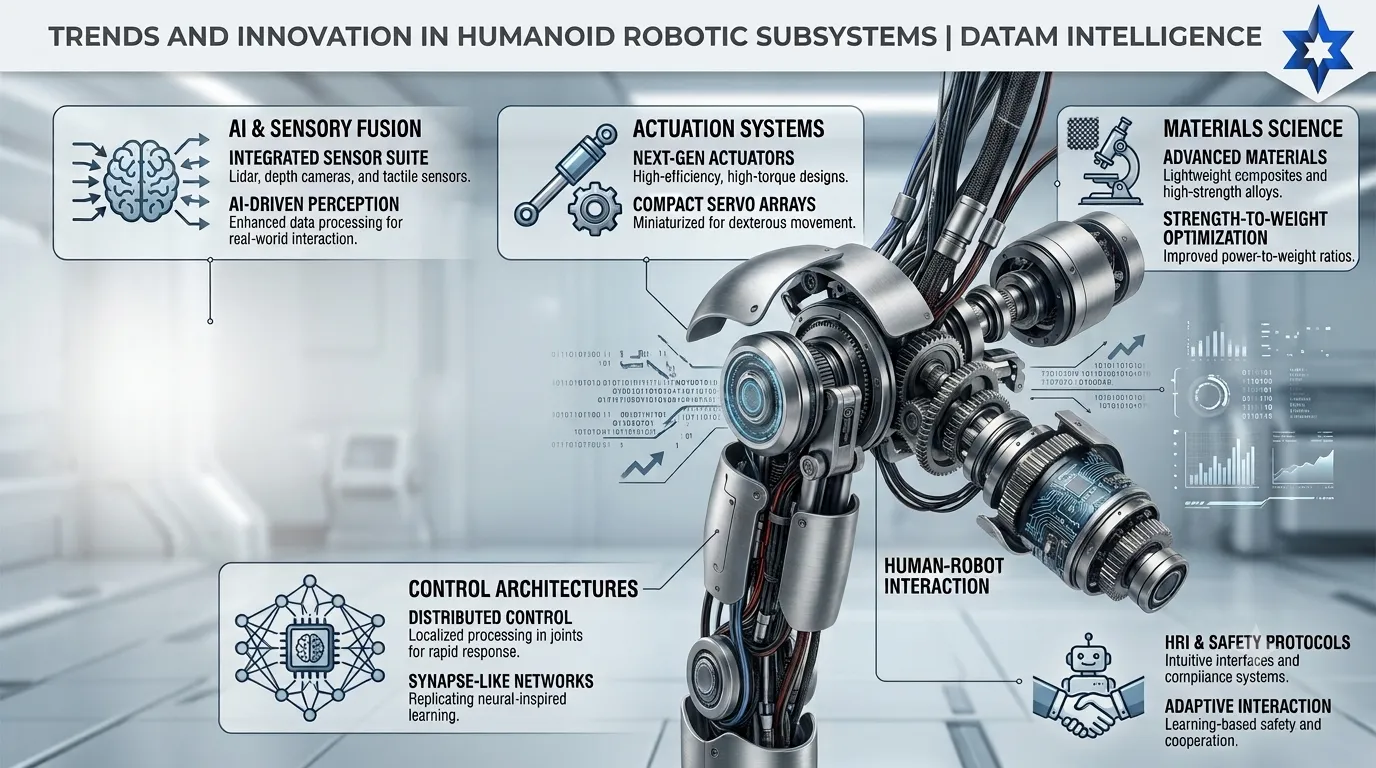
Every humanoid robot depends on a complex ecosystem of integrated technologies that enable movement, perception, decision-making, manipulation, and human interaction.
Industry analysis indicates that five core hardware domains actuation, sensing, computing, structural systems, and batteries account for the majority of humanoid robot costs and performance differentiation. Actuators alone represent approximately 40% - 60% of a humanoid robot's bill of materials, making them the single most valuable subsystem category.
As competition intensifies, manufacturers are increasingly investing in subsystem optimization to achieve:
- Higher autonomy
- Lower operational costs
- Extended battery life
- Improved dexterity
- Enhanced safety
- Faster commercialization
The companies that solve these subsystem challenges will likely shape the future of the humanoid robotics ecosystem.
1. Smart Actuators Are Becoming the Largest Value Driver
Actuators function as the muscles of humanoid robots, converting software commands into physical movement. They control walking, balancing, lifting, gripping, climbing, and manipulation tasks.
As enterprises demand robots capable of operating in human-designed environments, actuator performance is becoming a critical purchasing consideration.
Key Innovations Driving Growth
- High torque-density motors
- Harmonic and cycloidal reducers
- Integrated servo systems
- Electromechanical actuators
- Precision motion control platforms
- Lightweight actuator architectures
The latest actuator technologies are enabling smoother movement, greater energy efficiency, and improved durability while reducing overall system weight. Industry supply chain analysis suggests that actuator innovation will remain one of the strongest growth opportunities throughout the forecast period.
Actuators are the most important humanoid robot subsystem because they enable movement, balance, lifting, and manipulation. They account for up to 60% of robot hardware costs and play a critical role in determining robot performance, efficiency, and commercial viability.
2. Multimodal Sensor Fusion Is Transforming Robot Perception
For humanoid robots to operate safely alongside humans, they must continuously understand their surroundings.
Traditional camera-based vision systems are evolving into sophisticated multimodal perception platforms that combine multiple sensor technologies.
Emerging Sensor Technologies
- High-resolution RGB cameras
- Depth sensing cameras
- LiDAR systems
- Radar sensors
- Force-torque sensors
- Tactile sensing arrays
- Inertial measurement units (IMUs)
Recent research highlights the growing importance of multi sensor fusion and machine learning for environmental understanding, object recognition, and human interaction. These systems allow robots to perceive dynamic environments with significantly greater accuracy than earlier generations.
Market Impact
Improved perception capabilities are accelerating humanoid robot adoption in:
- Manufacturing
- Warehousing
- Healthcare
- Retail
- Hospitality
- Public service environments
As robots become more autonomous, perception systems will remain a major area of investment across the robotics value chain.
3. Robotic Hands and Dexterity Are Unlocking New Applications
One of the most difficult challenges in robotics is replicating the dexterity of the human hand.
Most human environments from factories and hospitals to homes and offices are designed around human manipulation capabilities. As a result, robotic hands are becoming one of the most strategically important humanoid subsystems.
Recent advances include:
- Multi-finger dexterous grippers
- Tactile feedback systems
- Slip detection technology
- Force-sensitive fingertips
- AI-driven manipulation control
New robotic hand platforms now approach human-like levels of dexterity, enabling delicate handling tasks and more flexible automation capabilities. Advanced humanoid robots can increasingly manipulate tools, operate machinery, and interact with everyday objects.
Robotic hands are critical to humanoid robot adoption because they enable interaction with tools, equipment, and objects designed for human use. Advances in dexterity and tactile sensing are expanding humanoid robot applications across manufacturing, healthcare, logistics, and service industries.
4. Edge AI Computing Is Becoming the Robot Brain
Artificial intelligence is rapidly becoming the central intelligence layer powering humanoid robots.
Modern systems increasingly rely on edge computing architectures that process data locally rather than depending entirely on cloud infrastructure.
Advantages of Edge AI
- Real-time decision-making
- Reduced latency
- Enhanced privacy
- Greater operational reliability
- Improved safety performance
- Lower bandwidth requirements
The integration of large language models (LLMs), multimodal AI systems, and embodied intelligence platforms is significantly improving robot autonomy and adaptability. AI-driven decision-making is increasingly viewed as a primary competitive differentiator within the humanoid robotics industry.
Edge AI allows humanoid robots to process information locally and respond instantly to environmental changes. This improves safety, reduces latency, and enables autonomous operation in manufacturing, logistics, healthcare, and commercial environments.
5. Battery Innovation Is Accelerating Commercial Deployment
Despite rapid advances in artificial intelligence and robotics hardware, battery technology remains one of the industry's most significant constraints.
Humanoid robots require compact, lightweight, and high-capacity energy systems capable of supporting extended operational periods.
Key Battery Trends
- Solid-state batteries
- High-density lithium battery systems
- Fast-charging architectures
- Swappable battery packs
- Advanced thermal management
Improved battery performance directly impacts productivity, operating costs, and return on investment. As organizations move toward continuous robot deployment, energy storage innovation will become increasingly important to market growth.
Why It Matters
Longer operational runtimes allow humanoid robots to complete more tasks while reducing downtime and maintenance interruptions.
6. Whole-Body Motion Control Is Reaching New Levels of Sophistication
Walking, balancing, climbing stairs, lifting objects, and recovering from disturbances require highly advanced motion control systems.
Recent developments are improving robot mobility through:
- Reinforcement learning
- Predictive motion planning
- Real-time balance correction
- Digital twin simulation
- Whole-body coordination algorithms
These technologies are helping humanoid robots navigate complex environments while maintaining stability and efficiency.
The combination of advanced motion control and improved hardware design is expanding deployment opportunities in industrial and commercial settings.
7. Human-Robot Interaction Systems Are Becoming Enterprise Priorities
As humanoid robots increasingly operate alongside employees, customers, and patients, communication capabilities are becoming essential.
Modern systems are integrating:
- Natural language processing
- Voice interaction
- Gesture recognition
- Context awareness
- Emotional intelligence models
- Multimodal communication interfaces
The convergence of generative AI and robotics is creating more intuitive and productive human-machine interactions. These capabilities are expected to play a major role in healthcare, customer service, hospitality, education, and caregiving applications.
8. Safety Systems Are Emerging as a Competitive Differentiator
As humanoid robots become larger, stronger, and more autonomous, safety technologies are moving to the forefront of industry development.
Key areas of innovation include:
- Collision avoidance systems
- Environmental risk detection
- Redundant control architectures
- Fail-safe shutdown mechanisms
- Predictive safety monitoring
Industry stakeholders are actively developing new safety standards to support widespread deployment. Safety capabilities are expected to become a major purchasing criterion for enterprise customers over the next decade.
9. Specialized AI Chips and Robotics Processors Gain Momentum
The growing complexity of humanoid robot workloads is increasing demand for dedicated computing hardware.
Future robots will require processors capable of handling:
- Computer vision
- Sensor fusion
- Language understanding
- Motion planning
- Real-time control
The emergence of robotics-specific AI chips is helping improve performance while reducing energy consumption, making large-scale commercialization more feasible.
Strategic Outlook: Subsystem Innovation Will Shape the Winners of the Humanoid Robot Market
The humanoid robotics industry is entering a critical commercialization phase. While robot manufacturers attract significant attention, long-term market leadership will be determined by the companies enabling movement, perception, intelligence, energy management, manipulation, and safety.
The next decade will likely see intense competition across actuator technologies, sensing platforms, AI processors, robotic hands, battery systems, and edge computing architectures. These subsystems collectively determine robot performance, reliability, and total cost of ownership.
For technology suppliers, investors, enterprise adopters, and robotics startups, subsystem innovation represents one of the most attractive growth opportunities within the broader automation landscape.
As humanoid robots move from experimental deployments to mainstream enterprise adoption, the organizations building the foundational technologies behind these machines will play a defining role in shaping the future of intelligent automation. DataM Intelligence forecasts strong market expansion through 2033, supported by advances in AI, hardware efficiency, and growing commercial demand across multiple industries.
Analyst Perspective
The humanoid robotics market is shifting from a robot-centric narrative to a subsystem-driven growth model. Over the forecast period, the most significant value creation is expected to occur in actuation systems, AI computing platforms, advanced perception technologies, battery innovation, and dexterous manipulation solutions. Organizations that secure leadership positions within these enabling technologies are likely to capture disproportionate value as global humanoid robot adoption accelerates.