


Introduction: Why Battery Chemicals Are Now the Strategic Core of EV Manufacturing
Battery chemicals have moved from being a technical input to becoming one of the most strategic parts of the global electric vehicle and energy storage supply chain. In 2026, the competitiveness of an EV battery is no longer decided only by cell design or gigafactory scale. It is increasingly decided by access to high-purity lithium chemicals, stable cathode active materials, advanced electrolytes, synthetic graphite, silicon anode materials, separators, binders and recyclable battery-grade metals.
The reason is simple: electric vehicles and battery energy storage systems are expanding quickly, and every new gigafactory needs a secure chemical supply chain behind it. Global electric car sales exceeded 20 million units in 2025, representing around one-quarter of all new cars sold worldwide, according to the IEA’s 2026 EV outlook. At the same time, LFP batteries, sodium-ion batteries and solid-state batteries are changing the material mix required by cell manufacturers. LFP is reducing battery cost in many segments, sodium-ion is gaining attention as a supply-chain diversification route, and solid-state designs are increasing demand for next-generation electrolytes and lithium-metal materials.
This is why the keyword Top Battery Chemical Manufacturers has strong commercial and informational intent. Buyers, investors, battery companies, EV manufacturers and chemical producers are not only searching for company names. They are trying to understand which suppliers control critical materials, who has regional manufacturing capacity, which firms are investing in low-carbon battery chemicals, and which companies are positioned for the next decade of EV and energy storage growth.
For deeper market sizing, segmentation and competitive intelligence, this article should internally link to the Battery Chemicals Market Report as the pillar page.
Request for Exclusive Sample on Battery Chemical Market
Who Are the Top Battery Chemical Manufacturers in 2026?
The top battery chemical manufacturers in 2026 are Albemarle, SQM, Ganfeng Lithium, Tianqi Lithium, BASF, Umicore, POSCO Future M, LG Chem, Asahi Kasei and Mitsubishi Chemical. Together, these companies cover the most important parts of the battery materials value chain, including lithium carbonate, lithium hydroxide, cathode active materials, electrolyte chemicals, anode materials, separators, and advanced battery-grade chemical solutions.
These companies are important because no single battery chemistry can dominate every application. EV batteries, stationary storage, two-wheelers, grid batteries, hybrid vehicles and future solid-state batteries all require different chemical platforms. The companies listed here are not identical competitors. Some are lithium chemical leaders, some are cathode material specialists, some dominate separators or electrolytes, and others are integrated battery materials suppliers.
Global Battery Chemical Industry Overview
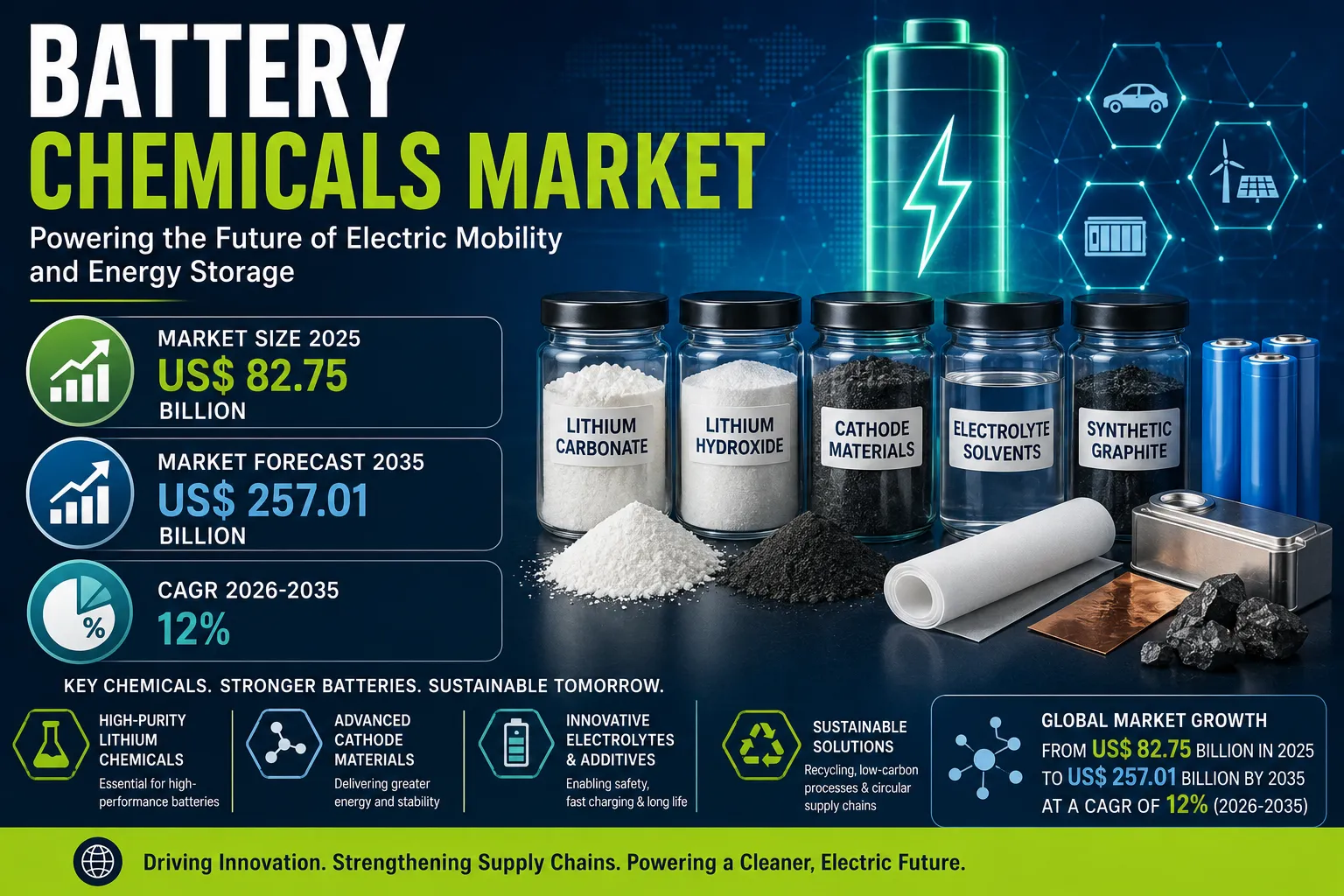
According to DataM Intelligence’s Battery Chemicals Market Report, the global battery chemicals market is estimated at US$82.75 billion in 2025 and is projected to reach US$257.01 billion by 2035, growing at a 12% CAGR during 2026–2035.
This growth is being driven by four structural changes:
First, EV manufacturing is moving from regional pilot scale to global industrial scale. Every new EV platform requires long-term supply agreements for lithium chemicals, cathode materials, separators, electrolytes and anode inputs.
Second, energy storage is becoming a second major demand center. Grid-scale battery energy storage systems are expanding the market beyond passenger vehicles and increasing demand for LFP, lithium iron phosphate materials and alternative chemistries.
Third, governments are treating battery materials as a strategic supply-chain priority. Critical minerals are now linked to energy security, economic resilience, AI infrastructure, defense and advanced manufacturing competitiveness.
Fourth, battery chemistry is diversifying. NMC, NCA, LFP, LMFP, sodium-ion, silicon-rich anodes and solid-state designs are creating a broader chemical opportunity than the traditional lithium-ion supply chain.
Why Battery Chemicals Matter More Than Ever
Battery performance depends on chemistry before it depends on branding. The most important chemical categories include:
Lithium chemicals: Lithium carbonate and lithium hydroxide are essential for lithium-ion battery cathode production. Lithium hydroxide is especially important for high-nickel cathodes, while lithium carbonate is widely used in LFP and other battery chemistries.
Cathode active materials: Cathodes determine battery capacity, voltage, cost and safety. NMC, NCA, LFP, LMFP and high-manganese cathode materials are among the most commercially important cathode platforms.
Electrolytes: Electrolytes enable ion movement between cathode and anode. Battery electrolyte manufacturers are becoming more important as fast charging, thermal stability, high voltage performance and solid-state development become critical.
Anode materials: Graphite remains the dominant anode material, but silicon anodes and lithium-metal anodes are gaining attention for higher energy density.
Separators: Separators prevent internal short circuits while allowing ion flow. High-performance separators are critical for battery safety, especially in EV and energy storage applications.
Binders and additives: These chemicals improve adhesion, conductivity, cycle life and manufacturing consistency. While smaller in volume, they are vital for cell reliability.
Request for Exclusive Sample on Battery Chemical Market
Top 10 Battery Chemical Manufacturers in the World 2026
1. Albemarle
Headquarters: Charlotte, North Carolina, USA
Revenue: Albemarle reported total net sales of approximately US$5.14 billion in 2025, with Energy Storage accounting for about US$3.02 billion of full-year net sales.
Albemarle is one of the world’s most important lithium chemical manufacturers and a critical supplier to the EV battery materials market. The company’s strength comes from its lithium resource base, refining capabilities and position in battery-grade lithium carbonate and lithium hydroxide. Albemarle supplies lithium products used across electric vehicles, energy storage, electronics and specialty applications.
Battery products: Battery-grade lithium carbonate, lithium hydroxide, lithium metal and lithium specialty materials. Albemarle states that its lithium carbonate and hydroxide products are derived from brine and hard-rock resources and support the battery value chain.
Major customers: Albemarle supplies global battery and energy storage value chains, although many customer agreements are confidential.
Recent expansion: Albemarle focused heavily on productivity, cash generation and portfolio optimization in 2025. The company achieved about US$450 million in cost and productivity improvements and reported strong cash flow conversion despite lithium price volatility.
Strengths:
Albemarle has one of the strongest global lithium positions, a large energy storage business and a strong reputation in high-purity lithium chemicals. Its global footprint makes it a key supplier for battery manufacturers seeking diversified lithium sourcing.
Weaknesses:
The company remains highly exposed to lithium price cycles. When lithium prices fall, revenue and margins can come under pressure even if long-term battery demand remains strong.
Future outlook:
Albemarle is likely to remain one of the most important lithium chemical suppliers through 2035. Its future growth will depend on lithium price recovery, capital discipline, resource development and the ability to support regionalized EV supply chains in North America, Europe and Asia.
2. SQM
Headquarters: Santiago, Chile
Revenue: SQM reported US$4.58 billion in 2025 revenue, with lithium and derivatives revenue of about US$2.29 billion.
SQM is one of the world’s leading lithium chemical manufacturers and a major producer of lithium carbonate and lithium hydroxide. Its operations in Chile place it at the center of the global lithium supply chain, particularly for battery-grade materials used in EV batteries and energy storage systems.
Battery products: Lithium carbonate, lithium hydroxide and lithium derivatives. SQM’s lithium carbonate is used in lithium-ion battery cathode materials, and the company produces lithium hydroxide at its Salar del Carmen plant.
Major customers: SQM serves global lithium-ion battery, cathode material, energy storage and industrial markets. Its customer base is broad and international.
Recent expansion: SQM reported record lithium sales volumes in 2025 and highlighted strong production at its Nova Andina lithium operations. The company also describes itself as having sales in more than 110 countries and commercial offices in more than 20 countries.
Strengths:
SQM benefits from large-scale brine resources, battery-grade product capability and a strong position in Chile, one of the world’s most important lithium-producing countries.
Weaknesses:
Its dependence on Chilean lithium policy, water management, environmental scrutiny and lithium price cycles creates strategic risk.
Future outlook:
SQM is expected to remain a core lithium chemical supplier as EV and energy storage demand rises. The company’s long-term position will depend on regulatory stability, sustainability performance and its ability to scale lithium output while maintaining environmental credibility.
3. Ganfeng Lithium
Headquarters: Xinyu, Jiangxi, China
Revenue: Ganfeng reported RMB 23.08 billion in 2025 operating revenue, according to its 2025 annual-report summary covered by EnergyTrend.
Ganfeng Lithium is one of the most vertically integrated battery materials companies in the world. It operates across upstream lithium resources, midstream refining, lithium metal, battery manufacturing and battery recycling. This makes Ganfeng more than a lithium chemical producer; it is a full lithium ecosystem company.
Battery products: Battery-grade lithium carbonate, lithium hydroxide, lithium metal, lithium foil, lithium salts, solid-state battery materials and recycling-derived lithium materials. Ganfeng states that its business covers upstream lithium resource development, midstream refining and downstream battery manufacturing and recycling.
Major customers: Ganfeng supplies battery, EV, energy storage and electronics value chains. Its customer base includes major global battery and automotive ecosystems, though specific active supply relationships vary by contract cycle.
Recent expansion: In 2025, Ganfeng highlighted the Mariana project in Argentina, the Goulamina project in Mali and progress in energy storage and solid-state battery products.
Strengths:
Ganfeng’s biggest advantage is vertical integration. It has lithium resources across geographies, refining capacity, battery manufacturing exposure and recycling capabilities.
Weaknesses:
Its global expansion exposes it to geopolitical risk, project execution risk and commodity-price volatility. Its strong China-linked supply-chain position may also face scrutiny in markets seeking localized sourcing.
Future outlook:
Ganfeng is positioned to benefit from lithium demand, solid-state batteries, energy storage and recycling. Its long-term advantage will depend on how effectively it converts resource ownership into reliable battery-grade chemical supply.
4. Tianqi Lithium
Headquarters: Chengdu, Sichuan, China
Revenue: Tianqi reported 2025 revenue of approximately RMB 10.35 billion, based on public annual-result summaries.
Tianqi Lithium is a major lithium chemical manufacturer with a strong position in hard-rock lithium through its exposure to Greenbushes in Western Australia, one of the world’s most important spodumene assets. The company supplies battery-grade lithium carbonate, lithium hydroxide and other lithium compounds for EV batteries, energy storage and industrial applications.
Battery products: Battery-grade lithium carbonate, battery-grade lithium hydroxide, lithium chloride and lithium metal. Tianqi’s annual report states that its lithium chemical product line covers battery and industrial-grade lithium carbonate and hydroxide, lithium chloride and lithium metal.
Major customers: Tianqi serves lithium-ion battery, cathode material, EV and energy storage supply chains.
Recent expansion: Tianqi’s Greenbushes operations remain central to its competitive position. The company reported that Greenbushes produced about 1.35 million tonnes of lithium concentrate in 2025, with concentrate capacity of about 2.14 million tonnes per year. It also operates lithium chemical plants in China and the Kwinana lithium hydroxide refinery in Western Australia.
Strengths:
Tianqi has one of the strongest hard-rock lithium positions in the world. Its access to spodumene supply supports long-term lithium chemical production.
Weaknesses:
The company is exposed to lithium pricing, project ramp-up risk and market cycles in cathode and battery production.
Future outlook:
Tianqi is likely to remain one of the leading lithium chemical manufacturers as EV and energy storage demand grows. Its future strength will depend on efficient conversion capacity, stable resource access and expansion beyond China into global battery value chains.
Request for Exclusive Sample on Battery Chemical Market
5. BASF
Headquarters: Ludwigshafen, Germany
Revenue: BASF reported €59.66 billion in 2025 sales.
BASF is one of the world’s most important chemical groups and a leading supplier of cathode active materials, battery recycling solutions and battery materials services. Unlike pure lithium players, BASF’s role is concentrated more in cathode chemistry, precursor materials, base metals management and recycling.
Battery products: Cathode active materials, precursor cathode active materials, battery recycling solutions and base metal management. BASF describes itself as a global supplier of advanced cathode active materials and battery recycling solutions.
Major customers: BASF has announced cooperation with CATL for cathode active materials and battery recycling, making it relevant to global battery cell supply chains.
Recent expansion: BASF has expanded its battery materials strategy around cathode materials and recycling, including black mass processing and regional battery value-chain development.
Strengths:
BASF brings global chemical manufacturing expertise, quality systems, R&D capability and customer relationships across automotive and industrial markets.
Weaknesses:
Battery materials profitability has been challenged by EV demand volatility, cathode overcapacity and raw material price swings.
Future outlook:
BASF’s battery materials future will likely be tied to high-performance cathode materials, recycling, European localization and low-carbon battery supply chains. Its success will depend on the pace of EV adoption in Europe and North America and its ability to compete with Asian cathode producers.
6. Umicore
Headquarters: Brussels, Belgium
Revenue: Umicore reported €3.6 billion in 2025 revenues.
Umicore is a leading battery materials and recycling company with strong expertise in cathode materials, precursors, cobalt and nickel chemicals, and battery recycling. The company’s battery materials business is strategically important because it connects cathode production with circular metal recovery.
Battery products: Cathode materials, precursor materials, cobalt chemicals, nickel chemicals and battery recycling solutions. Umicore states that its Battery Materials Solutions division includes battery cathode materials, precursors and battery recycling solutions.
Major customers: Umicore serves global automotive, battery and materials customers, although many supply relationships are confidential.
Recent expansion: In 2025, Umicore’s Battery Materials Solutions revenue reached €436 million, up 11%. The company also continued to emphasize circular, multi-metal recovery and battery materials restructuring.
Strengths:
Umicore has deep expertise in metal chemistry, recycling and European battery supply chains. Its circular model is highly relevant as battery recycling becomes more important.
Weaknesses:
The company has faced pressure in cathode materials due to slower-than-expected EV adoption in some regions and intense competition from Asian suppliers.
Future outlook:
Umicore’s long-term opportunity lies in battery recycling, sustainable cathode materials and localized European battery materials production. As recycled content and low-carbon sourcing become more important, Umicore’s circular model could become a stronger competitive advantage.
7. POSCO Future M
Headquarters: Pohang, South Korea
Revenue: POSCO Future M reported 2025 annual revenue of about KRW 2.93 trillion, according to Yonhap’s coverage of the company’s regulatory filing.
POSCO Future M is one of South Korea’s leading battery materials companies and is notable because it supplies both cathode and anode active materials. Its strategy is strongly connected to POSCO Group’s broader raw material, steel, chemical and global battery supply-chain ecosystem.
Battery products: Cathode active materials, precursor materials, natural graphite anode materials, artificial graphite anode materials and silicon anode development. POSCO Future M states that it is the only company in South Korea supplying both cathode and anode active materials.
Major customers: POSCO Future M serves global battery and automotive customers. It has supply relationships connected to GM and global automaker platforms.
Recent expansion: In 2025, POSCO Future M announced a large-scale long-term anode material supply agreement and highlighted Vietnam anode expansion, North American opportunities and growing customer discussions in Korea, North America and Europe.
Strengths:
Its biggest advantage is dual exposure to cathode and anode materials. This makes POSCO Future M strategically valuable for battery manufacturers seeking integrated materials partners.
Weaknesses:
The company faces high capital intensity, customer concentration risk and exposure to EV production ramp schedules.
Future outlook:
POSCO Future M is likely to become more important as battery companies diversify outside China and seek South Korea-based suppliers for cathode and anode materials. Its growth will depend on execution in North America, Europe and advanced anode technologies.
8. LG Chem
Headquarters: Seoul, South Korea
Revenue: LG Chem reported 2025 consolidated revenue of KRW 45.93 trillion, including LG Energy Solution, while revenue excluding LG Energy Solution was about KRW 23.8 trillion.
LG Chem is one of the most important battery materials companies in Asia. It supplies cathode materials, separators, carbon nanotubes, binders and other cell materials, while its broader group ecosystem connects it closely with EV batteries and energy storage.
Battery products: Cathode active materials, separators, CNTs, binders and battery material solutions. LG Chem describes itself as a global leader in cell materials including cathode materials, separators, CNT and binders.
Major customers: LG Chem has a major cathode material supply agreement with General Motors covering more than 500,000 tonnes of cathode materials over 2026–2035, enough for about 5 million EVs. It also has supply arrangements linked to Toyota and Panasonic battery ecosystems.
Recent expansion: LG Chem’s Tennessee cathode plant is strategically important for North American battery localization and is expected to support NCMA cathode material production.
Strengths:
LG Chem has strong technology depth, customer access, cathode expertise and a large battery ecosystem through LG Energy Solution.
Weaknesses:
Battery materials performance can be affected by EV demand swings, raw material pricing and the timing of large customer platform launches.
Future outlook:
LG Chem is positioned as a key supplier for North American and Asian EV supply chains. Its long-term growth will depend on cathode localization, high-nickel chemistry, LFP expansion, separator materials and advanced conductive additives.
9. Asahi Kasei
Headquarters: Tokyo, Japan
Revenue: Asahi Kasei reported ¥3.07 trillion in fiscal 2025 net sales for the year ended March 31, 2026.
Asahi Kasei is a major Japanese materials company and a key supplier of lithium-ion battery separators through its HIPORE wet-process separator business. Battery separators are often less visible than lithium or cathode materials, but they are essential for safety, reliability and battery performance.
Battery products: HIPORE lithium-ion battery separators and separator coating technologies. Asahi Kasei describes HIPORE as a wet-process battery separator for lithium-ion batteries.
Major customers: Asahi Kasei supplies lithium-ion battery separator customers in automotive and energy storage value chains. It has also announced partnerships involving Honda and Toyota Tsusho for North American separator production.
Recent expansion: Asahi Kasei is developing a separator plant in Port Colborne, Ontario, Canada, and expanding coating capacity in the United States, Japan and South Korea, with start-up targeted from the first half of fiscal 2026.
Strengths:
Asahi Kasei has strong separator technology, Japanese materials expertise and growing North American localization.
Weaknesses:
Separator demand is tied closely to EV production cycles, and North American EV demand shifts can affect expansion timing.
Future outlook:
Asahi Kasei should remain a major separator supplier as battery manufacturers focus on safety, fast charging and regional sourcing. Its North American expansion can improve its position with automotive battery customers.
10. Mitsubishi Chemical
Headquarters: Tokyo, Japan
Revenue: Mitsubishi Chemical Group reported sales revenue of about ¥3.70 trillion for the fiscal year ended March 31, 2026.
Mitsubishi Chemical is an important battery materials supplier with strengths in electrolyte materials, anode materials and specialty chemical solutions. Its battery materials business is relevant for lithium-ion batteries used in electric vehicles, electronics and energy storage systems.
Battery products: Electrolytes, electrolyte additives, natural graphite anode materials, artificial graphite anode materials and battery material solutions. Mitsubishi Chemical offers formulated electrolytes used in lithium-ion batteries and anode materials including natural and artificial graphite.
Major customers: Mitsubishi Chemical supplies global battery, electronics and automotive battery material customers, although many customer relationships are not publicly disclosed.
Recent expansion: Mitsubishi Chemical has been reshaping parts of its electrolyte manufacturing footprint, including the transfer of certain lithium-ion battery electrolyte manufacturing assets in the United States and United Kingdom.
Strengths:
Mitsubishi Chemical has strong specialty chemical expertise, established battery material technologies and a broad materials platform.
Weaknesses:
The company faces intense competition from Chinese, South Korean and Japanese electrolyte and anode material suppliers.
Future outlook:
Mitsubishi Chemical’s opportunity lies in high-performance electrolyte formulations,
The company faces intense competition from Chinese, South Korean and Japanese anode materials, additives and next-generation battery chemistry. Its role may become more important as battery makers require safer, faster-charging and higher-voltage chemistries.
Battery Chemical Manufacturers Comparison Table
| Company | Lithium | Cathode | Electrolyte | Anode | Separator | Global Presence |
| Albemarle | ✅ | Very High | ||||
| SQM | ✅ | High | ||||
| Ganfeng Lithium | ✅ | ✅ | Very High | |||
| Tianqi Lithium | ✅ | High | ||||
| BASF | ✅ | Very High | ||||
| Umicore | ✅ | Very High | ||||
| POSCO Future M | ✅ | ✅ | High | |||
| LG Chem | ✅ | ✅ | Very High | |||
| Asahi Kasei | ✅ | High | ||||
| Mitsubishi Chemical | ✅ | ✅ | High |
Request for Exclusive Sample on Battery Chemical Market
Key Industry Trends Shaping Battery Chemical Companies in 2026
1. Gigafactory Expansion Is Reshaping Chemical Procurement
Battery cell manufacturers are no longer buying chemicals only on spot markets. They are locking in multi-year supply agreements for lithium hydroxide, lithium carbonate, cathode active materials, separators and electrolytes. This trend benefits suppliers with scale, quality certification and regional manufacturing capacity.
2. LFP Dominance Is Changing the Cathode Materials Market
LFP batteries are becoming more important because they offer lower cost, longer cycle life and improved safety for mass-market EVs and stationary energy storage. However, LFP supply remains heavily concentrated in China, which is pushing the apan and South Korea to develop localized alternatives. citeturn324242search0
3. Sodium-Ion Batteries Are Creating a New Materials Opportunity
Sodium-ion batteries are attracting attention because they reduce dependence on lithium, nickel and cobalt. While sodium-ion is unlikely to replace lithium-ion across all EV applications, it can become important in low-cost EVs, two-wheelers, entry-level mobility and stationary storage. The IEA has identifieing chemistry that can diversify battery supply chains. citeturn324242search3
4. Solid-State Batteries Are Increasing Demand for Advanced Electrolytes
Solid-state batteries require new electrolyte materials, lithium metal compatibility, interface engineering and high-purity specialty chemicals. Companies with electrolyte and lithium metal expertise may gain an advantage as solid-state batteries move from pilot production to early commercialization.
5. Battery Recycling Is Becoming a Chemical Supply Source
Recycling is no longer only an environmental activity. It is becoming a strategic source of lithium, nickel, cobalt and manganese. Companies such as BASF and Umicore are building recycling capabilities because recycled metals can reduce supply risk, support regional content rules and improve battery sustainability.
6. Low-Carbon Battery Chemicals Are Becoming a Buying Criterion
Battery manufacturers are increasingly evaluating carbon footprint, traceability, water use, renewable energy sourcing and recycled content. Suppliers that can prove low-carbon production will have stronger positions with automotive and energy storage customers.
7. High-Purity Lithium Hydroxide Remains Critical for High-Nickel Batteries
High-nickel cathodes require consistent, battery-grade lithium hydroxide. This makes suppliers such as Albemarle, SQM, Ganfeng and Tianqi strategically important for premium EV battery platforms.
8. Silicon Anodes Are Moving Toward Commercial Adoption
Silicon-rich anodes can increase energy density and reduce charging time, but they require advanced binders, additives and cell engineering. Companies with anode materials and specialty chemical expertise can benefit from this transition.
Regional Analysis: Where Battery Chemical Manufacturing Is Growing Fastest
Asia-Pacific
Asia-Pacific remains the center of the global battery chemical supply chain. China dominates lithium refining, LFP cathode production, electrolyte manufacturing and many battery materials categories. South Korea is strong in cathode materials, anode materials and cell-material integration. Japan remains highly competitive in separators, electrolytes, binders and specialty battery materials.
China has the deepest battery chemical ecosystem, covering lithium processing, cathode materials, anodes, electrolytes, separators and battery recycling. Companies such as Ganfeng and Tianqi are central to this ecosystem.
Japan is important for separators, electrolyte materials, advanced anodes and high-quality specialty chemicals. Asahi Kasei and Mitsubishi Chemical represent Japan’s strength in safety-critical and performance-driven battery materials.
South Korea is a major cathode and anode materials hub. POSCO Future M and LG Chem are central suppliers to global EV battery supply chains.
Europe
Europe is building localized battery materials capacity to reduce dependence on imported cathodes, lithium chemicals and battery components. Germany, France and Poland are emerging as key battery manufacturing and supply-chain locations.
Germany is important due to automotive manufacturing, chemical expertise and battery recycling investments. BASF’s cathode and recycling strategy is highly relevant here.
France is developing battery and gigafactory projects that will require localized chemical supply.
Poland is a key European battery manufacturing hub and an important location for cell production and battery supply-chain integration.
North America
North America is becoming a strategic battery chemicals region due to EV incentives, domestic manufacturing policy and supply-chain localization.
United States demand is driven by EV battery plants, cathode material localization, lithium refining projects and recycling investments. Albemarle and LG Chem’s North American strategy are especially relevant.
Canada is becoming important for separators, battery materials and critical minerals. Asahi Kasei’s Ontario separator project highlights Canada’s role in localized North American battery supply chains.
Mexico is expected to play a larger role in EV and battery pack manufacturing as North American automotive supply chains continue to regionalize.
Read Complete Research Report On Battery Chemicals Market