


Steel Scrap Is Becoming a Strategic Raw Material
Why EAF expansion, carbon regulation, and scrap quality are changing steel procurement economics
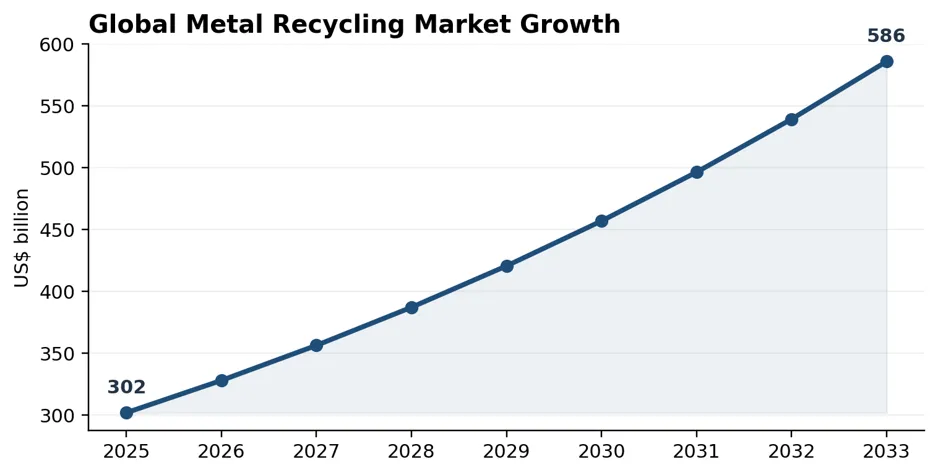
Figure 1 The global Metal Recycling Market is projected to grow from US$ 301.84 billion in 2025 to US$ 585.94 billion by 2033, showing how recycled feedstocks are becoming a larger industrial input market. Source: DataM Intelligence.
Steel Scrap Is Moving From Waste Stream to Strategic Feedstock
Steel scrap is entering a different phase of its market development. For decades, scrap was treated mainly as a recycled input that helped electric arc furnace producers reduce raw material costs. In 2026, the material is increasingly being treated as a strategic feedstock because global steel decarbonization plans depend on much larger volumes of reliable recycled iron units.
The shift is being driven by expanding electric arc furnace capacity, tighter carbon rules, growing demand for low-carbon steel, and national efforts to retain valuable secondary raw materials. OECD Steel Outlook 2026 says scrap is increasingly recognised as a strategic raw material and reports that 42 economies applied some form of restriction on ferrous scrap in 2023. The restrictions cover only part of global trade today, although the direction of policy is clear. Governments are paying more attention to whether domestic scrap is exported or retained for local steel production.
This changes procurement economics for steelmakers. The most valuable scrap is no longer simply the cheapest tonnes available. Buyers increasingly need predictable chemistry, lower residual contamination, consistent sizing and secure regional collection networks. These requirements can create a premium for high quality scrap that can replace larger shares of virgin metallics in demanding steel grades.
Related DataM Intelligence report Explore the DataM Metal Recycling Market report Download the sample to assess ferrous recycling growth, scrap segmentation, processing technologies and regional supply dynamics.
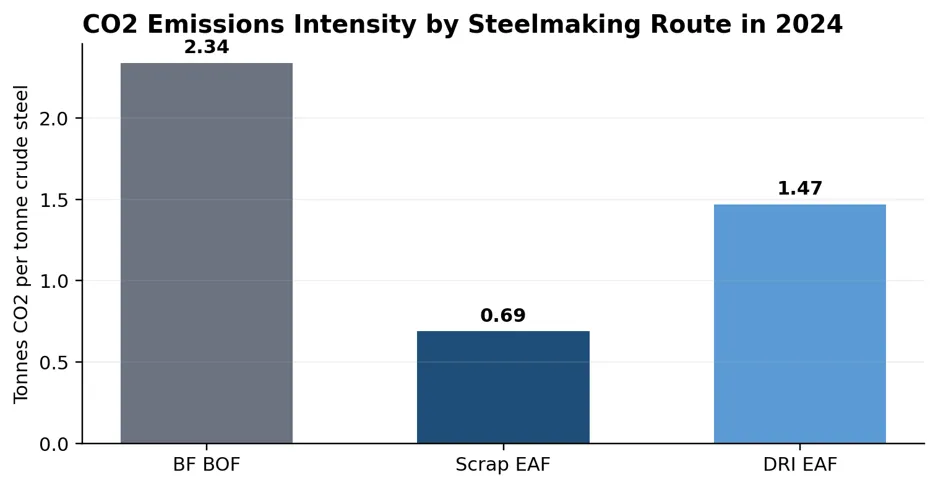
Figure 2 : Scrap-based EAF steelmaking has a much lower reported CO2 intensity than the blast furnace route. World Steel Association data for 2024 shows 0.69 tonnes of CO2 per tonne of crude steel for Scrap EAF versus 2.34 tonnes for BF BOF.
EAF Expansion Is Increasing the Strategic Value of High-Quality Scrap
The strongest structural demand signal comes from electric arc furnace expansion. EAF steelmaking can use high shares of recycled steel and supports one of the most mature pathways for lowering steel production emissions. World Steel Association data shows the 2024 CO2 intensity of Scrap EAF production at 0.69 tonnes per tonne of crude steel, compared with 2.34 tonnes for the BF BOF route.
Energy intensity also differs sharply. Scrap EAF production used 9.84 GJ per tonne of crude steel in 2024, while BF BOF production used 23.88 GJ. The difference helps explain why recycled steel is moving deeper into corporate decarbonization plans. When renewable electricity is available, EAF mills can reduce emissions further while avoiding part of the iron ore and metallurgical coal exposure associated with primary steelmaking.
The investment cycle is therefore creating a feedstock challenge. New furnaces can be built faster than new high quality scrap pools can develop. Scrap supply depends on historical steel consumption, product lifetimes, collection systems and sorting infrastructure. Regions with mature vehicle fleets and buildings can generate substantial scrap volumes. Rapidly industrializing markets can face tighter availability because steel remains locked inside relatively young infrastructure.
Related DataM Intelligence report Explore the DataM Steel Market report Use the report to track EAF investment, recycled steel adoption, green steel projects and changing raw material requirements.
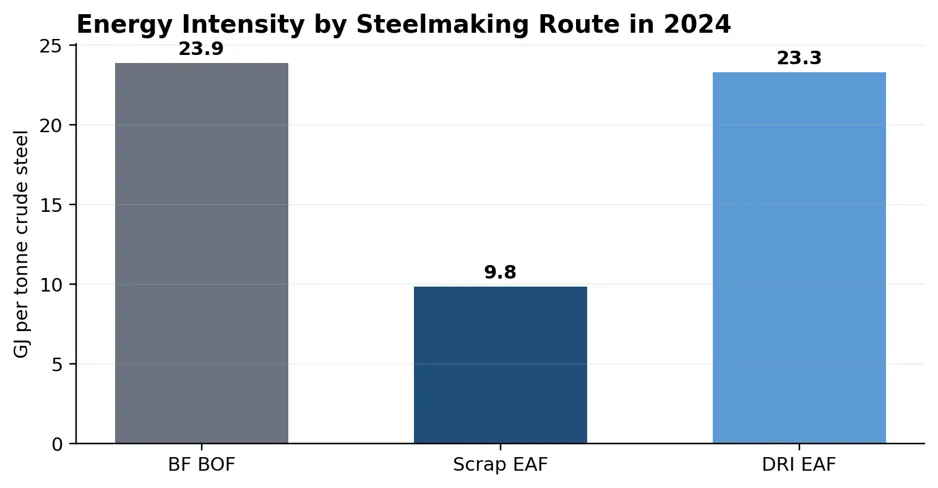
Figure 3 Scrap EAF also has a lower reported energy intensity than BF BOF steelmaking. The gap increases the procurement value of recycled iron units when mills have access to competitive electricity.
Source: World Steel Association Sustainability Indicators 2025.
Scrap Quality Is Becoming More Important Than Scrap Volume Alone
The future steel scrap market will become more segmented because different steel products need different feedstock quality. Construction grade long products can tolerate a wider scrap mix than exposed automotive sheet, electrical steel, or several advanced flat products. Copper and tin contamination can become difficult to remove once they enter the melt, which makes sorting quality a commercial issue rather than only a recycling issue.
This creates an investment opportunity in scrap processing. Advanced shredding, sensor-based sorting, material identification, and closed-loop industrial collection can increase the amount of scrap that qualifies for higher-value steel production. Steelmakers are also buying or partnering with recycling companies so they can control feedstock earlier in the chain.
The strongest future advantage may therefore sit with companies that can combine physical collection with quality data. Traceability can help mills understand scrap origin and chemistry before material reaches the furnace. Better classification can also support green steel claims because buyers increasingly want evidence around recycled content and production emissions.
Related DataM Intelligence report Explore the DataM Scrap Market report . Assess scrap supply, processor strategies, ferrous material demand, and circular industrial sourcing opportunities.
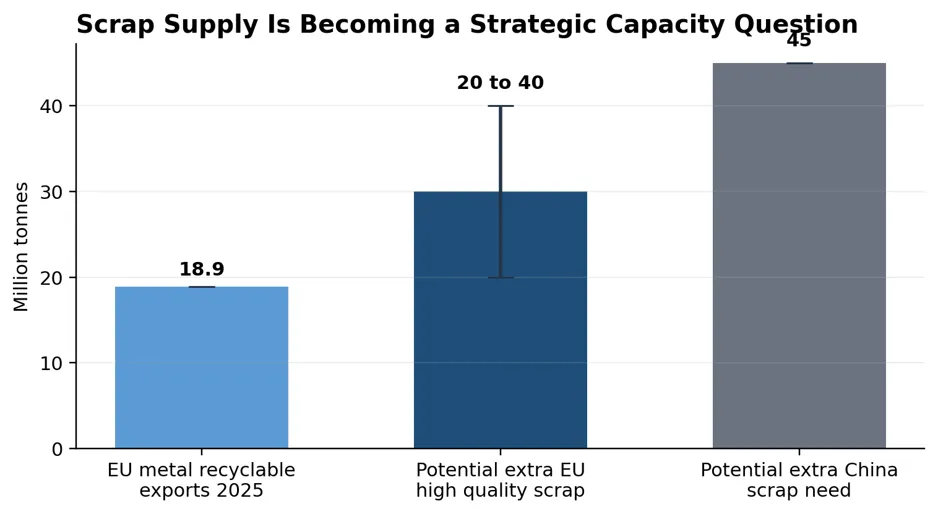
Figure 4 Scrap supply is becoming a strategic capacity question. The EU exported 18.9 million tonnes of recyclable metals in 2025. JRC analysis says better sorting and circularity could unlock 20 to 40 million tonnes of additional high-quality scrap each year, while stronger Chinese scrap use could require roughly 45 million tonnes of additional supply.
Trade Policy Is Turning Scrap Availability Into a Security Question
The strategic shift is already visible in trade policy. The OECD reports that 42 economies applied restrictions to ferrous scrap, while the European Commission introduced customs surveillance for metal scrap after warning that scrap leakage could weaken the ability of European industry to decarbonize. In 2025, the EU exported 18.9 million tonnes of recyclable metals to markets outside the bloc.
Europe has a particular reason to protect higher quality scrap. The region is investing in more electric furnace capacity while the Carbon Border Adjustment Mechanism increases the economic value of lower-emission steel. The European Commission Joint Research Centre estimates that stronger circularity could unlock an additional 20 to 40 million tonnes of high-quality scrap annually. The same analysis warns that stronger Chinese scrap use could require about 45 million tonnes of additional material.
This creates a possible trade tension between exporters that view scrap as a commodity and steel producing regions that increasingly view it as industrial feedstock. Export restrictions may remain selective, although buyers should assume that policy risk will become a larger part of long-term scrap sourcing decisions.
Steelmakers Are Moving Upstream Into Scrap Collection and Processing
The response from steelmakers is becoming more vertical. Companies with large EAF fleets already operate extensive recycling networks, while integrated producers are adding scrap processing assets as they prepare for lower carbon steelmaking. Tata Steel followed this logic in India by developing a 0.5 million tonne recycling plant in Rohtak before commissioning its 0.75 million tonne scrap-based EAF in Ludhiana in 2026.
The sequence matters because a furnace without secure metallic feedstock can become exposed to price volatility and quality shortages. Captive recycling does not eliminate market risk, although it gives steelmakers stronger visibility into supply. Long-term supply agreements with demolition companies, automotive processors and industrial manufacturers can create a similar advantage without full ownership of recycling assets.
For scrap processors, this changes the customer relationship. Mills will increasingly pay for consistency, chemistry control, traceability and reliable delivery. The higher margin part of the recycling market can therefore move toward specification-ready feedstocks rather than simple tonnage aggregation.
Related DataM Intelligence report Explore the DataM Recycled Metal Market report . Evaluate recycled metal demand, competitive positioning, regional sourcing and investment in secondary raw material processing.
Automotive and Flat Steel Could Create the Strongest Premium for Cleaner Scrap
The highest value opportunity is likely to emerge where recycled content targets meet demanding quality requirements. Automotive steel is a clear example because carmakers want lower embedded carbon while body structures and safety components require tightly controlled steel chemistry. This can increase the value of closed-loop automotive scrap because production offcuts and end-of-life vehicle material can be sorted into more predictable streams.
The same logic applies to electrical steel and several advanced flat products. These applications can benefit from recycled content, although contamination control becomes critical. As low-carbon procurement spreads through automotive and renewable energy supply chains, scrap quality can become part of contract negotiations between mills and industrial buyers.
The result is a two-tier market. Commodity scrap will remain important for volume steelmaking, while premium processed scrap can become a strategic input for higher specification products. This creates room for investments in sorting plants, regional collection hubs, scrap preparation equipment, and digital material tracking.
Related DataM Intelligence report Explore the DataM Automotive Steel Market report . Track automotive steel demand, low carbon sourcing, advanced grades, and the role of recycled feedstock in vehicle supply chains.
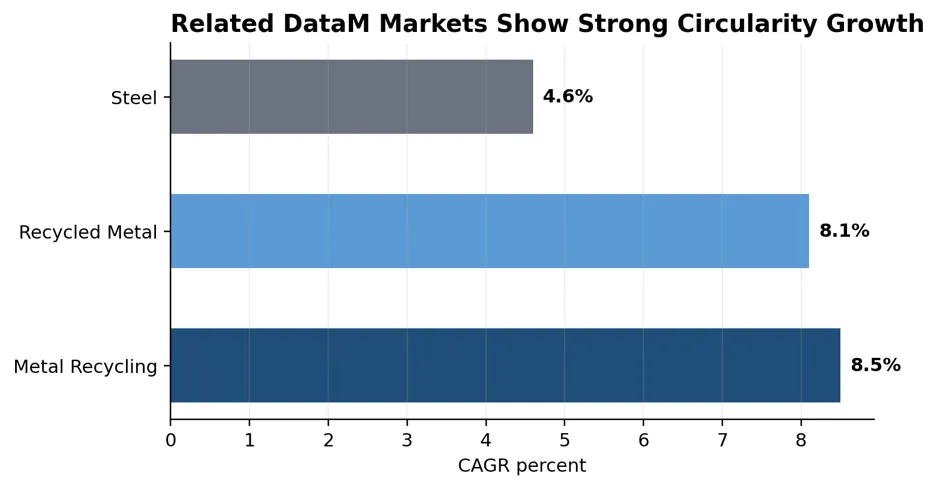
Figure 5 DataM Intelligence forecasts show circular metal markets growing faster than the overall steel market, supporting investment in recycling capacity, secondary raw material processing and scrap focused supply chains.
The Strategic Opportunity Is Moving Toward Scrap Security
The steel industry is entering a period where raw material strategy will become as important as furnace technology. EAF capacity can lower emissions, but the economics depend on access to suitable scrap. High quality material is geographically uneven, export policy can change quickly and premium steel grades require tighter control over residual elements.
For steelmakers, the strongest response is to secure more of the feedstock chain through recycling assets or long term procurement agreements. For recyclers, the opportunity is to move into higher quality processing and specification ready scrap. For automotive and industrial buyers, recycled steel procurement can become a way to reduce embedded carbon exposure while supporting circular supply chains.
This is why steel scrap is becoming a strategic raw material. The next phase of competition will be defined by who controls clean scrap, who can upgrade lower quality material and who can connect recycled feedstock with expanding EAF capacity at the right location. The market is shifting from waste management toward resource security.