


Autonomous vehicles, once the realm of exploratory pilot projects, have now graduated to commercial applications in a few select cities around the world. Although advancements in artificial intelligence, computer vision, Lidar, radar, high-definition mapping, and automotive computing platforms are driving the rapid evolution of the technology, it is regulation that remains the single most important determining factor when it comes to the scale of self-driving car rollout. Governments throughout the world are developing new regulatory structures covering safety standards, liability, cybersecurity, data management, insurance requirements and operational approval for autonomous vehicles. The success of the self-driving cars market over the coming decade will rely heavily on regulators balancing innovation and public safety. This post will explore how the regulatory and technology framework of self-driving cars is currently, where the regulations are headed over the next decade and the technological adoption of self-driving car programs by 2035.
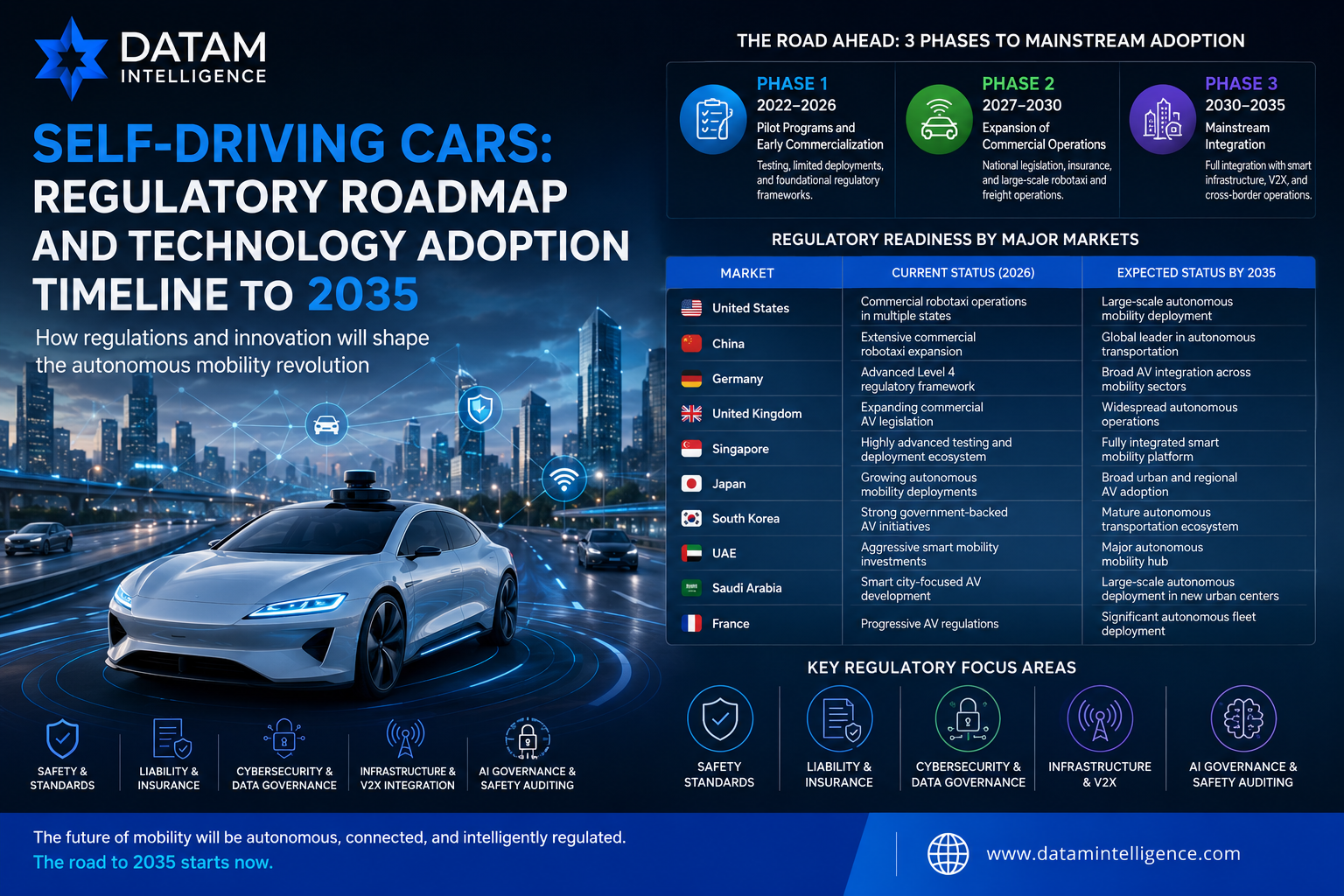
Regulatory Readiness by Major Markets
| Market | Current Status (2026) | Expected Status by 2035 |
| United States | Commercial robotaxi operations in multiple states | Large-scale autonomous mobility deployment |
| China | Extensive commercial robotaxi expansion | Global leader in autonomous transportation |
| Germany | Advanced Level 4 regulatory framework | Broad AV integration across mobility sectors |
| United Kingdom | Expanding commercial AV legislation | Widespread autonomous operations |
| Singapore | Highly advanced testing and deployment ecosystem | Fully integrated smart mobility platform |
| Japan | Growing autonomous mobility deployments | Broad urban and regional AV adoption |
| South Korea | Strong government-backed AV initiatives | Mature autonomous transportation ecosystem |
| UAE | Aggressive smart mobility investments | Major autonomous mobility hub |
| Saudi Arabia | Smart city-focused AV development | Large-scale autonomous deployment in new urban centers |
| France | Progressive AV regulations | Significant autonomous fleet deployment |
Phase 1: Pilot programs and early commercialization (2022-2026)
Currently characterized by limited regulatory approval, controlled commercial operations are at their inception. Dedicated testing and pilot programs for self-driving cars exist in a variety of locations around the world including China, Germany, Japan, Singapore, the UAE and the US. Regulators are now moving beyond simple testing permits toward approvals of limited commercial operations, primarily robotaxi and shuttle operations. Safety validation standards, remote operator oversight, testing permits, data logging, reporting standards and cybersecurity compliance are among the key regulatory priorities for this stage of development. Many jurisdictions now allow for Level 4 autonomy under certain conditions, where no human driver is necessary within a designated operating environment.
Phase 2: Expansion of commercial operations (2027-2030)
Focus for this next phase will be on expanding the scale of self-driving mobility services, with national autonomous vehicle legislation to be developed covering licensing, insurance, liability and fleet operation. This stage of development is expected to involve the development of national autonomous vehicle certification, harmonization of international safety standards, widespread commercial robotaxi approvals, initiation of autonomous freight operations, and the development of autonomous vehicle insurance programs. During this timeframe, Level 4 autonomous vehicles are expected by most industry observers to become commercially viable in the major markets of North America and China.
Phase 3: Mainstream Integration (2030-2035)
By the early part of the next decade, it is predicted that autonomous vehicles will be integrated with all of the existing transportation infrastructure, requiring regulations focused on vehicle interoperability and cross-border operations. Other regulatory priorities will include infrastructure compatibility, traffic control systems, smart city integration, vehicle to everything (V2X) communications standards, autonomous public transport systems and national autonomous freight lanes. AI governance and safety auditing are expected to become a focus of regulatory bodies during this period. Regulations will need to adapt to account for the mainstream deployment of autonomous vehicles in public space.
Self-Driving Cars Regulatory and Technology Timeline (2022–2035)
| Year | Major Regulatory and Technology Development |
| 2022 | Expansion of autonomous vehicle pilot programs in the U.S., China, Germany, and Singapore. Increased approvals for driverless testing. |
| 2023 | Commercial robotaxi services expand in select cities. Regulators introduce stricter AV safety reporting requirements. |
| 2024 | Several jurisdictions permit broader Level 4 autonomous operations in defined operational domains. AI safety oversight gains regulatory attention. |
| 2025 | Growth of commercial autonomous ride-hailing fleets. Governments begin developing national AV certification frameworks. |
| 2026 | Wider deployment of driverless robotaxis in major urban centers. Expanded cybersecurity and data governance requirements emerge. |
| 2027 | National autonomous vehicle legislation introduced in multiple advanced economies. Insurance and liability frameworks become more standardized. |
| 2028 | Autonomous freight corridors begin operation in leading markets. Cross-state and regional regulatory harmonization improves. |
| 2029 | Large-scale commercial deployment of Level 4 autonomous vehicles in select metropolitan regions. |
| 2030 | Integration of autonomous vehicles into smart city transportation planning. Enhanced V2X infrastructure deployment begins. |
| 2031 | Autonomous trucking and logistics operations gain widespread regulatory approval in major freight markets. |
| 2032 | Global standards bodies introduce more harmonized AV safety and certification protocols. |
| 2033 | Expansion of autonomous public transportation systems and shared mobility fleets. |
| 2034 | Regulatory frameworks increasingly support mixed traffic environments involving autonomous and conventional vehicles. |
| 2035 | Autonomous mobility becomes a mainstream transportation option in many developed markets, supported by mature regulatory ecosystems and large-scale commercial deployment. |
Long Term Outlook
Liability and Insurance, Cybersecurity, Data privacy and Harmonization across international boundaries are among the significant hurdles regulators face. But this is changing.
The long-term future of regulation surrounding the use of self-driving cars is bright. Today, most of the world’s major economies recognize autonomous mobility as a vital future industry; not only can it reduce traffic accidents but also alleviate traffic congestion, increase accessibility for the disabled and the elderly and stimulate economic growth. Though regulations will differ by region, the overall trend clearly indicates a more expansive commercialization of the technology as the 2030s approach.
The future of autonomous mobility extends beyond self-driving technology alone. Advancements in the Autonomous Vehicle Market, AI in Automotive Market, Automotive Cybersecurity Market, LiDAR Market, and Smart Cities Market are collectively shaping the next generation of intelligent transportation systems. As governments continue to refine regulatory frameworks, these interconnected markets are expected to play a pivotal role in accelerating commercial deployment worldwide.
Conclusion
Regulation is as crucial as technology in shaping the deployment of self-driving cars. From pilot programs to a widespread commercial presence, safe operation of autonomous vehicles hinges on clear standards, legal frameworks, robust cybersecurity and well-defined operational parameters. Investors, automakers, technology providers and mobility services providers need to pay close attention to the regulatory roadmap to make informed decisions about future investments within the Self-Driving Cars Market. It is increasingly common for organizations to use reports about the Self-Driving Cars Market to analyze regulatory advancements, technology trends, competitive landscape and future projections for the sector.