


The nuclear industry is searching for technologies that can provide dependable low-carbon electricity while also supplying the high-temperature energy required by industrial processes. Molten salt reactors are receiving greater attention within that search because they combine advanced nuclear generation with potential applications in hydrogen, chemicals, refining, desalination, synthetic fuels, and other heat-intensive operations.
This does not mean molten salt reactor technology is already commercially mature. Most programs remain at the research, testing, licensing or demonstration stage. The important change is that developers are increasingly being assessed against real deployment requirements: qualified fuel, durable materials, licensable safety cases, repeatable manufacturing, financeable project structures and credible customers for heat or electricity.
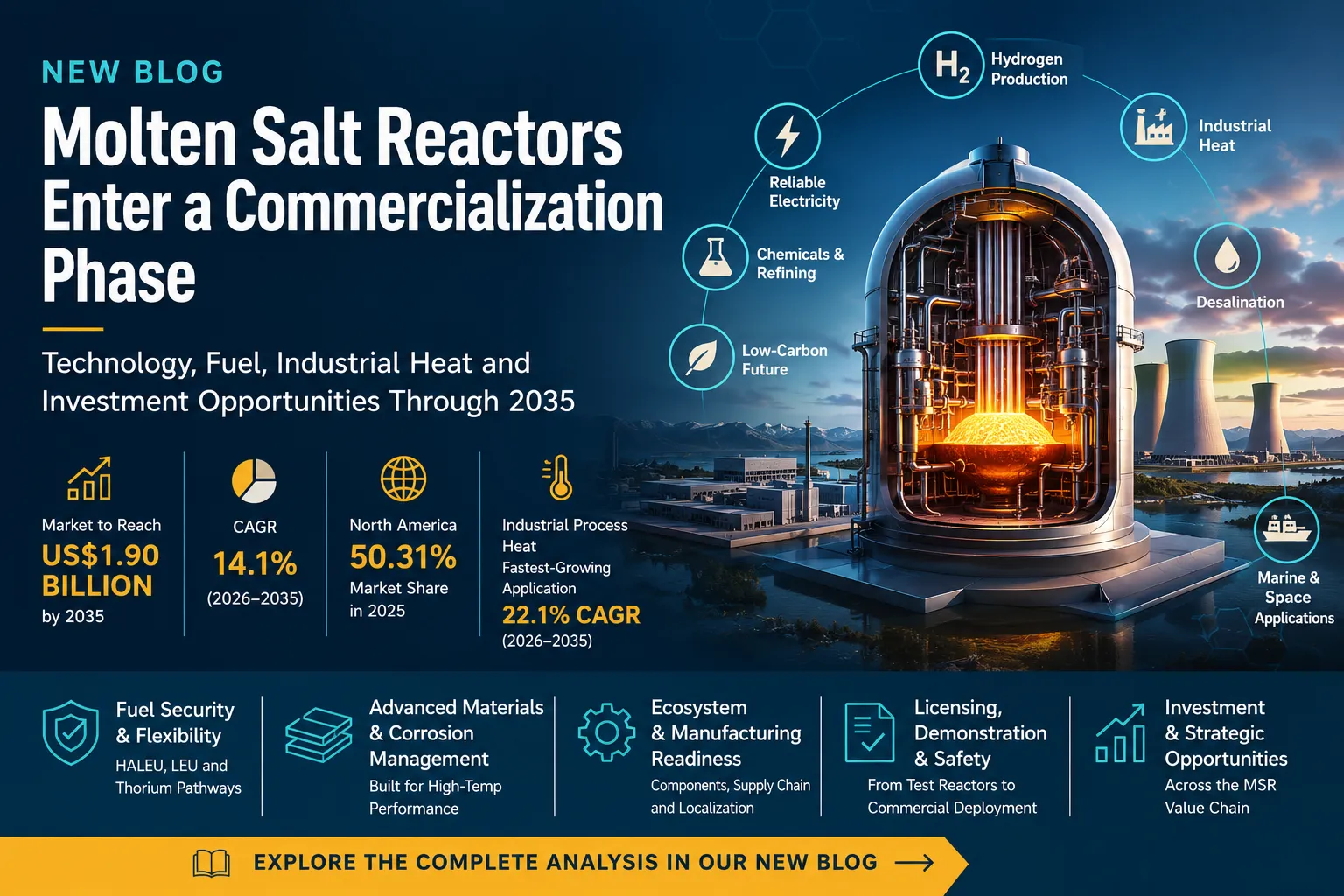
DataM Intelligence estimates that the molten salt reactor market was worth US$495.2 million in 2025 and could reach US$1.90 billion by 2035, representing a 14.1% compound annual growth rate during 2026–2035. Achieving that forecast will require more than technically attractive reactor concepts. Commercial viability will depend on the readiness of the entire ecosystem surrounding each design.
Request for Exclusive Sample: https://www.datamintelligence.com/research-report/molten-salt-reactor-market
Why Molten Salt Reactors Are Moving Beyond the Research Stage
A molten salt reactor, or MSR, uses molten salt as a coolant and, in some configurations, as the medium containing dissolved nuclear fuel. This distinction is important. Some designs use liquid fuel circulating in molten salt, while others use solid fuel with a separate molten-salt coolant. Reactor architecture, neutron spectrum, fuel composition, and salt chemistry therefore vary substantially across the category.
The concept itself is not new. Molten salt reactor experiments were conducted at Oak Ridge National Laboratory in the United States during the 1960s. What is changing is the commercial environment around the technology.
Earlier MSR programs concentrated primarily on physics, chemistry, and proof of concept. The current commercialization pipeline must address first-of-a-kind engineering, regulatory review, component qualification, construction execution, and operating performance. Developers are being asked not only whether a reactor can function, but whether it can be licensed, manufactured, financed, maintained, and replicated.
The U.S. Nuclear Regulatory Commission’s construction permit for Kairos Power’s Hermes test reactor illustrates this transition. Hermes is a test reactor rather than a commercial power plant, but its regulatory progression provides practical experience for reviewing a non-light-water reactor that uses molten-salt coolant. The permit should be understood as a demonstration-stage milestone-not proof that MSRs as a class are commercially established.
China is advancing a different approach. China’s National Nuclear Safety Administration reported that a 2 MW thermal liquid-fuel thorium molten salt experimental reactor reached first criticality in October 2023, full-power operation in June 2024, and completed a thorium-addition experiment in October 2024. These are significant experimental achievements, but the facility remains a research platform rather than a commercial power station.
Such projects change the competitive environment because operating data can reveal issues that computer models and laboratory loops cannot fully resolve. Demonstrations test component behavior, salt control, radiation effects, maintenance procedures, operator requirements, and the accuracy of cost assumptions.
As a result, competition among molten salt reactor companies is shifting from conceptual differentiation toward execution. The leading position will not necessarily belong to the design with the highest theoretical efficiency. It may belong to the developer that retires licensing, fuel, materials, and manufacturing risks in a sequence acceptable to regulators, customers, and capital providers.
The MSR Opportunity Is Larger Than Electricity Generation
Electricity remains an important molten salt reactor application, particularly in grids seeking firm generation to complement variable renewable power. However, electricity alone may not capture the full economic value of high-temperature reactor output.
The International Atomic Energy Agency notes that MSRs can operate at temperatures that support higher electricity-generation efficiency and non-electric process-heat applications. Their relatively low operating pressure is another distinguishing characteristic, although every design still requires a complete, design-specific safety assessment.
Industrial users do not always need electricity as their primary energy input. A chemical plant, refinery or hydrogen facility may require heat, steam or a controlled thermal stream. Converting reactor heat into electricity and then converting electricity back into heat introduces equipment, efficiency, and cost considerations. Direct thermal integration may offer a more efficient pathway where reactor temperature, plant configuration, distance, and operating requirements align.
DataM Intelligence projects industrial process heat to be the fastest-growing MSR application, with a 22.1% CAGR during 2026–2035. This forecast reflects an emerging strategic proposition: advanced nuclear reactors may be evaluated as integrated energy platforms rather than electricity-only assets.
Potential uses include process steam, high-temperature chemical reactions, hydrogen production, district heating, desalination and synthetic-fuel production. Marine propulsion and space applications are also under evaluation, although their technical, regulatory and commercial requirements differ markedly from terrestrial power projects.
High-temperature capability could therefore become an important commercial differentiator. The relevant question is not simply how many megawatts a reactor can generate. It is how effectively its thermal output matches a customer’s temperature profile, reliability requirements, operating schedule, and existing infrastructure.
Fuel Availability Could Shape the Commercialization Race
Fuel strategy is one of the most important variables in molten salt reactor commercialization. Different designs may depend on low-enriched uranium, high-assay low-enriched uranium, uranium-plutonium cycles, or thorium-uranium pathways. Fuel may be solid or dissolved in a carrier salt.
HALEU contains more than 5% but less than 20% uranium-235. The U.S. Department of Energy states that many advanced reactor designs require HALEU to enable smaller reactor configurations, longer operating cycles, greater efficiency, or improved fuel utilization. DOE also identifies limited commercial availability as a possible constraint on advanced-reactor deployment.
That constraint has several commercial implications. A developer may have a technically sound reactor but still face delays if enrichment, deconversion, fuel fabrication, transport, or qualification capacity is unavailable at the required scale. Fuel must be available not only for an initial demonstration but throughout the operating life of a potential reactor fleet.
Not every MSR requires HALEU, however. Some may be designed around conventional low-enriched uranium, while others envision different fissile inventories or fuel-cycle strategies. Commercial evaluation should therefore begin with the exact fuel form, enrichment level, sourcing plan, and qualification status of the individual technology.
Thorium also requires careful interpretation. Thorium-232 is fertile rather than fissile; it must absorb neutrons and ultimately form fissile uranium-233. A thorium molten salt reactor consequently needs an initial fissile driver and a technically credible strategy for managing the associated fuel cycle. The IAEA identifies potential long-term advantages but also notes challenges involving extraction, fuel handling, economics and limited operating experience.
Fuel-cycle flexibility may be an advantage, but flexibility should not be confused with readiness. Decision-makers need to understand fuel-salt preparation, isotopic composition, safeguards, processing requirements, waste streams and the licensing treatment of any online or batch fuel-processing system.
Reactor economics cannot be separated from these issues. Fuel security affects capital scheduling, capacity factors, inventory requirements, working capital and exposure to geopolitical supply disruptions. A credible molten salt reactor fuel strategy must cover the full chain-not merely access to uranium or thorium resources.
Materials and Molten Salt Chemistry Become Strategic Issues
Molten salts offer useful thermal properties, but they also create demanding materials conditions. High temperature, irradiation, salt composition, impurities and redox chemistry can influence corrosion and component degradation.
Nickel-based alloys have received significant attention because of their resistance to certain molten-salt environments. Graphite may be used as a moderator in some thermal-spectrum designs, while fast-spectrum configurations can follow different materials strategies. Seals, welds, pumps, heat exchangers, piping and instrumentation must all be compatible with the relevant salt and radiation conditions.
The crucial point is that “molten salt” is not one uniform material. Fluoride and chloride salts have different characteristics, and individual formulations behave differently according to composition, temperature and impurity levels. Compatibility claims must therefore be tied to the actual salt, alloy, operating environment and exposure duration.
Corrosion control can involve purification, chemistry monitoring and control of oxidation-reduction conditions. Even where laboratory samples perform well, commercial projects need evidence covering weldments, joints, manufactured components and prolonged operating transients. Radiation can change both salt behavior and material properties.
Materials science is consequently becoming a commercial issue. Component life influences outage schedules, replacement costs, radioactive maintenance, waste generation and plant availability. If a heat exchanger requires more frequent replacement than assumed, the effect may extend through lifecycle economics and project financing.
Qualification is equally important. Nuclear-grade components need traceable materials, controlled manufacturing procedures, inspection criteria and quality assurance. Repeatability across multiple factories and suppliers matters if modular construction is expected to reduce cost.
Advanced monitoring could improve asset management by measuring chemistry, temperature, flow and component condition. Digital twins and AI-assisted analysis may help interpret operating data or optimize maintenance, but these tools must be validated for nuclear applications. They cannot substitute for physical testing, qualified instruments or regulatory evidence.
The New MSR Supply Chain Is Taking Shape
The molten salt reactor supply chain extends well beyond the nuclear island. It may encompass reactor vessels, heat exchangers, pumps, steam generators, salt-processing equipment, off-gas systems, containment structures, instrumentation, digital controls and conventional balance-of-plant systems.
Some equipment resembles components used elsewhere in nuclear or process industries. Other equipment must be adapted to specific salts, temperatures, radiation fields and safety classifications. This creates opportunities for established manufacturers, engineering groups and specialist materials providers, but entering the ecosystem requires more than general industrial capability.
Supplier qualification can take years. Manufacturers may need nuclear quality-assurance programs, documented welding processes, approved testing methods and complete material traceability. Long-lead forgings, specialty alloys and qualified instrumentation can determine schedules even when their share of total capital expenditure appears relatively small.
Localization has strategic and economic dimensions. Governments may prefer domestic manufacturing for energy security, while project developers may seek shorter logistics chains and greater control over quality. Local production can also support political acceptance and project financing. However, premature localization can increase cost if suppliers lack sufficient order volume or nuclear experience.
Modular construction is frequently presented as a route to lower project risk, but its benefits depend on standardization and repetition. A factory cannot deliver learning-curve savings if reactor designs change repeatedly, order books remain intermittent or customers demand extensive project-specific modifications.
Supply-chain readiness should therefore be measured through evidence: qualified facilities, validated production processes, available capacity, realistic lead times and enforceable commercial agreements. Announced partnerships alone do not demonstrate manufacturing scalability.
Industrial Heat Could Change the Economics of Advanced Nuclear
Industrial heat may alter how an MSR project is designed, located and financed. The attraction comes from matching continuous nuclear output with facilities that require reliable energy for most of the year.
Chemical plants, refineries, ammonia facilities and mining-related processing often operate with high capacity factors. Steel and cement production also involve energy-intensive thermal processes, although not every step can be served directly by the temperature available from every reactor design. A credible assessment must compare the reactor’s delivered heat conditions with the customer’s actual process requirements.
Direct heat use can avoid some conversion losses associated with producing electricity first. Its value nevertheless depends on thermal integration. Heat cannot generally be transmitted economically over the same distances as electricity, making co-location or short-distance heat networks important.
This creates a different project-development model. The reactor may need to be located near an industrial customer, while satisfying nuclear siting, security and emergency-planning requirements. The industrial facility must be able to receive nuclear-generated heat without compromising product quality or operational flexibility. An isolation loop may be required between the reactor system and the industrial process.
Heat offtake agreements could become central to financing. Lenders need clarity about contract duration, demand stability, pricing, curtailment rights and the consequences of outages at either facility. A nuclear plant designed around one industrial customer may face concentration risk if that customer reduces production or closes.
The comparison with alternatives also matters. Electrification, heat pumps, resistance heating, natural gas with carbon capture, biomass and hydrogen may compete at different temperature levels. MSR industrial heat will not be economic simply because it is low carbon. It must offer a competitive combination of delivered cost, reliability, emissions performance and integration risk.
If these conditions are met, however, process heat could broaden the addressable advanced nuclear market. It may also create multiple revenue streams where a facility can vary the allocation of heat among electricity generation, hydrogen and industrial users.
Hydrogen and Synthetic Fuels Add New Revenue Pathways
High-temperature nuclear energy could support hydrogen production through conventional electrolysis, high-temperature steam electrolysis or thermochemical pathways. The commercial value depends on both electricity and heat requirements.
High-temperature steam electrolysis can potentially reduce the electrical energy needed for hydrogen production by supplying part of the required energy as heat. An MSR with suitable output conditions could provide continuous electricity and thermal energy to such a system.
The resulting hydrogen could serve ammonia, fertilizers, refining, chemicals, ironmaking or synthetic-fuel production. When combined with captured carbon dioxide, hydrogen can form feedstock for synthetic hydrocarbons. These pathways may contribute to industrial decarbonization and reduce dependence on imported fossil fuels.
The economics remain conditional. Electrolyzer cost, utilization, water supply, electricity value, heat integration, hydrogen transport and the availability of long-term buyers all matter. Low-carbon certification rules can also affect whether nuclear-produced hydrogen receives policy support or price premiums in a particular jurisdiction.
MSRs therefore do not automatically make hydrogen or synthetic fuels competitive. Their possible advantage is operational: a high-capacity-factor reactor could supply steady energy to equipment that benefits from continuous use. Whether that advantage outweighs FOAK reactor cost and integration complexity must be demonstrated project by project.
Licensing and Demonstration Will Matter More Than Reactor Design Alone
Commercial success requires a regulator to reach conclusions about the actual plant, not the concept in isolation. This includes the reactor, fuel, salt systems, containment strategy, source terms, waste management, safeguards, operating procedures and emergency response.
Many existing nuclear rules were developed around water-cooled reactors with solid fuel. Advanced nuclear regulation is evolving to address non-light-water technologies, but developers must still provide defensible safety cases and supporting data. The OECD Nuclear Energy Agency notes that advanced reactors may require additional or revised regulatory approaches and safety research.
Demonstration reactors can reduce uncertainty by validating physics, thermal hydraulics, chemistry control, component performance and human-machine interfaces. They can also expose construction and commissioning problems before a commercial fleet is attempted.
Operational validation is particularly important for liquid-fuel designs. Regulators and operators need evidence concerning fuel movement, radionuclide behavior, off-gas management, salt sampling, maintenance and material accountancy. Solid-fuel molten-salt-cooled reactors create a different evidence burden but still require qualification of coolant systems and fuel performance.
Public acceptance cannot be treated as a late-stage communications task. Communities will ask how the reactor differs from existing nuclear plants, how waste is managed and how local risks and benefits are distributed. Transparent engagement influences siting and political durability.
For financiers, licensing uncertainty translates directly into schedule and cost risk. A project with incomplete safety analysis, unresolved fuel qualification or uncertain regulatory jurisdiction will face a higher cost of capital regardless of its theoretical performance.
Investment Is Moving Toward the Broader MSR Ecosystem
Molten salt reactor investment is gradually broadening from reactor concepts toward enabling capabilities. Capital may be required for enrichment and fuel preparation, salt purification, materials testing, heat-transfer systems, qualified manufacturing, monitoring and industrial plant integration.
This does not mean every enabling technology is equally attractive. Strategic capital allocation should examine whether a capability serves one reactor design or multiple advanced nuclear platforms. A specialized component tied to one unlicensed design carries a different risk profile from a testing service or material platform that can support several developers.
Digital engineering is another emerging area. Advanced simulation can shorten design cycles, improve configuration control and identify manufacturing problems before construction. AI-assisted reactor design may help explore large design spaces, while condition-monitoring algorithms could improve maintenance planning.
Nuclear applications impose a higher standard than general industrial software. Models require verification and validation; data provenance must be controlled; cybersecurity must be addressed; and safety-related decisions must remain auditable. The commercial opportunity lies in tools that fit nuclear engineering and regulatory workflows-not in applying AI terminology to conventional software.
Investment decisions should also distinguish corporate funding from project finance. Venture or strategic capital may fund design development and testing. Commercial plants ultimately need contracts, permits, insurance, construction arrangements, fuel commitments and dependable revenue. Moving from one financing category to the other is a major commercialization milestone.
Regional Competition Is Becoming More Important
DataM Intelligence estimates that North America represented 50.31% of the molten salt reactor market in 2025. The region benefits from national-laboratory expertise, private reactor developers, government support, regulatory activity and established nuclear engineering capacity.
The United States is notable for its combination of private development and federal programs related to advanced reactors and HALEU. Canada offers an established nuclear regulatory system and an industrial base with experience evaluating small modular reactors. Regional leadership, however, will depend on converting policy support into demonstrations and repeatable projects.
Asia-Pacific is projected to be the fastest-growing region. China’s operating thorium molten salt experimental platform provides practical research data and reflects sustained government-backed development. Japan retains advanced materials, nuclear engineering and manufacturing capabilities. India’s long-standing interest in thorium is connected to its resource strategy and broader nuclear program, although specific MSR commercialization claims require careful verification against official milestones.
Europe presents a diverse picture. France combines nuclear engineering depth with advanced-reactor research, while other European programs are exploring high-temperature nuclear energy, fuel cycles and industrial decarbonization. Licensing coordination, state support and access to fuel and manufacturing will influence the pace of progress.
Russia also has extensive nuclear-fuel-cycle and reactor expertise, including research relevant to molten-salt systems. Geopolitical conditions, export controls and fuel-security policies may affect how Russian capabilities connect with international projects.
No region can be declared a simple winner. Leadership depends on a combination of research capability, regulatory clarity, demonstration performance, manufacturing capacity, fuel security, government commitment and accessible industrial demand.
What Will Determine Which MSR Technologies Succeed?
Commercial evaluation should use a multidimensional framework. The OECD-NEA applies a similar principle to small modular reactors by assessing progress across licensing, siting, financing, supply chain, engagement and fuel-not technical design alone.
| Evaluation factor | Evidence decision-makers should require |
| Technology readiness | Integrated-system testing, representative operating conditions and independent validation |
| Licensing progress | Defined regulator, accepted review pathway, submitted documentation and closed technical issues |
| Fuel availability | Qualified fuel specification, credible suppliers, transport arrangements and lifetime procurement strategy |
| Materials durability | Design-specific corrosion, irradiation and component-lifetime data |
| Thermal performance | Verified outlet temperature, efficiency, parasitic loads and usable heat conditions |
| Project economics | Transparent capital, operating, fuel, replacement and decommissioning assumptions |
| Manufacturing scalability | Qualified facilities, standardized modules, repeatable processes and realistic production rates |
| Supply-chain readiness | Named suppliers, available capacity, traceability and credible lead times |
| Industrial integration | Confirmed heat profile, interface design, siting feasibility and customer operating requirements |
| Demonstration performance | Construction, commissioning, safety and operating milestones achieved under representative conditions |
| Long-term operating model | Maintenance strategy, staffing, waste handling, lifecycle support and component replacement plans |
| Financing and offtake | Bankable customers, risk allocation, insurance, public support and sufficient contingency |
The framework also helps prevent a common mistake: comparing technologies using headline power output or theoretical efficiency alone. A somewhat less efficient reactor with available fuel, qualified suppliers and a credible licensing route may reach deployment before a more ambitious design carrying multiple unresolved dependencies.
DataM Intelligence projects thermal-spectrum MSRs to represent approximately 42.0% of the leading reactor-type segment. Thermal-spectrum designs may benefit from moderation and specific fuel-utilization characteristics, but segment leadership does not guarantee the success of every design. Fast-spectrum and other configurations may offer different fuel-cycle, waste-management or performance attributes.
What the Molten Salt Reactor Market Could Look Like by 2035
DataM Intelligence forecasts the molten salt reactor market size to increase from US$495.2 million in 2025 to US$1.90 billion by 2035, at a 14.1% CAGR during 2026–2035. The estimate represents a market outlook, not a guaranteed deployment trajectory.
Three broad pathways are possible.
Slower commercialization: Licensing reviews, HALEU shortages, materials qualification or FOAK cost escalation delay demonstrations. The ecosystem grows through research programs, testing facilities and component development, but commercial orders remain limited.
Base-case commercialization: Several demonstration projects generate credible operating data, selected designs progress through licensing and early industrial partnerships establish dependable heat or electricity demand. Manufacturing remains relatively low volume, but the industry begins moving from one-off projects toward standardized offerings.
Accelerated commercialization: Demonstrations perform strongly, fuel capacity expands, regulators develop efficient technology-appropriate review processes and energy-intensive customers sign long-term offtake agreements. Modular manufacturing and policy support could then enable a broader project pipeline.
The difference among these pathways will be determined by milestones, not enthusiasm. Reactor operation, license approvals, qualified fuel production, signed customer contracts and completed manufacturing facilities are more meaningful indicators than announcements of distant deployment targets.
Key Questions Decision-Makers Should Ask Before Entering the MSR Ecosystem
- What is the technology’s actual commercialization maturity? Distinguish simulations and laboratory loops from integrated demonstrations, licensed construction and operating experience.
- What is the regulatory pathway? Identify the responsible regulator, application type, review status, unresolved issues and realistic schedule contingency.
- Which fuel pathway does the design require? Determine enrichment, fuel form, initial inventory, replenishment needs and whether the fuel is commercially available.
- How resilient is the fuel supply? Examine enrichment, deconversion, fabrication, transport, geopolitical exposure and alternative suppliers.
- Which materials have been qualified? Require evidence for the exact salt chemistry, temperature, radiation environment, welds and expected component life.
- Which components have the longest lead times? Evaluate specialty alloys, vessels, pumps, heat exchangers, instrumentation and fuel-processing equipment.
- What output can customers actually use? Separate thermal power from net electrical output and determine temperature, pressure, availability and delivery conditions.
- How will the reactor integrate with industrial infrastructure? Assess distance, intermediate heat loops, process modifications, backup energy and outage coordination.
- What demonstration milestones remain? Identify which risks can only be retired through construction, commissioning or sustained operation.
- Which suppliers are already qualified? A memorandum of understanding is not equivalent to approved manufacturing capacity or a binding delivery contract.
- What are the lifecycle economics? Include fuel, maintenance, salt management, component replacement, security, waste and decommissioning-not just overnight capital cost.
- What evidence supports the deployment timeline? Test assumptions against regulatory submissions, procurement lead times, fuel availability, financing and site readiness.
Frequently Asked Questions About Molten Salt Reactors
What is a molten salt reactor?
A molten salt reactor is an advanced nuclear reactor that uses molten salt as a coolant, fuel carrier or both. Some MSRs circulate fissile material dissolved in salt, while molten-salt-cooled designs retain solid fuel. This distinction affects reactor physics, maintenance, fuel handling, waste management and licensing.
How does a molten salt reactor work?
A molten salt reactor generates heat through nuclear fission and transfers that heat using a liquid salt. The heat can produce electricity through a secondary power cycle or be delivered to an industrial process. In liquid-fuel designs, the fuel is dissolved in the salt; in other designs, fuel remains in solid form.
What is the molten salt reactor market size?
DataM Intelligence estimates the global molten salt reactor market at US$495.2 million in 2025. It forecasts the market to reach US$1.90 billion by 2035, expanding at a 14.1% CAGR during 2026–2035. This projection depends on licensing, fuel, demonstration and manufacturing progress.
Why are molten salt reactors gaining attention?
MSRs are gaining attention because they could provide firm low-carbon electricity and high-temperature process heat. Their potential low-pressure operation, modular configurations and fuel-cycle flexibility are also relevant. However, commercial viability still depends on materials durability, fuel availability, regulatory approval and demonstrated project economics.
What are molten salt reactors used for?
Molten salt reactors are being evaluated for electricity, industrial heat, hydrogen, desalination, district heating, synthetic fuels, research, marine propulsion and space applications. Most of these uses remain under development or demonstration. The suitability of each application depends on reactor temperature, scale, licensing and integration requirements.
Do molten salt reactors require HALEU?
Not all molten salt reactors require HALEU. Fuel requirements vary by reactor design, neutron spectrum and fuel cycle. Many U.S. advanced reactor concepts use HALEU, according to DOE, but other MSRs may use conventional low-enriched uranium or pursue thorium-uranium and alternative fuel pathways.
Why are materials and corrosion important in MSRs?
Materials and corrosion are important because reactor components must withstand hot, chemically active salts and radiation for long operating periods. Salt composition, impurities and redox conditions affect degradation. Component lifetime influences safety, maintenance frequency, plant availability, replacement cost and ultimately commercial economics.
Can molten salt reactors produce industrial heat?
Yes, molten salt reactors can potentially supply industrial heat where their temperature and delivery conditions match the process. Applications may include chemicals, hydrogen, refining, ammonia and some materials-processing operations. Commercial feasibility depends on co-location, heat-transfer infrastructure, reliability, licensing and a bankable heat offtake agreement.
Can MSRs support hydrogen production?
MSRs could support hydrogen production by supplying electricity, high-temperature steam or both. High-temperature electrolysis may benefit from thermal integration, but competitiveness depends on electrolyzer cost, utilization, water, infrastructure and hydrogen pricing. An MSR does not automatically make hydrogen economically viable.
Which regions are developing molten salt reactor technologies?
The United States, Canada, China, France, Japan, India and Russia are among the countries with relevant MSR research, development or industrial capabilities. North America held the largest estimated market share in 2025, while DataM Intelligence identifies Asia-Pacific as the fastest-growing regional market.
Related Report:
- Uranium Enrichment Market
- Small Modular Reactor Market
- Nuclear Reactor Decommissioning Market
- Shunt Reactor Market