


The enterprise AI contest is moving away from a simple question: which company has the best model?
For corporate buyers, that question is becoming less important than another one:
Which AI agent already knows where the work happens, can reach the right company data and has permission to complete the task?
That puts Microsoft, Salesforce and ServiceNow in a particularly strong position.
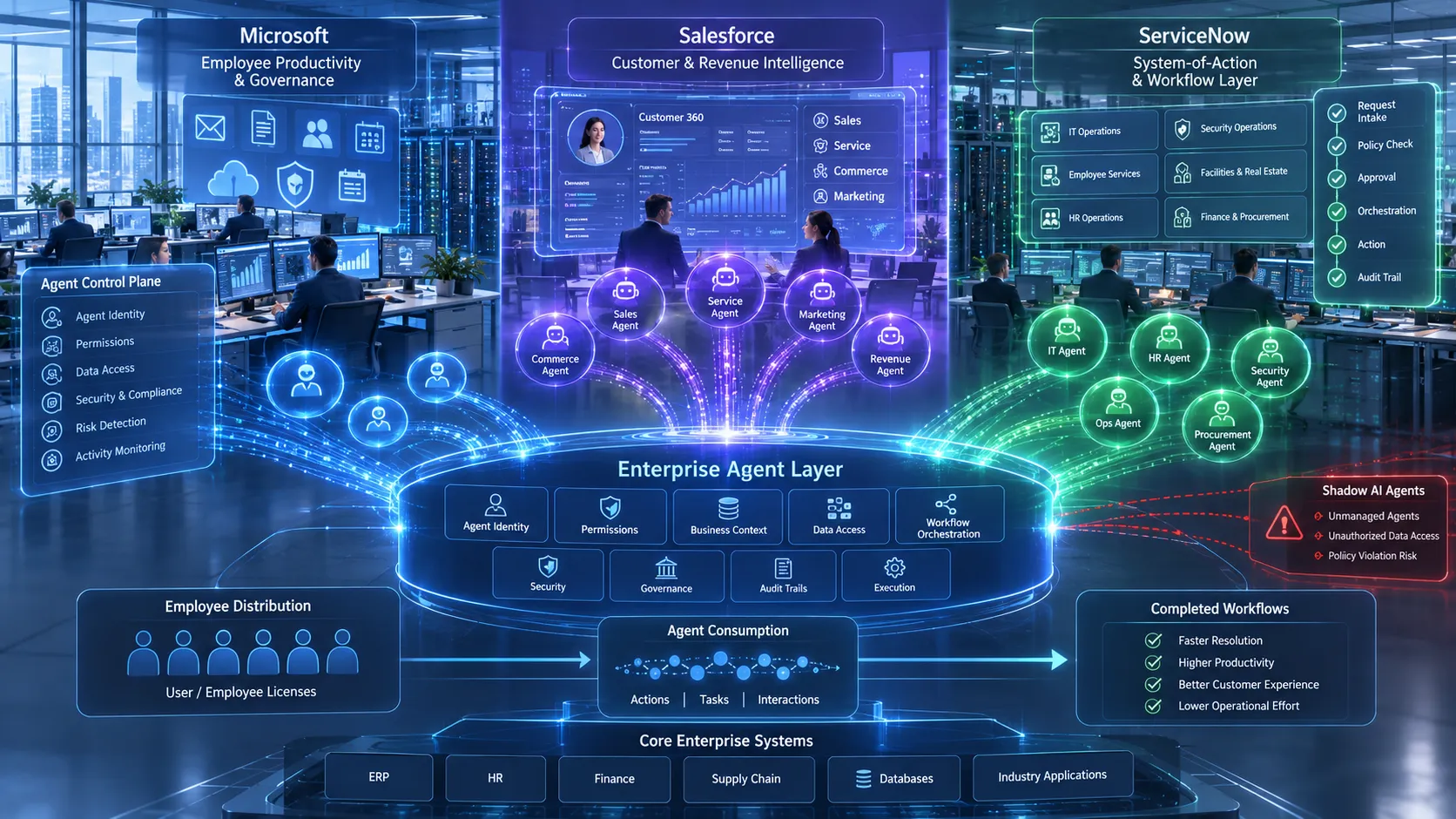
Microsoft starts with employees and productivity software. Salesforce starts with customers, sales and CRM data. ServiceNow starts with enterprise workflows and operational processes.
All three are now trying to expand beyond those starting points.
Microsoft wants to govern agents across the company. Salesforce wants Agentforce to use customer and enterprise data to complete more work. ServiceNow wants outside agents to use its platform when an action needs to be executed safely.
This is why DataM Intelligence views the emerging enterprise agent layer as one of the most important battlegrounds in agentic AI.
The company that owns this layer may not own the underlying AI model. It may instead own the connection between people, agents, enterprise data, identity, applications, and business actions.
According to DataM Intelligence, “Agentic AI Market is projected to grow to USD 211.99 Billion by 2035, registering exceptional growth at a CAGR of 46.87% by 2026 to 2035.”
Request for Exclusive Sample on Agentic AI Market
Enterprise Agents Are Becoming a Distribution Battle
An AI model without access to company systems can write an answer.
An enterprise agent with trusted access can do something more valuable. It can update a customer record, resolve a support request, create a document, investigate an incident, approve an internal request, schedule follow-up work, or trigger another agent.
That difference changes the competitive advantage.
OpenAI, Anthropic, Google and other model providers can improve reasoning quickly. Enterprise software distribution is harder to recreate.
Microsoft already sits inside email, documents, meetings, collaboration, identity and security.
Salesforce holds large amounts of customer, account, sales, service and commerce information.
ServiceNow manages workflows that connect IT, HR, security, operations and other business functions.
These are not simply software products anymore. They are places where agents can obtain context and permission to act.
That is why model quality alone is unlikely to decide the enterprise agent market.
Microsoft Starts With the Largest Employee Distribution Advantage
Microsoft's first advantage is obvious: employees already spend much of their working day inside Microsoft software.
Microsoft 365 Copilot passed 30 million paid seats during Microsoft's fiscal fourth quarter of 2026, according to the company's latest earnings disclosure reported on July 29. That gives Microsoft a large installed base from which it can move users from AI assistance toward agent-based work.
But Microsoft's more important move may be happening behind Copilot.
Microsoft Agent 365 became generally available on May 1, 2026. Microsoft describes it as a control plane that helps companies discover, observe, govern, and secure AI agents, including agents from Microsoft and supported outside platforms.
That changes Microsoft's position.
It does not have to build every agent used by a company.
If a business uses agents from multiple vendors, Microsoft wants those agents to receive identities, appear inside the Microsoft administration environment and operate under controls provided through technologies such as Entra, Defender and Purview. Microsoft also lists ecosystem agents from outside providers in Agent 365.
Microsoft's July 2026 Agent 365 update went further by adding broader cross-platform discovery, AI-spend controls, risk signals and multi-tenant management.
This suggests Microsoft sees agent sprawl as the next version of application sprawl.
Companies spent years trying to control shadow IT. They may now face shadow agents that can access data and perform actions without central visibility.
The vendor that solves that problem could become important even when it does not supply the actual AI model.
Microsoft Is Trying to Become the Agent Control Plane
This distinction matters for CIOs.
There are really two enterprise agent markets developing at the same time.
The first is the market for agents that perform work.
The second is the infrastructure required to identify, authorize, monitor, and secure those agents.
Microsoft has a strong position in the second category because it already controls identity and security infrastructure in many enterprises.
Agent 365 currently lists a price of $15 per user per month with an annual commitment as part of Microsoft's commercial offering.
That pricing model is revealing.
Microsoft is attempting to attach agent governance to the existing economics of enterprise users rather than treating every AI action as a separate product.
If agent fleets become large, the ability to govern them using familiar Microsoft IT tools may become a more important advantage than small differences between foundation models.
Salesforce Has Something Microsoft Cannot Easily Recreate: Customer Context
Salesforce enters the agent race from another direction.
A sales agent becomes useful when it understands the account, customer history, pipeline, products, pricing, previous communication, and the next action in the sales process.
A service agent needs similar context around cases, orders, entitlements, and customer history.
This is where Salesforce has a natural advantage.
Its fiscal first-quarter 2027 results showed subscription and support revenue of $10.6 billion and total revenue of $11.1 billion. More importantly for the agent strategy, Salesforce continues to position Agentforce and its data platform at the center of its next product cycle.
By the previous quarter, Salesforce said it had closed more than 29,000 Agentforce deals since launch. Agentforce ARR had reached $800 million, while Agentforce and Data 360 ARR exceeded $2.9 billion, including Informatica Cloud ARR.
Those figures do not measure the same thing as Microsoft Copilot seats or ServiceNow AI contract value, so they should not be used as direct market-share comparisons.
They do show that Salesforce is already converting agents into material enterprise software spending.
Salesforce Wants Agents to Follow the Customer Data
Salesforce's strategy becomes more important when Data 360, MuleSoft and Informatica are included.
Salesforce completed its acquisition of Informatica in November 2025. The transaction adds capabilities around cloud data management, governance and enterprise information that can help Agentforce work with data beyond a traditional CRM record.
This addresses one of the hardest enterprise-agent problems.
A customer-service agent rarely needs information from only one system.
It might need a CRM record from Salesforce, payment status from an ERP platform, product data from another application, and logistics information from a separate database.
The agent becomes more useful when those records can be connected and governed without manually copying everything into one place.
Salesforce is therefore trying to make customer context portable across agent workflows.
That is more difficult for Microsoft to reproduce because the deepest customer record often sits inside the CRM rather than the productivity suite.
Salesforce Is Also Moving Beyond One Agent at a Time
Another change arrived in Salesforce's Summer '26 release.
Salesforce introduced multi-agent orchestration capabilities that allow specialized Agentforce agents to cooperate on broader workflows. Some multi-agent orchestration features remain beta services rather than fully mature general-availability products.
This matters because enterprise tasks rarely belong to one department.
Consider a customer requesting a complex contract change.
A service agent might understand the request.
A sales agent could check the account.
Another agent might verify commercial terms.
A workflow could send the request for approval.
The final update might then return to the CRM and notify the customer.
The future enterprise agent layer is therefore unlikely to be one super-agent. It will increasingly involve specialized agents passing work between each other.
The platform controlling those handoffs gains leverage.
Salesforce Is Experimenting With a New Software Unit: Work Done
Salesforce's pricing model also reveals where the industry could be heading.
Agentforce can be purchased through user-based options, conversations and consumption-based Flex Credits. Salesforce currently lists 100,000 Flex Credits at $500, alongside other Agentforce licensing models.
The important idea is not the specific price.
It is that enterprise software can increasingly be priced around actions performed by software rather than people using seats.
Salesforce has also started reporting "Agentic Work Units," which it defines around tasks completed by AI agents. It reported 2.4 billion such units by the end of fiscal 2026.
That could become an important shift in CIO procurement.
Traditional SaaS asks, "How many employees need a license?"
Agentic software increasingly asks, "How much work will the software perform?"
Those are very different economics.
ServiceNow May Have the Most Valuable Position When an Agent Must Actually Act
ServiceNow does not have Microsoft's employee productivity reach or Salesforce's CRM footprint.
Its advantage appears at another point in the chain.
ServiceNow sits inside processes.
A company may use ServiceNow when an employee requests system access, reports an IT issue, joins the company, leaves the company, changes equipment, raises a security incident, or needs an approval.
That gives ServiceNow a strong position when an AI agent needs to move from understanding a request to changing something inside the business.
In May 2026, ServiceNow introduced Action Fabric, opening its system of action to AI agents built on other platforms. Through its MCP Server and other protocols, outside agents can connect to governed ServiceNow workflows.
This is an important strategic decision.
ServiceNow does not need to insist that the employee begins with a ServiceNow-built AI agent.
The request could start elsewhere.
The action can still run through ServiceNow.
ServiceNow Is Betting That Execution Matters More Than the Front Door
Imagine an employee asks a Microsoft agent:
"Give the new finance analyst access to the required systems."
Microsoft may control the conversation and employee identity.
But the request could still need ServiceNow workflows to verify policy, gather approvals, provision access and record what happened.
This is ServiceNow's opportunity.
It can become the execution layer underneath other companies' agents.
ServiceNow says its platform already processes more than 85 billion workflows annually.
In its second quarter of 2026, ServiceNow reported $3.877 billion in subscription revenue and said its AI business had crossed $1 billion in annual contract value.
That means its AI strategy is becoming financially meaningful while remaining attached to an existing workflow business.
Moveworks Gives ServiceNow Something It Previously Lacked
ServiceNow also needed a stronger user-facing entry point.
Its acquisition of Moveworks closed in December 2025. ServiceNow said the combination adds Moveworks' AI assistant, enterprise search and reasoning technology to ServiceNow's workflow capabilities.
ServiceNow later introduced EmployeeWorks, combining Moveworks technology with ServiceNow workflows so employees can start with a natural-language request and move toward governed execution.
The strategy is clear.
Microsoft wants to control the employee's productivity environment.
Salesforce wants to control the customer's business context.
ServiceNow now wants both a front door and the workflow engine behind it.
The Biggest Surprise: These Platforms May Need Each Other
Enterprise software rarely produces clean winner-take-all markets.
The agent layer could be even more interconnected.
Microsoft's Agent 365 documentation already includes outside ecosystem agents and connections with platforms that reach applications such as Salesforce. ServiceNow is positioning Action Fabric specifically to let outside agents perform ServiceNow actions.
That creates a realistic enterprise architecture:
An employee starts in Microsoft 365.
The agent requests customer information held in Salesforce.
A Salesforce agent interprets the account context.
ServiceNow executes the approved internal workflow.
Microsoft identity and security tools continue monitoring the agent.
In this model, all three companies can claim an important part of the transaction.
That is why the enterprise agent layer may be more like a technology stack than a single application category.
Model Quality May Become the Least Durable Advantage
Foundation models will remain important.
But an enterprise buyer can change models faster than it can replace years of CRM data, workflow configuration, identity rules, or employee software habits.
That makes distribution and enterprise context unusually durable advantages.
Microsoft's value comes from where employees already work.
Salesforce's value comes from what the business already knows about customers.
ServiceNow's value comes from how work is already governed and executed.
As model performance becomes more competitive, these embedded positions could matter more.
The question for CIOs therefore should not be:
Which agent gives the best demo?
It should be:
Which platform has access to the data, permissions, and workflows required to finish the job?
DataM Intelligence View: Who Will Own the Enterprise Agent Layer?
Microsoft currently has the strongest overall position.
Its distribution through Microsoft 365, combined with Copilot, Agent 365, Entra, security tooling and Azure, gives Microsoft reach across users, identities and agent governance. More than 30 million paid Microsoft 365 Copilot seats give it a powerful route into everyday knowledge work.
Salesforce has the strongest position when the agent's value depends on customer and revenue data.
Agentforce, Data 360, MuleSoft and Informatica give Salesforce a credible path from CRM agent to broader enterprise-data agent. Its emerging consumption model could also position Salesforce well if companies begin buying digital work rather than only software seats.
ServiceNow has the strongest claim on governed action.
Action Fabric lets agents from different ecosystems reach ServiceNow workflows, while Moveworks gives ServiceNow a stronger employee-facing layer. If enterprise agents increasingly need approvals, audit trails, and controlled execution, ServiceNow could become infrastructure underneath competitors' AI experiences.
The winner may therefore depend on which layer becomes most valuable.
If distribution dominates, Microsoft has the advantage.
If customer context dominates, Salesforce is difficult to displace.
If governed execution becomes the bottleneck, ServiceNow could own the most important part of the stack.
The enterprise agent battle will not be decided by who builds the most impressive chatbot.
It will be decided by who controls the moment when an AI agent stops talking and starts doing real business work.
Frequently Asked Questions
What is an enterprise agent platform?
An enterprise agent platform provides the tools needed to build, connect, manage, or govern AI agents that work with business data and applications. A complete platform may include identity, permissions, data access, orchestration, security, and workflow execution.
Is Microsoft ahead of Salesforce and ServiceNow in agentic AI?
Microsoft currently has the broadest employee distribution and agent-governance position. Salesforce has stronger native customer and CRM context, while ServiceNow is particularly strong in enterprise workflow execution. The platforms solve overlapping but different problems.
What is Microsoft Agent 365?
Microsoft Agent 365 is Microsoft's control plane for discovering, managing, governing, and securing enterprise AI agents, including supported third-party agents. It became generally available in May 2026.
What makes Salesforce Agentforce different?
Agentforce is closely integrated with Salesforce customer data, CRM applications, and Data 360. Salesforce is also adding multi-agent orchestration and consumption-based pricing, allowing agents to collaborate and charging for certain types of usage or actions.
Why is ServiceNow important in the enterprise agent market?
ServiceNow manages business workflows and approvals. Action Fabric allows AI agents from other platforms to connect to those governed workflows, giving ServiceNow an opportunity to become the execution layer underneath a multi-vendor agent environment.
Will one company control all enterprise AI agents?
Probably not. Large companies already operate Microsoft, Salesforce, ServiceNow, and many other systems together. Open connection standards and cross-platform agent support make a multi-vendor agent architecture increasingly practical.
What should CIOs measure when deploying AI agents?
CIOs should measure successful task completion, human intervention rates, error rates, access violations, cost per completed workflow, execution time, and measurable business outcomes-not simply prompts, tokens, or chatbot conversations.
Why does enterprise data matter more as AI agents improve?
Agents need accurate company context before they can act safely. CRM records, identity information, policies, workflow history, and operational data often provide more enterprise value than general information available to a foundation model.
How will agentic AI change SaaS pricing?
Agent software is introducing a mix of traditional user licenses and consumption-based pricing. Salesforce already offers Flex Credits, while Microsoft sells Agent 365 on a user basis. Companies may eventually manage AI costs through a combination of seats, actions, compute, and completed workflows.
What is the biggest risk from enterprise AI agents?
The risk increases when an agent can take action without adequate identity controls, permissions, monitoring, or audit trails. As enterprises deploy agents from multiple providers, agent discovery and governance become important security requirements.
Read Complete Research Report: https://www.datamintelligence.com/research-report/agentic-ai-market