


Global Agentic AI Market Size
The Agentic AI Market is estimated to reach USD 6.67 Billion in 2026 and is projected to grow to USD 211.99 Billion by 2035, registering exceptional growth at a CAGR of 46.87% during the forecast period from 2026 to 2035. The market is experiencing strong momentum as enterprises increasingly shift toward autonomous, goal-driven AI systems to manage complex workflows and decision-making processes.
Rapid advancements in large language models, agent orchestration frameworks, and RAG-enabled architectures are accelerating adoption across industries. Organizations are deploying agentic AI to improve operational efficiency, reduce manual intervention, and enable real-time intelligence. Growing emphasis on scalable automation and adaptive systems is further strengthening demand. Integration of agentic AI with enterprise software platforms is expanding use cases across IT, BFSI, healthcare, and manufacturing.
Agentic AI Industry Trends and Strategic Insights
- Asia-Pacific is the fastest growing region in the agentic AI market, capturing the share of 25.41% in 2025.
- By component, the software platforms is projected to be the largest market, holding a significant share of about 19.22% in 2025.
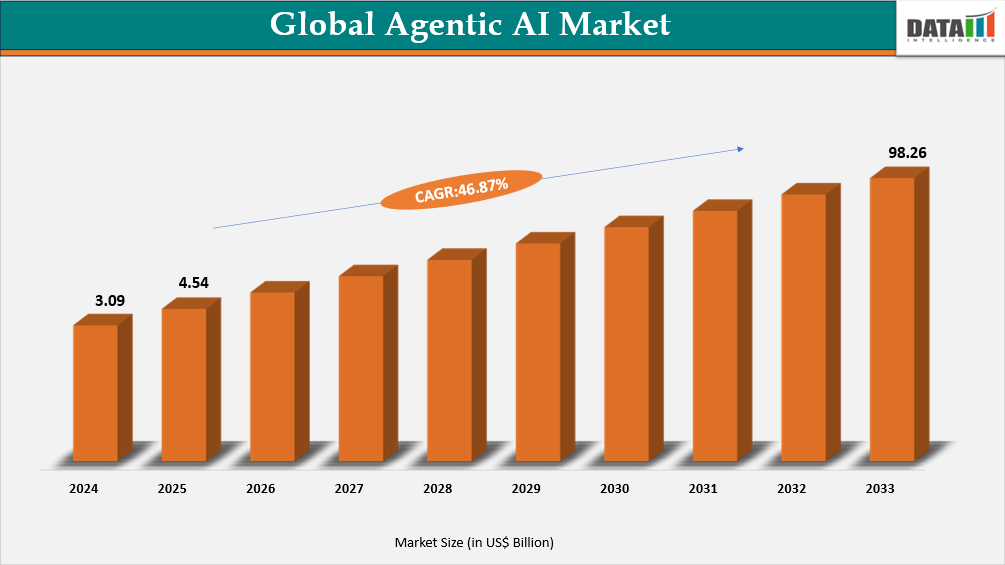
Source- DataM Intelligence
For more detailed information, Request for Free sample
Market Scope
| Metrics | Details |
| By Component | Software Platforms, AI Models & Frameworks, Agent Orchestration Engines, Tool Integration Layers, Services. Others |
| By Agent Type | Single-Agent Systems, Multi-Agent Systems Autonomous Agents, Semi-Autonomous Agents, Collaborative Agents, Others |
| By Deployment Mode | Cloud-Based, On-Premise, Hybrid |
| By Organization Size | Large Enterprises, Small & Medium Enterprises (SMEs) |
| By Application | IT & Telecommunications, BFSI (Banking, Financial Services & Insurance), Healthcare & Life Sciences, Retail & E-commerce, Manufacturing, Logistics & Transportation, Energy & Utilities, Media & Entertainment, Others |
| By Region | North America, South America, Europe, Asia-Pacific, Middle East and Africa |
| Report Insights Covered | Competitive Landscape Analysis, Company Profile Analysis, Market Size, Share, Growth |
Key Takeaways
- The market is expected to expand by more than 21 times its current size by 2033, driven by increasing enterprise demand for autonomous, goal-oriented AI systems capable of executing complex workflows with minimal human intervention.
- Asia-Pacific accounted for 25.41% of global market share in 2025 and is the fastest-growing regional market, supported by digital transformation initiatives, AI innovation programs, and increasing enterprise adoption across key industries.
- The Software Platforms segment held approximately 19.22% market share in 2025, reflecting growing demand for agent orchestration, workflow automation, and autonomous decision-making solutions.
- Cloud-based deployment continues to dominate market adoption due to its scalability, flexibility, lower infrastructure requirements, and seamless integration with enterprise software ecosystems.
- Large enterprises are leading adoption as organizations increasingly deploy autonomous AI agents to improve operational efficiency, automate decision-making, reduce costs, and enhance customer experiences.
- The convergence of Large Language Models (LLMs), Retrieval-Augmented Generation (RAG), agent orchestration frameworks, and enterprise software integration is significantly accelerating market expansion.
- Industries such as BFSI, healthcare, manufacturing, telecommunications, retail, and logistics are rapidly adopting agentic AI to streamline workflows, optimize operations, and enable intelligent automation.
Market Dynamics
Real-Time Knowledge Integration Accelerating Agentic AI Adoption
Outdated and inaccurate information remains a critical challenge for enterprises, directly impacting compliance, decision quality, and operational efficiency. In 2025, the integration of AI agents with Retrieval Augmented Generation (RAG) is emerging as a key market driver by enabling access to real-time, verified data sources.
RAG-powered agents combine the reasoning capabilities of large language models with dynamic retrieval from regulatory databases, enterprise repositories, and external knowledge systems. For instance, compliance assistant agents can automatically pull the latest regulatory updates, interpret changes, and assess potential exposure across business operations.
This significantly reduces manual research effort while improving accuracy and consistency in compliance workflows. By grounding agent decisions in up-to-date information, enterprises can mitigate regulatory risks and avoid costly errors. Faster, data-backed decision-making also enhances audit readiness and governance outcomes. As trust, transparency, and accountability become essential for autonomous systems, RAG-integrated AI agents are accelerating enterprise adoption and driving overall market growth.
Growth of Agentic AI Marketplaces and Partner Ecosystems
The growth of agentic AI marketplaces and partner ecosystems is acting as a strong catalyst for overall market expansion by lowering entry barriers for enterprises. Much like the early evolution of mobile app stores, the emerging agent economy allows organizations to access ready-made AI agents instead of building solutions from scratch. Enterprises can now purchase, customize, and deploy pre-built agents tailored to specific business functions and workflows.
Platforms such as Hugging Face Agents and Microsoft Copilot Studio are leading this shift by offering plug-and-play agent solutions. These ecosystems enable faster deployment cycles and significantly reduce development complexity. The availability of partner-built agents also encourages innovation and specialization across industries. For small and mid-sized businesses, marketplaces make agentic AI more affordable and accessible. As ecosystem participation grows, network effects are accelerating adoption and driving sustained market growth.
Investor-Focused Insights
- With a projected CAGR of 46.87%, Agentic AI represents one of the most attractive investment opportunities across the broader artificial intelligence ecosystem.
- Investment activity is accelerating across autonomous agents, multi-agent systems, AI orchestration frameworks, AI memory architectures, workflow automation platforms, and enterprise AI ecosystems.
- The market is attracting substantial interest from cloud providers, enterprise software companies, semiconductor manufacturers, and AI-native startups seeking to capitalize on the next phase of AI adoption.
- Organizations that successfully develop scalable, secure, and enterprise-ready agentic AI platforms are expected to capture significant market share as businesses transition from traditional automation toward autonomous AI systems.
Latest Industry Intelligence & Future Growth Catalysts (2026)
The evolution of Agentic AI is being driven by the growing need for autonomous systems that can manage increasingly complex business operations. Enterprises are moving beyond experimental AI deployments and integrating intelligent agents into mission-critical workflows to improve productivity, accelerate decision-making, and reduce operational costs.
Multi-agent systems are emerging as a major innovation trend, enabling multiple AI agents to collaborate, share information, and solve complex business challenges. This capability is expected to significantly expand the practical applications of Agentic AI across industries.
The growing adoption of AI copilots and digital workers is also accelerating market expansion. Organizations are increasingly deploying intelligent agents to assist employees, automate routine activities, and streamline business processes. These systems are becoming essential tools for customer service, finance, HR, IT operations, and supply chain management.
Agentic AI is also benefiting from increased investments in AI infrastructure, cloud computing, and advanced semiconductor technologies. As organizations scale AI adoption, demand for high-performance computing resources capable of supporting autonomous AI agents is expected to rise substantially.
Furthermore, advances in memory architectures, context management, and reasoning capabilities are enabling AI agents to perform more sophisticated tasks and maintain long-term operational effectiveness. These developments are expected to unlock new opportunities across enterprise and industrial environments.
Segmentation Analysis
The global agentic AI market is segmented based on component, agent type, deployment mode, organization size, application and region.
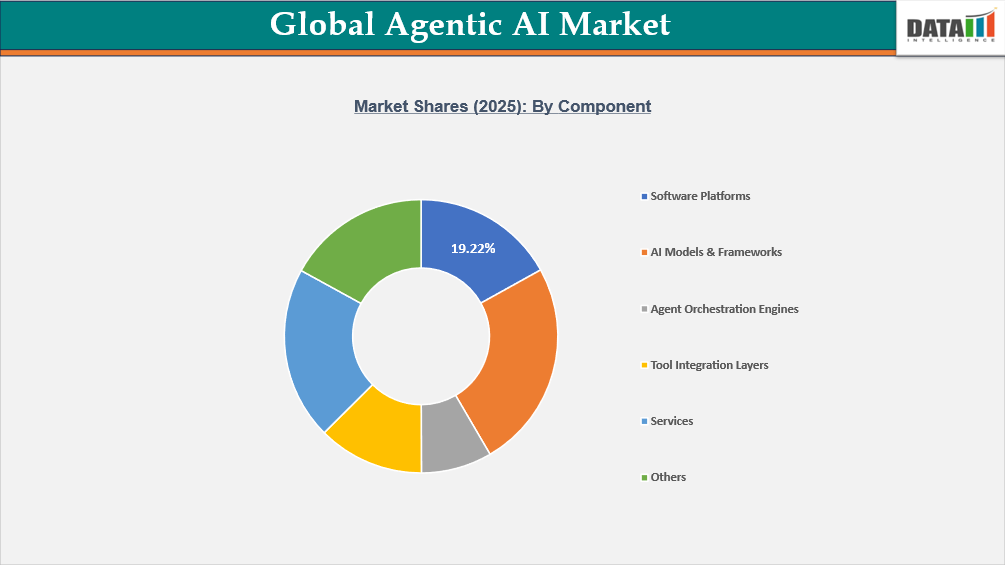
Software Platforms as the Foundation of Agentic AI Market Expansion
The software platforms segment plays a pivotal role in driving the growth of the Agentic AI market by serving as the core layer that enables agent development, deployment, and orchestration. These platforms provide end-to-end environments for building autonomous and multi-agent systems without requiring deep AI engineering expertise. Integrated capabilities such as agent memory, tool management, and workflow orchestration accelerate enterprise adoption.
Software platforms also support seamless integration with enterprise applications, APIs, and data sources, expanding real-world use cases. Built-in governance, monitoring, and security features increase trust in agent-driven operations. By reducing development time and operational complexity, platforms lower total cost of ownership for organizations. This scalability makes agentic AI viable across both large enterprises and SMEs. As enterprises prioritize speed, flexibility, and control, software platforms continue to act as a primary engine of market growth.
Cloud-Based Deployment Accelerating Scalable Adoption of Agentic AI
The cloud-based deployment segment is a major driver of growth in the Agentic AI market by enabling scalable, flexible, and cost-efficient adoption of autonomous AI systems. Cloud platforms allow enterprises to deploy and manage AI agents without heavy upfront infrastructure investments. On-demand compute and storage support the intensive processing requirements of large language models and multi-agent workflows.
Cloud environments also enable rapid experimentation, continuous updates, and real-time performance optimization of agents. Seamless integration with cloud-native data sources and enterprise SaaS applications expands agent use cases. Built-in security, monitoring, and compliance tools increase enterprise confidence in cloud deployments. For small and mid-sized organizations, cloud-based delivery significantly lowers entry barriers. As enterprises increasingly favor agility and scalability, cloud-based deployment continues to accelerate overall market growth.
Geographical Penetration
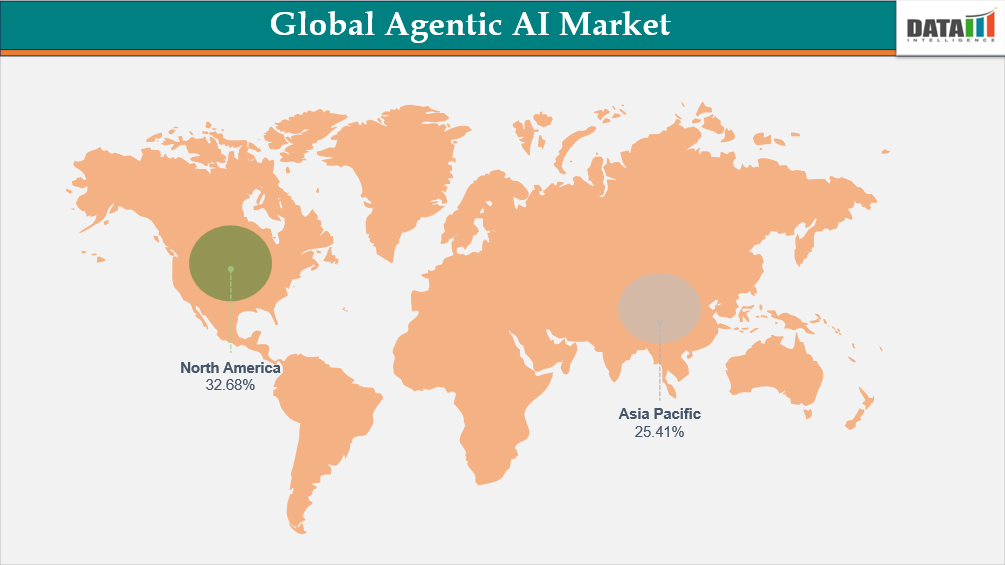
Asia-Pacific Driving Agentic AI Adoption Through Enterprise-Scale Innovation
Asia-Pacific is emerging as a key growth engine for the Agentic AI market, driven by rapid enterprise digital transformation and strong IT services innovation. In 2025, Coforge announced the launch of EvolveOps.AI, highlighting the region’s leadership in deploying agentic AI for real-world enterprise operations. The platform demonstrates how agentic AI enables end-to-end autonomous IT operations across complex hybrid cloud environments. Built on open-source technologies, such solutions lower adoption barriers and accelerate scalability for enterprises across the region. This combination of cost efficiency, technical expertise, and AI-first strategies is positioning Asia-Pacific as a major contributor to global market growth.
China Accelerating Agentic AI Growth Through Commerce-Led Innovation
China is emerging as a major force in driving the Agentic AI market by embedding autonomous agents directly into large-scale digital commerce ecosystems. In 2026, leading technology giants such as Alibaba, Tencent, and ByteDance are heavily investing in agentic AI to transform chatbots into end-to-end transaction engines. This shift toward “agentic commerce” enables AI systems to autonomously manage multi-step processes, from product discovery to payment completion.
Alibaba’s upgrade of its Qwen chatbot exemplifies this trend by allowing users to complete purchases, travel bookings, and service orders within a single interface. By connecting AI agents to platforms like Taobao, Fliggy, and Alipay, enterprises are demonstrating real-world scalability of agentic systems. This commerce-first approach is accelerating adoption, showcasing tangible ROI, and positioning China as a key driver of global Agentic AI market growth.
Japan Advancing Agentic AI Adoption Through Ecosystem-Driven Innovation
Japan is driving Agentic AI market growth through large-scale ecosystem integration and consumer-facing deployments. In 2025, Rakuten Group, Inc. and Rakuten Mobile, Inc. launched Rakuten AI, marking a significant step toward mainstream agentic AI adoption. By embedding AI agents into Rakuten Link and offering web-based access, Rakuten is normalizing everyday interaction with autonomous AI. Planned rollout across Rakuten Ichiba further extends agentic AI into digital commerce and lifestyle services. This ecosystem-led strategy is accelerating user adoption and positioning Japan as a key contributor to global Agentic AI market expansion.
North America Driving Agentic AI Growth Through Cloud Modernization and Enterprise Execution
North America is driving Agentic AI market growth by focusing on practical execution rather than experimental adoption. In 2026, many U.S. enterprises continue to face constraints from legacy systems and fragmented data environments, limiting large-scale agentic AI deployment. Against this backdrop, NTT Data announced a multi-year strategic collaboration with Amazon Web Services to accelerate cloud modernization and responsible agentic AI adoption. The partnership emphasizes modernizing mission-critical workloads and building cloud-compliant foundations. This execution-led approach helps enterprises unlock tangible business value from agentic AI, particularly in regulated and high-growth sectors. As modernization initiatives scale, North America continues to play a central role in shaping enterprise-grade agentic AI adoption globally.
United States: Driving Agentic AI Growth Through Enterprise-Scale Enablement
United States is accelerating Agentic AI market growth by enabling enterprises to operationalize AI at scale without disrupting existing infrastructure. In 2026, IBM launched IBM Enterprise Advantage, an asset-based consulting service focused on building, governing, and scaling internal agentic AI platforms. The solution allows organizations to redesign workflows and deploy agentic applications across heterogeneous environments. Its compatibility with platforms such as Amazon Web Services, Google Cloud, Microsoft Azure, and IBM watsonx reduces adoption friction. This execution-focused approach is strengthening U.S. leadership in enterprise-grade agentic AI deployment.
Canada Agentic AI Industry Growth
Canada is driving Agentic AI market growth by extending advanced AI capabilities to mid-market organizations. In 2025, MNP expanded its partnership with Microsoft to deliver agentic AI solutions tailored for mid-sized enterprises. Through the launch of MNP AI Foundry, clients are supported across the full AI lifecycle, from opportunity identification to large-scale deployment. The initiative focuses on scaling Microsoft 365 Copilot and related agents across business functions. This ecosystem-led, services-driven model is accelerating agentic AI adoption and market growth across Canada’s mid-market segment.
Sustainability Analysis
Sustainability is emerging as a critical consideration in the Agentic AI market as enterprises seek to balance automation benefits with environmental and social responsibility. Agentic AI systems help optimize resource utilization by reducing manual processes, improving energy efficiency, and minimizing operational waste across enterprise workflows.
Cloud-based and autonomous operations enable dynamic workload management, lowering compute and infrastructure inefficiencies. At the same time, growing focus on responsible AI ensures transparency, governance, and ethical decision-making within autonomous systems. Enterprises are increasingly aligning agentic AI deployments with long-term ESG goals and regulatory expectations. As sustainability-driven investments rise, agentic AI is positioned as a key enabler of efficient, resilient, and responsible digital transformation.
Competitive Landscape
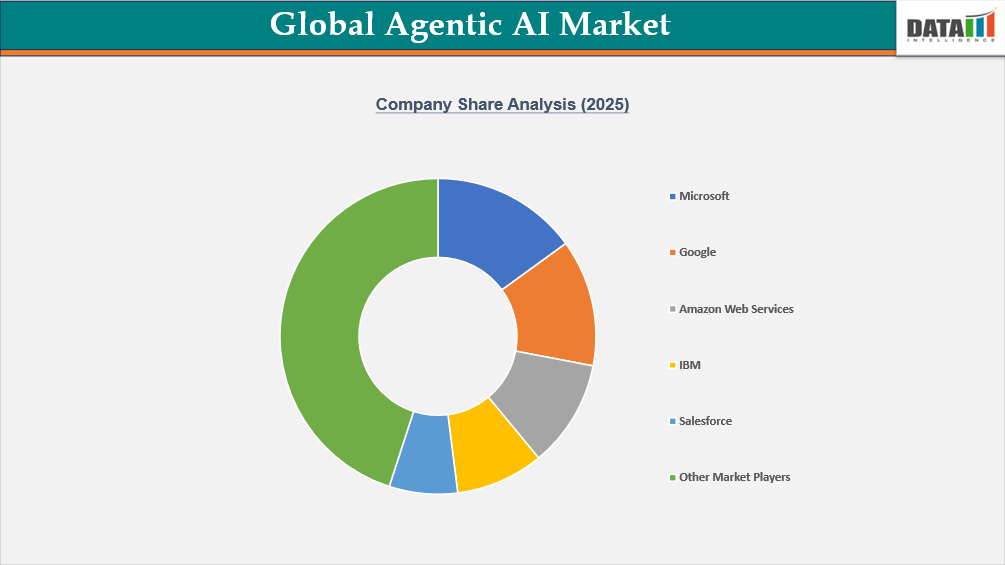
- The global agentic AI market is characterized by a competitive landscape that includes both established and regional players.
- Key players include Microsoft, Google, Amazon Web Services, Anthropic, IBM, Salesforce, ServiceNow, NVIDIA, Accenture, Oracle and among others.
Key Developments
- June 2026 - Microsoft and Google expanding enterprise AI agent ecosystems
Microsoft and Google accelerated deployment of autonomous AI agents capable of planning, reasoning, and executing multi-step business tasks across productivity, customer service, software development, and enterprise operations. - May 2026 - Amazon Web Services and Anthropic advancing agentic AI infrastructure
Amazon Web Services (AWS) and Anthropic enhanced AI agent development frameworks, enabling organizations to build, deploy, and govern intelligent agents with improved safety, scalability, and workflow automation capabilities. - April 2026 - Salesforce and ServiceNow strengthening AI-powered workflow automation
Salesforce and ServiceNow expanded agentic AI offerings designed to automate customer support, IT operations, business processes, and knowledge management through autonomous decision-making and task execution. - April-June 2026 - Rising investments in enterprise-grade AI agents and reasoning models
Companies including NVIDIA, IBM, Oracle, and Accenture increased investments in AI infrastructure, agent orchestration platforms, domain-specific AI assistants, and advanced reasoning models to support large-scale enterprise adoption of agentic AI solutions.
Why Choose DataM?
- Data-Driven Insights: Dive into detailed analyses with granular insights such as pricing, market shares and value chain evaluations, enriched by interviews with industry leaders and disruptors.
- Post-Purchase Support and Expert Analyst Consultations: As a valued client, gain direct access to our expert analysts for personalized advice and strategic guidance, tailored to your specific needs and challenges.
- White Papers and Case Studies: Benefit quarterly from our in-depth studies related to your purchased titles, tailored to refine your operational and marketing strategies for maximum impact.
- Annual Updates on Purchased Reports: As an existing customer, enjoy the privilege of annual updates to your reports, ensuring you stay abreast of the latest market insights and technological advancements. Terms and conditions apply.
- Specialized Focus on Emerging Markets: DataM differentiates itself by delivering in-depth, specialized insights specifically for emerging markets, rather than offering generalized geographic overviews. This approach equips our clients with a nuanced understanding and actionable intelligence that are essential for navigating and succeeding in high-growth regions.
- Value of DataM Reports: Our reports offer specialized insights tailored to the latest trends and specific business inquiries. This personalized approach provides a deeper, strategic perspective, ensuring you receive the precise information necessary to make informed decisions. These insights complement and go beyond what is typically available in generic databases.
Why Buy This Report?
This report delivers comprehensive intelligence on one of the fastest-growing and most disruptive segments within the artificial intelligence industry. It provides decision-makers with actionable insights into market trends, technology developments, competitive strategies, and future growth opportunities.
The study helps organizations evaluate investment opportunities, identify emerging business models, understand evolving customer requirements, and develop effective market-entry and expansion strategies. It also supports product development, partnership decisions, and long-term strategic planning by offering a detailed assessment of the evolving Agentic AI landscape.
Target Audience 2026
- Manufacturers/ Buyers
- Industry Investors/Investment Bankers
- Research Professionals
- Emerging Companies



























































