


Global Edge AI Chip Market Overview
The global Edge AI chips market is rapidly expanding, driven by the rising need for on-device AI processing in sectors such as autonomous vehicles, IoT, industrial automation, and smart healthcare. By enabling real-time computation, these chips reduce latency, enhance data privacy, and improve energy efficiency. Technological advancements, coupled with supportive government policies particularly in the Asia-Pacific region are further accelerating adoption, positioning edge AI chips as a key component of next-generation intelligent systems.
Edge AI Chip Industry Trends and Strategic Insights
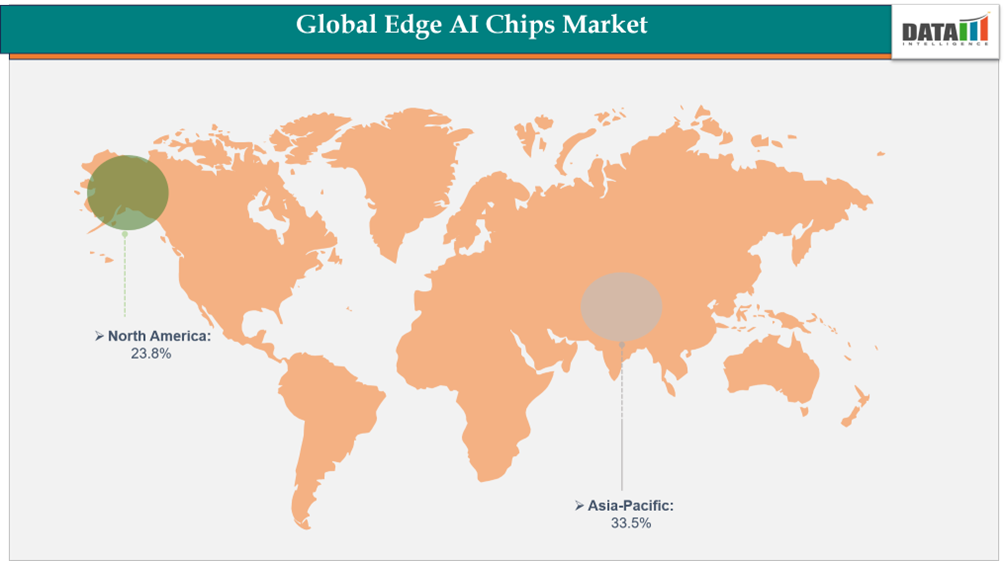
- Asia-Pacific dominates the edge AI chip market, capturing the largest revenue share of 33.5% in 2024.
- By end-user, the consumer electronics segment is projected to be the largest market, holding a significant share of 22.4% in 2024.
Edge AI Chip Market Size and Future Outlook
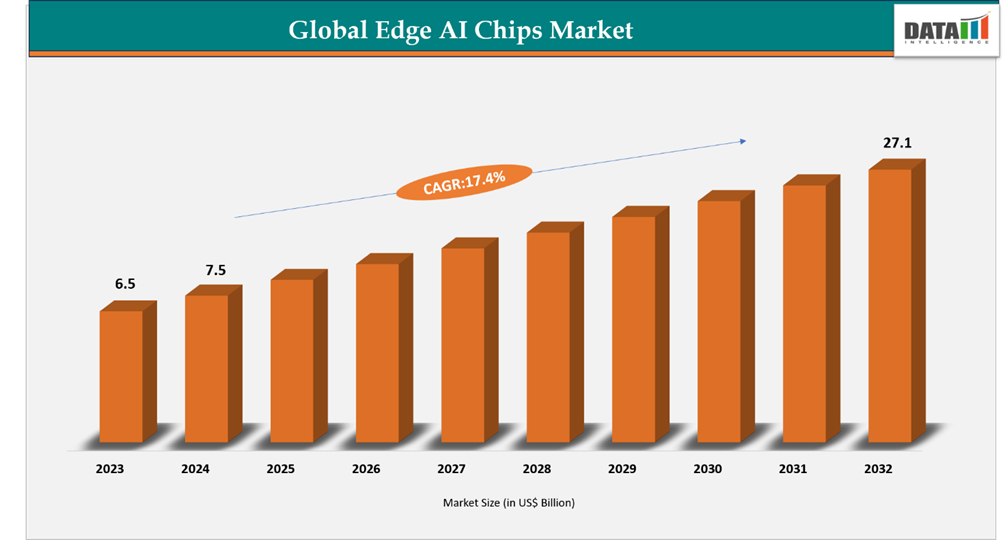
- 2025 Market Size: US$ 8.80 billion
- 2033 Projected Market Size: US$ 31.75 billion
- CAGR (2026-2033): 17.4%
- Largest Market: Asia-Pacific
- Fastest Market: North America
Edge AI Chip Market Key Takeaways
- Asia-Pacific continues to dominate Edge AI chip manufacturing and deployment, driven by strong semiconductor ecosystems in Taiwan, South Korea, and China. The region benefits from large-scale electronics production, rapid 5G penetration, and aggressive national AI semiconductor strategies, particularly in China where domestic chip self-sufficiency policies are accelerating edge AI accelerator adoption across surveillance, consumer devices, and industrial IoT.
- North America remains the innovation and architecture leadership hub for Edge AI chips. The U.S. is driving demand through hyperscale AI ecosystems, on-device generative AI integration in smartphones and PCs, and automotive AI compute platforms. Companies are shifting from cloud-first AI toward hybrid inference models where latency-sensitive workloads are processed at the edge using NPUs, TPUs, and custom silicon.
- A major structural shift is underway from cloud-centric AI to distributed inference at the edge. AI workloads are increasingly being executed directly on devices such as smartphones, cameras, vehicles, drones, and industrial sensors to reduce latency, bandwidth costs, and privacy risks. This is accelerating demand for low-power, high-efficiency neural processing units (NPUs) embedded in SoCs.
- The smartphone industry has become the primary scaling engine for Edge AI chips. Flagship devices from Apple, Qualcomm-powered Android OEMs, and MediaTek-based ecosystems are integrating dedicated AI accelerators for real-time translation, image generation, voice assistants, and multimodal AI processing directly on-device without cloud dependency.
- Automotive applications are emerging as a high-value growth frontier. Advanced driver-assistance systems (ADAS), in-cabin monitoring, and autonomous driving stacks increasingly rely on edge AI compute to process sensor fusion data in real time. This is driving demand for automotive-grade AI accelerators with strict power, thermal, and safety certifications.
- Industrial and IoT deployment is expanding rapidly, particularly in smart manufacturing, predictive maintenance, and video analytics. Edge AI chips are enabling real-time decision-making in environments where cloud connectivity is limited, expensive, or too slow for mission-critical operations.
- The competitive landscape is shifting from general-purpose GPUs toward specialized edge AI accelerators. Companies like NVIDIA, Qualcomm, Apple, Intel, Google (Edge TPU), and emerging pure-play startups such as Hailo and Kneron are competing on power efficiency, inference speed, and software ecosystem integration rather than raw compute alone.
- Geopolitical semiconductor fragmentation is reshaping supply chains. The U.S., China, and EU are all investing heavily in domestic chip design and packaging capabilities, leading to parallel ecosystems for AI silicon. This is accelerating regional diversification but also increasing cost and duplication of R&D efforts
Edge AI Chip Market Scope
| Metrics | Details |
| By Chip Type | CPU, GPU, NPU, ASIC, Others |
| By Function | Inference, Training |
| By End-User | Consumer electronics, Automotive, Healthcare, Retail & e-commerce, Manufacturing, Telecommunications, Others |
| By Region | North America, South America, Europe, Asia-Pacific, Middle East and Africa |
| Report Insights Covered | Competitive Landscape Analysis, Company Profile Analysis, Market Size, Share, Growth |
Edge AI Chip Market Dynamics
Growth of IoT and Connected Devices
The surge in IoT and connected devices is driving demand for Edge AI chips. From smart wearables and home appliances to industrial sensors and autonomous vehicles, the growing volume of edge-generated data requires on-device processing to reduce latency, enhance privacy, and limit reliance on cloud infrastructure.In March 2025, Illustrating this trend, at Embedded World in Germany, Qualcomm announced plans to acquire Edge Impulse to strengthen its developer platform and solidify its position in the IoT AI space. Such initiatives underscore the critical role of edge AI chips in enabling intelligent, connected devices across automotive, healthcare, industrial, and consumer applications.
Power Consumption and Thermal Management
Managing power consumption and thermal performance remains a key challenge for the Edge AI chips market. Edge devices like wearables, smart cameras, and autonomous sensors often have compact designs with limited battery life and minimal cooling, making high-performance AI processing prone to heat buildup, which can impact reliability and longevity. Nevertheless, innovations in energy-efficient chip designs, optimized NPUs, and advanced thermal management are helping to overcome these limitations. Techniques such as model quantization and pruning further enable efficient on-device AI inference without compromising accuracy, supporting continued market growth despite these constraints.
Edge AI Chip Market Segment Analysis
The global edge AI chip market is segmented based on chip type, function, end-user and region.
Rising Demand for Smart Devices in Consumer Electronics Fuels Segment Growth
The consumer electronics segment is a key driver of the Edge AI chips market, propelled by the rising adoption of smart devices such as smartphones, wearables, smart cameras, and home assistants. These devices increasingly depend on on-device AI processing to deliver features like voice recognition, image analysis, health tracking, and real-time personalization, which require low latency and energy-efficient performance. For instance, In August 2024, Amazon acquired Edge chip and AI model compression company Perceive in an US$ 80 Billion deal, aiming to strengthen AI capabilities in its consumer devices. This move underscores the growing importance of edge AI chips in enabling responsive, privacy-conscious, and intelligent electronics.
With the rapid expansion of connected IoT ecosystems, the demand for smarter devices continues to rise. Manufacturers are focusing on compact, energy-efficient chips capable of performing advanced computations without draining battery life. Moreover, the increasing emphasis on personalized, context-aware AI experiences is driving the integration of sophisticated AI directly into devices, reducing reliance on cloud processing and further accelerating market growth.
Rising Adoption of Connected and Autonomous Vehicles Drives Demand in Automotive End-User Segment
The automotive segment is a key driver of the Edge AI chips market, fueled by the rising adoption of connected, smart, and autonomous vehicles (SDVs). Edge AI chips play a vital role in vehicles by supporting advanced driver-assistance systems (ADAS), in-vehicle infotainment, predictive maintenance, and real-time safety monitoring, where on-device AI processing ensures low latency and high reliability.
For Instance, In January 2025, NXP strengthened its automotive portfolio through the acquisition of TTTech Auto, a leading software provider specializing in systems, safety, and security for SDVs. TTTech Auto complements and enhances the NXP CoreRide platform, helping automakers reduce system complexity, improve performance, and accelerate time-to-market. This move reflects NXP’s strategic goal to become a leader in intelligent edge systems for automotive and Industrial IoT, emphasizing the growing importance of edge AI chips in next-generation vehicles.
With the increasing focus on autonomous, connected, and intelligent vehicles, automakers are investing in high-performance, energy-efficient edge AI chips capable of handling complex computations locally. The demand for real-time decision-making, enhanced safety, and system optimization continues to fuel the automotive segment, establishing it as a major contributor to overall market growth.
Why does this report matter in 2026?
The year 2026 marks a pivotal phase for the Edge AI Chip Market as artificial intelligence shifts from centralized cloud infrastructure to distributed edge devices. Enterprises are increasingly deploying AI inference directly on smartphones, industrial equipment, autonomous vehicles, robotics, healthcare devices, surveillance systems and smart consumer electronics to reduce latency, improve data privacy and lower cloud computing costs. Semiconductor manufacturers are therefore racing to introduce dedicated AI accelerators with higher performance-per-watt, integrated NPUs and optimized software ecosystems.
The report matters because Edge AI Chips are no longer differentiated solely by TOPS (trillions of operations per second). Commercial success depends on balancing AI performance, power efficiency, thermal management, memory bandwidth, software compatibility, security and cost. Different applications require different chip architectures, process nodes and AI frameworks. The study separates smartphones, automotive, industrial IoT, consumer electronics, healthcare and edge servers, linking each segment with deployment trends, purchasing priorities and technology requirements.
The timing is equally important for investment planning. AI PCs, intelligent cameras, factory automation and autonomous systems are moving from pilot projects toward large-scale deployment. Companies investing in advanced packaging, heterogeneous computing, AI software toolchains, developer ecosystems and next-generation semiconductor manufacturing during 2026 are expected to strengthen their competitive position throughout the decade.
Edge AI Chip Market White Space & Investment Opportunities
- Ultra-low-power AI chips for battery-operated wearables, smart sensors and medical monitoring devices remain a significant growth opportunity.
- Automotive Edge AI processors supporting autonomous driving, ADAS and in-vehicle generative AI continue to attract long-term investment.
- AI chips optimized for industrial automation, robotics and predictive maintenance present strong opportunities as smart factories expand globally.
- Secure Edge AI processors with integrated cybersecurity and on-device encryption are becoming increasingly valuable for enterprise deployments.
- Edge AI accelerators supporting multimodal AI models, including vision, speech and language processing, offer premium growth potential.
- Software development platforms, AI compiler optimization and edge inference frameworks remain underpenetrated compared with hardware innovation.
Edge AI Chip Future Market Transformation
The market is expected to evolve from supplying standalone AI accelerators into delivering complete intelligent computing platforms that integrate AI hardware, software, connectivity and security. Early deployments focused primarily on computer vision and image recognition. Future Edge AI Chips will increasingly support generative AI, multimodal inference, real-time decision-making and autonomous operations directly on devices without relying on cloud connectivity.
The commercial ecosystem will become more integrated as semiconductor companies collaborate with cloud providers, OEMs, robotics manufacturers, automotive companies and software developers. AI model optimization, chip-software co-design and standardized AI development tools will reduce deployment complexity while improving scalability across multiple industries.
By 2035, the strongest vendors are expected to combine advanced semiconductor design, efficient AI software stacks, developer ecosystems, security capabilities and long-term manufacturing partnerships. Competitive differentiation will increasingly depend on software optimization, ecosystem maturity and power efficiency rather than raw computing performance alone.
Edge AI Chip Market Buyer Decision-Making Criteria
Technology buyers prioritize AI inference performance, power consumption, latency, thermal efficiency and compatibility with existing software frameworks. Edge AI Chips must reliably execute increasingly complex AI models while minimizing energy usage and maintaining real-time responsiveness across diverse operating environments.
Procurement teams also evaluate semiconductor supply reliability, manufacturing process technology, software development support, cybersecurity features, long-term product availability and ecosystem compatibility. Purchasing decisions increasingly consider total cost of ownership, software optimization, lifecycle support and scalability instead of chip pricing alone.
Edge AI Chip Market Economic & Investment Analysis
Commercial forecasting should distinguish theoretical semiconductor demand from qualified deployment opportunities. Adoption depends on AI workload complexity, device replacement cycles, semiconductor manufacturing capacity, software maturity, OEM integration and regional AI investment. Realistic forecasts therefore consider design wins, production timelines, AI application growth and technology adoption rates rather than relying solely on overall semiconductor demand.
The category remains highly attractive because AI functionality is becoming a core requirement across smartphones, industrial automation, automotive electronics, healthcare equipment and consumer devices. Once integrated into production platforms, Edge AI Chips generate recurring demand throughout product lifecycles while creating opportunities for software licensing, ecosystem expansion and platform upgrades.
Investment remains concentrated in advanced semiconductor fabrication, AI accelerator architecture, chiplet integration, advanced packaging, memory technologies, software optimization and developer ecosystems. Companies with proprietary AI architectures and strong software compatibility can achieve premium margins while expanding across multiple application segments.
Investment risks remain significant. Rapid AI model evolution, semiconductor manufacturing constraints, export regulations, high R&D costs and competitive pricing pressures can affect commercialization. Successful investment therefore requires balanced portfolios spanning hardware innovation, software ecosystems, manufacturing partnerships and customer support rather than relying exclusively on chip performance improvements.
From an investment perspective, milestone-based planning should differentiate research programs, prototype validation, OEM design wins, mass production and recurring commercial deployments. Near-term opportunities remain strongest in consumer electronics and AI PCs, while long-term growth depends on automotive autonomy, industrial robotics, healthcare AI and edge infrastructure expansion.
Edge AI Chip Investment Trends in the Market
- Investment is accelerating in dedicated NPUs and AI accelerators optimized for generative AI and multimodal inference.
- Semiconductor manufacturers are expanding advanced packaging, chiplet integration and heterogeneous computing capabilities.
- Capital continues flowing toward AI software frameworks, developer tools and model optimization platforms supporting Edge AI deployment.
- Automotive, industrial automation and robotics remain priority investment segments for next-generation Edge AI processors.
- Strategic partnerships between semiconductor companies, cloud providers, OEMs and AI software developers are accelerating commercialization.
- Advanced semiconductor manufacturing and energy-efficient AI architectures are becoming primary investment priorities as edge computing adoption expands.
Edge AI Chip Market Geographical Penetration
Rising Adoption of Edge AI Solutions in Asia-Pacific
The Asia-Pacific Edge AI chips market is the largest globally, representing around 33.5% of the total market in 2024, fueled by rapid industrialization, widespread IoT deployment, and growing demand from smart electronics and automotive sectors. China leads the region in production, supported by its robust semiconductor manufacturing ecosystem and government initiatives promoting AI and chip development. Japan and South Korea, despite smaller volumes, dominate the high-value segment with advanced chip design capabilities, serving industries such as autonomous vehicles, consumer electronics, and industrial automation.
For instance, In July 2025, SAC Group, a member of WPG Holdings, partnered with Axelera AI to expand into the Edge AI market and establish a new framework for smart applications. This collaboration underscores the increasing focus on innovation and strategic partnerships to accelerate the deployment of edge AI technologies across diverse applications in the region.
India Edge AI Chip Market Outlook
India's Edge AI Chip market is witnessing rapid growth, driven by expanding technology and industrial sectors and government initiatives supporting domestic semiconductor and AI development. Increasing adoption of AI-driven solutions across data centers, cloud platforms, automotive, and smart devices has significantly boosted the demand for edge AI chips. The growth of digital infrastructure, enterprise AI applications, industrial automation, and IoT deployment is further fueling the need for high-performance, low-latency edge computing solutions.
For instance, In October 2024, Indian companies are placing large-scale orders for Nvidia chips, with Tata Communications, Reliance Industries, and Yotta Data Services acquiring Nvidia H100s to strengthen their AI processing and edge computing capabilities. These strategic investments emphasize India’s push toward developing robust edge AI ecosystems and enhancing technological self-reliance.
China Edge AI Chip Market Trends
China's Edge AI Chips market outlook remains highly positive, as the country continues to be the dominant player. Leading Chinese companies such as Huawei, Horizon Robotics, and Cambricon are expanding production and R&D to meet the rising demand for cost-effective and high-performance edge AI solutions. At the same time, global firms including Nvidia, Intel, and Qualcomm maintain a strong presence in China through local subsidiaries, partnerships, and collaborations to cater to enterprise, automotive, and consumer electronics sectors. Japanese and South Korean firms also continue to serve the high-value premium segment, leveraging advanced chip design and manufacturing expertise.
Presence of Advanced Industrial and AI Infrastructure in North America
North America is projected to be a key region in the global Edge AI Chips market, accounting for around 23.8% of the market in 2024. The region’s growth is driven by strong demand from sectors such as automotive, aerospace, industrial automation, and manufacturing. With advanced industrial infrastructure, a mature semiconductor ecosystem, and a robust AI and IoT technology base, North America ensures consistent adoption of edge AI chips for diverse high-performance applications.
Although alternative AI computing architectures are emerging, edge AI chips remain essential for low-latency, energy-efficient, on-device processing. The region’s strong presence of chipmakers, technology innovators, and end-user industries reinforces its position as a major market for edge AI solutions.
Supporting this trend, in February 2025, NXP Semiconductors announced its acquisition of US edge AI chipmaker Kinara for $307 Billion. Kinara, known for its energy-efficient neural processing units (NPUs), will have its edge NPUs and AI software integrated into NXP’s industrial and IoT processors. Both companies focus on IoT and AI systems for industrial and automotive applications, with the deal expected to close in the first half of 2025, underscoring North America’s strategic importance in advancing edge AI technology..
US Edge AI Chip Market Insights
The US holds the largest share of the North America Edge AI Chips market, driven by strong demand from the automotive, aerospace, and industrial technology sectors. The automotive industry, producing Billions of connected and autonomous vehicles, relies on edge AI chips for real-time data processing, ADAS, and in-vehicle intelligence. Likewise, the aerospace sector is increasingly deploying edge AI for predictive maintenance, avionics, and mission-critical applications. Investments in industrial IoT and smart manufacturing further support consistent demand for high-performance, energy-efficient edge AI chips. While alternative computing solutions are emerging, edge AI chips remain essential due to their on-device processing, low latency, and adaptability across diverse applications.
Canada Edge AI Chip Industry Growth
In Canada, the Edge AI Chips market is smaller than in the US but remains important, supported by the country’s technology-driven industries, aerospace cluster, and expanding data center infrastructure. Major aerospace companies like Bombardier and Pratt & Whitney Canada are increasingly leveraging edge AI for operational efficiency and real-time monitoring. Industries such as mining, energy, and advanced manufacturing are also adopting edge AI for automation and predictive analytics. With a growing focus on AI research, industrial IoT, and smart manufacturing, demand for edge AI chips in Canada is expected to rise steadily, though at a slightly slower pace compared to the US.
Technology Analysis
The Edge AI Chips market is being shaped by innovations in energy-efficient computing, AI accelerators, and TinyML technologies, which enable real-time, on-device intelligence across applications such as automotive, industrial automation, consumer electronics, and healthcare. Modern edge AI chips emphasize low latency, high performance, and seamless integration with IoT and smart devices.
For instance, on June 17, 2025, Nordic Semiconductor announced the acquisition of Neuton.AI’s intellectual property and core technology, a leader in fully automated TinyML solutions for edge devices. By combining Nordic’s ultra-low-power nRF54 Series SoCs with Neuton’s neural network framework, the partnership brings scalable, high-performance AI to even the most resource-constrained edge devices, showcasing the fast-paced technological advancements in the market.
Strategic Indicators for Edge AI Chip Market
High Technology Adoption
The rapid deployment of generative AI, edge computing and on-device intelligence is accelerating demand for Edge AI Chips. Adoption is expanding across smartphones, AI PCs, industrial automation, autonomous vehicles, robotics, healthcare devices and smart surveillance. Companies capable of delivering high-performance AI inference with low power consumption are gaining a competitive advantage.
High Investment Activity
Investment continues to accelerate in AI accelerators, NPUs, advanced semiconductor fabrication, chiplet architectures and AI software ecosystems. Capital is increasingly directed toward companies developing energy-efficient Edge AI processors, heterogeneous computing platforms and optimized AI toolchains for commercial-scale deployment.
Supply Chain Disruption
The market remains sensitive to semiconductor foundry capacity, advanced packaging availability, high-bandwidth memory supply and geopolitical trade restrictions. Manufacturers are diversifying fabrication partners, strengthening regional supply chains and securing long-term wafer agreements to reduce production risks.
Pricing Volatility
Edge AI Chip pricing varies based on process node, AI performance (TOPS), memory integration, packaging technology and software capabilities. Customers increasingly evaluate total platform value, including power efficiency, AI optimization, lifecycle support and software compatibility rather than hardware cost alone.
Procurement Pressure
OEMs and enterprise buyers require reliable semiconductor supply, long-term product availability, AI software support, cybersecurity features and global manufacturing capability. Procurement teams increasingly prioritize ecosystem maturity, software optimization and supply continuity alongside competitive pricing.
New Technology Adoption
The market is rapidly adopting chiplet architectures, heterogeneous computing, advanced NPUs, multimodal AI acceleration, RISC-V processors and AI-specific software frameworks. Companies integrating hardware innovation with optimized AI development tools are expected to achieve faster commercial adoption.
Regional Expansion Opportunity
Asia-Pacific remains the largest semiconductor manufacturing hub, while North America leads AI processor innovation and software ecosystem development. Europe continues investing in automotive AI, industrial automation and semiconductor resilience, creating additional regional growth opportunities.
Government Policy Support
Governments worldwide are increasing investments in AI infrastructure, semiconductor manufacturing, advanced chip research and domestic fabrication capabilities. Incentive programs supporting AI innovation, semiconductor independence and digital transformation are strengthening long-term Edge AI Chip demand.
Pricing Intelligence
Commercial pricing increasingly reflects AI computing capability, energy efficiency, software ecosystem value, security features and long-term platform support rather than silicon cost alone. Vendors delivering optimized hardware-software integration, lower power consumption and scalable AI deployment can achieve premium pricing and stronger long-term customer retention.
Edge AI Chip Market Competitive Landscape
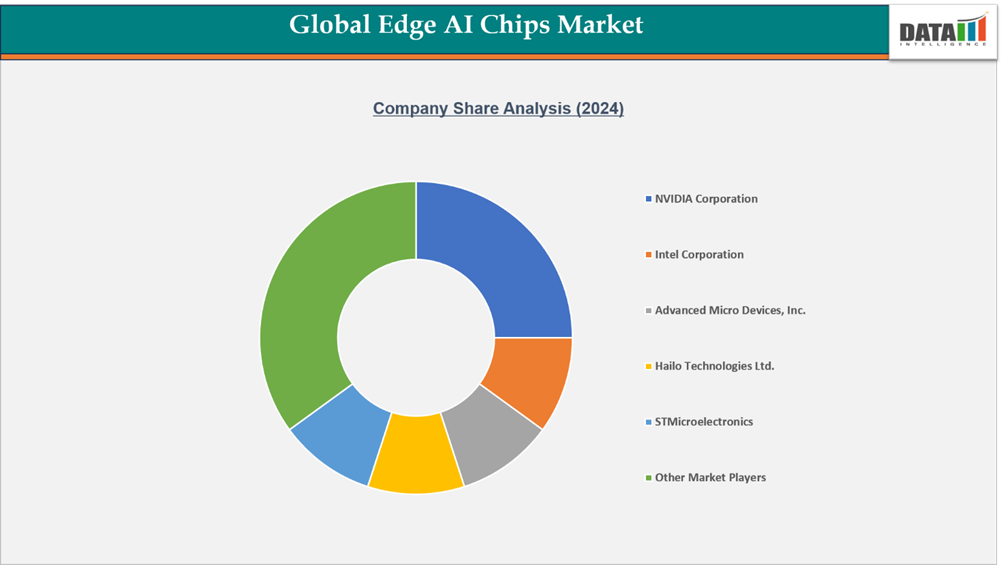
- The global Edge AI Chips market is characterized by a competitive landscape comprising both established semiconductor giants and innovative AI hardware startups.
- Key players include NVIDIA Corporation, Intel Corporation, Advanced Micro Devices, Inc., Hailo Technologies Ltd., STMicroelectronics, Texas Instruments Incorporated, Mythic, Qualcomm Technologies, Inc, Samsung, MediaTek.
- These companies focus on product differentiation by offering high-performance, energy-efficient chips with advanced AI accelerators, low-latency processing, and on-device intelligence suitable for applications in automotive, industrial, and consumer electronics.
- Strategic investments in R&D, AI model optimization, energy-efficient architectures, and software-hardware integration are critical, as the industry faces competition from alternative AI computing solutions and emerging edge-focused architectures.
Edge AI Chips Market Key Developments
- In May 2026, NVIDIA Corporation expanded its Edge AI ecosystem by strengthening collaborations with global automotive OEMs and robotics firms, enhancing real-time inference capabilities for autonomous machines and industrial edge deployments using next-generation Jetson platforms.
- In April 2026, Qualcomm Technologies Inc. announced advancements in its Edge AI chip portfolio, integrating upgraded neural processing units (NPUs) designed for ultra-low power performance in smartphones, smart cameras, and IoT edge devices, accelerating on-device generative AI adoption.
- In March 2026, Intel Corporation scaled its Edge AI strategy through enhancements in the Intel Movidius and Xeon edge platforms, enabling higher-performance AI inference for smart manufacturing, healthcare imaging, and retail analytics applications across distributed networks.
- In February 2026, MediaTek Inc. introduced new edge AI chipset solutions targeting consumer electronics and smart home ecosystems, with improved AI acceleration for voice recognition, vision processing, and real-time translation features integrated into connected devices.
- In January 2026, Hailo Technologies and SiMa.ai reported increased deployment of their dedicated edge AI accelerators across surveillance, industrial automation, and smart city infrastructure projects, focusing on high-efficiency AI processing at the edge with reduced cloud dependency.
- In September 2025, Grinn, a leader in advanced IoT and embedded systems, has formed a strategic partnership with MediaTek to drive the development of AI-powered edge solutions.
- In July 2025, Blaize secures a $120 Billion deal to expand the deployment of edge AI chips in Asia.
Target Audience 2025
- Manufacturers/ Buyers
- Industry Investors/Investment Bankers
- Research Professionals
- Emerging Companies



























































