


Japan’s Humanoid Robot Revolution: AI Robots Become the Future of Industrial Automation
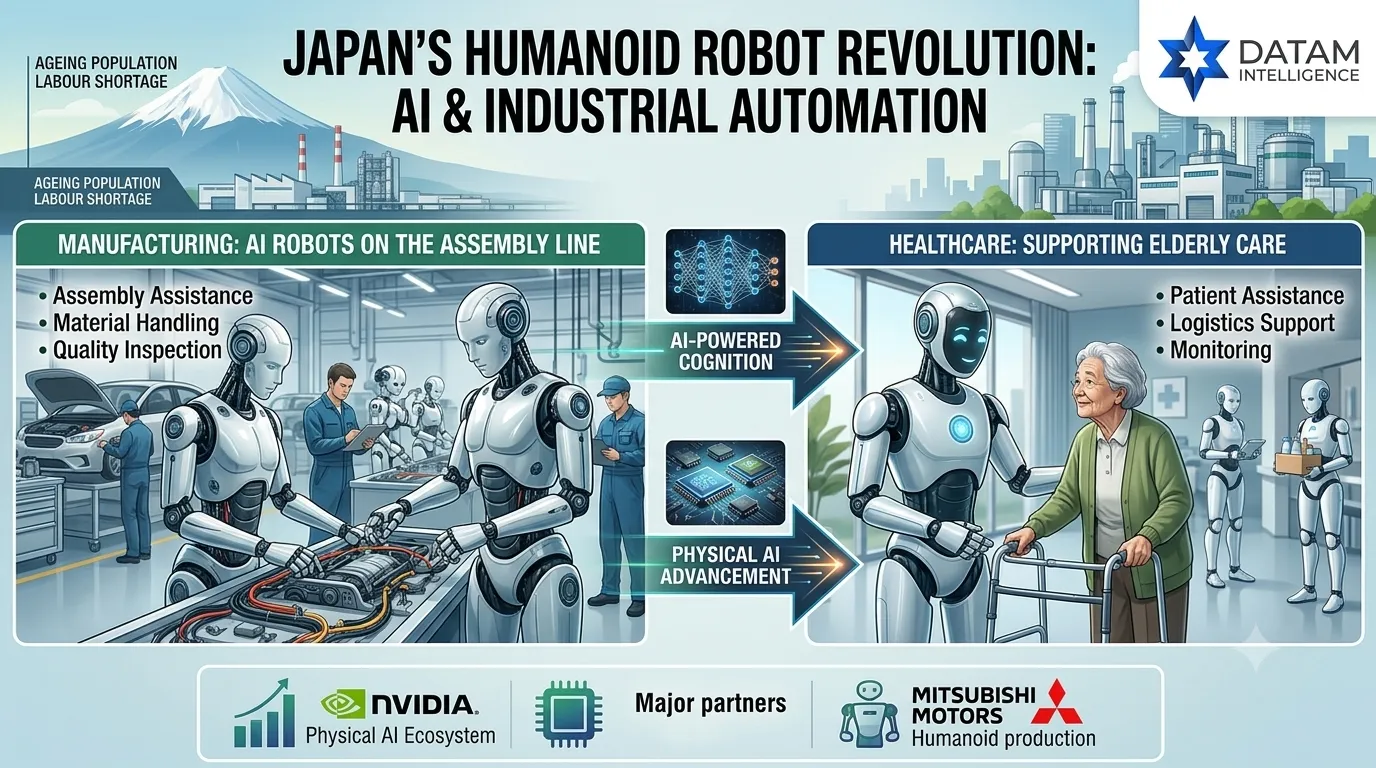
Japan is entering a new era of industrial automation as humanoid robots move from research laboratories into real-world factories. Driven by labour shortages, artificial intelligence breakthroughs and rising demand for smart manufacturing, Japan is accelerating investments in AI-powered robots that can work alongside humans.
Government initiatives, Mitsubishi Motors’ humanoid robot manufacturing plans, and Nvidia’s physical AI partnerships with leading Japanese robotics companies are positioning Japan as a global hub in the race for next-generation humanoid robotics.
Japan has long been recognized as a global robotics powerhouse, but the country is now entering a new phase of automation the era of humanoid robots powered by artificial intelligence.
Unlike traditional industrial robots designed for repetitive tasks, modern humanoid robots combine AI models, computer vision, advanced sensors and human-like mobility to perform complex activities in factories, warehouses, healthcare facilities and service environments.
The rapid development of Humanoid Robotics Market is being accelerated by Japan’s ageing population, workforce shortages and the global competition between Japan, China and the United States to dominate the emerging physical AI economy.
Explore the Future of the Humanoid Robot Market
Discover Humanoid Robot Market size, growth forecasts, competitive landscape, technology trends and investment opportunities shaping the global humanoid robot industry.
Request a Sample Report to understand how AI-powered robotics will transform manufacturing, healthcare and logistics.
Japan’s Labour Shortage Drives Humanoid Robot Adoption
Japan faces one of the world’s most serious workforce challenges. An ageing population and declining workforce availability are creating pressure across manufacturing, logistics, healthcare and construction industries.
According to industry analysts, automation and robotics are becoming essential solutions to maintain productivity while reducing dependency on human labour.
Humanoid robots are gaining attention because they can operate in environments designed for humans without requiring major infrastructure changes.
Key applications include:
- Factory assembly operations
- Material handling
- Warehouse automation
- Healthcare assistance
- Inspection and maintenance
- Elderly care support
Japan’s AI Robot Strategy: Building a Humanoid Robot Economy
Japan is moving beyond traditional industrial automation and developing a new generation of AI-powered humanoid robots designed to operate in complex, human-centric environments. While Japan has been a global leader in industrial robotics for decades, the next phase of its robotics strategy focuses on integrating artificial intelligence, machine learning, advanced sensors and autonomous systems to create robots capable of understanding situations, making decisions and performing tasks with greater flexibility.
The shift from conventional automation to intelligent robotics is driven by several national priorities, including addressing labour shortages, improving productivity, strengthening manufacturing competitiveness and creating new economic opportunities in emerging robotics markets.
Unlike traditional factory robots that perform predefined repetitive movements, next-generation humanoid robots are being developed with advanced cognitive capabilities. These systems can analyze their surroundings, learn from data, interact safely with humans and adapt to changing working conditions.
Japan’s Vision for an AI-Powered Robot Economy
Japan’s long-term robotics strategy aims to establish a society where AI robots work alongside humans across multiple industries. The country is focusing on developing a robotics ecosystem that combines hardware innovation, artificial intelligence capabilities and industrial expertise.
The objective is not only to manufacture robots but also to create a broader humanoid robot economy involving:
- Robotics hardware manufacturers
- AI software developers
- Semiconductor companies
- Sensor technology providers
- Automation solution providers
- Industrial users
This ecosystem approach is expected to accelerate the commercial adoption of humanoid robots and position Japan as a key player in the global physical AI revolution.
Key Sectors Driving Japan’s AI Robot Adoption
1. Manufacturing: The First Major Market for Humanoid Robots
Manufacturing is expected to become one of the earliest and largest adoption areas for AI-powered humanoid robots.
Japan’s automotive, electronics and machinery industries are increasingly exploring robots that can support human workers in production environments.
Potential applications include:
- Assembly line assistance
- Quality inspection
- Equipment monitoring
- Material handling
- Component transportation
- Factory maintenance
Humanoid robots offer a major advantage because they can operate in existing factory environments designed for human workers, reducing the need for expensive infrastructure modifications.
For manufacturers facing workforce shortages, AI robots could provide a scalable solution to maintain production capacity while improving operational efficiency.
2. Healthcare: Supporting Japan’s Ageing Population
Healthcare is another critical area where Japan expects AI robots to create significant value.
With one of the world’s fastest-ageing populations, Japan faces increasing demand for elderly care services and healthcare workers. Humanoid and assistive robots are being developed to support medical professionals and improve quality of life for elderly citizens.
Applications include:
- Patient assistance
- Elderly care support
- Rehabilitation services
- Hospital logistics
- Healthcare monitoring
AI-enabled robots could help reduce pressure on healthcare workers by performing routine tasks and providing support in care facilities.
Unlock Strategic Insights into the Humanoid Robots in Healthcare Market
As healthcare providers increasingly adopt AI-driven robotics to address workforce shortages and improve patient outcomes, understanding market trends has become critical. Explore comprehensive analysis covering Humanoid Robots in Healthcare Market dynamics, technology innovations, leading players and growth opportunities across global healthcare systems.
Request for a Sample Report and stay ahead of the next wave of healthcare automation.
3. Logistics: Automating Warehouses and Supply Chains
Japan’s logistics industry is experiencing growing demand for automation due to labour shortages and increasing e-commerce activity.
AI-powered humanoid robots could transform logistics operations by performing tasks such as:
- Picking and sorting products
- Moving materials
- Warehouse navigation
- Inventory management
- Distribution centre operations
Because humanoid robots are designed to move through human environments, they could integrate into existing warehouses without requiring complete redesigns of facilities.
4. Agriculture: Addressing Rural Workforce Challenges
Japan is also exploring robotics solutions for agriculture, where an ageing farming workforce and declining rural populations are creating significant challenges.
AI robots could support:
- Crop monitoring
- Harvesting activities
- Agricultural inspection
- Farm equipment operations
- Precision farming
By combining robotics with artificial intelligence and data analytics, Japan aims to improve agricultural productivity while reducing dependence on manual labour.
5. Public Services and Smart Society Applications
Japan’s robotics strategy extends beyond commercial industries into public services and smart city development.
Future applications may include:
- Public facility assistance
- Disaster response
- Security monitoring
- Infrastructure inspection
- Transportation support
Humanoid robots equipped with AI capabilities could become part of Japan’s broader vision for a technology-driven society where humans and machines collaborate.
Japan’s Position in the Global Humanoid Robot Race
The global humanoid robot market is becoming increasingly competitive, with Japan facing strong challenges from China and the United States.
Japan’s competitive advantages include:
- Decades of robotics expertise
- Advanced manufacturing capabilities
- Strong industrial automation companies
- High-quality engineering talent
- Established robotics supply chains
However, China is rapidly expanding its robotics ecosystem through large-scale manufacturing capabilities and government-backed investments, while the United States maintains leadership in artificial intelligence, semiconductor technology and robotics startups.
Japan’s strategy is focused on combining its robotics manufacturing strength with next-generation AI technologies to remain competitive in the global humanoid robot industry.
Technology Foundations Supporting Japan’s Humanoid Robot Growth
The expansion of AI robotics is being enabled by rapid advances across multiple technology areas:
Artificial Intelligence Models
Advanced AI models allow robots to understand environments, process information and make autonomous decisions. These capabilities are essential for creating robots that can perform flexible tasks rather than fixed programmed actions.
Robotics Software
Modern robotics platforms are becoming increasingly software-driven, enabling:
- Real-time decision-making
- Autonomous movement
- Task learning
- Human-robot interaction
Semiconductor Technology
High-performance chips are critical for powering humanoid robots. Advanced processors enable robots to process large amounts of data from cameras, sensors and AI models in real time.
Sensor Systems
Next-generation robots rely on advanced sensors, including:
- Computer vision systems
- Force and touch sensors
- Motion tracking technology
- Environmental detection systems
These technologies allow robots to safely interact with humans and navigate complex environments.
Autonomous Navigation
AI-powered navigation enables robots to move independently, understand surroundings and perform tasks in dynamic environments such as factories, hospitals and warehouses.
Mitsubishi Motors Enters Humanoid Robot Production
One of Japan’s biggest industrial developments is the entry of automotive companies into humanoid robotics.
Mitsubishi Motors is exploring humanoid robot manufacturing capabilities, leveraging its automotive production expertise, engineering workforce and factory infrastructure.
The company’s Kyoto facility is expected to play a role in developing and producing advanced robotic systems.
Why Automotive Companies Are Entering the Humanoid Robotics Market
The automotive industry is emerging as one of the most important players in the development and commercialization of humanoid robots. Automotive manufacturers have spent decades building expertise in precision engineering, industrial automation, robotics integration and large-scale manufacturing, making them uniquely positioned to transition from using robots in factories to developing and producing the next generation of intelligent robotic systems.
As humanoid robots move closer to commercial deployment, automakers are leveraging their existing manufacturing ecosystems, production facilities and engineering capabilities to accelerate robot development and achieve mass production at scale.
Unlike traditional robotics companies that focus primarily on robotic hardware or software, automotive companies bring deep experience in designing complex machines, managing global supply chains and operating highly automated production environments.
Automotive Manufacturing Expertise Creates a Competitive Advantage
Precision Manufacturing Capabilities
Automotive manufacturers have some of the world’s most advanced precision manufacturing systems, developed through decades of producing vehicles with thousands of complex components.
This expertise is highly transferable to humanoid robot production, which requires:
- High-precision mechanical components
- Advanced motion systems
- Lightweight structural materials
- Reliable actuator systems
- Complex assembly processes
Humanoid robots require the same level of engineering accuracy found in modern vehicles, particularly in areas such as joint movement, balance control and mechanical reliability.
Automakers’ experience in producing millions of vehicles annually provides a foundation for scaling humanoid robot manufacturing from prototypes to commercial production.
Factory Automation Expertise
Automotive companies are among the largest users of industrial robots globally. Modern vehicle production facilities already depend heavily on automated systems for:
- Welding
- Painting
- Assembly
- Quality inspection
- Material movement
This creates a strong advantage because automakers understand how robots operate in real industrial environments.
By developing humanoid robots, automotive companies can design machines specifically for factory applications, allowing robots to perform tasks alongside human workers in existing production facilities.
Potential benefits include:
- Increased manufacturing efficiency
- Reduced production downtime
- Improved workplace safety
- Greater operational flexibility
Humanoid robots could eventually handle tasks that are difficult to automate using conventional industrial robots due to their limited movement capabilities.
Strong Supply Chain Networks
Automotive manufacturers operate some of the most sophisticated global supply chains, involving thousands of suppliers across mechanical, electronic and software components.
This ecosystem provides access to critical technologies required for humanoid robots, including:
- Motors and actuators
- Batteries and energy systems
- Semiconductor components
- Sensors
- Control systems
- Advanced materials
Existing supplier relationships can help automotive companies reduce production costs and accelerate the commercialization of humanoid robots.
Robotics Engineering Knowledge
Automakers already have extensive experience integrating robotics, artificial intelligence and automation technologies into manufacturing operations.
Their engineering capabilities include:
- Motion control systems
- Autonomous technologies
- Machine vision
- Human-machine interaction
- Industrial AI applications
The development of humanoid robots requires combining mechanical engineering with artificial intelligence, and automotive companies have a strong foundation across both hardware and industrial automation.
Why Automotive Companies Are Well Positioned for Humanoid Robot Mass Production
Developing a humanoid robot prototype is only the first step. The major challenge is achieving reliable, cost-effective mass production.
Automotive companies have advantages that can help overcome this challenge:
Manufacturing Scale
Automakers already operate large production facilities capable of producing complex machines at high volumes.
Quality Control Systems
Vehicle manufacturing requires strict quality standards, which are essential for reliable humanoid robot production.
Global Distribution Networks
Automotive companies already have established channels to deploy technology across global markets.
Cost Optimization Expertise
Decades of manufacturing experience allow automakers to reduce production costs through automation and supply chain optimization.
Potential Applications of Humanoid Robots in Automotive Manufacturing
1. Vehicle Manufacturing Assistance
Humanoid robots could support workers in vehicle production by performing repetitive or physically demanding tasks.
Applications may include:
- Component installation
- Assembly assistance
- Material transportation
- Tool handling
By working alongside human employees, robots can improve productivity while allowing workers to focus on more complex operations.
2. Factory Inspection and Quality Control
AI-powered humanoid robots could improve manufacturing quality through advanced inspection capabilities.
Potential uses include:
- Detecting production defects
- Monitoring equipment conditions
- Performing safety inspections
- Collecting real-time manufacturing data
Combined with AI vision systems, robots could identify issues faster and improve overall production reliability.
3. Component Handling and Material Movement
Factories require constant movement of parts and materials between production areas.
Humanoid robots could assist with:
- Transporting components
- Loading and unloading materials
- Warehouse operations
- Inventory movement
Their human-like design allows them to operate in environments already built around human workers.
4. Production Line Support
Humanoid robots could become flexible assistants on automotive production lines by adapting to different manufacturing tasks.
Unlike traditional robots designed for a single function, AI-powered humanoid robots could potentially:
- Learn new tasks
- Switch between operations
- Support multiple production stages
- Work collaboratively with employees
This flexibility is especially valuable as automotive manufacturers move toward electric vehicles, smart factories and increasingly customized production models.
Future Outlook: Automotive Companies as Key Players in the Humanoid Robot Economy
The entry of automotive companies into humanoid robotics represents a major shift in the global robotics industry.
Companies that already mastered vehicle manufacturing are now applying their expertise to building intelligent machines capable of operating in the physical world.
With advantages in manufacturing scale, automation expertise, supply chains and engineering capabilities, automotive companies could become some of the most influential players in the future humanoid robot market.
As the competition between Japan, China and the United States intensifies, automotive manufacturers are expected to play a critical role in transforming humanoid robots from experimental technology into commercially viable industrial solutions.
Nvidia’s Physical AI Partnership Accelerates Japan Robotics Race
Artificial intelligence chip market leader Nvidia is becoming a key technology partner in the global humanoid robot industry.
Through its physical AI ecosystem, Nvidia is supporting robotics companies developing machines that can understand environments, learn tasks and interact with the physical world.
Japanese robotics leaders including:
- Fanuc
- Yaskawa Electric
- Fujitsu
are exploring AI-powered robotics technologies that combine industrial automation expertise with advanced AI computing.
What is Physical AI?
Physical AI refers to artificial intelligence systems that interact with the real world through robots.
Unlike traditional AI applications that operate only digitally, physical AI enables machines to:
- Understand surroundings
- Make decisions
- Navigate environments
- Perform physical tasks
This technology is expected to become a major driver of future manufacturing automation.
Japan vs China vs US: Global Humanoid Robot Competition
The race to dominate humanoid robotics is becoming a major technology competition between Japan, China and the United States.
Japan
Strengths:
- Decades of robotics expertise
- Advanced manufacturing
- Industrial automation leadership
- Strong robotics companies
Key players:
- Fanuc
- Yaskawa
- Mitsubishi
- Toyota
China
China is rapidly investing in humanoid robots through:
- Government-backed robotics programs
- Manufacturing scale
- AI development
- Domestic supply chains
Chinese companies are focusing on mass production and commercial deployment.
United States
The US leads in:
- Artificial intelligence
- Robotics startups
- Semiconductor technology
- Foundation AI models
Companies are combining advanced AI software with robotic hardware development.
Market Opportunity: Humanoid Robots Transform Multiple Industries
The global humanoid robot market is expected to experience significant growth as companies move from pilot projects to commercial deployment.
Industrial Automation
Factories are expected to become the first major adoption area.
Applications include:
- Assembly
- Quality inspection
- Machine operation
- Packaging
- Maintenance
Healthcare Robotics
Japan’s ageing population creates strong demand for healthcare robots.
Potential applications:
- Elderly assistance
- Patient support
- Hospital logistics
- Rehabilitation
Logistics and Warehousing
Humanoid robots could transform:
- Distribution centres
- Last-mile operations
- Inventory management
- Material movement
Future Outlook: Japan’s Role in the Global Humanoid Robot Industry
Japan’s combination of robotics expertise, manufacturing strength and AI innovation gives it a strong position in the emerging humanoid robot economy.
As companies such as Mitsubishi, Nvidia partners and Japanese robotics leaders accelerate development, humanoid robots are expected to move from experimental technology into mainstream industrial applications.
The next decade could determine which country leads the global physical AI revolution.
Why is Japan investing in humanoid robots?
Japan is investing in humanoid robots to address labour shortages, improve manufacturing productivity and develop next-generation AI-powered automation systems. Humanoid robots can perform human-like tasks in factories, logistics centres and healthcare environments without requiring major infrastructure changes.