


Global Aluminium Supply Intelligence
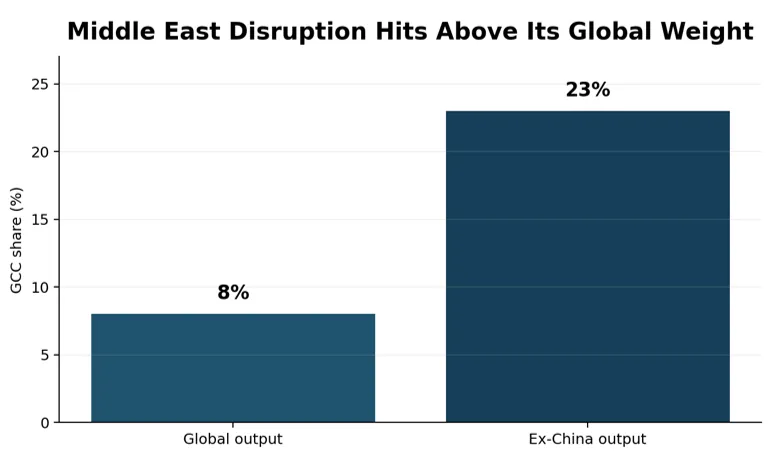
| SUPPLY SHOCK | Middle East disruptions have removed and delayed exportable metal, while LME inventories are already at multi-decade lows. |
| STRUCTURAL CAP | China - still the world’s dominant primary producer - has effectively reached its 45 Mt annual capacity ceiling, limiting the traditional supply response. |
| ENERGY CONFLICT | New smelting capacity must secure decades of low-cost power at the same time AI data centers are willing to pay multiples of smelter economics. |
The Market Is Running Out of Easy Supply Responses
The 2026 aluminium squeeze is often described as an inventory or logistics problem. That is only the visible layer. The deeper issue is that several of the industry’s traditional pressure-release mechanisms are constrained at the same time: Gulf exports have been disrupted, China has little room to add primary capacity, Western consumers cannot freely substitute every tonne sitting in exchange warehouses and new smelters struggle to secure power at economically viable prices.
Request Executive Sample: https://www.datamintelligence.com/download-sample/aluminium-market
China’s 45 Mt Ceiling Removes the Old Global Safety Valve
For most of the last two decades, a tightening global aluminium market could eventually be met by another wave of Chinese primary capacity. That mechanism is now largely exhausted. China’s regulatory ceiling was introduced to limit overcapacity and emissions, and national production is now operating close to the cap.
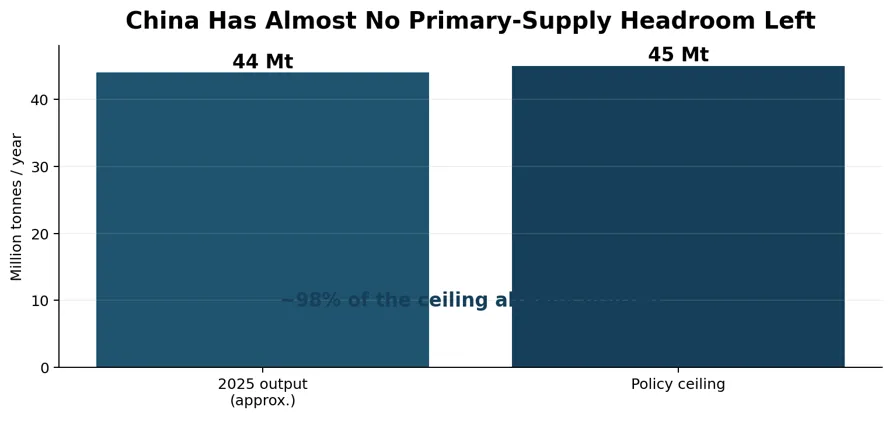
IEA and industry sources put China’s 2025 primary production at just over 44 Mt against a 45 Mt ceiling. In practical terms, the country is already using roughly 98% of its permitted primary-production headroom. That means incremental global growth increasingly has to come from Indonesia, India, Vietnam, Angola, recycling or expensive restarts elsewhere.
This is why the cap matters even if Chinese demand is soft. China can still redirect exports and recycled metal, but it can no longer provide the same primary-capacity surge that historically absorbed global shortages.
The Supply Response Is Moving to New Geographies - But It Takes Time
INDONESIA growth pipeline outside China. | INDIA Expanding smelting and alumina capacity with domestic demand support. |
RECYCLING than primary smelting. | RESTARTS Europe and North America can recover idled capacity, but power economics remain the gatekeeper. |
Source: IEA; S&P Global; Fastmarkets.
The Immediate Problem: Not Every Exchange Tonne Is Commercially Equivalent
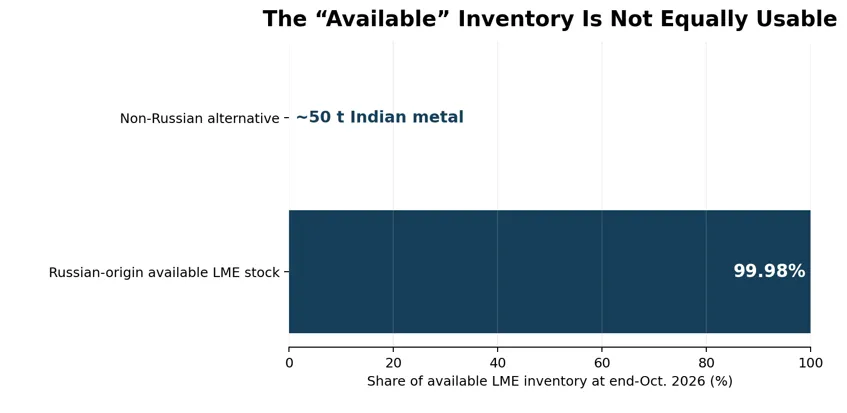
Reuters reported that Russian-origin metal represented 99.98% of available LME aluminium inventories at the end of October, with only around 50 tonnes of Indian material as an alternative. The point is not that Russian metal is universally inaccessible. It is that sanctions, company policies, financing rules and customer specifications mean a large share of visible inventory cannot be treated as a frictionless substitute by Western buyers.
Power Is Becoming the Hardest Input to Replace
Primary aluminium is effectively solid electricity. A new smelter can consume around 11 TWh per year and typically needs a 10-20 year power contract close to $40/MWh to be globally competitive. That requirement now collides directly with the AI infrastructure build-out.
The Aluminum Association says technology companies are committing more than $115/MWh for AI data-center power, while Alcoa has described roughly $30-$40/MWh as the range required for competitive smelting. That gap explains why two announced U.S. smelter projects still depend on securing long-term power agreements. The bottleneck is no longer simply capital or permitting - it is access to the right electricity contract.
This also creates a feedback loop. Aluminium is needed for transmission, data centers and grid expansion, yet the same grid build-out is making it harder to add domestic primary aluminium capacity.
Four Upstream Constraints Are Now Reinforcing Each Other
| GULF LOGISTICS Longer, riskier and more expensive routes | CHINA CAP 45 Mt primary ceiling | SANCTIONS / TRADE Visible stock is not fully substitutable | POWER AI can outbid new smelting |
The strategic risk comes from correlation. Any one of these constraints could be absorbed. When all four are active together, the global system loses flexibility. Supply can exist on paper while still being unavailable to the buyer who needs a particular origin, delivery window, carbon profile or physical form.
What This Means for Buyers, Producers and Investors
| Signal | What it reveals | Likely market effect | Decision implication |
| Gulf route disruption | Physical metal cannot reach consumers on normal routes | Higher regional premiums and inventory drawdown | Increase origin diversification and buffer stock |
| China at cap | Largest producer has limited primary headroom | Global growth shifts to slower ex-China projects | Track Indonesia, India and recycling capacity |
| Russian-heavy LME stocks | Visible inventory overstates usable Western supply | Tighter non-Russian premiums | Separate exchange stock from commercially acceptable stock |
| Power contract competition | New smelters cannot secure economic electricity | Restarts/new builds delayed or repriced | Monitor PPAs, grid access and energy cost by asset |
Request a Customized Report According to Your Business Strategy: https://www.datamintelligence.com/customize/aluminium-market
Why the Aluminium Market Can Stay Tight Even if LME Stocks Recover
A recovery in exchange inventories would relieve the immediate squeeze, but it would not solve the structural constraints upstream. The industry still needs enough non-sanctioned metal in the right geography, enough low-cost electricity to support new smelting, enough freight capacity to move Gulf material and enough ex-China capacity to offset a Chinese sector that is already close to its ceiling.
That is why the next phase of aluminium intelligence cannot stop at the benchmark price. Buyers and suppliers need to track where the tonnes are produced, whether they are deliverable, how the metal is routed, which smelters have power security and where new capacity can realistically come online.
The New Aluminium Supply Map Is a Decision Problem, Not a Price Forecast
| ORIGIN Where is primary metal available? | ACCESS Is the origin acceptable and sanction-compliant? | ROUTE Can it reach the consuming region economically? | POWER Can supply expand at competitive energy cost? | ACTION Contract, hedge, qualify or diversify |
For procurement teams, this means benchmarking supplier exposure by origin and route. For producers, it means identifying where premiums justify restarts, recycling investment or regional capacity expansion. For investors, it means separating projects with nominal capacity from those that actually have secured feedstock, logistics and long-term electricity.
What the Full Aluminium Market Report Will Answer For You
- How much incremental primary aluminium can realistically be added outside China through 2030?
- Which Gulf, European, North American and Asian supply routes are most exposed to logistics or geopolitical disruption?
- How much LME and off-exchange inventory is genuinely usable by buyers under prevailing sanctions and origin policies?
- Which smelters and proposed projects have secure, competitive long-term power contracts?
- Where are recycling, remelt and secondary aluminium becoming the fastest supply response?
- Which regional premiums and trade flows indicate the next physical tightness before it appears in headline LME prices?
Go beyond headline aluminium prices. Map the capacity caps, sanctioned inventory, freight bottlenecks and power constraints that determine which tonnes are actually available. | EXPLORE THE FULL ALUMINIUM MARKET REPORT |