


For decades, the automotive industry has focused on moving people and goods more efficiently along roads. That may not be the only direction mobility develops. Advances in electric propulsion, aerospace engineering, automation and connected systems are bringing new forms of air mobility into the conversation.
Tesla’s October 2026 Roadster demonstration has brought that conversation back into the spotlight. The company showed a Roadster performing a brief airborne maneuver using air jets and a suction-based system. Tesla has said production is targeted for 2028. It was a dramatic demonstration, but it does not establish that practical, everyday flying-car transport is close.
For business leaders, the more useful question is broader: how could the convergence of automotive and aerospace technologies change competition across the mobility industry?
The answer will depend on much more than the design of a vehicle. Certification, energy systems, manufacturing economics, infrastructure, software, customer demand and integration with existing transport networks will shape whether flying vehicles remain specialized products or become a meaningful part of mobility.
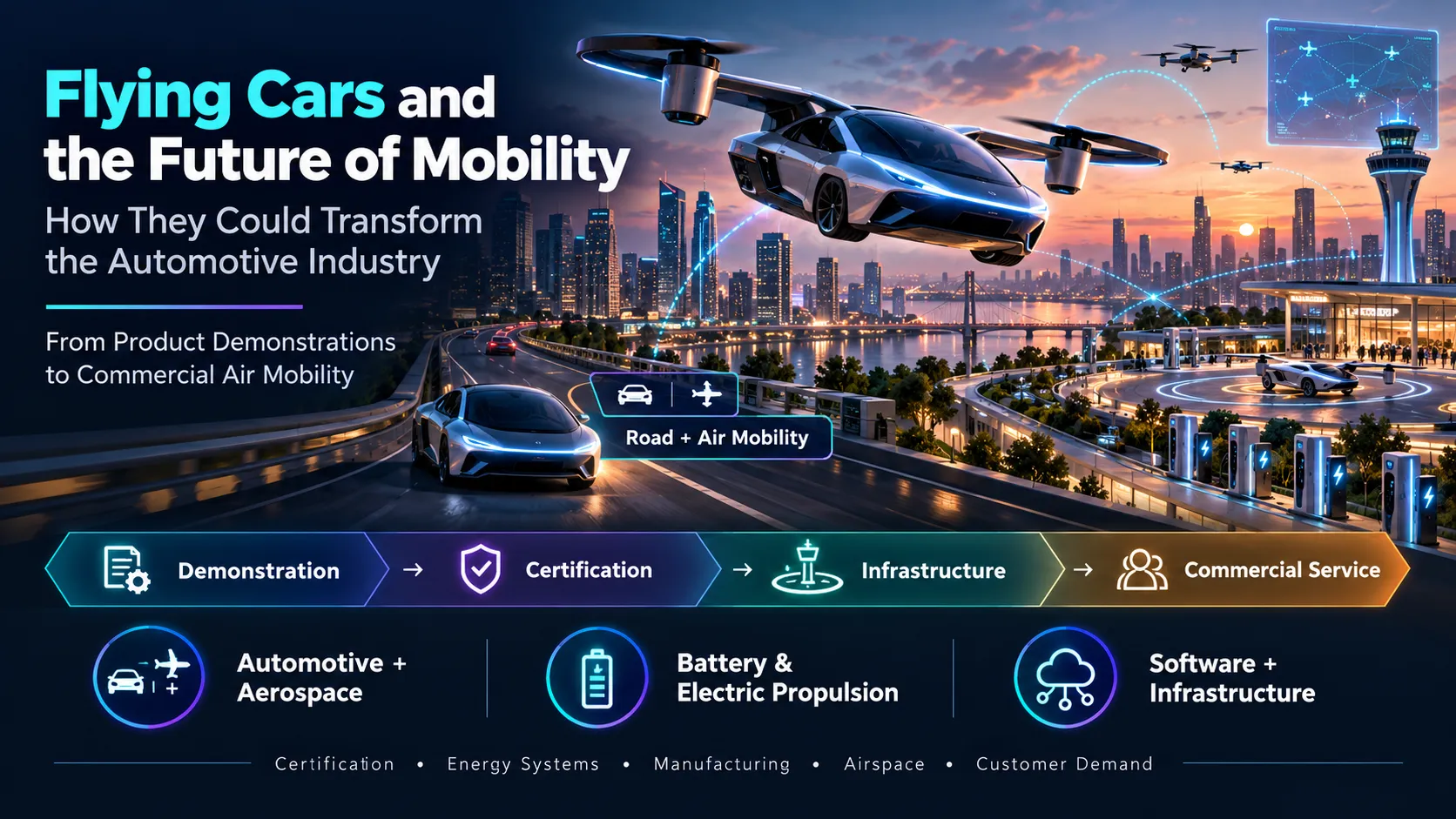
Request an exclusive sample as per your business requirements: https://www.datamintelligence.com/customize/flying-cars-market
A demonstration is not yet a transportation system
“Flying car” can describe several different concepts. A roadable aircraft is designed to operate both on roads and in the air. An electric vertical take-off and landing aircraft, or eVTOL, is designed primarily for flight. These concepts differ in engineering requirements, regulation, operating models and potential customers.
A vehicle that briefly leaves the ground is not necessarily equivalent to an aircraft designed for sustained, controlled passenger flight. Commercial air mobility requires validated performance, safety systems, appropriate certification, trained operators, maintenance arrangements, landing facilities and suitable operating rules.
Tesla’s Roadster page notes that the Rocket trim is not available in every region and that availability is subject to local legal requirements. That reinforces why launch demonstrations and market readiness should be considered separately.
The Roadster reveal is still relevant to the automotive sector. It illustrates how vehicle companies are exploring technologies and ideas that cross traditional industry boundaries. But it should be treated as an engineering and product-positioning signal, rather than evidence that road cars are about to become routine aircraft.
The future is likely to develop in stages
The first commercially viable air-mobility services may be more specialized than the popular image of a personal flying car. Potential applications include premium airport transfers, selected regional connections, tourism, medical transport and time-sensitive logistics. Their prospects will vary by route, local infrastructure, regulatory environment and operating cost.
The broader advanced-air-mobility ecosystem also includes aircraft operators, charging systems, landing facilities, maintenance providers, airspace management, fleet software and passenger services. A flying vehicle is only one part of that system.
Regulation is a key part of the transition. The FAA’s powered-lift framework addresses pilot certification and operating rules, while its advanced-air-mobility work covers how new aircraft may be integrated into the national airspace. These steps show why a product reveal is only one stage on the path toward commercial operations.
How flying cars could affect the automotive industry
1. Competition could expand beyond automakers
Traditional automakers bring experience in manufacturing scale, supply-chain coordination, vehicle integration and customer service. Aerospace companies bring expertise in flight systems, airworthiness and aviation operations. Technology firms may contribute software, sensing, computing and autonomous systems.
No single group necessarily has every capability needed to establish a successful mobility service. Partnerships, licensing, component supply and joint development may offer more practical routes into the sector than attempting to build an entire aircraft platform independently.
For some companies, the opportunity may be a critical subsystem: power electronics, battery management, lightweight structures, thermal management, sensors or fleet software.
2. Batteries and electric propulsion will face different demands
Automotive electrification has made batteries, motors, power electronics and thermal management central to vehicle development. Aircraft add different constraints. Propulsion power, battery mass, payload, flight duration and reserve energy all have to be considered together.
A battery system that performs well in a road vehicle is not automatically suitable for aircraft use. Aviation applications may require different levels of redundancy, thermal safety, reliability and certification. The opportunity for automotive suppliers lies in adapting their capabilities to those requirements-not assuming the technologies can transfer unchanged.
3. Manufacturing models may diverge
Automotive manufacturing is built around repeatable production, standardized components and cost-efficient assembly. Early flying vehicles are more likely to involve specialized designs, lower production volumes and additional inspection and certification processes.
Over time, digital engineering, automation, simulation and advanced materials could help improve manufacturing consistency. But lower production cost alone will not prove a viable market. Maintenance, utilization, operator needs, insurance, infrastructure and lifecycle cost will also shape commercial economics.
4. Software and connected systems could become differentiators
Future air mobility depends on more than propulsion. Depending on the aircraft and intended operation, it may require flight-control software, navigation, obstacle detection, communications, monitoring, cybersecurity and fleet-management systems.
Automotive experience in embedded software, sensing and automated systems may be relevant, but aviation applications require their own validation and safety processes. Autonomy may eventually change operating models; it should not be treated as a shortcut around certification or safety requirements.
5. Infrastructure could create opportunities beyond vehicles
Air-mobility services may require suitable landing locations, charging, maintenance, emergency procedures, airspace coordination and connections to ground transport. Infrastructure developers, energy providers, operators, software platforms and cities may all have a role.
The best business model will depend on the use case. A tourism service, airport connection and regional route will have different demand patterns, infrastructure needs and operating costs. Cities and investors will need to assess whether air mobility offers a meaningful advantage over existing road, rail and aviation options.
Where might early applications make sense?
Potential use cases include:
- Airport transfers: Premium services could appeal where road congestion is severe and suitable landing facilities exist.
- Regional connections: Selected routes may benefit from shorter travel times, depending on aircraft range, payload and operating economics.
- Tourism and leisure: Scenic flights could support specialized operations in appropriate locations.
- Specialized logistics: Some time-sensitive or high-value deliveries may benefit from aerial transport, subject to payload, cost and operating limits.
- Medical and emergency services: Air mobility may be relevant where rapid access is valuable and operations can meet safety and regulatory requirements.
These are potential applications, not proof of broad adoption. The market may develop through several distinct business models rather than one universal flying-car design.
Request an exclusive sample as per your business requirements: https://www.datamintelligence.com/customize/flying-cars-market
What decision makers should monitor
Executives assessing the opportunity should look beyond headlines and product demonstrations. Useful indicators include:
- Evidence of sustained, controlled flight and independent performance validation
- Certification progress and the regions where operations may be permitted
- Battery performance, payload, range and turnaround time
- The cost of aircraft, charging, maintenance and infrastructure
- Route economics and evidence of customer willingness to pay
- Qualified suppliers, repeatable production and credible delivery timelines
The immediate task is to assess whether air mobility fits the company’s portfolio and capital priorities. CTOs and research leaders can map transferable technologies while checking their aviation-specific requirements. Strategy and corporate-development teams can identify potential partners across aerospace, software, energy and infrastructure.
A disciplined approach should tie investment to evidence: technical readiness, regulatory progress, customer demand and a viable operating model.
A new layer of mobility-not an overnight replacement
Flying vehicles are unlikely to make conventional cars obsolete in the near term. Road vehicles remain flexible and supported by extensive infrastructure. Air mobility must clear distinct technical, economic and regulatory hurdles before it can serve a broad customer base.
The more consequential development may be a connected transportation ecosystem in which road vehicles, aircraft, digital services, energy systems and infrastructure serve different needs.
For automotive companies, the strategic question is not simply whether to build a flying car. It is whether their capabilities, partnerships and investment choices will remain relevant as mobility technologies converge.
Explore the Flying Cars Market analysis for additional market segmentation, competitive coverage and regional context.