


Chemical Substitution Trends: How PFAS Alternatives and Safer Materials Are Reshaping Industrial Formulations
Specialty Chemicals Market to Reach USD 1,070.17 Billion by 2035 as PFAS, Phthalate, Refrigerant and Flame Retardant Rules Reshape Formulation Strategy
Regulatory Pressure Is Turning Chemical Reformulation Into a Growth Market
Regulatory substitution is becoming one of the most important demand drivers in the specialty chemicals industry. Manufacturers across packaging, electronics, construction, automotive and consumer products are being pushed to replace materials that face restrictions because of persistence, toxicity, climate impact or migration risk. The result is a new market for performance chemicals that can meet tighter safety requirements while preserving durability, heat resistance, flexibility and process efficiency.
DataM Intelligence estimates that the global Specialty Chemicals Market reached USD 626.51 billion in 2025 and is projected to reach USD 1,070.17 billion by 2035, expanding at a CAGR of 5.5% during 2026 to 2035. Regulation is increasing the value of formulation expertise because buyers need alternatives that can pass technical qualification, regulatory review and customer validation at the same time.
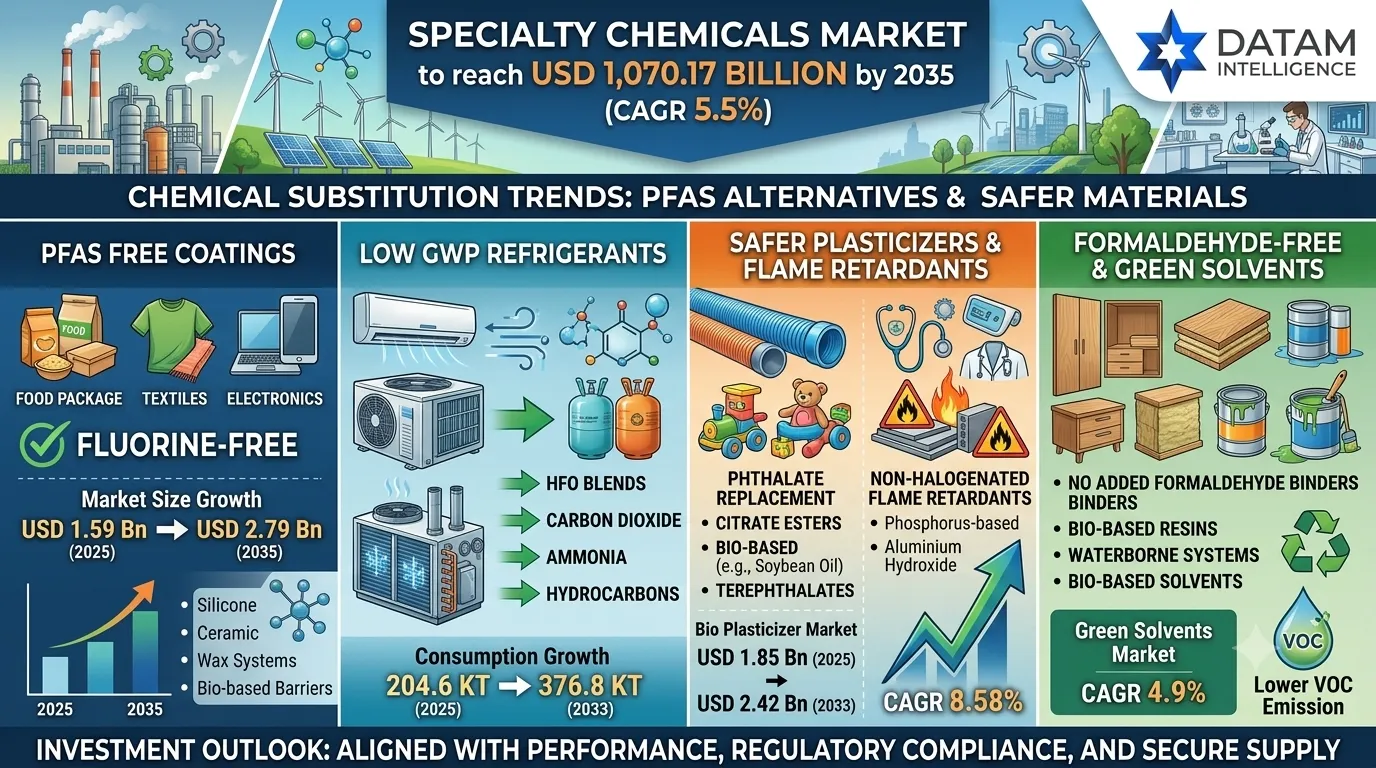
The strongest substitution opportunities are developing around PFAS free coatings, low GWP refrigerants, non halogenated flame retardants and safer plasticizers. Green solvents, waterborne resins, bio based additives and formaldehyde reducing binders are also gaining importance as chemical restrictions extend into building materials, packaging, textiles and industrial processing.
PFAS Restrictions Are Creating the Largest Cross Industry Substitution Cycle
PFAS regulation is creating the broadest reformulation challenge because fluorinated chemistry is used across coatings, textiles, packaging, electronics, lubricants, seals and fire suppression systems. In March 2026, the European Chemicals Agency supported an EU wide PFAS restriction with targeted derogations, while the European Commission confirmed that food contact packaging containing PFAS above defined limits will be restricted from August 2026. PFHxA restrictions also begin applying to selected consumer products from October 2026.
These measures are accelerating demand for silicone based coatings, wax systems, ceramic surfaces and bio based barrier technologies. DataM Intelligence estimates that the PFAS free Coatings Market reached USD 1.59 billion in 2025 and could reach USD 2.79 billion by 2035, growing at a CAGR of 5.8%. Europe accounted for 36.8% of the market in 2025 because regulatory pressure is moving buyers toward fluorine free surface technologies.
The commercial opportunity is strongest where suppliers can match a narrow performance requirement. Food packaging needs grease and moisture barriers. Textiles need water repellence and wash durability. Industrial components need corrosion resistance and chemical stability. Electronics require dielectric performance and clean processing. This means one universal substitute is unlikely to dominate. The market will reward suppliers with application specific platforms and strong customer qualification support.
Explore the Future of PFAS-Free Coatings Market Opportunities
Gain deeper insights into PFAS-free coating technologies, market trends, regulatory developments, competitive landscape and growth opportunities. Request a sample report to understand how evolving chemical regulations are reshaping coating solutions across industries. Request Sample Report Today!
Low GWP Refrigerants Shift Substitution From Molecules to Equipment Design
Refrigerant regulation is creating another major specialty chemical transition. HFC phase down schedules under the Kigali Amendment, European F gas rules and regional climate policies are pushing equipment makers toward HFO blends, carbon dioxide, ammonia and hydrocarbons. DataM Intelligence estimates that the Low GWP Refrigerants Market will expand from 204.6 kilotons in 2025 to 376.8 kilotons by 2033 at a CAGR of 4.2%.
The opportunity extends beyond refrigerant producers because each replacement pathway changes compressor design, seals, lubricants, leak detection and servicing requirements. Carbon dioxide systems operate at higher pressure. Ammonia needs strict safety controls. Hydrocarbons require charge limits and flammability management. HFO blends depend on fluorochemical supply and compatibility testing.
This creates demand across refrigerant chemistry, compressor components, specialty lubricants and system controls. Suppliers that provide a complete transition package will have an advantage because buyers are evaluating lifecycle cost, energy efficiency and service availability together.
Safer Plasticizers and Flame Retardants Gain From Cumulative Risk Review
Plastic additives are moving through a similar substitution cycle. In May 2026, the U.S. Food and Drug Administration advanced its review of eight phthalates authorized for food contact use and proposed grouping DEHP, DCHP, DIOP and DINP for a future cumulative risk assessment. This increases pressure on flexible PVC, packaging, medical devices and consumer goods supply chains to evaluate alternatives before final restrictions are adopted.
The strongest substitutes include citrate esters, benzoates, terephthalates and bio based plasticizers derived from soybean oil or castor oil. DataM Intelligence estimates that the Bio Plasticizer Market reached USD 1.85 billion in 2025 and could reach USD 2.42 billion by 2033. Non phthalate suppliers can gain share where migration resistance, low volatility and medical or food contact compliance matter more than minimum purchase price.
Flame retardants are also being reformulated as buyers reduce reliance on brominated or chlorinated chemistry. Phosphorus based systems, aluminium hydroxide, magnesium hydroxide and nitrogen based additives are gaining attention across electronics, transportation and construction. DataM Intelligence expects the Non Halogenated Flame Retardants Market to grow at a CAGR of 8.58% through 2031. The main challenge is maintaining fire performance without weakening mechanical properties or increasing compound weight.
Get a Customized Specialty Chemicals Market Report Tailored to Your Business Needs
Access customized market insights covering market dynamics, regulatory trends, competitive landscape, segment analysis and growth opportunities specific to your business objectives. Request a customized report to support strategic planning, investment decisions and market expansion.
Formaldehyde Free Resins and Green Solvents Expand the Substitution Opportunity
Building materials and industrial coatings are creating additional opportunities for lower emission chemistry. Formaldehyde exposure limits and indoor air quality standards are encouraging wood panel, insulation and furniture producers to evaluate no added formaldehyde binders, bio based resins and alternative crosslinking systems. The most successful products will need to deliver moisture resistance, curing speed and long term bond strength while fitting existing production lines.
Solvent substitution is moving in the same direction. Waterborne systems, bio based esters, alcohols and glycol alternatives are replacing higher VOC or more hazardous solvents in coatings, cleaners, adhesives and printing inks. DataM Intelligence expects the Green Solvents Market to grow at a CAGR of 4.9% through 2031. Demand is strongest where reformulation can lower worker exposure, improve environmental compliance and preserve drying performance.
These markets show why regulatory substitution is a formulation challenge rather than a simple raw material swap. Buyers need complete systems that account for curing, viscosity, adhesion, compatibility and manufacturing throughput.
Regional Rules Are Reshaping Specialty Chemical Investment Priorities
Europe is leading many substitution programs through REACH, the Packaging and Packaging Waste Regulation and tighter F gas controls. This creates early demand for fluorine free coatings, natural refrigerants, non halogenated additives and safer process chemicals. European suppliers can benefit from regulatory proximity, while Asian producers may gain through scale and lower conversion costs.
The United States is developing a more fragmented market. Federal reviews, state PFAS bans and food contact rules are creating different compliance timelines across products. This favors suppliers that can provide documentation for multiple jurisdictions and help customers manage state level requirements.
Asia Pacific will remain critical because it controls a large share of chemical manufacturing, electronics production and polymer conversion. Regional producers that invest in compliant formulations before export restrictions tighten can capture share in Europe and North America while serving domestic manufacturers with global customer requirements.
Investment Outlook Favors Qualified Alternatives With Proven Performance
The next wave of specialty chemical value creation will come from products that solve a specific regulatory problem without creating a new technical weakness. Buyers will prioritize validated alternatives with stable supply, clear toxicology data and strong application support. Suppliers with pilot facilities, analytical capability and regulatory teams will be better positioned than companies offering commodity replacements.
PFAS free coatings are positioned to gain across packaging, textiles and industrial surfaces. Low GWP refrigerants will expand through cooling and cold chain investment. Non phthalate plasticizers and non halogenated flame retardants will benefit from cumulative risk reviews and stricter product safety standards. Green solvents and lower emission resins will gain as manufacturing shifts toward safer processes.
The broader market opportunity is clear. Regulation is creating a multi year substitution cycle across specialty chemicals. The winners will be suppliers that can combine compliance readiness with performance, manufacturing compatibility and secure regional supply.
Purchase Corporate License for Comprehensive Specialty Chemicals Market Intelligence
Empower your team with in-depth specialty chemicals market insights, including industry trends, competitive analysis, market forecasts, segment intelligence and strategic growth opportunities. Get corporate access to the complete report and support data-driven business decisions across your organization. Purchase Corporate License Now!
Related DataM Intelligence Market Reports
Explore the Specialty Chemicals Market for market sizing, regulatory analysis and competitive intelligence.
Explore the PFAS Free Coatings Market for market sizing, regulatory analysis and competitive intelligence.
Explore the Low GWP Refrigerants Market for market sizing, regulatory analysis and competitive intelligence.
Explore the Non Halogenated Flame Retardants Market for market sizing, regulatory analysis and competitive intelligence.
Explore the Bio Plasticizer Market for market sizing, regulatory analysis and competitive intelligence.
About DataM Intelligence
DataM Intelligence is a global market research and consulting firm that empowers organizations with actionable market intelligence, competitive insights and strategic advisory services. Serving clients across 100+ countries and 35+ industries, we deliver high quality syndicated reports, custom research, competitive intelligence and virtual research support to help businesses identify growth opportunities, assess market trends and make confident data driven decisions. Trusted by leading enterprises worldwide, our expertise spans healthcare, life sciences, chemicals, energy, ICT, automotive, food and beverage, packaging and advanced materials.
Selected regulatory references: European Chemicals Agency PFAS opinions, European Commission PFAS policy, U.S. FDA phthalate review, DataM Intelligence market reports.