


Autonomous Self-Driving Cars Market Forecast 2035: AI Innovations and Global Demand Trigger Unprecedented Growth
The global automotive industry is entering a new era of intelligent mobility. Powered by advancements in artificial intelligence (AI), machine learning, computer vision, sensor fusion, and vehicle-to-everything (V2X) connectivity, autonomous self-driving cars are rapidly evolving from experimental concepts to commercial reality.
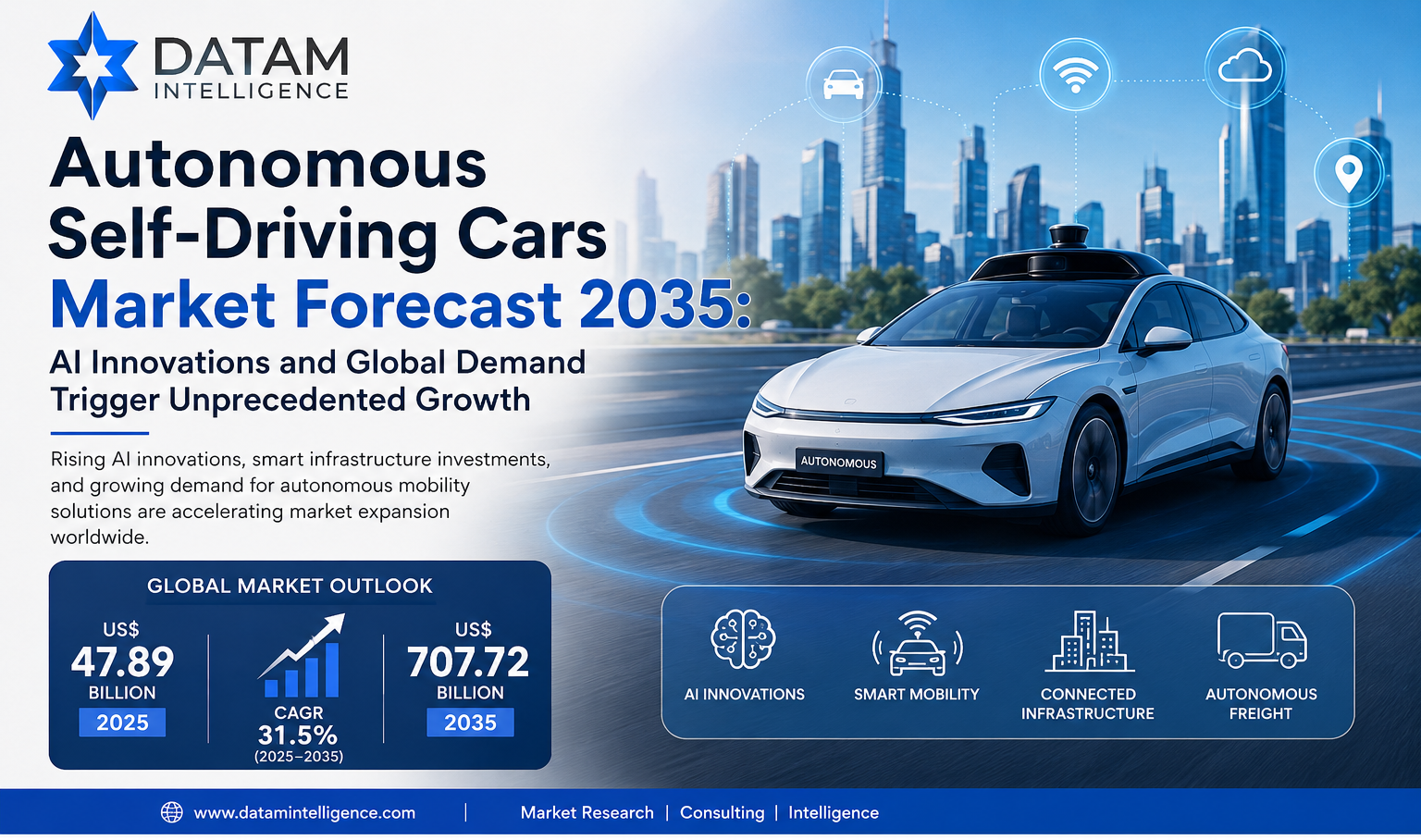
According to DataM Intelligence, the global autonomous self-driving cars market was valued at US$ 47.89 Billion in 2025 and is projected to reach US$ 707.72 Billion by 2035, growing at a CAGR of 31.5% during the forecast period. This growth reflects increasing investments in autonomous driving technologies, smart transportation infrastructure, and next-generation mobility solutions.
Governments, automotive manufacturers, technology companies, semiconductor providers, and mobility service operators are investing billions of dollars to accelerate the development and deployment of autonomous vehicles (AVs). From robotaxis and autonomous freight transportation to smart city ecosystems, self-driving technology is expected to redefine how people and goods move across the world over the next decade.
What is the Autonomous Self-Driving Cars Market?
The autonomous self-driving cars market comprises vehicles equipped with advanced software, sensors, cameras, radar, LiDAR, and AI-powered decision-making systems that enable driving with minimal or no human intervention.
These technologies allow vehicles to:
- Detect and classify objects
- Interpret traffic conditions
- Navigate complex road environments
- Communicate with surrounding infrastructure
- Make real-time driving decisions
As AI models become increasingly sophisticated and regulatory frameworks continue to evolve, autonomous vehicles are expected to become a cornerstone of future mobility systems.
Why Is the Autonomous Self-Driving Cars Market Growing So Rapidly?
Artificial Intelligence Is Transforming Transportation
AI serves as the foundation of autonomous driving systems. Modern vehicles can process millions of data points every second, enabling them to recognize pedestrians, analyze traffic patterns, identify road hazards, and make split-second decisions. Growing innovations in the Artificial Intelligence Market are accelerating the development of advanced perception systems, predictive analytics, and autonomous decision-making capabilities that power next-generation self-driving vehicles.
Recent advances in deep learning, neural networks, generative AI, and edge computing have significantly improved autonomous vehicle performance, accelerating commercialization efforts worldwide.
Growing Focus on Road Safety
Road accidents remain a major global concern, with human error contributing to a significant percentage of collisions. Autonomous driving systems are designed to reduce these risks through continuous monitoring, predictive analytics, and real-time response mechanisms.
Features such as:
- Automatic emergency braking
- Adaptive cruise control
- Lane-keeping assistance
- Driver monitoring systems
- Collision avoidance technologies
are already improving road safety and building consumer confidence in autonomous mobility solutions.
Smart City Investments Are Accelerating Adoption
Governments across North America, Europe, China, Japan, South Korea, and the Middle East are investing heavily in smart city infrastructure.
Connected traffic systems, intelligent transportation networks, V2X communication technologies, and digital road infrastructure create an ideal environment for autonomous vehicle deployment.
These investments are expected to support large-scale commercialization of autonomous transportation over the coming decade.
Smart Cities Are Creating the Foundation for Autonomous Transportation
The success of autonomous vehicles depends not only on vehicle intelligence but also on surrounding infrastructure. Smart cities are deploying intelligent traffic systems, connected road networks, advanced mapping technologies, and V2X communication platforms that allow vehicles to interact with their environment in real time.
Cities in the United States, China, Japan, Germany, Singapore, and the UAE are increasingly investing in connected mobility ecosystems designed to improve transportation efficiency, reduce congestion, and support autonomous vehicle deployment.
Rise of Robotaxis and Mobility-as-a-Service
Autonomous ride-hailing platforms are emerging as one of the most promising applications of self-driving technology.
Robotaxis have the potential to:
- Reduce transportation costs
- Improve accessibility
- Lower vehicle ownership rates
- Enhance urban mobility
As cities become increasingly congested, autonomous mobility services are expected to play a critical role in future transportation ecosystems.
Autonomous Freight Transportation Creates New Opportunities
Beyond passenger transportation, autonomous driving technology is revolutionizing logistics and freight operations.
Autonomous trucks and delivery vehicles offer:
- Improved fleet utilization
- Reduced operating costs
- Lower fuel consumption
- Enhanced route optimization
- Solutions to driver shortages
Industry experts believe autonomous trucking could become one of the first large-scale commercial applications of self-driving technology.
Why Autonomous Logistics Could Become the First Major Commercial Success
While passenger-focused autonomous vehicles receive significant media attention, freight transportation may represent the most immediate commercial opportunity. Long-haul trucking routes are generally more predictable than urban driving environments, making them ideal for autonomous operations.
Autonomous freight solutions offer several advantages, including lower operating costs, improved delivery efficiency, reduced fuel consumption, and solutions to ongoing driver shortages. As supply chains become increasingly digitized, autonomous logistics is expected to become a major growth driver for the autonomous mobility ecosystem.
Key Technology Trends Shaping the Industry
AI-Powered Decision Engines
Advanced AI systems enable autonomous vehicles to interpret complex driving environments and make real-time decisions with increasing accuracy.
Sensor Fusion Technologies
Autonomous vehicles combine data from LiDAR, radar, ultrasonic sensors, and cameras to create a comprehensive view of their surroundings.
Vehicle-to-Everything (V2X) Connectivity
V2X communication allows vehicles to interact with traffic infrastructure, pedestrians, and other vehicles, improving traffic flow and safety.
Digital Twin Simulation Platforms
Automotive companies increasingly use digital twin technology to simulate real-world driving scenarios, reducing development costs and accelerating testing.
High-Performance Automotive Computing
Growing computational requirements are driving demand for advanced automotive processors, AI accelerators, and edge computing platforms.
Top Companies Leading the Autonomous Vehicle Revolution
Competition in the autonomous vehicle market continues to intensify as automotive and technology leaders invest heavily in self-driving technologies.
Key players include:
- Tesla
- Waymo (Alphabet)
- Cruise (General Motors)
- Mobileye (Intel)
- NVIDIA
- Baidu Apollo
- Mercedes-Benz
- BMW Group
- Toyota Motor Corporation
- Volkswagen Group
These companies are shaping the future of autonomous mobility through investments in AI, advanced sensors, high-performance computing, and connected transportation technologies.
How Generative AI Is Transforming Autonomous Driving
Generative AI is becoming a critical tool for autonomous vehicle development.
Applications include:
- Driving scenario simulation
- Synthetic data generation
- Route optimization
- Fleet management
- Predictive maintenance
- Digital twin development
These capabilities are expected to improve vehicle performance, safety, and scalability while reducing development timelines.
Autonomous Trucks vs. Robotaxis: Which Segment Will Grow Faster?
While robotaxis attract significant investor attention, autonomous trucking may achieve commercialization more rapidly due to predictable operating environments and stronger economic incentives.
Autonomous Trucking Advantages
- Long-haul route optimization
- Reduced labor shortages
- Improved fuel efficiency
- Faster ROI
- Increased operational efficiency
Robotaxi Growth Drivers
- Urban mobility demand
- Lower transportation costs
- Smart city integration
- Improved passenger convenience
Both segments are expected to contribute significantly to market growth through 2035.
Recent Industry Developments Accelerating Market Growth
The autonomous vehicle industry has witnessed significant momentum in recent years as companies continue to improve autonomous driving capabilities and expand commercial testing programs.
Several leading innovators are advancing the market:
- Tesla continues enhancing its Full Self-Driving (FSD) platform through AI-powered software updates.
- Waymo has expanded autonomous ride-hailing operations across multiple U.S. cities.
- Baidu Apollo continues large-scale autonomous vehicle deployments and testing programs in China.
- Mercedes-Benz has strengthened its position in advanced driver assistance and autonomous driving technologies.
- NVIDIA continues developing high-performance AI computing platforms designed specifically for autonomous mobility applications.
These developments indicate increasing confidence in the commercial viability of autonomous transportation technologies.
Regional Outlook
North America
North America remains a leader in autonomous vehicle innovation, supported by strong investments, advanced infrastructure, and favorable testing environments.
Asia-Pacific
China, Japan, and South Korea continue to drive market expansion through government-backed initiatives, smart city investments, and large-scale autonomous vehicle pilot programs.
Europe
European automakers and regulators are focusing on sustainability, road safety, and intelligent transportation systems to support autonomous mobility deployment.
Frequently Asked Questions
How do autonomous self-driving cars work?
Autonomous self-driving cars rely on AI algorithms, cameras, radar, LiDAR sensors, GPS, and advanced computing systems to analyze their surroundings and make driving decisions in real time.
What is the future of autonomous self-driving cars?
Autonomous self-driving cars are expected to become increasingly common by 2035 as AI, connectivity, and smart infrastructure continue to evolve.
Which industries benefit from autonomous vehicles?
Industries benefiting from autonomous vehicles include automotive manufacturing, transportation, logistics, insurance, artificial intelligence, semiconductors, telecommunications, and smart city development.
What are the biggest challenges facing autonomous vehicles?
Major challenges include regulatory approval, cybersecurity, infrastructure readiness, public trust, data privacy, and development costs. As autonomous vehicles become increasingly connected, concerns around the Automotive Cybersecurity Market are gaining importance, with manufacturers investing heavily in advanced security frameworks to protect vehicles, networks, and user data from evolving cyber threats.
Which countries are leading autonomous vehicle adoption?
The United States, China, Japan, Germany, and South Korea are among the leading countries investing in autonomous vehicle technologies, smart mobility infrastructure, and commercialization initiatives.
The Road Ahead for Autonomous Self-Driving Cars
The next decade is expected to be a defining period for autonomous transportation. As artificial intelligence becomes more sophisticated and regulatory frameworks continue to evolve, autonomous vehicles are likely to become increasingly integrated into daily transportation networks.
The transition may occur gradually, with autonomous shuttles, robotaxis, freight vehicles, and commercial fleets leading adoption before fully autonomous passenger vehicles become mainstream. Organizations that invest early in autonomous mobility technologies, software platforms, and supporting infrastructure will be best positioned to capitalize on future market opportunities.
Analyst Perspective
Autonomous driving is no longer a futuristic concept it is becoming a strategic priority for governments, automotive manufacturers, technology providers, and investors worldwide.
The convergence of artificial intelligence, advanced sensors, high-performance computing, connectivity, and smart infrastructure is expected to unlock unprecedented opportunities across the global mobility ecosystem.
Companies that invest early in autonomous driving technologies and connected transportation platforms will be well-positioned to capitalize on one of the most transformative growth opportunities in the automotive industry.
Access the Full Market Report
For detailed market forecasts, competitive benchmarking, technology assessments, company profiles, investment opportunities, and regional insights, explore the DataM Intelligence Autonomous Self-Driving Cars Market Report and gain strategic intelligence to support informed business decisions through 2035.