


Beyond Leading-Edge Logic: The Underestimated Investment Opportunity in Analog, Power and Specialty Semiconductors
2026 Market Perspective
The semiconductor investment cycle is dominated by discussion of artificial intelligence accelerators, advanced process nodes and high bandwidth memory. That focus captures the most visible part of the current boom, while a much broader group of semiconductor suppliers is benefiting from electrification, automation and the growing power intensity of digital infrastructure.
Analog integrated circuits, power semiconductors, MEMS sensors and other specialty devices are becoming more strategically important because every advanced system needs to sense the physical world, convert power, control motors and manage signals. These functions often use mature or specialty process technologies where product longevity, reliability and manufacturing scale matter more than transistor density.
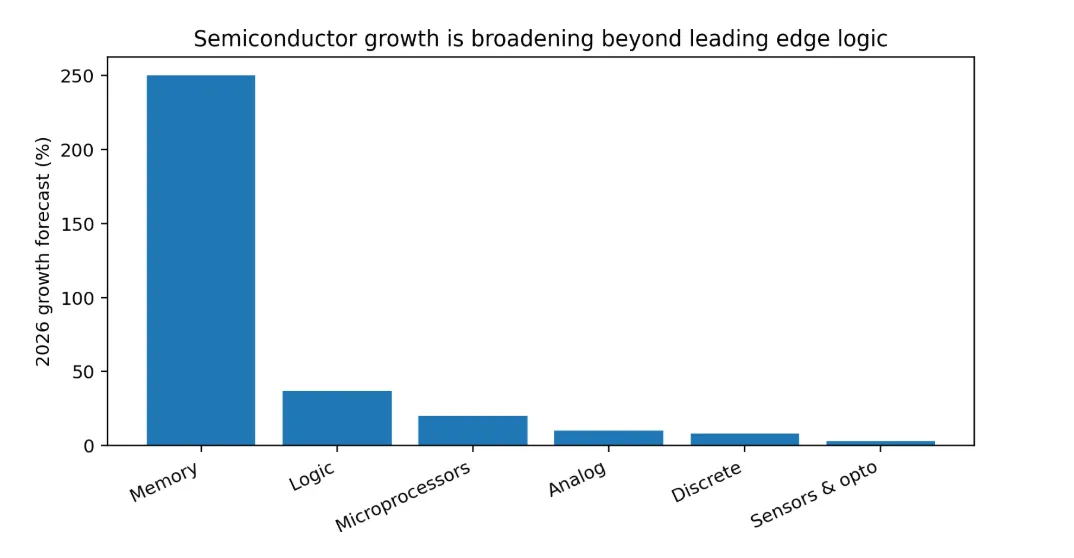
The 2026 market data reinforces this opportunity. WSTS expects analog semiconductor sales to grow 10 percent in 2026 and discrete semiconductors to grow 8 percent, even as memory and leading edge logic capture most of the headlines. DataM Intelligence estimates the Power Semiconductor Market could expand from US$85.30 billion in 2025 to US$401.87 billion by 2035, highlighting how power conversion is becoming a larger semiconductor profit pool.
AI Infrastructure Is Pulling Power Semiconductors Into the Center of the Data Center Buildout
AI data centers are creating a new demand layer for semiconductor companies that historically sold into automotive and industrial systems. Accelerators consume enormous amounts of electricity, which means every rack requires power factor correction, voltage conversion, point of load regulation and protection. As rack power moves toward hundreds of kilowatts and eventually megawatt scale, conversion efficiency becomes a capital and operating cost issue.
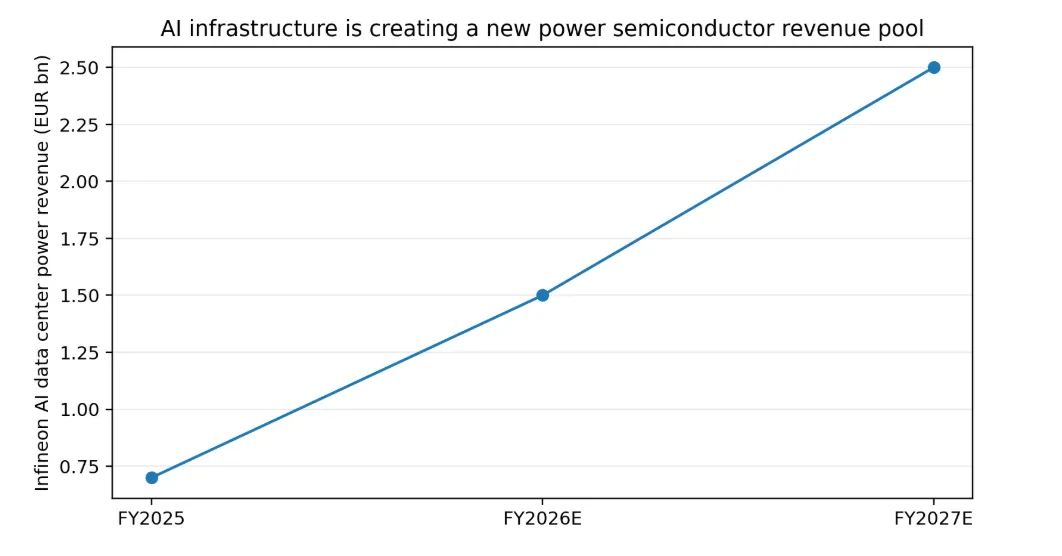
Infineon illustrates the shift. The company reported more than EUR700 million of revenue from AI data center power supply solutions in fiscal 2025 and expects about EUR1.5 billion in fiscal 2026. It has indicated approximately EUR2.5 billion for fiscal 2027 and raised planned investment to around EUR2.7 billion to expand manufacturing capacity for AI data center power solutions. Onsemi has also identified AI data center power as its fastest growing business and expects revenue from the category to more than double during 2026.
This changes the semiconductor opportunity around AI. GPU demand still determines compute deployment, while power conversion determines how much of that compute can be installed inside a given electrical envelope. Silicon MOSFETs and IGBTs remain relevant, while silicon carbide and gallium nitride gain share where switching frequency, thermal performance and power density justify the higher device cost.
Explore the Power Semiconductor Market Report
Discover in-depth insights into the Global Power Semiconductor Market, including market size and forecasts, growth drivers, SiC and GaN technology trends, EV and AI data center demand, manufacturing capacity, investment opportunities, competitive landscape, and regional developments through 2035.
Request a Free Sample Report to access key insights before purchasing the complete study.
Analog Chips Benefit From Electrification Because Every Digital System Needs a Physical Interface
Analog semiconductors occupy a different position from leading edge processors. They measure voltage, condition sensor signals, manage power and connect digital systems with motors, batteries and physical equipment. The devices are embedded throughout vehicles, factories, medical equipment and communications infrastructure, which gives the market a broad demand base and long product cycles.
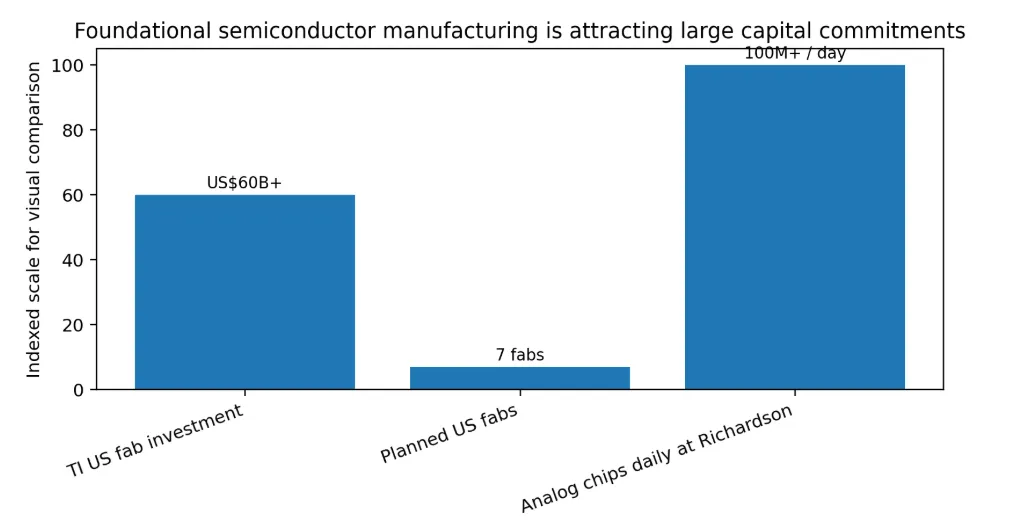
The investment case is increasingly tied to manufacturing economics. Texas Instruments plans to invest more than US$60 billion across seven U.S. semiconductor fabs in Texas and Utah. The strategy centers on 300 millimeter manufacturing for analog and embedded processing chips, which can lower unit costs and improve supply control. TI says its two Richardson fabs can manufacture more than 100 million analog chips every day.
This capacity buildout matters because analog demand rises with electronic content rather than only with unit shipments. An electric vehicle can require far more power management and sensing content than an internal combustion vehicle. An AI server requires additional monitoring and conversion devices as rack density rises. Industrial automation adds sensors and control ICs to equipment that previously relied on simpler electromechanical systems.
Explore DataM Intelligence analysis on the Analog Integrated Circuits Market https://www.datamintelligence.com/research-report/analog-integrated-circuits-market
Explore the Analog Integrated Circuits Market Report
Gain comprehensive insights into the Global Analog Integrated Circuits Market, including market size and forecasts, product and application segmentation, consumer electronics and automotive demand, 5G-driven opportunities, regional trends, competitive dynamics, and key industry developments through 2031.
Request a Free Sample Report to review key insights before accessing the complete study.
Automotive and Industrial Systems Create a Long Duration Specialty Semiconductor Demand Base
Automotive electronics are becoming one of the clearest examples of specialty semiconductor expansion. Electrification increases demand for power modules and battery management devices, while software defined vehicles require more sensing and mixed signal electronics. Mature node microcontrollers remain essential because reliability qualification and long vehicle lifecycles make rapid process migration difficult.
Industrial systems show a similar pattern. Factory automation, robotics, energy storage and grid equipment require power management, motor control and sensing. These applications reward high reliability and long availability. They also create opportunities for foundries that operate mature node and specialty processes, plus assembly and test providers that can handle high reliability packaging.
The result is a semiconductor market where leading edge capacity and specialty capacity solve different problems. Investors focused only on two nanometer or sub two nanometer logic risk missing the portion of the supply chain tied directly to electrification and physical AI.
Explore the Automotive Semiconductor Market Report
Gain comprehensive insights into the Global Automotive Semiconductor Market, including market size and forecasts, EV and ADAS adoption, power semiconductor and sensor demand, software-defined vehicle trends, wafer capacity, advanced packaging, supply chain dynamics, regional opportunities, and competitive landscape through 2035.
Request a Free Sample Report to review key insights before accessing the complete study.
MEMS and Sensing Turn Physical AI Into a Specialty Chip Opportunity
Artificial intelligence is moving from software into machines. Humanoid robots, autonomous equipment and intelligent vehicles need continuous information about motion, pressure, position and the surrounding environment. That creates a direct opportunity for MEMS sensors and mixed signal interfaces.
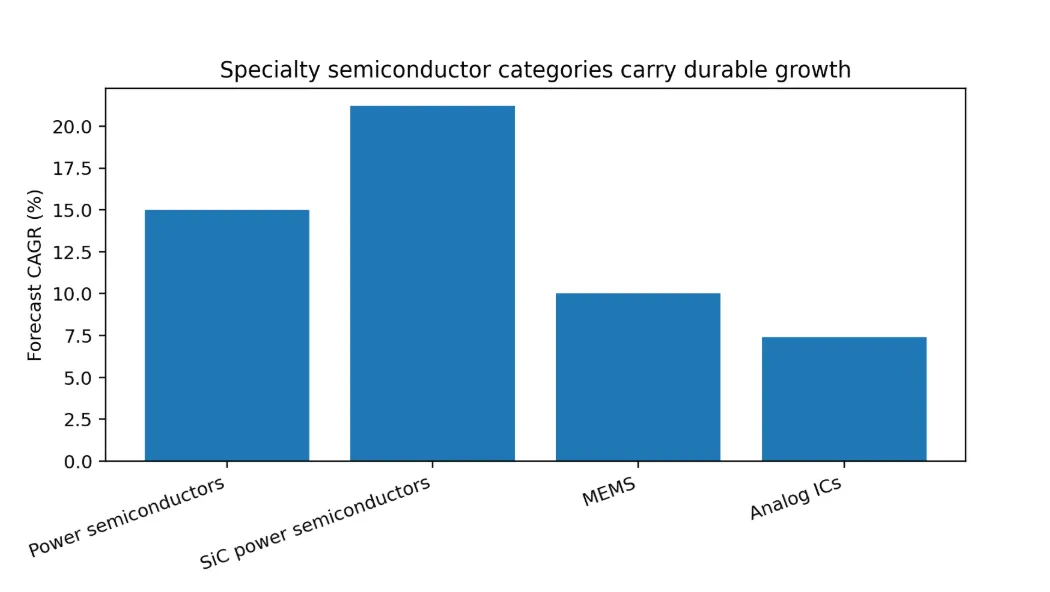
DataM Intelligence estimates the MEMS market at US$18.98 billion in 2025 and forecasts US$49.23 billion by 2035, equal to a 10 percent CAGR. More than half of ongoing innovation activity is focused on multifunction MEMS platforms according to the report, while automotive electrification and ADAS continue to increase demand for inertial and pressure sensing.
MEMS also demonstrates why specialty semiconductor value can persist despite mature process nodes. Performance depends on device structure, packaging, calibration and application know how. These capabilities are difficult to reproduce through simple access to wafer capacity.
Explore the Microelectromechanical Systems (MEMS) Market Report
Gain comprehensive insights into the Global Microelectromechanical Systems (MEMS) Market, including market size and forecasts, sensors and actuators, automotive and ADAS applications, consumer electronics, IoT, healthcare, industrial automation, technology developments, supply chain dynamics, regional trends, and competitive landscape through 2035.
Request a Free Sample Report to review key insights and market opportunities before accessing the complete study.
Wide Bandgap Devices Are Expanding the Addressable Market for Power Electronics
Silicon carbide and gallium nitride are extending semiconductor competition into applications where power density and energy efficiency matter more than raw compute. Silicon carbide is strongest in high voltage applications such as EV traction inverters, charging infrastructure and industrial power. Gallium nitride is gaining traction in high frequency conversion, compact power supplies and selected AI data center stages.
DataM Intelligence forecasts the Silicon Carbide Power Semiconductor Market at a 21.2 percent CAGR through 2035. Its broader Power Semiconductor Market forecast calls for 15 percent CAGR, while the Gallium Nitride Semiconductor Market forecast indicates 18.18 percent CAGR through 2032. These growth rates are substantially above many mature semiconductor categories and show how power electronics can become one of the most important semiconductor investment themes outside leading edge compute.
The opportunity will be distributed across device makers, substrate suppliers, epitaxy providers and advanced packaging companies. Qualification speed and manufacturing yield will determine which suppliers capture the economics as end markets move from pilot deployments into volume production.
Explore the Silicon Carbide Power Semiconductor Market Report
Gain comprehensive insights into the Global Silicon Carbide Power Semiconductor Market, including market size and forecasts, SiC MOSFETs and power modules, 800V EV architectures, electric vehicle adoption, renewable energy applications, wafer manufacturing, substrate technologies, regional trends, competitive landscape, and key industry developments through 2035.
Request a Free Sample Report to review key insights and market opportunities before accessing the complete study.
The Investment Case Is Shifting Toward Semiconductor Content per System
The next semiconductor investment cycle will be measured by more than leading edge wafer capacity. The more useful question is how much semiconductor content each new system requires. AI servers need more power conversion. Electric vehicles need more power devices and analog control. Industrial automation needs more sensing and motor control. These trends increase semiconductor content even when end product volumes grow modestly.
That creates a broad opportunity for suppliers with strong application knowledge, manufacturing control and customer qualification. Analog leaders can benefit from 300 millimeter cost advantages. Power semiconductor suppliers can gain from AI infrastructure and electrification. MEMS companies can benefit from physical AI and intelligent machines. Specialty foundries and packaging providers can capture demand that does not migrate to leading edge nodes.
Leading edge logic will continue to absorb enormous capital because AI compute remains one of the strongest technology spending cycles in history. The underestimated opportunity sits alongside it in the semiconductors that regulate power, sense the environment and control physical systems. As electrification and AI converge, these foundational devices are moving closer to the center of semiconductor value creation