


Aluminium’s next competitive advantage is being built well beyond the smelter. Producers are securing recycling assets, developing lower-carbon products with customers, transferring process technology and strengthening control over upstream resources.
Five developments highlighted in September 2026 illustrate this shift. Rio Tinto is expanding regional billet supply with RevoCast. Hydro is working with CHANEL on lower-carbon packaging. Emirates Global Aluminium is growing its recycling footprint and licensing smelting technology to India. Alcoa has advanced financing for a proposed major asset acquisition.
Together, these moves suggest that production scale alone will not determine commercial success. For procurement, investment and strategy teams, the increasingly important question is whether a supplier can deliver the right alloy, documented environmental performance and reliable supply at an acceptable total cost.
Request for Exclusive Sample: https://www.datamintelligence.com/download-sample/aluminium-market
1. Rio Tinto and RevoCast strengthen North American billet supply
On September 28, Rio Tinto announced a long-term agreement with RevoCast Aluminum Billets to expand low-carbon aluminium billet supply to North American extrusion customers. Rio Tinto will exclusively market billet produced at RevoCast’s newly commissioned casting facility in Langley, British Columbia.
The offering combines hydropower-based primary aluminium from Rio Tinto’s Kitimat operations with recycled aluminium processed by RevoCast. Its significance lies in combining primary-metal access, recycling and casting capability within a regional supply model.
For extrusion buyers, proximity can support more responsive supply planning. However, a lower-carbon proposition still needs to satisfy alloy chemistry, mechanical performance and delivery requirements. Buyers should establish how emissions and recycled-content claims are calculated before comparing competing products.
2. Hydro and CHANEL connect low-carbon aluminium with premium packaging
Hydro and CHANEL Fragrance and Beauty announced a partnership with a shared 2026–2030 roadmap for lower-carbon aluminium in fragrance, makeup and skincare packaging.
The partners aim to develop packaging solutions with an aluminium carbon footprint approaching 3.0 kilograms of carbon-dioxide equivalent per kilogram by 2030. Their work initially draws on Hydro REDUXA primary aluminium sheet ingot and explores enhanced traceability and material recovered from end-of-life products.
This development matters because packaging is judged on more than material weight. Appearance, forming behaviour, finish consistency and product performance can determine whether a material reaches commercial adoption.
The commercial lesson is that sustainability targets become more actionable when the producer and end customer work together on specifications. For converters, the opportunity is to demonstrate that lower-carbon inputs can meet demanding design and manufacturing requirements.
3. EGA’s Eco Green acquisition expands its recycling platform
On September 10, Emirates Global Aluminium completed its acquisition of an 80% stake in Italian aluminium recycling company Eco Green after obtaining the required approvals and meeting closing conditions.
EGA said the acquisition brings its recycling capacity to more than 400,000 tonnes annually across the UAE, United States, Germany and Italy, with a further 200,000 tonnes under development.
The transaction shows how a primary producer can build a broader offering through recycling. It also places scrap sourcing, processing capability and regional customer access closer to the centre of corporate strategy.
For buyers, recycling capacity is only one part of the assessment. They should also examine feedstock availability, scrap composition, sorting capability, alloy suitability and the consistency of finished metal.
For independent recyclers, the implication is strategic: differentiated collection networks, processing technology and reliable quality can make them attractive commercial partners or acquisition candidates.
4. EGA–NALCO technology transfer supports India’s planned expansion
On September 8, EGA and National Aluminium Company signed an agreement to transfer EGA’s DX+ Ultra smelting technology to India.
NALCO plans to use the technology for a 500,000-tonne-per-year brownfield smelter expansion at Anugola, Odisha. First aluminium production is expected by the end of 2030. The agreement includes technology licensing, expert project support and employee training.
This is more than a technology purchase. It illustrates a partnership model that combines process design with deployment assistance and operating knowledge.
For Indian engineering, equipment and service firms, the planned project creates areas worth monitoring, including construction, plant systems, maintenance and operational support. These are potential opportunities, not confirmed supplier awards.
Execution remains critical. Licensing advanced technology does not remove construction, energy-supply, commissioning or workforce-readiness risks. Prospective partners should align their capabilities with project milestones rather than assume an announcement creates immediate demand.
5. Alcoa advances financing for its proposed South32 acquisition
Alcoa’s September financing activity supports its proposed acquisition of selected South32 bauxite, alumina and aluminium assets. The company completed a US$2.6 billion senior-notes offering to fund part of the transaction’s cash consideration.
The acquisition agreement was originally announced on June 30, 2026—not September. It provides for US$4.1 billion in upfront cash and stock consideration, plus contingent consideration of up to US$750 million. The proposed portfolio includes assets in Australia, South Africa and Brazil.
The strategic significance is upstream integration. Control across mining, refining and smelting can support coordinated investment and raw-material planning. Nevertheless, financing completion is not the same as acquisition completion.
Customers and investors should distinguish the proposed deal’s benefits from outcomes still dependent on closing, integration and operating performance.
Four forces reshaping aluminium competitiveness
Carbon performance is becoming a qualification question
The partnerships above show companies connecting carbon reduction with specific customer applications. The practical challenge is comparability: buyers should check calculation boundaries, verification methods and the product to which a claim applies.
A corporate sustainability statement is not a substitute for evidence covering the material being purchased. Procurement teams need technical and sustainability specialists involved in the same supplier review.
Recycling requires control of material flows
Recycling offers commercial opportunities, but feedstock quality and availability shape what a plant can reliably produce. Scrap access, sorting and alloy management deserve attention alongside furnace capacity.
For manufacturers, a useful strategy is to explore whether production scrap or end-of-life material can return through a qualified processing partner. Such arrangements require workable collection, quality and commercial terms.
Technology and energy must be assessed together
Improved smelting technology can support operating efficiency, while electricity remains a central consideration in primary aluminium production. A supplier’s competitiveness therefore depends on more than installed equipment.
Buyers evaluating long-term supply should examine power arrangements, operating resilience and the assumptions behind planned efficiency improvements.
Regional supply needs a total-cost assessment
Closer production may offer planning advantages, but distance alone cannot establish the best supplier. Freight, inventory, product qualification, financing and disruption exposure all affect delivered cost.
The strongest sourcing strategy balances regional responsiveness with technical capability and alternative supply options.
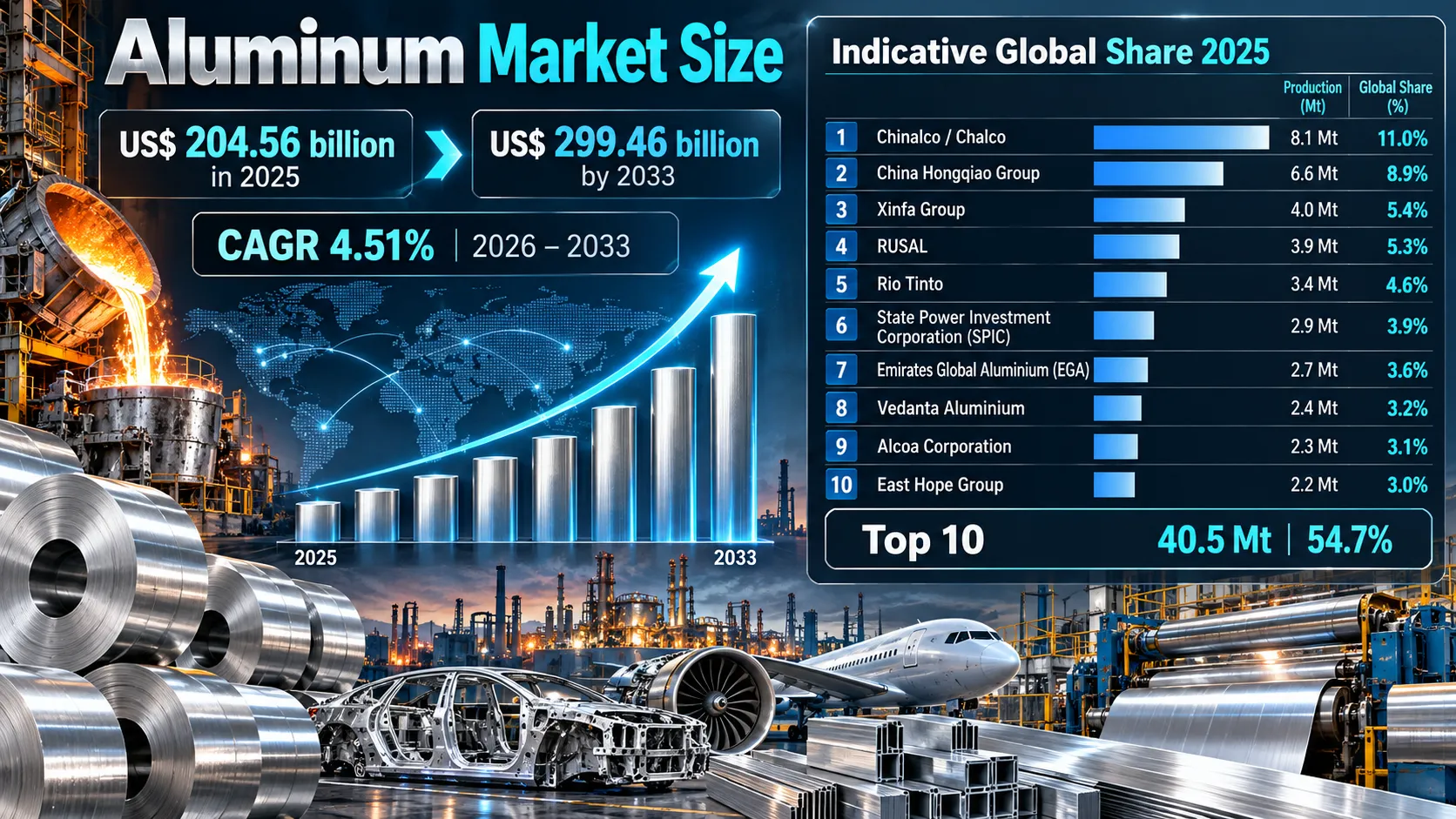
Five leading aluminium companies to watch
The following companies are influential across the global value chain. This is a strategic watchlist, not a verified production-volume or market-share ranking.
- China Hongqiao Group: Its integrated upstream and downstream model makes it an important company to monitor when assessing Chinese production economics and international competition.
- Aluminum Corporation of China Limited, or Chalco: A listed subsidiary of Chinalco, Chalco operates across resources, alumina, primary aluminium, alloys and supporting activities. Distinguishing the listed company from its parent is important when assessing assets or potential partnerships.
- RUSAL: A major integrated aluminium producer, RUSAL’s hydropower-based operations and ALLOW product positioning make it relevant to lower-carbon sourcing discussions. Buyers must also assess applicable trade rules and transaction-specific sourcing risks.
- Rio Tinto Aluminium: Its upstream operations and Canadian hydropower-based production give it a significant role in aluminium supply. The RevoCast agreement demonstrates how primary production can connect with regional recycling and casting.
- Alcoa Corporation: Its bauxite, alumina and aluminium operations make it an important upstream supplier. The proposed South32 transaction is a key development to monitor for portfolio and customer-supply implications.
EGA, Norsk Hydro, Hindalco and NALCO also deserve attention, particularly where the purchasing requirement involves recycling, downstream processing, technology or regional supply.
What procurement and strategy leaders should do now
The immediate task is to translate these developments into a supplier and partnership review.
Start with the required alloy, product form, application and volume. Then identify which requirements are non-negotiable: technical performance, verified emissions data, recycled content, delivery geography or supply continuity.
Next, assess potential partners against capability, financial resilience, feedstock or energy exposure and expansion readiness. Separate operating capacity from announced capacity and distinguish an available product from one still under development.
Finally, establish alternative sourcing options and a qualification roadmap. A promising supplier becomes commercially useful only when its material, documentation and delivery model meet the buyer’s requirements.
Turning aluminium market signals into qualified partnerships
For companies entering new markets or rebuilding supply chains, these announcements create a practical question: which recyclers, producers, processors, technology providers or distributors should be approached?
DataM Intelligence’s Partnership Identification service helps answer that question through value-chain mapping, capability assessment and prioritised partner selection.
Its framework evaluates strategic fit, market access, capability fit, scalability, risk profile and likelihood of engagement. For an aluminium business, that can support searches for regional billet suppliers, recycling collaborators, technology partners or commercial channels.
The outcome is a prioritised shortlist with a clear rationale and outreach roadmap. It supports informed engagement; it does not replace technical audits, contractual diligence or customer qualification.
Conclusion: Aluminium’s opportunity lies in connected capabilities
September’s developments point toward a more connected aluminium industry. Primary metal, recycling, customer-led material development, process technology and upstream resources are increasingly being combined through partnerships and portfolio decisions.
For decision-makers, the opportunity is not simply to buy more aluminium or add capacity. It is to secure the combination of material quality, supply resilience and documented environmental performance that their customers require.
Explore DataM Intelligence’s Partnership Identification service to identify and prioritise aluminium suppliers, recyclers, technology collaborators and market-entry partners aligned with your business goals.