


Long-Duration Energy Storage & Data Center Power Perspective | 2026
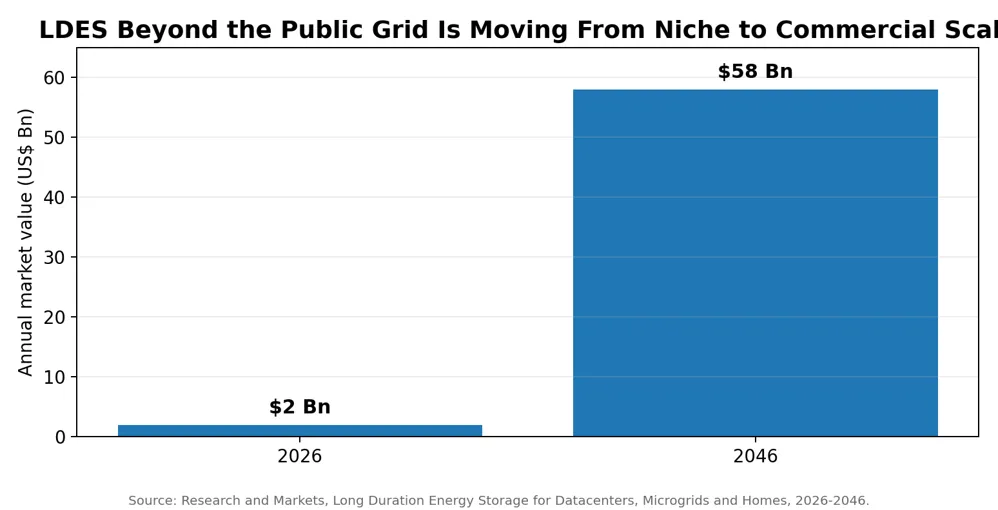
| SECTOR SHIFT | A November 16, 2026 market study forecasts LDES for data centers, microgrids and homes rising from US$2 Bn to US$58 Bn over 20 years as beyond-grid applications scale. |
| WHY AI CHANGES LDES | Conventional data-center batteries are optimized for ride-through, UPS and short-duration peak management. AI campuses increasingly need storage that can bridge renewable shortfalls lasting tens of hours or multiple days. |
| COMMERCIAL QUESTION | Which AI campuses are moving from short-duration backup to 10-hour, 100-hour or multi-day architectures - and which LDES technologies can meet reliability, footprint and commissioning requirements? |
AI Is Pulling LDES Away From the Grid-Only Use Case
Long-duration energy storage was historically discussed as a grid-balancing technology. AI data centers are changing that commercial logic. These campuses combine very high power density, around-the-clock uptime requirements and increasingly constrained grid access. The result is a new buyer class willing to contract storage directly as part of a private power architecture.
The November 16, 2026 Research and Markets study estimates the beyond-grid LDES segment for data centers, microgrids and homes will expand from US$2 Bn to US$58 Bn over 20 years. The important signal is not the headline forecast by itself. It is the shift in where LDES value is being created: closer to the load, inside microgrids and behind the meter.
Request Executive Sample: https://www.datamintelligence.com/download-sample/ai-data-centers-market
Short-Duration Batteries Solve a Different Problem
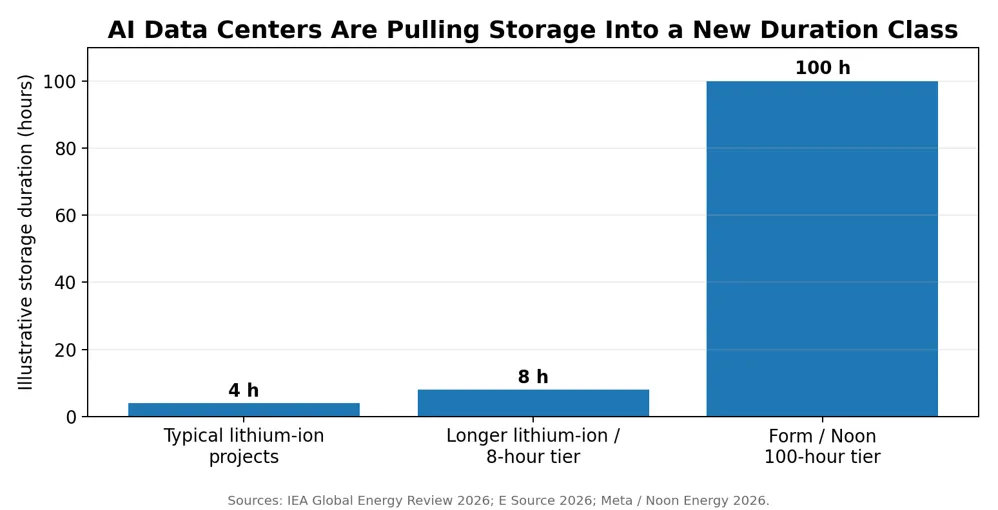
Most data centers already use batteries, but the majority of conventional installations are designed for seconds, minutes or a few hours. The IEA notes that battery UPS systems primarily bridge outages until other backup sources start, while most grid-scale lithium-ion projects still cluster around roughly two hours and an increasing share reach four hours or more.
DOE defines LDES as systems capable of delivering electricity for 10 hours or more. The new hyperscale contracts are pushing well beyond that threshold. Form Energy and Noon Energy are both targeting roughly 100-hour systems - enough to cover multi-day renewable lulls rather than only peak shaving or generator start-up.
The Hyperscaler Contracts Are Already Measured in Tens of GWh
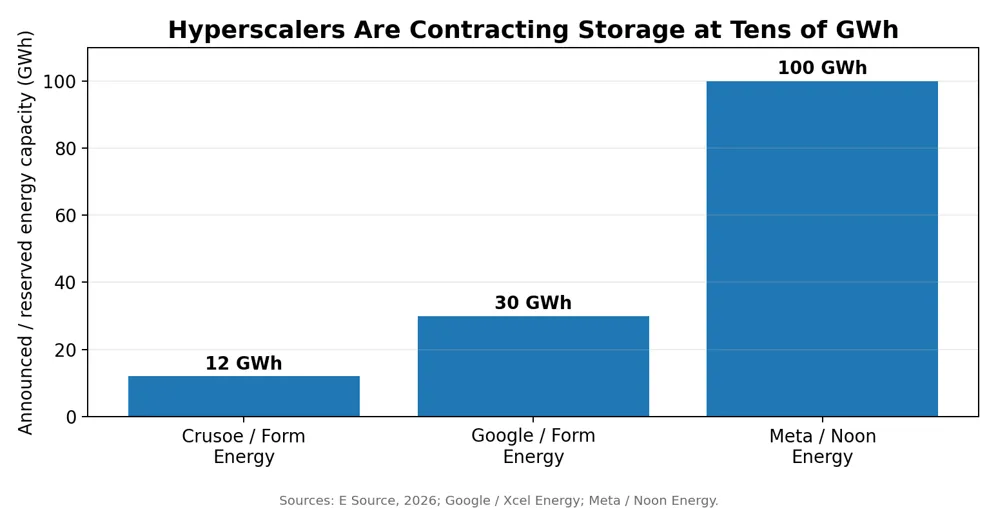
Commercial interest is moving faster than operating deployment. E Source reports that Google has reserved about 30 GWh of Form Energy iron-air capacity for a Minnesota data center, Crusoe has contracted another 12 GWh for AI data centers and Meta has reserved up to 100 GWh from Noon Energy. That is a different scale from traditional UPS procurement.
Google and Meta Are Building Different Versions of the Same 24/7 Architecture
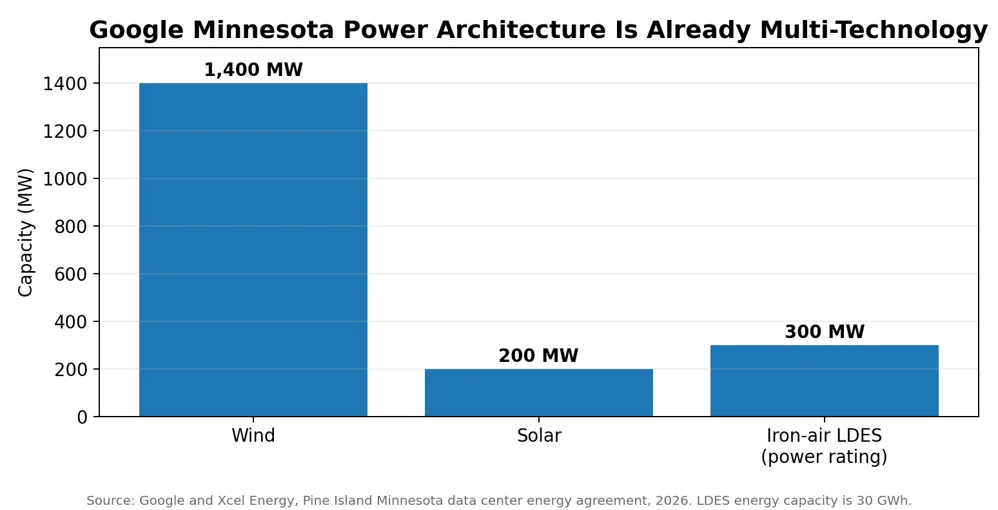
Google and Xcel Energy designed a Minnesota supply agreement for a new data center that combines 1,400 MW of wind, 200 MW of solar and a 300 MW / 30 GWh Form Energy iron-air battery. The storage system is designed for 100-hour duration, turning variable renewable generation into a firmer supply stack rather than using the battery only as backup.
Meta is taking an even more direct ultra-LDES route. In April 2026 it reserved up to 1 GW / 100 GWh of Noon Energy capacity. The first 25 MW / 2.5 GWh project is scheduled for 2028, followed by the larger supply agreement if the technology performs as expected. Meta explicitly describes the objective as 24/7 clean, reliable power for next-generation AI infrastructure.
Why This Is Not Simply “Replace Lithium-Ion”
The likely architecture is layered rather than winner-take-all. High-power UPS systems still manage ride-through and rapid load swings inside the data center. Lithium-ion BESS can handle shorter-duration peak shaving and daily cycling. LDES becomes valuable when the design requirement changes to 10 hours, 100 hours or multiple days of firming. The commercial opportunity is therefore determined by duration, cycling profile, footprint, response time, safety, efficiency and the value of avoided grid or generation constraints.
| Power layer | Typical role | Duration signal | Commercial implication |
| UPS | Ride-through / power quality | Seconds-minutes | Still essential inside the white space |
| Li-ion BESS | Peak shaving / daily shifting | 2-8 hours | High bankability, faster cycling |
| LDES | Firm renewable supply | 10-100+ hours | Covers extended renewable shortfalls |
| Ultra-LDES | Multi-day resilience | 100+ hours | Targets 24/7 clean baseload architectures |
Request a Customized Report According to Your Business Strategy: https://www.datamintelligence.com/customize/ai-data-centers-market
Five Commercial Signals LDES Suppliers Should Track
| Signal | What it reveals | Likely equipment need | Commercial action |
AI campus adds dedicated renewables | Storage duration becomes a firming requirement, not just backup | 10-100+ hour storage, controls, PCS | Engage before power architecture is frozen |
| Grid energization slips | Behind-the-meter power gains schedule value | LDES, microgrid controls, switchgear | Link storage proposal to speed-to-power |
| 24/7 carbon-free target | Hourly matching exposes multi-day renewable gaps | Ultra-LDES and hybrid storage | Model duration against worst-case weather events |
Hyperscaler signs capacity reservation | Technology moves from pilot to bankable pipeline | Manufacturing scale and EPC capacity | Map factory slots and project sequencing |
| Campus grows toward GW scale | Storage requirement moves into multi-GWh territory | Modular LDES, substations, thermal management | Sell a system architecture, not a standalone battery |
LDES Buyers Need More Than a Technology List - That is Where DataM Steps In
The data-center LDES opportunity cannot be sized by counting battery projects alone. Buyers need to understand which campuses are constrained by grid timing, which have 24/7 clean-power commitments, the renewable generation profile behind each site, the required storage duration, incumbent UPS and BESS architecture, technology maturity, manufacturing capacity and who controls the procurement decision.
That is where a dedicated LDES market report becomes commercially useful. The most valuable intelligence is project-level: where the 10-hour, 100-hour and multi-day opportunities are forming, which technologies are actually being specified and which hyperscaler, utility, developer or EPC is setting the commercial structure.