


Wealth Management Platform Market Overview
The global Wealth Management Platform market is estimated at US$ 5.84 billion in 2025 and is expected to reach US$ 15.71 billion by 2035, expanding at a CAGR of 10.4% during 2026-2035. The market is moving from fragmented advisor tools toward connected operating systems that combine onboarding, planning, portfolio management, compliance, reporting and client engagement. Growth is increasingly tied to the amount of investable wealth that institutions can serve profitably rather than software replacement alone.
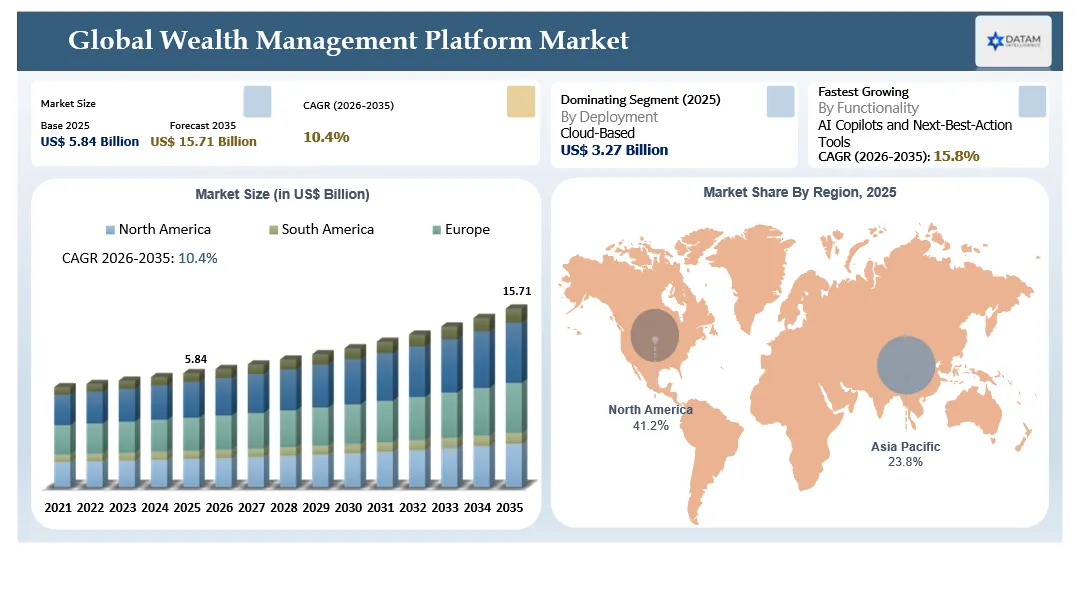
Global assets under management are expected to rise from US$139 trillion in 2024 to US$200 trillion by 2030, while total investable wealth could exceed US$481 trillion. Mass-affluent and high-net-worth clients are expected to generate two-thirds of this increase. At the same time, 89% of asset managers surveyed by PwC reported profitability pressure, and profit per unit of AUM has fallen 19% since 2018. This combination creates a direct technology spending case for workflow automation, scalable advice and digital distribution.
The January 2026 funding round for AssetPlus demonstrates where capital is moving in emerging markets. The company raised INR 175 crore to expand its distributor-led assisted wealth model. It reported more than 18,000 mutual fund distributors and INR 7,250 crore in assets managed through the platform. The model uses technology to increase the productivity and product reach of human distributors, creating a scalable alternative to fully direct digital investing.
The strongest opportunities through 2035 will be in AI advisor copilots, hybrid advice, alternative investment access, unified household reporting, tax-aware portfolio management, compliance automation and platform infrastructure for independent advisors. Buyers will prioritize lower implementation risk, open APIs, advisor adoption and the ability to support more assets per employee.
| Metric | Details |
| 2025 Market Size | US$ 5.84 Billion |
| 2035 Projected Market Size | US$ 15.71 Billion |
| CAGR, 2026-2035 | 10.4% |
| Largest Region | North America |
| Fastest Growing Region | Asia-Pacific |
| Largest Deployment | Cloud-Based |
| Fastest Growing Advisory Model | Hybrid Advisory |
| Largest End User | Banks and Private Banks |
| Fastest Growing Functionality | AI Copilots and Next-Best-Action Tools |
Wealth Management Platform Market Key Takeaways
- The market is estimated at US$5.84 billion in 2025 and projected to reach US$15.71 billion by 2035.
- North America remains the largest market because of its large RIA sector, private bank technology budgets and mature digital brokerage infrastructure.
- Asia-Pacific is the fastest-growing region because investable wealth, mutual fund participation and digital distribution are expanding rapidly in India, Singapore, Hong Kong and Southeast Asia.
- Global AUM is projected to reach US$200 trillion by 2030, creating a larger asset base that requires scalable digital advice and reporting infrastructure.
- Tokenized fund AUM is projected to increase from US$90 billion in 2024 to US$715 billion by 2030, opening new platform requirements for custody, suitability and reporting.
- AssetPlus raised INR175 crore in January 2026 and serves more than 18,000 distributors with INR7,250 crore in assets on platform, validating the assisted wealth infrastructure model.
- India mutual fund AUM reached approximately INR80.23 lakh crore by December 2025, more than six times the 2015 level, supporting distributor and platform expansion.
- AI spending will focus on meeting preparation, portfolio explanation, compliance review, next-best-action and workflow orchestration rather than autonomous advice alone.
Why does this report matter in 2026?
Wealth managers are facing a simultaneous increase in client expectations, product complexity, compliance workload and cost pressure. The market opportunity is therefore concentrated in platforms that improve the economics of advice. Institutions need to onboard clients faster, aggregate fragmented financial data, provide household-level views and support private market products without increasing operational headcount at the same rate as assets.
The AssetPlus funding round shows that investors are backing infrastructure that enables human advisors and distributors to scale. The company’s distributor-led model is relevant in markets where trust, product explanation and local relationships remain important. It also shows that platform expansion will occur through networks of intermediaries rather than direct acquisition alone. Buyers need analysis of which business models generate durable advisor adoption, recurring platform revenue and defensible distribution.
Wealth Management Platform Market White Space and Investment Opportunities
- AI copilots that prepare advisor meetings, summarize client portfolios, generate compliant follow-ups and surface next-best actions.
- Alternative investment operating systems that support suitability, capital calls, document workflows, valuation and consolidated reporting.
- Assisted wealth platforms for mutual fund distributors, insurance advisors and independent planners in India and Southeast Asia.
- Tax-aware rebalancing, retirement income, estate planning and intergenerational wealth transfer tools.
- Unified data layers that aggregate banking, brokerage, pension, insurance, private assets and liabilities at household level.
- Cybersecurity and compliance monitoring services for smaller advisory firms that cannot maintain full internal technology teams.
- White-label platform infrastructure for banks, insurers, digital marketplaces and employer financial wellness programs.
Wealth Management Platform Future Market Transformation
The market will evolve toward modular, API-led ecosystems. Institutions will assemble client engagement, financial planning, portfolio management and alternative investment capabilities from interoperable components. Platform value will shift toward the data model and workflow layer that connects these systems. Firms with closed architectures will face replacement pressure as buyers demand faster integrations and lower migration risk.
AI will change how advisors use platforms. Instead of navigating multiple screens, advisors will use conversational tools to retrieve client information, draft investment explanations and complete routine operational tasks. Human review will remain central because financial advice is regulated and context dependent. The strongest vendors will provide traceability, permission controls and auditable model outputs.
Wealth Management Platform Buyer Decision-Making Criteria
Buyers evaluate platforms on workflow fit, integration depth, data quality, implementation risk, cybersecurity, regulatory support and advisor adoption. Large banks require scalability, configurable controls and multi-jurisdiction support. RIAs prioritize ease of use, custody integrations, reporting and cost. Distributor networks require mobile access, product comparison, commission visibility and local-language support. Across all buyer groups, platform selection is moving from feature count toward measurable productivity, assets served per advisor and client retention.
Wealth Management Platform Economic and Investment Analysis
Investment is moving toward platforms that can capture recurring software revenue while influencing asset flows. The AssetPlus round is important because it combines software economics with a distribution network. With more than 18,000 distributors and INR7,250 crore on platform, the company can add products and services across an existing advisor base. Similar models can scale through retirement products, insurance and alternative investments.
Global industry economics also support platform spending. PwC projects private market revenues of US$432.2 billion by 2030 and tokenized fund AUM of US$715 billion. These products require suitability checks, document workflows, custody integration and complex reporting. Vendors that make these products accessible to advisors can expand wallet share beyond traditional mutual funds and listed securities.
Strategic Indicators for Wealth Management Platform Market
| Indicator | Market Interpretation |
| High Technology Investment | Platforms are central to cost reduction, client experience and advisor productivity. |
| Strong Funding Activity | Capital is flowing toward assisted wealth, advisor infrastructure, AI and alternative investment platforms. |
| High Regulation Impact | Suitability, data privacy, cybersecurity and model governance influence platform design. |
| Platform Consolidation | Buyers want fewer systems and unified data, supporting acquisitions and suite expansion. |
| Pricing Pressure | Seat fees face scrutiny, increasing interest in AUA-linked and outcome-linked pricing. |
| Regional Expansion | India, Singapore, UAE and Latin America offer strong digitization opportunities. |
AI Impact Analysis of Wealth Management Platform Market
AI can reduce the time spent on meeting preparation, note-taking, research synthesis, client communication and compliance review. The near-term opportunity is advisor augmentation. Platforms can identify portfolio drift, upcoming liquidity events and client service gaps. They can also produce personalized explanations based on approved investment content. The commercial value comes from increasing advisor capacity and improving consistency across large networks.
Model governance will be a purchasing requirement. Wealth managers need controls over data access, approved prompts, source attribution and human review. Vendors that cannot provide audit trails will struggle in regulated settings. This creates a white space for AI governance layers designed specifically for wealth management workflows.
Disruption Analysis of Wealth Management Platform Market
The market is being disrupted by the convergence of wealth management, asset management and fintech. Investors increasingly expect one interface for public markets, private assets, retirement and cash management. Advisors need platforms that support the entire household balance sheet. Embedded wealth also allows non-financial brands, employers and marketplaces to distribute investment services through APIs. This expands the addressable customer base for platform vendors while increasing competition for traditional institutions.
Wealth Management Platform Market Dynamics
Driver Impact Analysis
| Driver | Impact | Demand Concentration | Strategic Impact |
| Growth in Investable Wealth | 28% | North America, Asia-Pacific | Expands the client and asset base served by digital platforms. |
| Advisor Productivity Pressure | 24% | Global | Drives automation, unified workflows and AI copilots. |
| Hybrid Advice Adoption | 19% | India, U.S., Europe | Combines human trust with scalable digital servicing. |
| Alternative Investment Retailization | 16% | U.S., Europe, Asia hubs | Creates new onboarding, suitability and reporting requirements. |
| Regulatory and Cybersecurity Requirements | 13% | Global | Increases demand for compliance-native platforms. |
Driver: Advisor Productivity and Hybrid Advice
Wealth firms need to serve more households without increasing cost at the same rate as assets. Hybrid advice addresses this by automating onboarding, reporting and routine communication while preserving human guidance. AssetPlus demonstrates this model in India by supporting more than 18,000 mutual fund distributors through a fully digital assisted platform. The funding round will support expansion of product and platform capabilities, creating additional demand for data, compliance and advisor workflow infrastructure.
Restraint Impact Analysis
| Restraint | Drag | Primary Impact | Strategic Impact |
| Legacy Integration Complexity | 22% | Banks and established wealth firms | Extends implementation timelines and raises migration risk. |
| Cybersecurity and Data Privacy | 19% | All end users | Raises vendor due diligence and operating costs. |
| Advisor Resistance and Training | 16% | Distributor and RIA networks | Limits utilization even after platform deployment. |
| Regulatory Fragmentation | 14% | Cross-border platforms | Requires jurisdiction-specific workflows. |
| Vendor Lock-In | 11% | Large institutions | Increases demand for APIs and data portability. |
Wealth Management Platform Market Segment Analysis
By Deployment: Cloud-Based Platforms Lead New Implementations
Cloud platforms lead because they support faster releases, remote advisor access, elastic data processing and API integration. Banks remain selective for sensitive workloads, creating demand for hybrid deployment. Cloud-native vendors gain an advantage where clients need continuous feature updates and lower infrastructure maintenance.
By Component: Software Platforms Remain the Core Revenue Pool
Software subscriptions remain the largest component, but implementation, data migration and managed services account for a substantial share of project value. Vendors with strong integration capabilities can capture more revenue and reduce the risk that clients delay adoption after licensing.
By Advisory Model: Hybrid Advice Is the Fastest-Growing Model
Hybrid advice combines digital onboarding and portfolio automation with human guidance. The model is particularly effective for mass-affluent clients and emerging markets where trust remains important. AssetPlus is an example of technology amplifying distributor relationships rather than replacing them.
By Functionality: AI Copilots and Unified Data Are the Fastest-Growing Areas
AI copilots are being embedded into advisor workstations, but their value depends on clean client data and workflow integration. Unified data platforms that reconcile holdings, transactions, liabilities and household relationships will receive sustained spending because they support reporting, planning and compliance.
By End User: Banks Lead Spending, Independent Advisor Networks Drive New Adoption
Banks and private banks have the largest budgets and broadest requirements. RIAs, mutual fund distributors and independent advisors represent the fastest new adoption opportunity because cloud platforms can provide institutional capabilities without large internal technology teams.
By Business Model: AUA-Linked and Platform-as-a-Service Models Gain Share
Subscription licensing remains common, but AUA-linked fees align vendor revenue with client growth. Platform-as-a-service and white-label models allow insurers, banks and digital marketplaces to launch wealth products without building full infrastructure.
By Product Architecture: Open APIs Become a Procurement Requirement
Buyers increasingly require open APIs for custodians, market data, CRM, financial planning and alternative investments. Open architecture reduces replacement risk and allows institutions to add specialized capabilities without migrating the entire platform.
By Client Segment: Mass-Affluent Platforms Offer the Largest Scaling Opportunity
Mass-affluent clients represent a large pool of investable wealth but cannot be served economically through traditional high-touch models. Digital planning, standardized portfolios and targeted human support can improve unit economics while maintaining personalization.
By Distribution Strategy: Advisor Networks Create Defensible Platform Growth
Platforms that control or deeply integrate with advisor networks can add products at lower acquisition cost. AssetPlus demonstrates how a distributor base can become a channel for mutual funds, insurance and retirement products. This model can be replicated in other under-advised markets.
By Technology Maturity: AI Governance Separates Enterprise-Ready Vendors
Enterprise buyers will differentiate vendors based on audit trails, permissions, model monitoring and approved content controls. AI features without governance will remain limited to low-risk tasks.
Wealth Management Platform Market Geographical Penetration
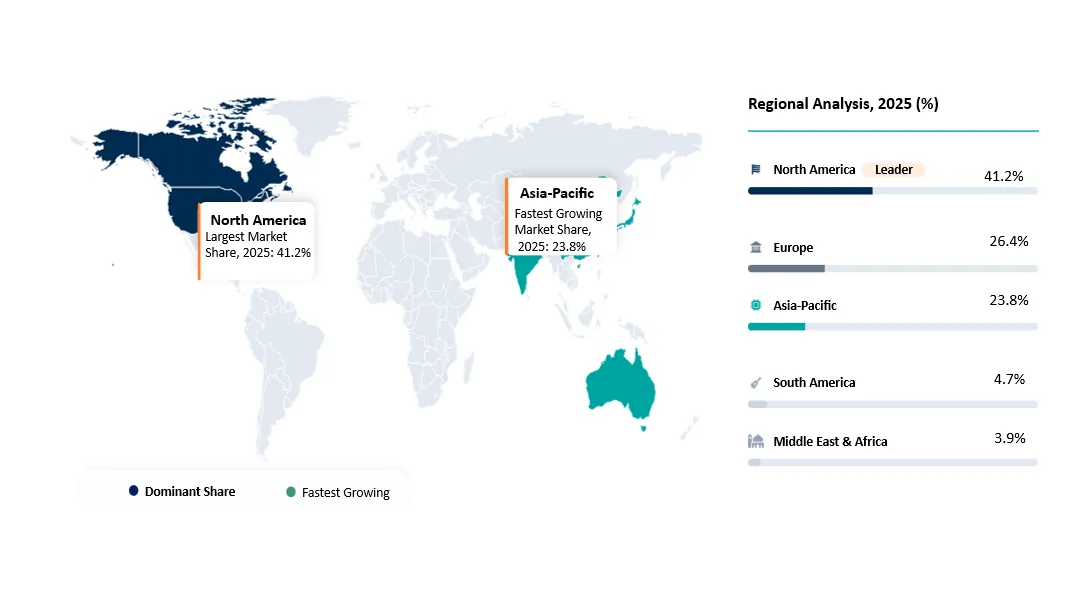
| Region | 2025 Share | Opportunity |
| North America | 41.2% | RIA technology, private banking, AI copilots and alternative investment platforms |
| Europe | 26.4% | Open banking, cross-border compliance and private wealth modernization |
| Asia-Pacific | 23.8% | Assisted wealth, mobile investing and mass-affluent expansion |
| South America | 4.7% | Digital brokerage and advisor infrastructure |
| Middle East & Africa | 3.9% | Family office, private banking and cross-border wealth hubs |
Asia-Pacific Wealth Management Platform Market Landscape
Asia-Pacific is the fastest-growing market because investable wealth and digital financial participation are expanding. India is a priority opportunity. Mutual fund AUM reached approximately INR80.23 lakh crore by December 2025, more than six times the 2015 level. AssetPlus serves more than 18,000 distributors and manages INR7,250 crore through its platform, illustrating the scale of assisted distribution. Singapore and Hong Kong remain important private wealth hubs, while Australia, Japan and South Korea offer mature institutional demand.
North America Wealth Management Platform Market Outlook
North America remains the largest market due to the scale of RIAs, broker-dealers, custodians and private banks. Buyers are investing in advisor productivity, unified household reporting and alternative investment workflows. Platform consolidation is strong because firms seek to reduce the number of applications used by advisors.
Europe Wealth Management Platform Market Outlook
Europe offers opportunities in cloud migration, open banking integration, suitability and cross-border reporting. Switzerland and the UK remain major private wealth centers. Regulatory fragmentation creates demand for configurable compliance engines and local data controls.
South America Wealth Management Platform Market Outlook
Brazil leads regional adoption through digital brokerage, banking apps and expanding investor participation. Wealth firms need platforms that combine mobile access, local products and advisor workflows. Currency volatility and regulatory change make risk reporting and client communication important buying criteria.
Middle East and Africa Wealth Management Platform Market Outlook
The UAE and Saudi Arabia are building financial hubs that attract private banks, family offices and fintech companies. Opportunities include cross-border portfolio reporting, Sharia-compliant products and family office systems. South Africa and Nigeria offer longer-term opportunities in advisor digitization and mobile investment distribution.
Wealth Management Platform Market Competitive Landscape
- Large vendors compete through broad suites that cover front, middle and back-office workflows.
- Cloud-native specialists compete through faster deployment, advisor experience and open integrations.
- AI copilots are becoming a visible differentiator, but enterprise buyers require governance and traceability.
- Funding is flowing toward assisted wealth platforms that combine software with advisor distribution.
- Alternative investment and private market capabilities are becoming a strategic acquisition target.
- Competitive advantage increasingly depends on data portability, implementation capability and partner ecosystems.
Key Companies of Wealth Management Platform Market
- Avaloq
- SEI
- SS&C Technologies
- Temenos
- FIS
- Broadridge
- InvestCloud
- Envestnet
- Addepar
- FNZ
- Objectway
- Orion Advisor Solutions
- Black Diamond Wealth Platform
- Morningstar Wealth
- Salesforce
- Microsoft
- AssetPlus
- Groww
- Wealthfront
- Betterment
Wealth Management Platform Market Major Pain Points
- Fragmented client and portfolio data across custodians, banking systems and spreadsheets.
- Long implementation and migration timelines for large institutions.
- Low advisor adoption when platforms add clicks or fail to match existing workflows.
- Cybersecurity, privacy and third-party model risk.
- Difficulty supporting private assets and complex household structures.
- Fee pressure that limits technology budgets for smaller firms.
- Cross-border regulatory complexity and localization requirements.
- Vendor lock-in and limited data portability.
Wealth Management Platform Market Recent Developments
- January 2026: AssetPlus raised INR175 crore in a funding round led by Nexus Venture Partners, with participation from existing investors including Eight Roads Ventures and Rainmatter. The company reported more than 18,000 mutual fund distributors and INR7,250 crore in assets managed through the platform.
- 2026: AssetPlus outlined plans to expand its assisted wealth infrastructure and broaden the products available to distributors, including mutual funds, insurance and retirement products.
- 2025-2026: Global wealth and asset managers increased investment in AI, data ecosystems and private market distribution as global AUM moved toward a projected US$200 trillion by 2030.
- 2025: Tokenized fund assets were projected to grow from US$90 billion in 2024 to US$715 billion by 2030, accelerating platform requirements for digital asset workflows and investor suitability.
- 2025-2026: Platform vendors continued to expand cloud and API capabilities as banks and RIAs sought to consolidate fragmented advisor technology stacks.
Analyst View / Opinion on Wealth Management Platform Market
- The market is shifting from standalone advisor tools toward connected operating systems for the full client lifecycle.
- Hybrid advice will capture the strongest growth because it combines trusted human relationships with scalable digital operations.
- AI will create value where it reduces workflow time and improves consistency, while human oversight remains central to regulated advice.
- India and Southeast Asia offer strong opportunities for distributor-led platforms that enable existing financial intermediaries.
- Alternative investments, tokenized products and household-level reporting will create premium platform revenue pools.
- Long-term winners will combine open architecture, strong data models, implementation capacity and measurable advisor adoption.
Wealth Management Platform Market Target Audience
| Industry | Who Should Buy This Report? | Reason to Buy |
| Banks and Private Banks | CIOs, wealth heads, digital transformation teams | To evaluate platform modernization, AI and client experience priorities. |
| Wealth Firms and RIAs | CEOs, COOs, advisor technology leaders | To improve advisor capacity, reporting and integration. |
| Asset Managers and Distributors | Distribution heads and platform teams | To assess digital distribution and assisted wealth opportunities. |
| FinTech Companies | Founders, product teams and investors | To identify white spaces, funding trends and partner opportunities. |
| Family Offices | Chief investment officers and operations teams | To evaluate consolidated reporting and private asset workflows. |
| Technology Vendors | Product strategy and sales teams | To prioritize features, regions and buyer segments. |
| Investors and Consultants | Private equity, venture capital and strategy teams | To identify acquisition targets and growth platforms. |
Why Choose DATAM?
- Data-driven insights covering platform demand, buyer criteria, pricing, funding and competitive positioning.
- Post-purchase analyst support for vendor evaluation, market entry and partnership questions.
- White papers and case studies on AI copilots, assisted wealth, private markets and tokenized products.
- Annual report updates reflecting funding, regulation, platform launches and market consolidation.
- Detailed emerging market coverage across India, Southeast Asia, the Middle East and Latin America.
- Buyer-intent analysis that connects platform features to operational outcomes and investment opportunities.
What DATAM Uniquely Provides
- Detailed 10-year predictions by deployment, component, enterprise type, advisory model, functionality, end user, business model and region.
- Buyer intelligence covering integration, migration, cybersecurity, compliance, advisor adoption and pricing.
- Analysis of assisted wealth platforms, AI copilots, alternative investment infrastructure and API ecosystems.
- Funding, M&A, partner identification and strategic alliance tracking.
- Country-level recommendations for banks, RIAs, distributors, fintechs and investors.
Questions This Report Answers
- Which platform capabilities will receive the most technology spending through 2035?
- How will AI change advisor productivity and platform purchasing?
- Where are assisted wealth models most attractive?
- Which end users and business models offer the strongest recurring revenue?
- How will private markets and tokenized funds change platform requirements?
- Which companies are best positioned and what strategies are they using?
- Where are the strongest regional investment and partnership opportunities?




























































