


Sports Drink Market Size
The global Sports Drink market reached an estimated US$ 31.8 billion in 2025 and is expected to reach US$ 58.7 billion by 2035, growing at an estimated CAGR of 6.3% during 2026-2035. The category is expanding beyond traditional carbohydrate-electrolyte beverages into low-sugar, zero-sugar, clean-label, powdered and functional hydration formats. Growth is supported by broader fitness participation, higher awareness of heat stress, digital wellness communities, product innovation and strong route-to-market investment by global beverage companies.
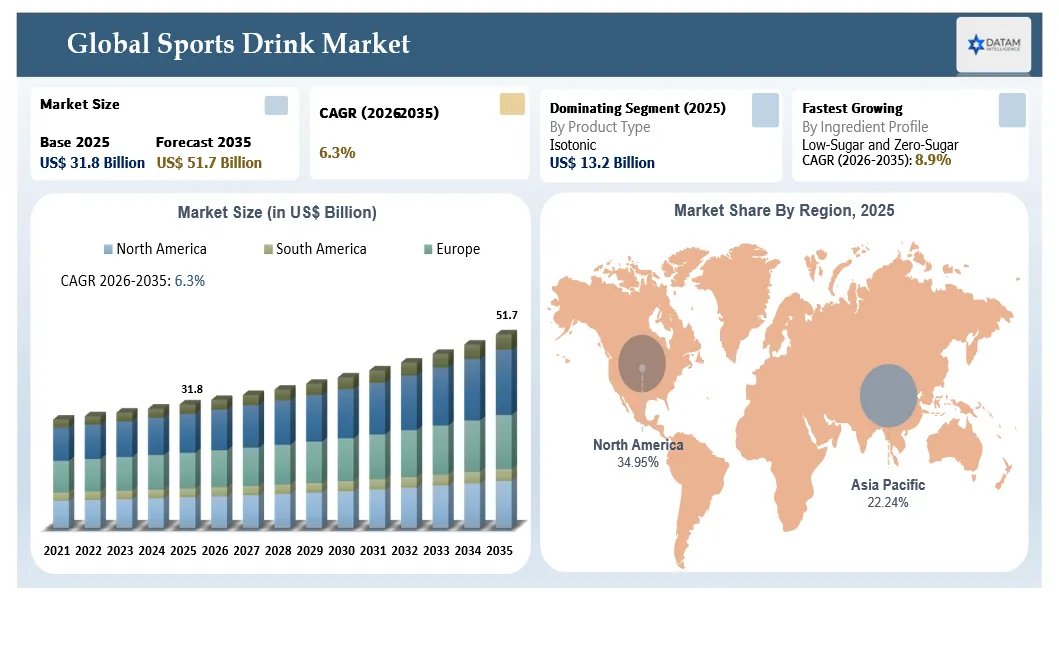
Ready-to-drink isotonic beverages remain the commercial center of the market because they combine mass retail availability, strong brand recognition and immediate convenience. However, the fastest growth is shifting toward lower-sugar products, powders and portable electrolyte formats that allow consumers to control concentration, serving size and packaging waste. The boundary between sports drinks, energy drinks, electrolyte water and wellness beverages is also becoming less distinct, creating both expansion opportunities and positioning risk.
North America remains the largest market due to mature participation, high per-capita spending and the strength of Gatorade, Powerade, BODYARMOR and emerging hydration brands. Asia-Pacific is expected to be the fastest-growing region as urban fitness, organized sport, e-commerce and hot-climate hydration demand expand. Competitive leadership will depend on innovation, distribution density, pack-price architecture, athlete credibility, sugar reduction and the ability to serve both performance and everyday hydration occasions.
Sports Drink Market Scope
| Metrics | Details |
| 2025 Market Size | US$ 31.8 Billion (DataM estimate) |
| 2035 Projected Market Size | US$ 58.7 Billion (DataM estimate) |
| CAGR (2026-2035) | 6.3% |
| Largest Market | North America |
| Fastest Growing Market | Asia-Pacific |
| By Product Type | Isotonic, Hypotonic, Hypertonic, Hybrid and Functional Hydration |
| By Ingredient Profile | Conventional, Low/Zero Sugar, Natural, Fortified, Plant-Based/Organic |
| By Form | Ready-to-Drink, Powder, Concentrate, Tablets/Effervescent |
| By Packaging | PET Bottles, Cans, Cartons/Pouches, Sachets/Tubs, Others |
| By Consumer Group | Professional, Recreational, Youth, Family, Occupational/Outdoor |
| By Application | Endurance, Team Sports, Fitness, Outdoor, Everyday Hydration, Heat Stress |
| By Distribution Channel | Supermarkets, Convenience, Pharmacies, Gyms, Online, Institutional |
| Report Insights Covered | Market Size, Share, Growth, Ecosystem, Public Company Comparison, Company Profiles and Country Opportunity |
Sports Drink Market Key Takeaways
- Isotonic ready-to-drink products remain the largest segment due to established consumer habits and high retail penetration.
- Low-sugar and zero-sugar products are expected to gain share as consumers and regulators scrutinize added sugar.
- Powders, tablets and concentrate formats are growing through e-commerce, endurance sport and portable hydration use cases.
- North America leads in value, while Asia-Pacific offers the strongest long-term volume expansion.
- Convenience stores remain strategically important for impulse purchase, while online channels are central to challenger-brand discovery.
- Brand growth is increasingly driven by athlete credibility, community marketing, flavor innovation and package-price architecture.
- Electrolyte functionality is moving into everyday wellness, outdoor work and heat-stress management.
- Future leadership will depend on distribution, formulation credibility, margin discipline and the ability to manage category overlap with energy and wellness drinks.
Sports Drink Industry Trends and Strategic Insights
- Portfolio renovation is accelerating as large brands add lower-sugar, zero-sugar and natural-flavor variants.
- Powder sticks and tablets are gaining because they reduce shipping weight and allow consumers to customize concentration.
- Premium functional hydration is integrating magnesium, amino acids, vitamins, coconut water, nootropics and adaptogen-adjacent claims.
- Retailers are segmenting shelves by performance, everyday hydration, clean label and youth-oriented use cases.
- Sports sponsorship remains important, but digital creators, running communities and gym partnerships are becoming more measurable acquisition channels.
- Packaging strategy is shifting toward recycled PET, lightweighting, cans and refill-oriented powder formats.
Why does this report matter in 2026?
The year 2026 is a transition point because major beverage groups are balancing premium innovation with pressure on consumer affordability. Category leaders are introducing reduced-sugar extensions, widening pack-price options and investing in performance marketing while facing competition from electrolyte powders, enhanced waters and energy beverages. Regulatory scrutiny of sugar, sweeteners and marketing to children is also shaping formulation and communication strategies.
The report matters because sports drinks are no longer a single-format category. Competitive opportunity differs by product type, ingredient profile, use occasion and channel. The study separates mature isotonic retail demand from faster-growing low-sugar, powder, tablet, clean-label and everyday hydration opportunities. It also evaluates the ecosystem of ingredient suppliers, bottlers, co-manufacturers, distributors, retailers, sports partners and digital communities that determine launch success.
Sports Drink Market White Space & Investment Opportunities
- Electrolyte powders and tablets for travel, endurance and subscription commerce.
- Reduced-sugar products with clear electrolyte and carbohydrate logic rather than lifestyle-only positioning.
- Women-focused and age-specific hydration products supported by evidence-based formulation.
- Occupational heat-stress solutions for construction, logistics, agriculture and industrial workforces.
- Emerging-market pack sizes that combine affordability with safe hydration and local flavors.
- B2B partnerships with gyms, sports clubs, schools, events and corporate wellness programs.
Sports Drink Future Market Transformation
The market will evolve from a shelf-defined beverage category into a broader hydration platform spanning ready-to-drink products, powders, tablets, concentrates and connected wellness services. Consumers will increasingly select products by activity intensity, sweat profile, sugar tolerance, climate and convenience. This will favor portfolios that provide multiple formats under a trusted brand architecture rather than relying on one conventional bottle.
By 2035, differentiation is likely to center on scientifically credible electrolyte systems, lower sugar, personalization, sustainable packaging and omnichannel availability. Large companies will use distribution and sponsorship scale, while challenger brands will compete through sharper positioning and community engagement. Partnerships with ingredient suppliers, sports science organizations, co-manufacturers and digital fitness platforms will become more important to accelerate innovation and reduce launch risk.
Sports Drink Market Buyer Decision-Making Criteria
Consumers evaluate taste, hydration performance, sugar level, electrolyte composition, price, convenience, brand trust and package size. Endurance athletes may prioritize carbohydrate delivery and sodium concentration, while gym users and everyday consumers may prefer low-calorie formulations. Institutional buyers evaluate cost per serving, shelf stability, food-safety compliance, bulk availability and the ability to support heat-stress or event hydration programs.
Retail buyers consider sales velocity, gross margin, promotional support, category incrementality and supply reliability. Online buyers also value subscription suitability, review quality and portable packaging. Products that clearly communicate when and how to use them are better positioned than offerings with broad but vague wellness claims.
Sports Drink Market Economic & Investment Analysis
Market economics vary materially by format. Ready-to-drink beverages carry high packaging and freight exposure but benefit from scale and impulse distribution. Powders and tablets can generate attractive margins and e-commerce economics, though customer acquisition costs and repeat purchase become critical. Brand owners must balance promotional intensity, distributor margins, athlete partnerships, packaging costs and formulation complexity.
Investment is shifting toward challenger brands with differentiated functional claims, digital communities and capital-light manufacturing models. Large strategic buyers value brands that can scale through existing bottling and retail networks. Investors should distinguish true sports hydration from adjacent energy or wellness products, assess retention and repeat purchase, and model the dependence on a small number of distributors or retailers.
Sports Drink Investment Trends in the Market
- Investment in low-sugar and zero-sugar reformulation.
- Expansion of powder sticks, tablets and direct-to-consumer subscriptions.
- Strategic distribution agreements with major beverage systems.
- Sponsorship of running, cycling, team sports and digital fitness communities.
- Packaging innovation, recycled material and lightweight formats.
- Data-driven revenue growth management and localized pack-price architecture.
Strategic Indicators For Sports Drink Market
High Regulation Impact
Sugar taxes, labeling rules, sweetener scrutiny, marketing restrictions and sports-nutrition claims affect formulation and communication. Compliance is especially important for products marketed to children or positioned with functional performance claims.
High Investment Activity
Global beverage companies and challenger brands continue to invest in formulation, brand building, athlete partnerships, distribution and e-commerce. Capital is concentrated in products that can expand beyond elite sport into everyday hydration.
Supply Chain Disruption
Sugar, sweeteners, electrolytes, flavors, PET resin, aluminum and freight costs can affect gross margin. Bottling concentration and co-manufacturer dependence create additional operational risk.
Pricing Volatility
The category is exposed to packaging and commodity costs as well as retailer promotions. Premium powders and functional formats can defend pricing better than conventional mass-market bottles.
Procurement Pressure
Retailers seek reliable supply, competitive pack-price architecture and strong promotional support. Institutional buyers emphasize cost per serving, safety and consistent formulation.
New Technology Adoption
Advances include microencapsulation, improved natural flavors, rapid-dissolve powders, smart caps, personalized hydration algorithms and AI-enabled demand forecasting.
Regional Expansion Opportunity
Asia-Pacific, Latin America and the Middle East offer growth through urban fitness, hot climates, organized sport and modern retail expansion.
Government Policy Support
Public health and heat-stress initiatives can support hydration demand, while sugar reduction policies may shift the product mix toward low- and zero-sugar formats.
Pricing Intelligence
Mass-market RTD products compete through pack architecture and promotion, while powders and premium functional beverages support higher unit margins through differentiated claims and subscription models.
Disruption Analysis of Sports Drink Market
The market is being disrupted by electrolyte powders, enhanced water, energy beverages and wellness products that compete for the same hydration occasion. Digital-first brands can build communities quickly and use contract manufacturing to scale without owning bottling assets. Large beverage companies are responding with portfolio extensions, distribution partnerships and acquisitions.
The second disruption is the shift from “sports-only” to everyday hydration. This broadens the addressable market but increases the need for clear segmentation. Brands that overextend performance credentials may lose authenticity, while products that remain too narrowly athletic may miss high-frequency wellness occasions.
Sports Drink Market BCG Matrix: Company Evaluation
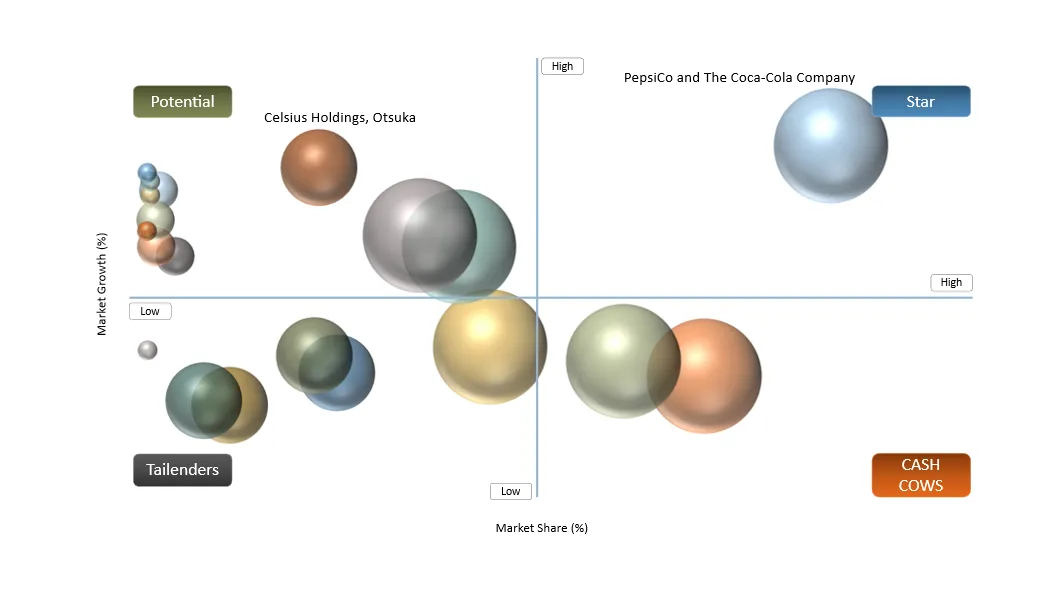
STAR
PepsiCo and The Coca-Cola Company are positioned as Stars because they combine strong global distribution, billion-dollar hydration brands, sponsorship assets and continuous portfolio renovation. Their ability to defend shelf space and launch lower-sugar extensions supports sustained category leadership.
POTENTIAL
Celsius Holdings, Otsuka, Electrolit and selected digital-first hydration brands represent Potential players. Their growth depends on differentiated functionality, distribution scale, channel expansion and the ability to build repeat purchase beyond initial novelty.
Sports Drink Market Dynamics
Driver Impact Analysis
| Driver | Market Growth Impact | Demand Concentration | Impacted Use Case | Strategic Impact |
| Rising fitness and sports participation | High | Global urban markets | Team sports, gym, running | Expands user base and supports event/channel partnerships |
| Low-sugar and functional innovation | High | North America, Europe, APAC | Everyday hydration and fitness | Improves relevance with health-conscious consumers |
| Hot-climate and heat-stress demand | Medium-High | APAC, MEA, Latin America | Outdoor work and recreation | Creates institutional and occupational opportunities |
| E-commerce and portable formats | Medium | Global | Powders, tablets and subscriptions | Lowers entry barriers for challenger brands |
Driver: Rising Fitness Participation and Broader Hydration Awareness
Participation in gyms, running, cycling, team sports and outdoor recreation continues to broaden the consumer base. The commercial effect extends beyond athletes because consumers increasingly associate electrolytes with travel, illness recovery, heat exposure and daily wellness. Brands can capture this demand by separating high-carbohydrate performance products from lower-calorie everyday hydration products.
Restraint Impact Analysis
| Restraint | Drag on Market Growth | Primary Impact Area | Impacted Use Case | Strategic Impact |
| Sugar and calorie concerns | High | Formulation and public health | Youth and everyday use | Accelerates low- and zero-sugar reformulation |
| Competition from adjacent beverages | High | Shelf space and consumer attention | All use cases | Raises marketing cost and blurs category boundaries |
| Packaging and logistics cost | Medium-High | RTD economics | Mass retail | Encourages lightweighting and powder formats |
| Claim and labeling complexity | Medium | Regulatory compliance | Functional and youth products | Requires evidence and disciplined communication |
Restraint: Sugar Concerns and Category Substitution
Traditional sports drinks can be criticized when consumed outside intensive activity because their carbohydrate content may exceed consumer needs. At the same time, enhanced water, coconut water, electrolyte powders and energy beverages offer competing benefits. Brands must explain the role of carbohydrates and electrolytes by use occasion while offering reduced-sugar options for lower-intensity consumption.
Sports Drink Market Segmentation Analysis
The global Sports Drink market is segmented based on Product Type, Ingredient Profile, Form, Packaging Type, Consumer Group, Application, Distribution Channel and region.
By Product Type
Isotonic Products Will Continue to Lead
Isotonic sports drinks remain the largest segment because they are widely recognized, easy to consume and supported by strong retail distribution. Hypotonic and hybrid hydration products are gaining attention for lighter everyday use, while hypertonic products retain relevance for carbohydrate replenishment in selected endurance settings.
By Ingredient Profile
Low-Sugar and Zero-Sugar Will Record the Fastest Growth
Reduced-sugar products address public-health concerns and expand use beyond intense exercise. Conventional carbohydrate-electrolyte products remain important for prolonged activity, but brands increasingly offer parallel zero-sugar lines to serve fitness and casual hydration consumers.
By Form
Ready-to-Drink Will Remain Largest, While Powders Grow Faster
Ready-to-drink products dominate through convenience and impulse availability. Powders and tablets are growing because they lower shipping weight, support subscription commerce and allow personalized concentration.
By Packaging Type
PET Bottles Will Retain Leadership
PET bottles remain dominant because they are resealable, portable and compatible with existing bottling systems. Cans are gaining in premium and zero-sugar positioning, while sachets and tubs support powder growth.
By Consumer Group
Recreational Athletes and Fitness Consumers Will Drive Volume
The largest growth pool is consumers who exercise regularly but are not professional athletes. They seek convenient hydration, lower sugar and credible functionality without complex sports-nutrition protocols.
By Application
Everyday Hydration Will Expand the Addressable Market
Endurance and team sports remain core credibility anchors, but everyday hydration, outdoor recreation and occupational heat stress create additional purchase occasions.
By Distribution Channel
Convenience and Supermarkets Lead, Online Grows Fastest
Mass retail and convenience stores provide scale and impulse access. Online channels are particularly important for powders, tablets and challenger brands using subscriptions and community marketing.
Sports Drink Market Geographical Penetration
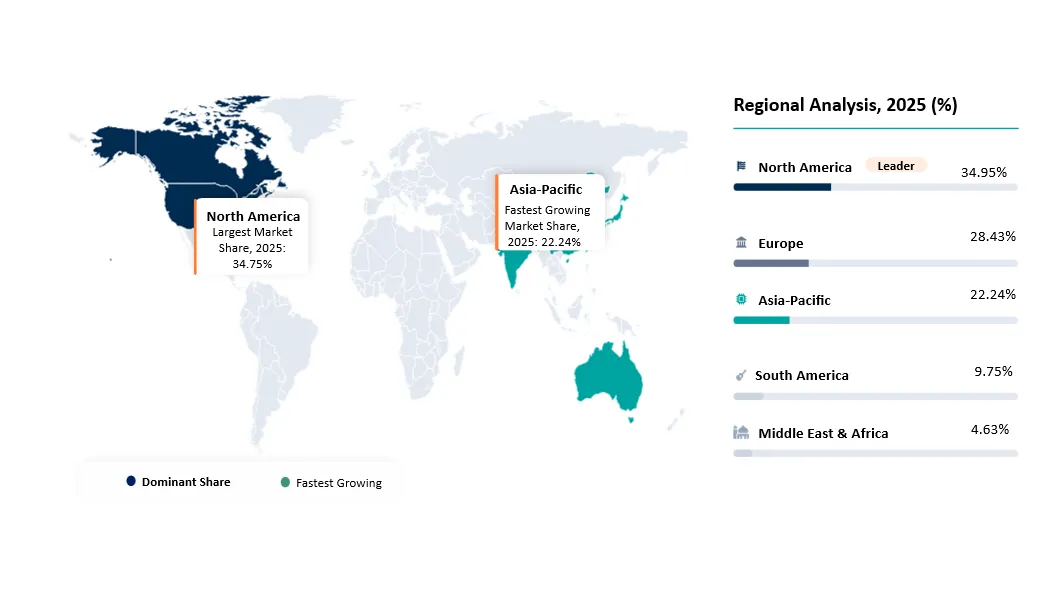
U.S. Sports Drink Market Landscape
The U.S. is the largest national market, supported by Gatorade, Powerade, BODYARMOR, convenience retail, organized sport and a large fitness economy. Growth is increasingly linked to zero-sugar extensions, electrolyte powders, athlete partnerships and pack-price architecture. Competition is intense because energy drinks and enhanced water target overlapping consumers.
Germany Sports Drink Market Outlook
Germany is a mature but innovation-oriented market where reduced sugar, clean label and functional credibility are important. Sports clubs, gyms, pharmacies and e-commerce support specialist products, while retail buyers emphasize compliance and packaging sustainability.
Japan Sports Drink Market Trends
Japan has strong hydration culture through Pocari Sweat and Aquarius, with demand extending beyond sport into hot-weather and everyday replenishment. Aging demographics, convenience stores and vending distribution support frequent consumption.
China Sports Drink Market Outlook
China offers growth through urban fitness, e-commerce, domestic sports events and expanding modern retail. Local flavors, digital marketing and affordable pack sizes are important. Competition from functional and energy beverages remains high.
India Sports Drink Market Outlook
India provides strong long-term potential because of hot climate, youth demographics, cricket, gym participation and modern retail expansion. Price-sensitive packaging, powder formats and distribution outside large cities are central to growth.
Brazil Sports Drink Market Outlook
Brazil benefits from football, running, outdoor recreation and a large youth population. Economic volatility makes affordability important, while local flavors and convenience distribution can support differentiation.
Middle East and Africa Sports Drink Market Outlook
High temperatures, outdoor work and sports investment create strong hydration need. Gulf markets support premium products, while affordability and distribution remain key constraints across parts of Africa.
Sports Drink Market Competitive Landscape
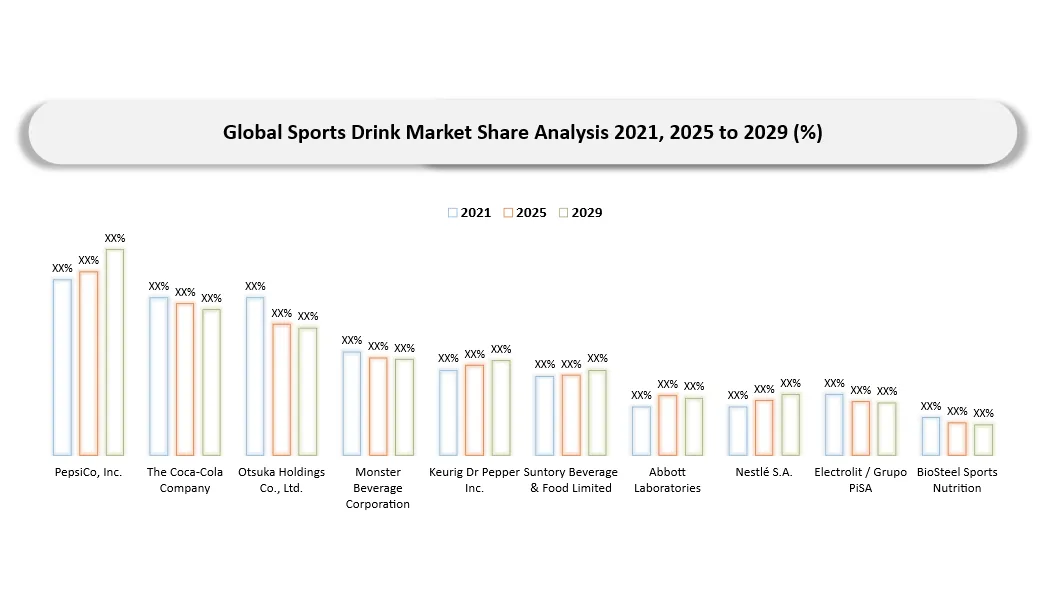
- PepsiCo leads through Gatorade, global distribution, sports partnerships and portfolio breadth across ready-to-drink, powder and zero-sugar formats.
- The Coca-Cola Company competes through Powerade and BODYARMOR, supported by bottling reach and increasing emphasis on sports-drink growth across regions.
- Otsuka has a differentiated hydration platform through Pocari Sweat, particularly in Asia, where everyday electrolyte replenishment is well established.
- Challenger brands compete through clean label, coconut water, powder sticks, direct-to-consumer subscriptions and community-led marketing.
- Competitive advantage increasingly depends on route-to-market density, velocity management, pack-price architecture, formulation credibility and consistent innovation.
Public Company Q1-Q2 2026 Performance Comparison
| Public Company | Q1-Q2 2026 Performance | Sports Drink Exposure | Growth Drivers | Interpretation |
| The Coca-Cola Company | Q1 net revenue +12% and Q2 global unit case volume +5%; Q2 sports drinks volume +5%. | Powerade and BODYARMOR | North America, EMEA and Asia-Pacific sports-drink growth; pricing, marketing and bottling execution. | Strongest directly disclosed sports-drink operating signal among selected companies. |
| PepsiCo, Inc. | Q2 net revenue approximately US$24.2 billion, +6.4%; North America beverage volume declined 4%, while international beverages grew. | Gatorade and Gatorade Zero | International growth, lower-sugar innovation, retail space, affordability and sports marketing. | Category leader facing near-term North American demand pressure but retaining unmatched distribution and brand scale. |
| Monster Beverage Corporation | Q1 net sales US$2.35 billion, +26.9%; operating income +28.1%. | Adjacent functional and performance beverage exposure rather than core sports drinks. | International expansion, portfolio scale, pricing and strong energy category growth. | Important comparator for consumer spending and shelf competition across performance beverages. |
| Celsius Holdings, Inc. | Q1 revenue US$782.6 million, +138%, driven by acquisitions; core CELSIUS brand revenue +6%. | Adjacent fitness and functional beverage exposure. | PepsiCo distribution, Alani Nu integration, international expansion and zero-sugar demand. | Demonstrates how fitness-positioned brands can scale rapidly through major distribution systems. |
| Suntory Beverage & Food Limited | First-half 2026 performance should be read at consolidated and regional beverage level; sports-drink revenue is not separately disclosed in this document. | Aquarius in selected markets and broader non-alcoholic beverage portfolio. | Regional execution, vending and convenience channels, brand renovation and hot-weather demand. | Relevant public comparator, but category-specific inference should remain cautious without separate disclosure. |
Key Companies of Sports Drink Market
- PepsiCo, Inc.
- The Coca-Cola Company
- Otsuka Holdings Co., Ltd.
- Monster Beverage Corporation
- Celsius Holdings, Inc.
- Keurig Dr Pepper Inc.
- Suntory Beverage & Food Limited
- Abbott Laboratories
- Nestlé S.A.
- Electrolit / Grupo Pisa
- BioSteel Sports Nutrition
- NOOMA
- BA Sports Nutrition
- Skratch Labs
- Nuun / Nestlé Health Science
Market Ecosystem
| Value-Chain Sector | Role in the Market | Representative Companies / Organizations |
| Electrolyte and mineral suppliers | Supply sodium, potassium, magnesium, calcium and specialty mineral systems. | Jungbunzlauer, ICL, K+S, Balchem, Gadot Biochemical |
| Sweeteners and carbohydrate suppliers | Provide sugar, dextrose, maltodextrin, stevia and high-intensity sweeteners. | Cargill, ADM, Ingredion, Tate & Lyle, Tereos |
| Flavor, color and functional ingredient companies | Develop taste systems, natural colors, vitamins, amino acids and masking solutions. | Givaudan, dsm-firmenich, Kerry, IFF, Symrise, Sensient |
| Packaging suppliers | Provide PET preforms, bottles, cans, caps, labels, cartons and flexible packs. | Amcor, Berry Global, Ball Corporation, Crown Holdings, Sidel |
| Bottlers and co-manufacturers | Blend, fill and package ready-to-drink beverages at scale. | Coca-Cola bottling partners, PepsiCo bottling system, Refresco, Niagara Bottling, regional co-packers |
| Core sports drink brand owners | Own large-scale sports hydration brands and consumer platforms. | PepsiCo, The Coca-Cola Company, Otsuka, Electrolit/Grupo Pisa |
| Challenger and specialist brands | Compete through clean label, powders, endurance or digital-first positioning. | LMNT, Skratch Labs, Nuun, NOOMA, Liquid I.V., BioSteel |
| Distributors and wholesalers | Provide route-to-market, foodservice and specialty distribution. | UNFI, KeHE, McLane, Sysco, regional beverage distributors |
| Retail and e-commerce | Drive shelf access, velocity, subscription and consumer discovery. | Walmart, Costco, Kroger, Carrefour, Amazon, sporting-goods retailers |
| Sports and fitness partners | Support credibility, sampling and community acquisition. | Professional leagues, national federations, gyms, endurance events, sports clubs |
| Testing, standards and certification | Validate safety, quality, banned-substance control and product claims. | NSF, Informed Sport/LGC, SGS, Eurofins, Intertek |
| Regulators and public-health bodies | Oversee labeling, ingredients, claims, sugar policy and marketing. | FDA, EFSA, national food authorities, Codex Alimentarius |
Company Profiles
PepsiCo, Inc.
PepsiCo is the global category leader through Gatorade and related hydration formats. Its advantage comes from brand equity, sports-science heritage, broad pack architecture, direct-store-delivery capabilities and relationships with teams, leagues and retailers. Strategic priorities include zero-sugar innovation, affordability, international expansion and stronger integration of powders and performance nutrition.
Competitive priorities include product renovation, channel expansion, packaging optimization, pricing discipline and consumer education around use occasion. Recent developments should be monitored for launches, sponsorships, distribution agreements and geographic expansion.
The Coca-Cola Company
The Coca-Cola Company competes through Powerade and BODYARMOR. Its bottling system provides global scale, while BODYARMOR supports premium positioning and Powerade serves mass-market sports hydration. Q2 2026 reporting indicated 5% sports-drink volume growth, demonstrating improving category momentum across North America, EMEA and Asia-Pacific.
Competitive priorities include product renovation, channel expansion, packaging optimization, pricing discipline and consumer education around use occasion. Recent developments should be monitored for launches, sponsorships, distribution agreements and geographic expansion.
Otsuka Holdings Co., Ltd.
Otsuka is a major hydration participant through Pocari Sweat. The brand is positioned around fluid and electrolyte replenishment and has strong recognition across Japan and Asian markets. Its opportunity lies in geographic expansion, hot-weather demand and broader everyday hydration occasions.
Competitive priorities include product renovation, channel expansion, packaging optimization, pricing discipline and consumer education around use occasion. Recent developments should be monitored for launches, sponsorships, distribution agreements and geographic expansion.
Monster Beverage Corporation
Monster is an adjacent competitor rather than a pure sports-drink company. Its relevance comes from strong shelf competition, fitness-oriented consumers, convenience-store strength and rapid international growth. The company’s 2026 performance demonstrates continued spending momentum in functional beverages.
Competitive priorities include product renovation, channel expansion, packaging optimization, pricing discipline and consumer education around use occasion. Recent developments should be monitored for launches, sponsorships, distribution agreements and geographic expansion.
Celsius Holdings, Inc.
Celsius owns a fast-growing fitness and functional beverage platform. The PepsiCo distribution relationship and acquisitions of Alani Nu and Rockstar created substantial scale. Although the portfolio is primarily energy rather than sports hydration, it competes for the same active consumer and retail space.
Competitive priorities include product renovation, channel expansion, packaging optimization, pricing discipline and consumer education around use occasion. Recent developments should be monitored for launches, sponsorships, distribution agreements and geographic expansion.
Keurig Dr Pepper Inc.
Keurig Dr Pepper participates through a broad beverage distribution platform and partnerships. Its strategic relevance is route-to-market capability, retailer relationships and potential to scale emerging hydration brands within North America.
Competitive priorities include product renovation, channel expansion, packaging optimization, pricing discipline and consumer education around use occasion. Recent developments should be monitored for launches, sponsorships, distribution agreements and geographic expansion.
Suntory Beverage & Food Limited
Suntory has a broad non-alcoholic beverage portfolio and participates in sports hydration through brands such as Aquarius in selected markets. Regional distribution, vending, convenience channels and formulation capabilities support its position.
Competitive priorities include product renovation, channel expansion, packaging optimization, pricing discipline and consumer education around use occasion. Recent developments should be monitored for launches, sponsorships, distribution agreements and geographic expansion.
Abbott Laboratories
Abbott participates in performance nutrition through products serving athletes and active consumers. Its strengths include clinical credibility, nutrition science, institutional channels and cross-category brand trust.
Competitive priorities include product renovation, channel expansion, packaging optimization, pricing discipline and consumer education around use occasion. Recent developments should be monitored for launches, sponsorships, distribution agreements and geographic expansion.
Nestlé S.A.
Nestlé participates through hydration, nutrition and specialist brands. Its advantages include global distribution, science capabilities and e-commerce reach. Portfolio overlap with powders, tablets and wellness hydration creates strategic adjacency.
Competitive priorities include product renovation, channel expansion, packaging optimization, pricing discipline and consumer education around use occasion. Recent developments should be monitored for launches, sponsorships, distribution agreements and geographic expansion.
Electrolit / Grupo Pisa
Electrolit has grown from medical-style oral hydration positioning into broader sports and everyday hydration. The brand benefits from strong taste, Latin American recognition and expanding U.S. retail distribution.
Competitive priorities include product renovation, channel expansion, packaging optimization, pricing discipline and consumer education around use occasion. Recent developments should be monitored for launches, sponsorships, distribution agreements and geographic expansion.
Sports Drink Market Major Pain Points
- High sugar perception for products consumed outside intensive activity.
- Crowded shelf space and overlap with water, energy and wellness beverages.
- Packaging and freight exposure for ready-to-drink products.
- Difficulty proving differentiated hydration benefits to mainstream consumers.
- Dependence on promotions and sponsorships to maintain awareness.
- Retailer pressure on velocity, margins and pack-price architecture.
- Regulatory complexity around claims, sweeteners and youth marketing.
- Supply risk for packaging, flavors, sweeteners and selected electrolytes.
Sports Drink Market Recent Developments
- July 2026: The Coca-Cola Company reported 5% growth in global sports-drink unit case volume for the second quarter, driven by North America, EMEA and Asia-Pacific.
- July 2026: PepsiCo reported second-quarter revenue growth but weaker North American beverage volume, while continuing to support lower-sugar innovation and affordability initiatives across its beverage portfolio.
- May 2026: Monster Beverage reported 26.9% first-quarter net sales growth, highlighting strong demand in adjacent performance and energy beverages.
- May 2026: Celsius Holdings reported first-quarter revenue of US$782.6 million, supported by Alani Nu and Rockstar integration and PepsiCo distribution.
- 2026: Major sports hydration brands continued to expand zero-sugar, powder and portable electrolyte formats to capture everyday and fitness-oriented demand.
Analyst View / Opinion on Sports Drink Market
- The category will continue to grow, but value will shift from conventional sugar-heavy bottles toward segmented hydration portfolios.
- Gatorade and Powerade/BODYARMOR retain major advantages through distribution, shelf space and sports partnerships, yet challenger brands can win in powders, clean label and community-led niches.
- Everyday hydration is the largest expansion opportunity, but brands must maintain scientific credibility and avoid vague wellness positioning.
- Asia-Pacific offers the strongest volume runway, while North America remains the most valuable and competitive market.
- Powders and tablets will gain strategic importance because they improve freight economics, personalization and e-commerce suitability.
- Long-term winners will combine formulation credibility, flavor quality, pack-price architecture, omnichannel distribution and disciplined use-occasion segmentation.
Sports Drink Market Target Audience
| Industry | Who Should Buy This Report? | Reason to Buy This Report |
| Beverage Companies | Brand owners, innovation teams, category managers | Assess segment growth, portfolio gaps, pricing and competitive strategy. |
| Ingredient Suppliers | Electrolyte, sweetener, flavor, vitamin and carbohydrate suppliers | Identify formulation trends and customer opportunities. |
| Bottlers & Co-Manufacturers | Bottling groups, contract manufacturers, packaging partners | Evaluate capacity, format and regional demand opportunities. |
| Retail & Distribution | Retailers, wholesalers, convenience chains and e-commerce platforms | Understand velocity drivers, assortment and channel shifts. |
| Sports & Fitness | Teams, gyms, events, coaches and sports nutrition professionals | Assess product evolution and partnership opportunities. |
| Investors & Consulting | Private equity, venture capital, institutional investors and advisors | Evaluate market size, public company performance, ecosystem and acquisition potential. |
| Government & Public Health | Regulators, schools, occupational health and hydration programs | Understand sugar reduction, heat stress and labeling implications. |
Why Choose DATAM?
- Data-driven insights combining market sizing, consumer occasions, pricing, channel analysis and company disclosures.
- Post-purchase analyst consultations for portfolio strategy, market entry, partnership selection and custom modeling.
- Annual updates covering product launches, sponsorships, quarterly performance, regulation and competitive changes.
- Specialized focus on emerging markets and route-to-market differences rather than generalized regional summaries.
- Actionable analysis linking formulation trends with retail execution, ecosystem partners and investment decisions.
What DATAM Uniquely Provides
- Ten-year forecasts across product type, ingredient profile, form, packaging, consumer group, application, channel and region.
- A value-chain ecosystem map spanning ingredients, packaging, bottling, brands, distribution, retail, sports partners and regulators.
- Public-company Q1-Q2 2026 performance comparison with clear distinction between corporate and sports-drink-specific indicators.
- Country-level views linking fitness participation, climate, retail structure, affordability and brand competition.
- Strategic recommendations for product renovation, channel entry, partnership and investment prioritization.



























































