


Smart Water Grid Market Size
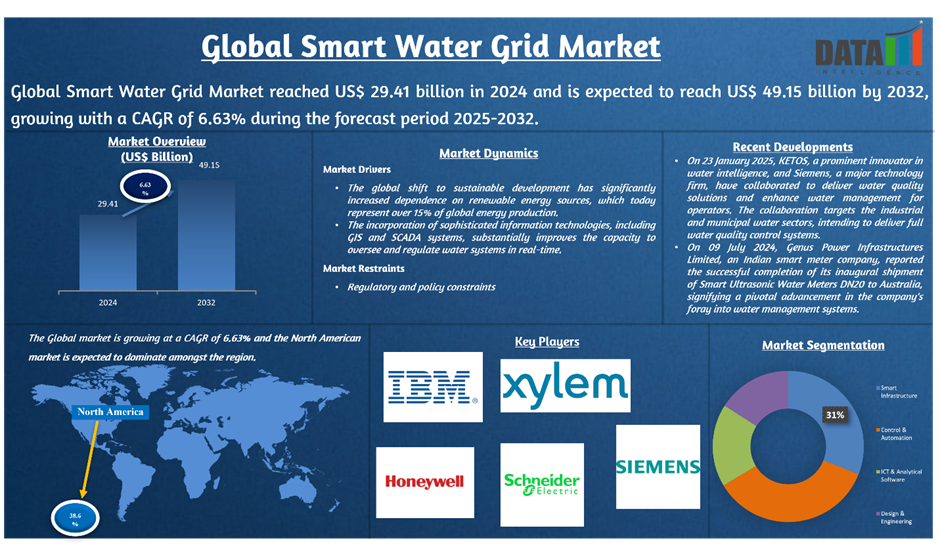
Global Smart Water Grid Market size reached US$ 31.36 billion in 2025 and is expected to reach US$ 59.57 billion by 2035, growing with a CAGR of 6.63% during the forecast period 2026-2035.
The smart water grid market is projected for considerable growth, driven by its advanced features and growing global acceptance. Significant advancements like real-time sensing, quality monitoring, demand forecasting and effective identification of bursts and leaks are transforming water management systems. The characteristics improve operating efficiency, facilitate strategic planning and reduce water loss, a progressively vital goal amid escalating worldwide water scarcity, as per our research.
The refurbishment of old water infrastructure and the establishment of precise billing methodologies further propel the market's growth. The increasing focus on enhancing water supply systems and management methods highlights the essential function of smart water grids in tackling modern water issues. The incorporation of smart grid technology, which is already revolutionizing the energy sector, is crucial to this advancement.
Through the usage of digital intelligence, smart grids enhance the capabilities of water utilities and consumers, facilitating effective resource management and minimizing operational inefficiencies. In July 2023, the US exemplified the revolutionary capabilities of smart grids, featuring comprehensive infrastructure that facilitates efficient electricity delivery. The water sector is anticipated to gain from these developments, promoting sustainable resource management and decreasing carbon emissions associated with water distribution and treatment systems.
Smart Water Grid Market Executive Summary
For more details on this report – Request for Sample
Key Takeaways
- North America accounted for approximately 34.6% of the global Smart Water Grid Market in 2025, supported by extensive investments in smart utility infrastructure, advanced metering systems, and digital water management technologies.
- Smart metering solutions represented approximately 39.8% of the overall market, driven by widespread deployment of Advanced Metering Infrastructure (AMI) and increasing focus on real-time consumption monitoring and billing accuracy.
- Municipal water utilities remain the largest end-user segment as governments continue investing in digital infrastructure modernization, leakage reduction, and sustainable water resource management initiatives.
- Artificial intelligence, IoT sensors, digital twins, cloud-based SCADA platforms, and predictive analytics are transforming utility operations by improving infrastructure reliability, operational efficiency, water conservation, and asset performance.
- Leading technology providers are expanding strategic collaborations with utilities and smart city developers to accelerate the deployment of intelligent monitoring systems, predictive maintenance solutions, and integrated digital water management platforms.
- Growing concerns regarding water scarcity, climate resilience, aging infrastructure, regulatory compliance, and smart city development continue creating strong long-term growth opportunities for smart water grid technologies across developed and emerging economies.
Smart Water Grid Market Scope
| Metrics | Details |
| CAGR | 6.63% |
| Size Available for Years | 2023-2032 |
| Forecast Period | 2025-2032 |
| Data Availability | Value (US$) |
| Segments Covered | Component, Technology, Application and Region |
| Regions Covered | North America, South America, Europe, Asia-Pacific, Middle East and Africa |
| Fastest Growing Region | Asia-Pacific |
| Report Insights Covered | Competitive Landscape Analysis, Company Profile Analysis, Market Size, Share, Growth, Demand, Recent Developments, Mergers and Acquisitions, New Product Launches, Growth Strategies, Revenue Analysis, Porter’s Analysis, Pricing Analysis, Regulatory Analysis, Supply-Chain Analysis and Other key Insights. |
Smart Water Grid Market Dynamics
Driver 1 - Sustainability and efficiency in the smart water grid
The global shift to sustainable development has significantly increased dependence on renewable energy sources, including wind, solar, biofuels, hydro and geothermal, which today represent over 15% of global energy production. This change introduces increased complexity to power infrastructure, requiring creative solutions such as smart grid technologies.
Smart grids are transforming conventional infrastructure, especially in water management, by improving reliability and resilience. Smart grid technology facilitates swift service restoration following disturbances, decreasing outages, expenses and downtime, therefore mitigating financial losses. Utilizing cloud-based data processing and automation, these systems enhance situational awareness and optimize resource allocation through big data analytics.
Furthermore, incorporating technologies such as outage mapping optimizes the utilization of smart grid data for preventive and restorative initiatives. The infrastructure facilitates the seamless incorporation of renewable energy at transmission and distribution levels, enhancing energy efficiency and diminishing carbon emissions in water supply systems for commercial and residential applications.
Driver 2 – Technological advancement
The incorporation of sophisticated information technologies, including Geographic Information Systems (GIS) and Supervisory Control and Data Acquisition (SCADA) systems, substantially improves the capacity to oversee and regulate water systems in real-time. Geographic Information Systems (GIS) offer a more precise depiction of system assets and their geographical positions, enhancing planning and resource distribution. SCADA systems facilitate the centralized aggregation and processing of sensor data, hence enhancing the precision of control over geographically dispersed assets.
The above mentioned technologies provide the prompt identification and prevention of leaks, an essential component of efficient asset management and the reduction of water losses. Conventional water delivery systems frequently prioritize sustaining high-pressure pumping to service remote clients, resulting in inefficiencies, particularly within deteriorating infrastructure. Smart water grids are used near real-time data, variable-speed pumps, dynamic control valves and smart meters to equilibrate demand, mitigate over-pressure in pipelines and enhance the efficiency of both water and energy consumption. This dynamic, data-driven methodology facilitates the optimal management of water resources and systems, assuring long-term sustainability and cost efficiency.
Smart water systems provide substantial economic and environmental advantages through improved leak detection, enhanced conservation initiatives and ongoing water quality monitoring. The deployment of such devices enables utilities to detect water loss or unauthorized connections, hence minimizing financial waste and enhancing overall service performance. Smart water grids provide consumer monitoring of water usage via wireless data transfer, so enabling individuals to conserve water and reduce utility expenses, fostering a more sustainable and customer-oriented water management framework.
Restraint: Regulatory and policy constraints
Current laws, generally formulated for conventional grid systems, are not compatible with the adaptable, dynamic characteristics of smart grids. Consequently, there is an urgent necessity to revise legislative frameworks to integrate new technology, business models and market structures vital for the effective deployment of smart grids.
In the US, the Federal Energy Regulatory Commission (FERC) and state regulators play essential roles in policy formulation; yet, regulatory differences among states may obstruct the establishment of a unified and efficient smart water grid infrastructure. The regulatory anomalies hinder the standardization of policies that may promote the use of smart grid technologies across various regions.
Furthermore, policy uncertainty inhibits investment, since utilities and stakeholders are reluctant to engage in long-term projects without clear and stable policies that provide dependable support. Effectively handling the extensive data produced by smart grids, encompassing real-time data from sensors and meters, necessitates advanced systems for data collecting, storage and analysis. The intricacy of complying with data privacy requirements, such as the GDPR in Europe, exacerbates the issue, since utilities must guarantee that sensitive consumer information is protected from unwanted access.
Smart Water Grid Market Segment Analysis
The global smart water grid market is segmented based on component, technology, application and region.
Advancement in smart water infrastructure for efficient water management
Smart Water Grid Market's Smart Infrastructure segment demonstrated a steady increase between 2022 and 2023. Valued at $8.29 billion in 2022, this segment grew to $8.33 billion in 2023.
Smart Water Infrastructure (SWI) is an essential component of the modernized water distribution and treatment system, leveraging advanced technologies and data-driven analytics to enhance water resource management. SWI incorporates sensors, Internet of Things (IoT) devices, smart meters and real-time monitoring systems to improve the efficiency and sustainability of water systems.
By continuously monitoring water usage, flow rate and pressure levels, SWI can help utilities reduce water losses, improve water quality and optimize distribution and treatment processes. The technology behind SWI includes advanced data analytics and machine learning algorithms, enabling predictive maintenance, early leak detection and pollution monitoring. These capabilities provide utilities with the tools needed to make informed decisions about water usage and resource allocation.
Additionally, SWI helps utilities respond swiftly to issues, preventing overloading and ensuring efficient water supply management. In August 26, 2024, according to Siemens Smart Infrastructure in a release, the new grid sensor solution will play a pivotal role in digitalising distribution grids, enabling grid operators to achieve full network transparency.
Smart Water Grid Market Geographical Share
Rising urbanization and water security in North America
Smart Water Grid Market in North America demonstrated sustained growth, with its valuation increasing from $8.91 billion in 2022 to $9.26 billion in 2023.
The market in North America is experiencing significant growth, driven by the increasing adoption of Automated Meter Reading (AMR) and Advanced Metering Infrastructure (AMI) technologies. The solutions provide utilities with real-time data on water consumption, enabling more efficient water management, improved billing accuracy and enhanced leak detection. North America, particularly US, leads in the installation of AMI systems, representing over 70% of the installed endpoints in Europe and North America in 2019.
The market’s expansion is also fueled by rising concerns about water security, particularly the need to reduce Non-Revenue Water (NRW), which includes water lost due to leaks, poor metering and theft. In North America, urbanization, aging infrastructure and rising energy costs are further driving the demand for smart water solutions. The US government’s investment in smart grid infrastructure, including the installation of smart water meters, has played a critical role in advancing the market. With projections for a 28% growth in the AMI smart water metering sector in 2024, the market outlook remains positive.
Smart Water Grid Market Major Players
The major global players in the market include IBM Corporation, Siemens AG, Xylem Inc., Schneider Electric SE, Honeywell International Inc., ABB Group, Itron Inc., Badger Meter, Inc., Aclara Technologies LLC and Trimble Inc.
Smart Water Grid Market Investment and Strategic Collaboration Analysis
Governments, municipal authorities, private investors, and multilateral development organizations are significantly increasing investments in smart water infrastructure to address aging distribution networks, rising urbanization, climate resilience, and water conservation goals. Water utilities are allocating substantial budgets toward intelligent metering, AI-powered monitoring platforms, cloud-based SCADA systems, and predictive asset management to improve operational efficiency while reducing water losses. Technology companies including Xylem, SUEZ, Veolia, Siemens, Schneider Electric, Itron, Honeywell, ABB, Badger Meter, and Kamstrup continue expanding strategic collaborations with municipal utilities, engineering firms, and communication technology providers to accelerate digital transformation across water infrastructure. These partnerships are supporting large-scale smart city initiatives, digital utility modernization, and sustainable water resource management worldwide.
Smart Water Grid Market Emerging Technologies Analysis
Emerging technologies including artificial intelligence, digital twins, edge computing, advanced IoT sensors, blockchain-enabled data security, satellite-based leak detection, autonomous inspection robots, cloud-native SCADA platforms, predictive analytics, and GIS-integrated asset management are transforming the Smart Water Grid Market. AI-powered analytics enable utilities to forecast demand, optimize pressure management, detect leaks, and improve maintenance planning using real-time operational data. Digital twins provide virtual representations of water distribution networks for infrastructure simulation and decision support, while autonomous robotic inspection systems improve pipeline monitoring and reduce manual maintenance requirements. These innovations are expected to significantly improve operational efficiency, water conservation, infrastructure resilience, and long-term sustainability.
Smart Water Grid Market Water Loss and Non-Revenue Water (NRW) Reduction Analysis
Reducing non-revenue water remains one of the highest priorities for water utilities globally. Water losses resulting from pipeline leakage, unauthorized consumption, inaccurate metering, and aging infrastructure create significant financial and operational challenges for utilities. Smart water grids address these issues through continuous monitoring of flow rates, pressure variations, and consumption patterns using intelligent sensors and advanced analytics. AI-driven leak detection, automated pressure management, and predictive maintenance enable utilities to rapidly identify infrastructure failures before major water losses occur. These technologies improve distribution efficiency, lower operational costs, extend asset life, and support sustainable water resource management.
Smart Water Grid Market Water Quality Monitoring Analysis
Water quality monitoring is becoming a central component of modern smart water grids as utilities prioritize public health, regulatory compliance, and operational transparency. Advanced sensor technologies continuously monitor parameters including pH, turbidity, chlorine concentration, dissolved oxygen, conductivity, and microbial contamination throughout water distribution systems. Real-time monitoring enables early detection of contamination events, treatment failures, and pipeline abnormalities, allowing utilities to respond proactively before service quality is compromised. Growing regulatory requirements and increasing public awareness regarding safe drinking water continue driving investments in intelligent water quality management technologies.
Smart Water Grid Market Climate Resilience and Sustainable Water Management Analysis
Climate change, population growth, and increasing water scarcity are accelerating the adoption of smart water grid technologies capable of improving long-term water security. Intelligent water management systems optimize water allocation, reservoir operations, groundwater utilization, and demand forecasting while supporting efficient drought management and flood resilience. Smart grids also improve energy efficiency through optimized pumping operations and intelligent pressure control, reducing operational costs and environmental impact. Governments worldwide are integrating digital water infrastructure into broader climate adaptation and sustainability strategies to strengthen resilience against extreme weather events and future water resource challenges.
Smart Water Grid Market Future Trends (2026-2035)
The Smart Water Grid Market is expected to witness sustained growth throughout the forecast period, driven by increasing investments in digital infrastructure, smart city development, climate resilience, and intelligent utility management. Future market expansion will be supported by widespread deployment of IoT-enabled sensors, AI-powered predictive analytics, digital twins, cloud-based asset management, advanced communication networks, and autonomous infrastructure monitoring. Utilities are expected to increasingly integrate renewable energy, edge computing, GIS platforms, and cybersecurity solutions into digital water networks while expanding intelligent metering infrastructure. Continuous government investments in sustainable water management, aging infrastructure modernization, and climate adaptation initiatives are anticipated to strengthen long-term market growth through 2035.
Smart Water Grid Market Early Stage Innovations
The smart water grid market is experiencing a significant technological shift, driven by advancements like digital twin technologies and the enhanced use of sensors and artificial intelligence (AI). Significant early-stage advancements in this field encompass solutions aimed at mitigating non-revenue water and optimizing water management procedures.
An exemplary case is the collaboration between Xylem and Idrica, which introduced Xylem Vue powered by GoAigua. This platform consolidates data into a cohesive model, improving the efficiency of water utility operations. The proliferation of AI-driven technology is evident in initiatives such as VA SYD in Sweden, where AI is employed to identify water leaks and decrease non-revenue water by roughly 2%, from 10% to below 8%. The deployment of smart water meters, including the 315,000 NB-IoT meters provided by Vodafone in Spain, illustrates the continuous advancement towards digitalization.
The necessity for enhanced water management is becoming pressing as the global water crisis escalates, affecting 2-3 billion individuals globally who face water scarcity. The industry is experiencing an increase in funding, propelled by government subsidies and initiatives aimed at improving water efficiency and resilience. This financial assistance is expediting the implementation of smart water grid technologies.
Companies are prioritizing water reclamation, automation for process enhancement and cybersecurity to protect digital infrastructure. With water demand projected to rise by 30% by 2050, advances like AI and automation will be crucial for the efficient and sustainable management of water resources. The developments position the smart water grid market for substantial growth, tackling present and future difficulties in water management.
Smart Water Grid Market Players
IBM Corporation, Siemens AG, Xylem Inc., Schneider Electric SE, Honeywell International Inc., ABB Group, Itron Inc., Badger Meter, Inc., Aclara Technologies LLC, Trimble Inc.
Emerging players in the smart water grid market are focusing on large-scale initiatives to drive digital transformation and enhance operational efficiency. A prominent example is the Dubai Electricity and Water Authority (DEWA), which on December 30th, 2024, announced the implementation of a smart grid with a total investment of AED 7 billion (US$ 1.9 billion). This ambitious project aligns with the UAE’s vision to position Dubai as the smartest and happiest city globally.
The smart grid will enable seamless, 24/7 integrated services, incorporating cutting-edge technologies such as artificial intelligence (AI) and the Internet of Things (IoT). These innovations will facilitate automated decision-making and ensure interoperability across electricity and water networks, contributing to more reliable, efficient and sustainable operations. Such strategic initiatives reflect a growing commitment to leveraging the potential of disruptive technologies to enhance water and energy management in the global smart grid market.
By Component
- Hardware
- Software
- Services
By Technology
- Smart Infrastructure
- Control & Automation
- ICT & Analytical Software
- Design & Engineering
By Application
- Residential
- Commercial
- Industrial
By Region
- North America
- South America
- Europe
- Asia-Pacific
- Middle East and Africa
Key Developments
- July 2026: IBM Corporation expanded its AI-powered water management solutions by advancing predictive analytics and digital twin technologies that improve water distribution efficiency and infrastructure resilience.
- July 2026: Siemens AG strengthened its smart infrastructure portfolio by enhancing intelligent water grid technologies that integrate automation, real-time monitoring, and energy-efficient operations.
- June 2026: Xylem Inc. advanced its digital water platform through the deployment of AI-enabled smart metering, leak detection, and network optimization solutions for utilities worldwide.
- June 2026: Schneider Electric SE expanded its EcoStruxure™ platform by introducing advanced digital solutions for smart water networks, enabling improved operational efficiency and sustainability.
- May 2026: Honeywell International Inc. strengthened its industrial automation portfolio by enhancing connected water infrastructure solutions with AI-driven monitoring and predictive maintenance capabilities.
- May 2026: ABB Ltd. continued investing in intelligent automation technologies by advancing digital control and monitoring systems for municipal and industrial water distribution networks.
- April 2026: Itron Inc. expanded its smart utility solutions by introducing next-generation water metering and grid management technologies that improve resource efficiency and reduce non-revenue water losses.
- April 2026: Badger Meter, Inc. strengthened its smart water management portfolio through innovations in ultrasonic metering, remote monitoring, and cloud-based analytics for water utilities.
- March 2026: Trimble Inc. enhanced its geospatial and asset management technologies by expanding digital mapping and infrastructure monitoring solutions supporting smart water grid deployments.
- In 23 January 2025, KETOS, a prominent innovator in water intelligence and Siemens, a major technology firm, have collaborated to deliver water quality solutions and enhance water management for operators. The collaboration targets the industrial and municipal water sectors, intending to deliver full water quality control systems.
- In 09 July 2024, Genus Power Infrastructures Limited, an Indian smart meter company, reported the successful completion of its inaugural shipment of Smart Ultrasonic Water Meters DN20 to Australia, signifying a pivotal advancement in the company's foray into water management systems.
Why Choose DataM?
Technological Innovations: DataM provides comprehensive analysis of advanced smart water technologies including AI-powered leak detection, digital twins, IoT-enabled smart meters, cloud-based SCADA systems, GIS-integrated asset management, predictive maintenance, autonomous inspection technologies, advanced communication networks, and intelligent pressure management solutions that are transforming modern water utilities.
Product Performance & Market Positioning: The report evaluates how leading companies differentiate their solutions based on leak detection accuracy, smart metering capabilities, AI analytics, communication technologies, interoperability, water quality monitoring, cybersecurity, operational scalability, cloud integration, and digital infrastructure performance while benchmarking competitive positioning across global technology providers.
Real-World Evidence: DataM highlights the deployment of smart water grid technologies across municipal utilities, smart cities, industrial facilities, commercial buildings, and water treatment plants worldwide. The report examines industry initiatives involving Xylem's intelligent water network solutions, SUEZ's AQUADVANCED digital water platform, Veolia's Hubgrade digital performance platform, Itron's Advanced Metering Infrastructure (AMI) solutions, Siemens' digital water automation technologies, Schneider Electric's EcoStruxure for Water and Wastewater, Honeywell's smart utility monitoring systems, ABB's digital control platforms, and Badger Meter's BlueEdge smart water solutions, demonstrating how utilities are reducing non-revenue water, improving operational efficiency, modernizing aging infrastructure, and strengthening climate resilience through digital water management.
Market Updates & Industry Changes: The report tracks infrastructure modernization programs, smart city investments, utility digitalization projects, AI adoption, communication technology advancements, mergers and acquisitions, regulatory developments, and strategic collaborations that continue reshaping the Smart Water Grid Market across North America, Europe, Asia-Pacific, Latin America, and the Middle East.
Competitive Strategies: The report analyzes how leading companies strengthen market leadership through AI-enabled software platforms, strategic partnerships, acquisitions, cloud-native water management systems, IoT innovation, regional expansion, cybersecurity integration, and end-to-end digital utility solutions designed to improve operational efficiency and water sustainability.
Pricing & Market Access: The report evaluates pricing variations based on smart meters, communication infrastructure, analytics software, deployment scale, cloud services, and system integration while assessing market access through municipal utilities, engineering companies, government agencies, industrial customers, EPC contractors, and technology integrators supporting digital water transformation projects.
Market Entry & Expansion: DataM identifies high-growth opportunities driven by increasing investments in water infrastructure modernization, climate resilience, smart cities, digital utilities, industrial water management, sustainability initiatives, and AI adoption while outlining strategies including technology partnerships, regional expansion, software innovation, cloud platform development, and integrated digital water solutions to support long-term market growth.
Target Audience
The Smart Water Grid Market report is designed for water utilities, municipal authorities, government agencies, smart city planners, engineering and infrastructure companies, water treatment solution providers, industrial water users, EPC contractors, IoT technology providers, smart metering manufacturers, SCADA solution providers, cloud platform developers, environmental agencies, sustainability consultants, utility operators, research institutions, technology investors, venture capital firms, private equity organizations, policy makers, and business leaders seeking strategic insights into digital water infrastructure, intelligent utility management, infrastructure modernization, competitive positioning, regulatory developments, and future investment opportunities.




























































