


Predictive Corrosion Management Market Size & Overview
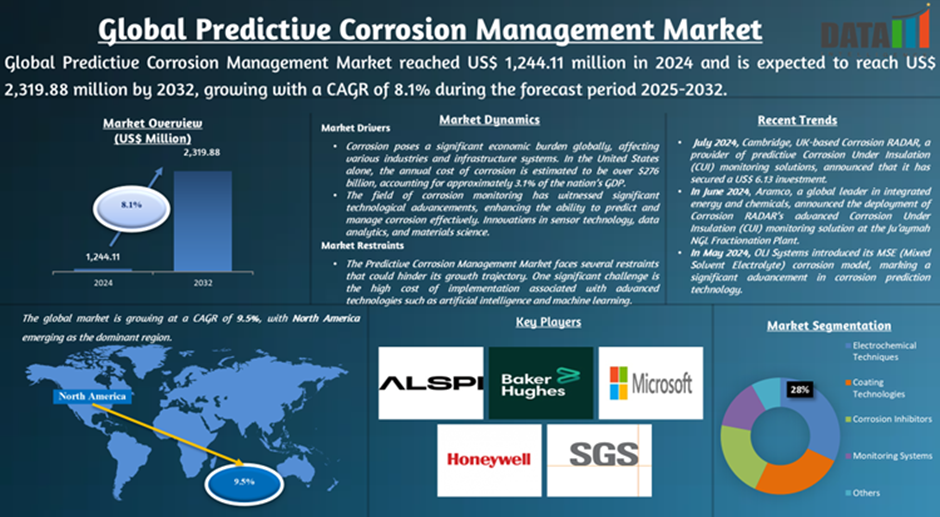
Global Predictive Corrosion Management Market reached US$ 1,344.90 million in 2025 and is expected to reach US$ 2,513.00 million by 2033, growing with a CAGR of 8.1% during the forecast period 2026-2033.
The global predictive corrosion management market is witnessing substantial growth, propelled by the increasing need to maintain infrastructure integrity and minimize economic losses due to corrosion. Industries such as aerospace, oil and gas and transportation are increasingly adopting predictive analytics to proactively manage corrosion, thereby enhancing safety and reducing maintenance costs.
The adoption of Internet of Things (IoT) devices and Artificial Intelligence (AI) algorithms in corrosion monitoring systems is revolutionizing predictive maintenance strategies. These technologies enable real-time data collection and analysis, allowing for early detection of corrosion and timely intervention, thereby reducing downtime and maintenance costs. Industries are increasingly focusing on sustainable practices and adhering to stringent environmental regulations.
Asia-Pacific is experiencing rapid growth in the predictive corrosion management market, driven by accelerated industrialization and infrastructure development. Countries such as China and India are investing heavily in infrastructure projects, leading to a heightened demand for effective corrosion management solutions. Predictive corrosion management aids in preventing leaks and spills caused by corrosion, thereby mitigating environmental hazards and ensuring compliance with regulatory standards. The adoption of advanced technologies in manufacturing and construction sectors further propels the market in this region.
Executive Summary
For more details on this report – Request for Sample
Predictive Corrosion Management Market Scope
| Metrics | Details |
| CAGR | 8.1% |
| Size Available for Years | 2025-2033 |
| Forecast Period | 2026-2033 |
| Data Availability | Value (US$) |
| Segments Covered | Technology, Deployment Mode, Application, End-User and Region |
| Regions Covered | North America, Europe, Asia-Pacific, South America and Middle East & Africa |
| Fastest Growing Region | Asia-Pacific |
| Largest Region | North America |
| Report Insights Covered | Competitive Landscape Analysis, Company Profile Analysis, Market Size, Share, Growth, Demand, Recent Developments, Mergers and Acquisitions, New Product Launches, Growth Strategies, Revenue Analysis, Porter’s Analysis, Pricing Analysis, Regulatory Analysis, Supply-Chain Analysis and Other key Insights. |
Predictive Corrosion Management Market Dynamics
Increasing Economic Impact of Corrosion
Corrosion poses a significant economic burden globally, affecting various industries and infrastructure systems. In US alone, the annual cost of corrosion is estimated to be over US$ 276 billion, accounting for approximately 3.1% of the nation's Gross Domestic Product (GDP). This substantial financial impact underscores the critical need for effective corrosion management strategies. Industries such as transportation, utilities and infrastructure are particularly vulnerable, with corrosion leading to increased maintenance costs, operational downtime and, in severe cases, catastrophic failures.
Predictive corrosion management offers a proactive approach to mitigate these economic losses. By utilizing advanced monitoring technologies and data analytics organizations can anticipate corrosion-related issues before they escalate, allowing for timely maintenance and repairs. This not only extends the lifespan of assets but also reduces the overall cost associated with corrosion damage. For instance, in the transportation sector, corrosion of metallic structures significantly impacts the economy, including infrastructure and utilities.
Advancements in Corrosion Monitoring Technologies
The field of corrosion monitoring has witnessed significant technological advancements, enhancing the ability to predict and manage corrosion effectively. Innovations in sensor technology, data analytics and materials science have collectively contributed to the development of more accurate and reliable predictive corrosion management systems. One notable advancement is the integration of Internet of Things (IoT) devices into corrosion monitoring frameworks. IoT-enabled sensors can continuously collect real-time data on environmental conditions, material degradation and structural integrity.
The adoption of these advanced technologies is further supported by industry standards and guidelines. Organizations such as the National Association of Corrosion Engineers (NACE) provide frameworks and best practices for integrating corrosion management elements into organizational systems, promoting the use of advanced monitoring and predictive techniques. In summary, advancements in corrosion monitoring technologies are a significant driver for the predictive corrosion management sector.
High Energy Consumption and Environmental Concerns
The Predictive Corrosion Management Market faces several restraints that could hinder its growth trajectory. One significant challenge is the high cost of implementation associated with advanced technologies such as artificial intelligence and machine learning. Many organizations, particularly smaller firms, may find it difficult to allocate sufficient budgets for these sophisticated systems, which can limit market penetration and adoption rates. Additionally, the initial investment in hardware and software solutions can be a barrier for companies operating on tight budgets.
Another restraint is the shortage of skilled labor in the field of predictive maintenance and corrosion management. The integration of complex technologies requires a workforce that is well-versed in data analytics and corrosion science. As companies struggle to find qualified personnel, they may experience delays in implementing effective predictive strategies, ultimately impacting operational efficiency and increasing costs.
Predictive Corrosion Management Market Segmentation Analysis
The global predictive corrosion management market is segmented based on technology, deployment mode, application, end-user and region.
Critical Need to ensure the Safety, Reliability and Longevity of Aircraft Structures
Predictive Corrosion Management Market specifically within the Aerospace sector experienced a modest but consistent increase between 2022 and 2023. Valued at $0.34 billion in 2022, this segment grew to $0.35 billion in 2023.
Aircraft are exposed to various environmental factors that contribute to corrosion, including humidity, temperature fluctuations and exposure to saltwater in coastal regions. The use of lightweight materials, such as aluminum alloys, while beneficial for performance, also increases susceptibility to corrosion. The aerospace industry in North America, led by companies like Boeing and Lockheed Martin, is heavily investing in predictive corrosion monitoring to enhance aircraft longevity and safety.
The FAA's Aircraft Maintenance Manual specifies rigorous corrosion inspections and maintenance requirements. Predictive corrosion management helps reduce aircraft maintenance costs by 15-20%, as reported by the U.S. Department of Defense (DoD). The National Aeronautics and Space Administration (NASA) has been at the forefront of developing corrosion control strategies for aerospace applications. NASA's Corrosion Technology Laboratory focuses on understanding corrosion mechanisms and developing predictive models to enhance the durability of aerospace materials.
In commercial aviation, airlines are adopting predictive maintenance programs that incorporate corrosion monitoring to optimize maintenance schedules and reduce operational disruptions. For example, Delta Air Lines has implemented an advanced predictive maintenance system that monitors various aircraft systems, including structural components susceptible to corrosion. This system analyzes data from sensors and maintenance records to predict potential issues, allowing for proactive maintenance and reducing unscheduled downtime.
Predictive Corrosion Management Market Geographical Share
Advanced Industrial Infrastructure of North America Drives the demand of Predictive Corrosion
Predictive Corrosion Management Market in North America experienced steady growth between 2022 and 2023, increasing from a valuation of $0.37 billion to $0.39 billion.
North America dominates the predictive corrosion management market due to its advanced industrial infrastructure, high adoption of predictive maintenance technologies and stringent regulatory frameworks. The region is home to key industries such as aerospace, oil and gas and automotive, all of which are highly vulnerable to corrosion-related issues. According to the National Association of Corrosion Engineers (NACE), the annual cost of corrosion in the U.S. alone exceeds US$ 276 billion, representing 3.1% of the country's GDP. This substantial economic burden drives the widespread adoption of predictive corrosion management solutions.
Furthermore, North America is at the forefront of technological innovations in predictive maintenance. The integration of Artificial Intelligence (AI), Machine Learning (ML) and Internet of Things (IoT) into corrosion management systems allows industries to detect early signs of material degradation and take preventive actions. According to the National Institute of Standards and Technology (NIST), AI-powered predictive maintenance can reduce unexpected equipment failures by up to 75%, translating to billions of dollars in cost savings annually.
Predictive Corrosion Management Market Major Players
The major global players in the market include Baker Hughes, WebCorr Corrosion Consulting Services, Microsoft, Honeywell International Inc., SMARTCORR, Cosasco, Alabama Specialty Products, SGS SA, ICORR Technologies and Permasense Emerson.
Sustainable Analysis
Predictive corrosion management plays a crucial role in promoting sustainability by reducing material waste, minimizing hazardous emissions and extending asset lifespans. Corrosion leads to premature degradation of infrastructure, resulting in massive amounts of metal waste. According to the U.S. Environmental Protection Agency (EPA), approximately 60 million tons of metal waste is generated annually due to corroded infrastructure. Predictive corrosion management extends the lifespan of industrial assets, reducing the need for frequent replacements and minimizing material consumption.
Traditional corrosion management practices involve frequent repairs, replacements and production of new materials, all of which contribute to increased carbon emissions. The World Resources Institute (WRI) highlights that steel production (a key material affected by corrosion) accounts for 7-9% of global CO₂ emissions. By proactively preventing corrosion, industries can reduce the demand for new steel production, thereby lowering their carbon footprint.
Impact of Artificial Intelligence (AI) and Internet of Things (IoT)
Artificial Intelligence (AI) and the Internet of Things (IoT) are revolutionizing corrosion management by enabling real-time monitoring and predictive analytics. In Schleswig-Holstein, Germany, the CHAI research project is leveraging AI and IoT to enhance corrosion detection in ports and waterways. With a US$ 81378638.98 investment from the federal state and leadership from the Helmholtz Center Hereon, the project integrates sensor technology and machine learning algorithms to monitor environmental conditions such as temperature, water composition and solar radiation. This data allows AI to analyze and predict corrosion patterns more accurately, reducing the reliance on costly manual inspections and enabling proactive maintenance strategies.
By training AI models on collected sensor data, researchers predict the severity and speed of corrosion under various conditions, optimizing preventative measures for maritime infrastructure. The involvement of Christian Albrechts Universität zu Kiel (CAU), the Port of Kiel and AC Korro-Service GmbH ensures that this technology transition benefits both scientific research and industrial applications. As the AI continues to learn from expanding datasets, its predictions will become increasingly precise, allowing organizations like the Port of Kiel to implement automated maintenance strategies.
Key Developments in Predictive Corrosion Management Market
- On May 2026: Emerson & Aramco - Announced a strategic R&D collaboration to co-develop next-generation corrosion management solutions using advanced ultrasonic online corrosion monitoring, wireless wall-thickness monitoring, and real-time data analytics. The initiative is designed to enable continuous, predictive corrosion monitoring and improve asset-integrity decision-making.
- On March 10, 2026, Baker Hughes Company announced the expansion of its AI-enabled corrosion prediction platform for oil & gas pipelines and offshore assets. The upgraded system integrates real-time sensor data, digital twins, and machine learning models to forecast corrosion risks with higher accuracy, reducing unplanned shutdowns and maintenance costs.
- On December 5, 2025, Siemens AG launched an enhanced version of its industrial asset integrity management suite, incorporating predictive corrosion analytics for chemical plants and power generation facilities. The solution uses IIoT-enabled monitoring and cloud-based analytics to detect early-stage material degradation.
- On September 18, 2025, Schneider Electric SE introduced a new EcoStruxure-based predictive maintenance module designed to improve corrosion monitoring in industrial infrastructure. The platform leverages edge computing and AI-driven anomaly detection to enhance asset lifespan in harsh environments.
- On July 2, 2025, Honeywell International Inc. announced the deployment of its Forge Predictive Corrosion Intelligence System, targeting refineries and petrochemical plants. The system integrates corrosion loop modeling with predictive analytics to improve safety compliance and reduce inspection costs.
- On April 15, 2025, Emerson Electric Co. expanded its Plantweb digital ecosystem with advanced corrosion monitoring capabilities, enabling continuous tracking of pipeline integrity and equipment degradation using AI-driven sensors and predictive diagnostics.
- On January 20, 2025, ABB Ltd strengthened its asset performance management (APM) solutions with new corrosion prediction algorithms for heavy industries. The update focuses on integrating robotics inspection data with predictive analytics to enhance maintenance planning and operational efficiency.
Why Choose DataM?
Technological Innovations: Explores advancements in predictive corrosion management, including ultrasonic wall-thickness sensors, IoT-enabled corrosion monitoring, real-time condition monitoring, advanced analytics, machine learning-based corrosion forecasting, corrosion-rate prediction, and AI-driven risk assessment. These technologies enable continuous asset monitoring, earlier identification of corrosion and erosion, improved integrity management, and more proactive maintenance decisions across pipelines, tanks, vessels, refineries, petrochemical facilities, power plants, and other industrial assets.
Product Performance & Market Positioning: Evaluates predictive corrosion management solutions based on sensor accuracy, monitoring frequency, wall-thickness measurement, corrosion-rate analysis, predictive analytics, data visualization, alert capabilities, asset coverage, environmental suitability, and integration with asset integrity and risk-based inspection programs. The analysis highlights how solution providers differentiate through continuous monitoring, advanced analytics, engineering-based models, and actionable corrosion-risk insights.
Real-World Evidence: Highlights the deployment of predictive corrosion management technologies across upstream and downstream oil & gas, pipelines, refineries, petrochemical facilities, power generation, chemical processing, storage tanks, and other corrosion-sensitive industrial assets. Real-world applications demonstrate the use of continuous sensor data, wall-thickness measurements, corrosion forecasting, and analytics to support asset integrity, maintenance planning, personnel safety, and reduced inspection requirements.
Market Updates & Industry Changes: Tracks developments in AI-enabled corrosion prediction, IoT-based monitoring, ultrasonic sensing, corrosion modelling, digital asset integrity management, and predictive analytics. It also covers strategic collaborations, technology deployments, new software capabilities, and the increasing integration of real-time operational data with corrosion engineering and risk-based inspection practices across major industrial markets.
Competitive Strategies: Analyzes how leading companies strengthen their position through sensor and software innovation, AI/ML-based corrosion prediction, strategic partnerships, engineering expertise, asset integrity services, digital monitoring platforms, and integration of inspection and operational data. Competitive positioning also reflects the ability to provide predictive insights across different corrosion mechanisms, assets, operating environments, and industrial applications.
Pricing & Market Access: Explains pricing considerations across sensor hardware, software platforms, monitoring frequency, number of monitored assets, installation requirements, analytics capabilities, data integration, engineering services, and ongoing support. It also examines market access through industrial technology providers, corrosion monitoring specialists, inspection and asset integrity companies, engineering firms, and technology partnerships supporting deployment across industrial facilities.
Market Entry & Expansion: Identifies opportunities arising from increasing requirements for asset integrity, continuous condition monitoring, predictive maintenance, digitalization of industrial operations, and improved management of corrosion-related risks. Expansion strategies include AI-driven predictive analytics, integration with existing inspection and integrity-management programs, deployment of wireless and permanent sensors, engineering-led corrosion modelling, and partnerships that broaden access to industrial and energy-sector customers.
The global predictive corrosion management market report would provide approximately 70 tables, 70 figures and 204 pages.
Target Audience
- Oil & Gas Companies & Refinery Operators
- Pipeline Operators & Asset Owners
- Petrochemical & Chemical Processing Companies
- Power Generation Companies
- Corrosion Monitoring & Inspection Companies
- Asset Integrity Management Solution Providers
- Industrial IoT & Sensor Technology Providers





























































