


Market Size
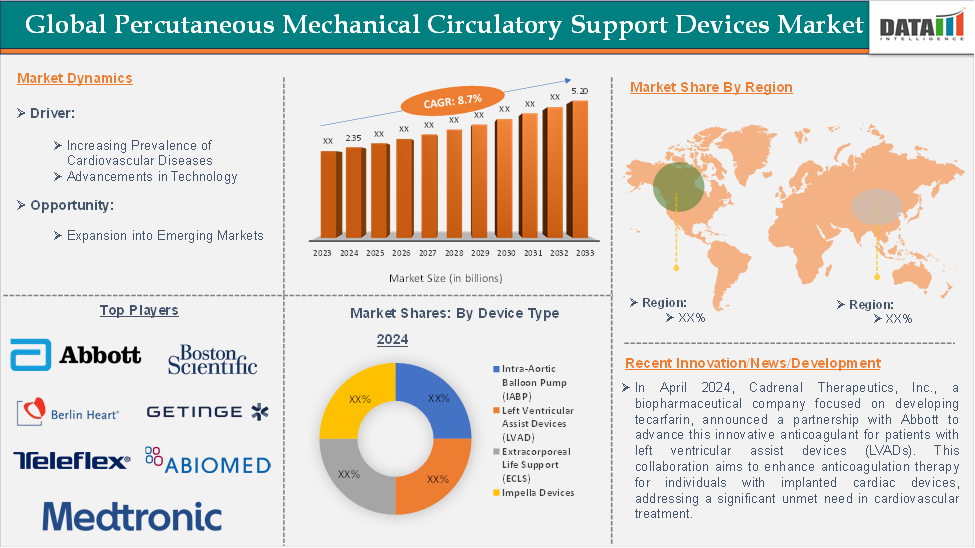
The global percutaneous mechanical circulatory support devices market reached US$ 2.55 billion in 2025 and is expected to reach US$ 5.20 billion by 2033, growing at a CAGR of 8.7% during the forecast period of 2026-2033.
Percutaneous mechanical circulatory support devices are advanced medical tools created to offer temporary support to patients suffering from severe heart failure or cardiogenic shock. These devices are essential for stabilizing hemodynamic status and maintaining sufficient blood flow to critical organs until more permanent treatment options can be applied.
These devices boost the heart's capacity to pump blood efficiently, which is vital for patients with weakened cardiac function. By providing support to the heart, these devices help reduce the pressure in the heart's chambers, thereby relieving stress on the heart.
Executive Summary
Market Dynamics: Drivers & Restraints
Increasing Prevalence of Cardiovascular Diseases
Cardiovascular diseases (CVDs) are a major global health concern, ranking among the primary contributors to illness and death worldwide. The incidence of acute myocardial infarction (heart attacks) and chronic heart failure is on the rise, fueled by an aging population, sedentary lifestyles, unhealthy dietary patterns, and the growing prevalence of obesity and diabetes. The rising prevalence of heart-related issues, including acute myocardial infarction and chronic heart failure, is driving healthcare providers to utilize percutaneous mechanical circulatory support (pMCS) devices to improve patient outcomes during critical medical procedures.
According to a study published in the American Heart Association's journal Circulation in June 2024, the number of adults affected by cardiovascular disease (CVD) and stroke is projected to rise significantly over the next three decades. The researchers estimate that by 2050, clinical CVD will impact 45 million adults, while the total number of individuals affected by CVD, including hypertension, will exceed 184 million, accounting for over 61% of the adult population. All these factors demand the global percutaneous mechanical circulatory support devices market.
Product Recalls
Product recalls represent a significant restraint in the global percutaneous mechanical circulatory support (pMCS) devices market, directly impacting the reliability and reputation of key players in the industry. These devices, which include ventricular assist devices, intra-aortic balloon pumps, and extracorporeal support systems, are crucial for patients suffering from acute cardiac failure.
Getinge has faced multiple recalls for its circulatory support devices, notably the Cardiosave Intra-Aortic Balloon Pump and the Cardiohelp System. Between January 2023 and April 2024, the FDA reported 12 voluntary recalls for the Cardiosave pump, with eight classified as Class I, the most serious type. These recalls were due to device malfunctions linked to serious injuries and deaths.
Also, in July 2023, Abiomed issued an urgent medical device correction for its Impella 2.5 intravascular micro axial blood pump due to risks of impeller blade destruction in patients with certain heart valve replacements, which could lead to low blood flow and embolization. Thus, the above factors could be limiting the global percutaneous mechanical circulatory support devices market's potential growth.
For more details on this report, Request for Sample
Segment Analysis
The global percutaneous mechanical circulatory support devices market is segmented based on device type, application, end-user, and region.
Device Type:
The impella devices segment in device type is expected to dominate the global percutaneous mechanical circulatory support devices market with the highest market share
Impella devices are compact ventricular assist devices inserted through the femoral artery and positioned in the left ventricle. They pump blood from the left ventricle into the ascending aorta, maintaining systemic perfusion at rates ranging from 2.5 to 5.0 liters per minute. This mechanism helps to offload the left ventricle and rapidly increases overall cardiac output. By providing immediate hemodynamic support, Impella devices reduce the workload on the left ventricle while augmenting blood flow to the body's vital organs.
Moreover, major players in the industry have innovative product launches & approvals, and key developments in circulatory support devices help to drive this segment growth in the market. For instance, in September 2022, the U.S. Food and Drug Administration (FDA) granted two approvals concerning the clinical research of Abiomed’s Impella heart pumps. The FDA has authorized the on-label RECOVER IV randomized controlled trial (RCT) to evaluate the use of Impella heart pumps in patients experiencing acute myocardial infarction (AMI) with cardiogenic shock. Abiomed has indicated that the two-arm study protocol has received FDA approval to utilize the Exception from Informed Consent (EFIC) pathway for enrolling participants.
Also, in April 2022, Abiomed announced the first successful implants of its Impella Bridge-to-Recovery (BTR) device as part of an early feasibility study. The Impella BTR is a forward-flow heart pump that is implanted through the axillary artery and positioned in the left ventricle. Designed to pump over six liters of blood per minute, this device is less invasive than traditional left ventricular assist devices (LVADs) and offers patients with chronic heart failure a longer-term, minimally invasive option for heart support. These factors have solidified the segment's position in the global percutaneous mechanical circulatory support devices market.
Geographical Analysis
North America is expected to hold a significant position in the global percutaneous mechanical circulatory support devices market with the highest market share
The rising elderly population in the U.S. is a significant factor in the increasing prevalence of cardiovascular diseases. Older individuals are more vulnerable to heart-related issues, leading to heightened demand for advanced treatment solutions such as percutaneous mechanical circulatory support (pMCS) devices.
According to projections from the U.S. Census Bureau in January 2024, the number of Americans aged 100 and older is expected to more than quadruple over the next three decades, rising from an estimated 101,000 in 2024 to approximately 422,000 by 2054Currently, centenarians represent just 0.03% of the total U.S. population, but this figure is anticipated to increase to 0.1% by 2054.
The growing number of individuals diagnosed with cardiovascular diseases, particularly heart failure and acute myocardial infarction, is a key factor driving the demand for percutaneous mechanical circulatory support (pMCS) devices in the U.S. As more patients necessitate interventions for severe cardiac conditions, the requirement for efficient mechanical support technologies becomes increasingly crucial.
Moreover, a major number of key players are present, financial investments in mechanical circulatory support devices, well-advanced healthcare infrastructure, and innovative product launches are driving this market growth. For instance, in July 2024, Magenta Medical, an Israeli company, secured $105 million to advance trials for its Elevate device, touted as the world's smallest heart pump. The company is preparing for pivotal trials in the United States as it seeks FDA approval for its use in mechanical circulatory support applications.
Also, in May 2024, the HeartMate 3 is an advanced left ventricular assist device (LVAD) developed by Abbott for patients with severe heart failure. Thus, the above factors are consolidating the region's position as a dominant force in the global market for percutaneous mechanical circulatory support devices.
Competitive Landscape
The major global players in the percutaneous mechanical circulatory support devices market include Abbott, Berlin Heart, Medtronic, Teleflex Incorporated, Getinge, ABIOMED, Boston Scientific Corporation, LivaNova, Inc., EUROSETS, and Evaheart, Inc., among others.
Key Developments
April 2026: Abiomed expanded adoption of its percutaneous mechanical circulatory support devices across North America and Europe, supporting the treatment of cardiogenic shock and high-risk percutaneous coronary interventions.
March 2026: Medtronic strengthened its cardiovascular support portfolio through investments in advanced circulatory support technologies and minimally invasive cardiac care solutions for critically ill patients.
February 2026: Getinge enhanced its extracorporeal life support and mechanical circulatory support offerings with advanced monitoring and patient management capabilities, improving outcomes in acute cardiac care settings.
January 2026: Japan accelerated investments in advanced cardiac care infrastructure and minimally invasive circulatory support technologies, supporting increased adoption of mechanical circulatory support devices in tertiary healthcare centers.
December 2025: LivaNova expanded research and development activities focused on next-generation circulatory support technologies for severe heart failure and cardiogenic shock management.
November 2025: The United States increased investments in cardiovascular disease treatment programs and critical care infrastructure, supporting growing utilization of percutaneous mechanical circulatory support devices in hospitals and cardiac centers.
October 2025: Abbott introduced advancements in catheter-based cardiovascular technologies and hemodynamic support solutions, strengthening its position in the interventional cardiology market.
September 2025: India accelerated expansion of advanced cardiac care facilities and investments in interventional cardiology technologies across major metropolitan healthcare institutions, supporting broader access to life-saving circulatory support therapies.
July 2025: Terumo Corporation expanded production and commercialization of cardiovascular support systems across Asia Pacific and European markets, addressing increasing demand for minimally invasive cardiac treatment solutions.
May 2025: Europe strengthened adoption of advanced circulatory support technologies across Germany, France, and the United Kingdom, supported by increasing prevalence of cardiovascular diseases and growing investments in critical care infrastructure.
March 2025: Teleflex Incorporated enhanced its interventional cardiology and vascular access product portfolio through innovations supporting complex cardiovascular procedures and acute cardiac care applications.
January 2025: China strengthened investments in cardiovascular healthcare infrastructure and advanced cardiac intervention technologies across major healthcare institutions, supporting increased adoption of mechanical circulatory support devices and critical care solutions.
| Metrics | Details | |
| CAGR | 8.7% | |
| Market Size Available for Years | 2023-2033 | |
| Estimation Forecast Period | 2026-2033 | |
| Revenue Units | Value (US$ Bn) | |
| Segments Covered | Device Type | Intra-Aortic Balloon Pump (IABP), Left Ventricular Assist Devices (LVAD), Extracorporeal Life Support (ECLS), Impella Devices |
| Application | Cardiogenic Shock, High-Risk Percutaneous Coronary Interventions (PCI), Cardiac Arrest | |
| End-User | Hospitals, Specialty Cardiology Centers, Ambulatory Surgical Center, Others | |
| Regions Covered | North America, Europe, Asia-Pacific, South America, and the Middle East & Africa | |
Why Purchase the Report?
- Pipeline & Innovations: Reviews ongoing clinical trials and product pipelines and forecasts upcoming advancements in medical devices and pharmaceuticals.
- Product Performance & Market Positioning: Analyzed product performance, market positioning, and growth potential to optimize strategies.
- Real-World Evidence: Integrates patient feedback and data into product development for improved outcomes.
- Physician Preferences & Health System Impact: Examines healthcare provider behaviors and the impact of health system mergers on adoption strategies.
- Market Updates & Industry Changes: This covers recent regulatory changes, new policies, and emerging technologies.
- Competitive Strategies: Analyze competitor strategies, market share, and emerging players.
- Pricing & Market Access: Reviews pricing models, reimbursement trends, and market access strategies.
- Market Entry & Expansion: Identifies optimal strategies for entering new markets and partnerships.
- Regional Growth & Investment: Highlights high-growth regions and investment opportunities.
- Supply Chain Optimization: Assesses supply chain risks and distribution strategies for efficient product delivery.
- Sustainability & Regulatory Impact: Focuses on eco-friendly practices and evolving regulations in healthcare.
- Post-market Surveillance: Uses post-market data to enhance product safety and access.
- Pharmacoeconomics & Value-Based Pricing: Analyzes the shift to value-based pricing and data-driven decision-making in R&D.
The global percutaneous mechanical circulatory support devices market report delivers a detailed analysis with 62 key tables, more than 54 visually impactful figures, and 176 pages of expert insights, providing a complete view of the market landscape.
Target Audience
- Manufacturers: Pharmaceutical, Medical Device, Biotech Companies, Contract Manufacturers, Distributors, Hospitals.
- Regulatory & Policy: Compliance Officers, Government, Health Economists, Market Access Specialists.
- Technology & Innovation: AI/Robotics Providers, R&D Professionals, Clinical Trial Managers, Pharmacovigilance Experts.
- Investors: Healthcare Investors, Venture Fund Investors, Pharma Marketing & Sales.
- Consulting & Advisory: Healthcare Consultants, Industry Associations, Analysts.
- Supply Chain: Distribution and Supply Chain Managers.
- Consumers & Advocacy: Patients, Advocacy Groups, Insurance Companies.
- Academic & Research: Academic Institutions.
Suggestions for Related Report
- Global Cardiovascular Devices Market
- Global Interventional Cardiology Market
- Global Cardiac Surgery Devices Market
For more medical device-related reports, please click here




























































