


Global Pediatric Orthopedic Immobilization Market – Industry Trends & Outlook
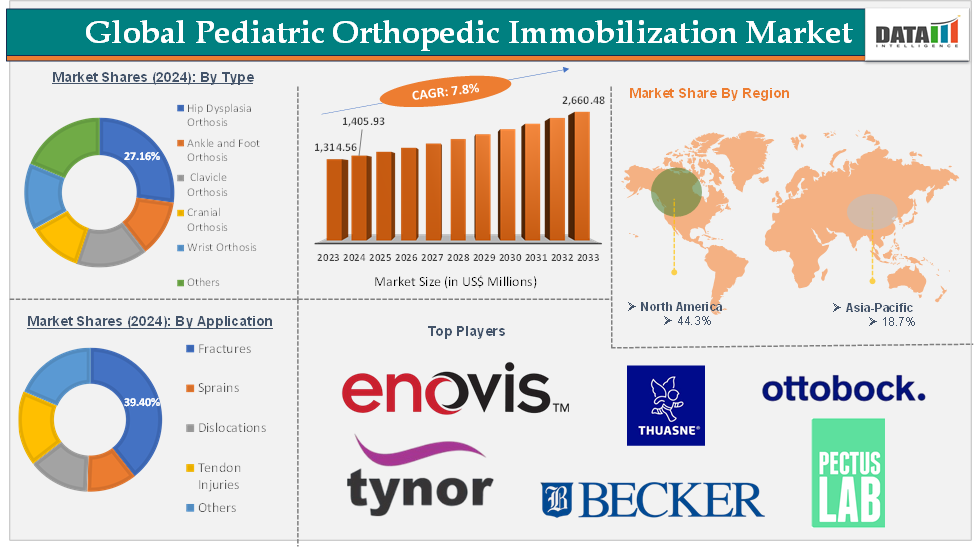
The global pediatric orthopedic immobilization market was valued at US$ 1,314.56 Million in 2023. The market size reached US$ 1,405.93 Million in 2024 and is expected to reach US$ 2,660.48 Million by 2033, growing at a CAGR of 7.8% during the forecast period 2025-2033.
The rising incidence of pediatric injuries and technological advancements are driving this market growth. Innovations in orthopedic devices are revolutionizing the treatment of pediatric orthopedic injuries by providing more effective and comfortable immobilization solutions. There is an increasing awareness among parents and healthcare professionals about the necessity of quickly addressing orthopedic injuries in children. Major players in the market are more focused on technological advances in pediatric orthopedic immobilization, which help drive this market growth.
Global Pediatric Orthopedic Immobilization Market – Executive Summary
Global Pediatric Orthopedic Immobilization Market Dynamics: Drivers
Increasing incidence of pediatric orthopedic injuries
The increasing incidence of pediatric orthopedic injuries is a significant driver for the growth of the pediatric orthopedic immobilization market. The prevalence of orthopedic injuries among children is on the rise, mirroring a global trend. Research indicates that these injuries frequently occur due to accidents, with falls being a primary cause.
A considerable number of injuries result from falls from heights and incidents that happen during play, both of which are common among active children. As the reported cases of such injuries increase, there is a growing need for effective immobilization solutions to facilitate proper healing and recovery.
As per the Journal of Musculoskeletal Surgery and Research publication in February 2022, the data shows that 76.9% of the patients were male, indicating that boys are disproportionately affected by these types of traumatic injuries. The majority of the patients (92.3%) were aged 12–18 years, with only 7.7% aged 6–12 years. This suggests that older children and adolescents are more frequently involved in incidents leading to severe injuries.
The demographic data on injured children indicates that males are significantly more affected, especially those in the 12 to 18 age range. This group tends to participate in more physical activities and exhibit risk-taking behaviors, which heightens their chances of experiencing orthopedic injuries. The prevalence of injuries within this demographic fuels the demand for specialized immobilization devices designed to meet the specific needs of adolescents. There is an increasing recognition among parents and healthcare professionals that the necessity of promptly addressing orthopedic injuries in children is driving this market in this country.
Global Pediatric Orthopedic Immobilization Market Dynamics: Restraints
High cost of advanced orthopedic devices
One of the major restraints facing the global pediatric orthopedic immobilization market is the high cost of advanced orthopedic devices. As technology in this field evolves, new devices are being developed with features such as lightweight, breathable materials, custom 3D-printed designs, and smart sensors to monitor healing. While these innovations greatly improve patient comfort and treatment outcomes, they also significantly increase the cost of these devices. This high price point makes advanced immobilization solutions less accessible, especially in low- and middle-income countries where healthcare budgets are limited and insurance coverage may not fully support such expenses.
Many hospitals and clinics in these regions continue to rely on traditional, less expensive options like plaster casts, which may not offer the same level of comfort or effectiveness. The cost barrier not only slows the adoption of new technologies but also widens the gap in healthcare quality between developed and developing regions, ultimately restricting the overall growth of the pediatric orthopedic immobilization market.
Global Automated Ophthalmic Perimeters Market Dynamics: Opportunities
Demand for customized orthopedic solutions
The growing demand for customized orthopedic solutions presents a significant opportunity for the global pediatric orthopedic immobilization market. Customization allows immobilization devices such as casts, splints, and braces to be tailored to the unique anatomical and therapeutic needs of each child, which enhances comfort, improves compliance, and leads to better clinical outcomes.
Recent advances, including 3D printing and the use of lightweight, breathable materials, enable the creation of patient-specific devices that fit more precisely and are less restrictive, reducing complications like skin irritation and increasing patient satisfaction. As awareness of the benefits of customized care grows among parents and healthcare providers, and as technology becomes more accessible, the segment of personalized and adjustable immobilization devices is expected to dominate the market.
Companies that invest in research and development to deliver innovative, customized solutions are likely to gain a competitive advantage and capture a larger share of this expanding market. Furthermore, the adoption of smart technologies such as sensors for real-time monitoring can further differentiate products and improve outcomes, making customization a key driver of future growth in pediatric orthopedic immobilization.
For more details on this report, Request for Sample
Global Pediatric Orthopedic Immobilization Market - Segment Analysis
The global pediatric orthopedic immobilization market is segmented based on type, injury type, material, application, end-user, and region.
Type:
The hip dysplasia orthosis type segment in the pediatric orthopedic immobilization market was valued at US$ 382.41 Million in 2024
Hip dysplasia is among the most prevalent orthopedic conditions affecting infants and young children. Timely detection and intervention are essential to avoid complications like hip dislocation, which can result in pain and reduced mobility in the future. Growing awareness of this condition among healthcare professionals and parents has resulted in an increased demand for effective treatment solutions, including orthotic devices.
Hip dysplasia orthoses, particularly the Pavlik harness, play a crucial role in the non-surgical management of developmental dysplasia of the hip (DDH) by maintaining the hip joint in a stable position. These devices are essential for promoting proper development and alignment of the hip joint, especially in infants diagnosed with DDH at an early stage. Untreated developmental dysplasia of the hip (DDH) can lead to severe complications, particularly hip dislocation. The incidence of congenital hip dislocation, which is the most severe form of DDH, ranges between 0.1% and 0.2% of the population.
If a child with congenital hip dislocation is not properly treated, they are likely to experience substantial physical impairment during adulthood. This is because untreated DDH leads to a sequence of anatomical alterations that change the joint biomechanics, increasing tension on a reduced-contact articular surface. The maintenance of increased articular pressures for lengthy periods promotes articular cartilage degradation and early osteoarthritis.
Key players are focusing more on the different types of hip dysplasia orthosis, such as abduction braces, custom orthoses, and others are helping to propel this segment's growth in the market. These factors have solidified the segment's position in the global pediatric orthopedic immobilization market.
Application:
The fractures application segment in the pediatric orthopedic immobilization market was valued at US$ 553.94 Million in 2024
The fractures application segment refers to the use of immobilization devices such as casts, splints, and braces for the treatment and management of bone fractures in children. Pediatric fractures can involve various bones, including the distal radius, tibia, fibula, femur, humerus, and others, and may result from trauma, falls, or direct impacts.
The fractures application segment plays a crucial role in the global pediatric orthopedic immobilization market due to its wide range of essential uses and strong market drivers. Immobilization is fundamental for fracture healing in children, as it restricts movement at the injury site, thereby preventing further damage and promoting proper bone repair. Devices like casts and splints are also vital for stabilizing the injured area, which helps reduce pain and minimizes the risk of the fracture shifting or causing nerve and blood vessel injuries.
Several factors are driving growth in this segment. The high incidence of fractures among children, attributable to their active lifestyles and developing bones, creates consistent demand for immobilization devices. Advances in materials, moving from traditional plaster to modern synthetic and eco-friendly options, have improved device strength, comfort, and overall patient outcomes.
Clinical guidelines universally recommend immobilization for most pediatric fractures, ensuring its continued necessity in medical practice. Greater awareness among healthcare providers and parents about the importance of proper immobilization has also fueled demand for specialized pediatric solutions. Furthermore, ongoing innovations focused on enhancing patient comfort and reducing complications, such as skin irritation or improper healing, are further propelling market growth.
Global Pediatric Orthopedic Immobilization Market – Geographical Analysis
The North America pediatric orthopedic immobilization market was valued at US$ 622.83 Million in 2024
The United States alone sees nearly 3.5 million children annually requiring orthopedic intervention due to injuries, fractures, and congenital deformities. This high prevalence creates sustained demand for immobilization products such as casts, splints, and braces. North America benefits from a highly developed healthcare system, which ensures access to specialized pediatric care and advanced medical technologies. The presence of dedicated pediatric orthopedic centers and well-trained healthcare professionals supports the widespread adoption of modern immobilization devices.
North American manufacturers and healthcare providers are at the forefront of developing and adopting advanced immobilization solutions, including lightweight, breathable materials, 3D-printed custom devices, and smart monitoring technologies. These innovations improve patient comfort, compliance, and clinical outcomes, further boosting market growth.
The presence of leading medical device companies and a robust regulatory environment ensures high standards for product quality and safety, encouraging market expansion. For instance, in December 2023, OSSIO received FDA clearance for its OSSIOfiber bio-integrative fixation technology to be used in orthopedic surgeries for children and adolescents with bone fractures, osteotomies, or fusions.
This clearance allows OSSIOfiber Compression Screws and Trimmable Fixation Nails to be used in pediatric patients aged 2 to 21 years in standard clinical practice. Thus, the above factors are consolidating the region's position as a dominant force in the global pediatric orthopedic immobilization market.
Asia-Pacific pediatric orthopedic immobilization market was valued at US$ 262.91 Million in 2024
The Asia-Pacific pediatric orthopedic immobilization market is experiencing rapid growth. The region’s large and growing population, especially the high proportion of children, naturally increases the incidence of pediatric injuries and musculoskeletal disorders that require immobilization devices. Rising disposable incomes across countries such as China, India, and Southeast Asia are enabling more families to access advanced healthcare services and products, including modern immobilization solutions.
Improvements in healthcare infrastructure, such as the expansion of hospitals, clinics, and specialized pediatric care centers, are making orthopedic treatments more widely available. There is also a growing awareness among parents and healthcare providers about the importance of early intervention and proper management of pediatric fractures and orthopedic conditions, which is boosting demand for effective immobilization devices.
Technological advancements are another major driver, with innovations like lightweight, breathable materials, 3D-printed custom casts, and adjustable braces improving patient comfort and compliance. Government initiatives to enhance pediatric healthcare, coupled with expanding insurance coverage in several countries, are further supporting market expansion.
Global Pediatric Orthopedic Immobilization Market – Competitive Landscape
The major global players in the pediatric orthopedic immobilization market include Enovis Corporation, Thuasne Group., Ottobock, TYNOR ORTHOTICS, Pectus Lab, Becker Orthopedic, Orthomerica Products, Inc., Boston Orthotics & Prosthetics, Allard USA Inc., and Fillauer LLC, among others.
Global Pediatric Orthopedic Immobilization Market – Key Developments
In December 2023, OrthoPediatrics Corp. launched a new division called OrthoPediatrics Specialty Bracing (OPSB), focused on non-surgical interventions for children with orthopedic conditions. This division acts as a "house of brands," bringing together innovative products designed to address the needs of pediatric patients who require bracing or orthotic solutions rather than surgery.
Global Pediatric Orthopedic Immobilization Market – Scope
Metrics | Details | |
CAGR | 7.8% | |
Market Size Available for Years | 2022-2033 | |
Estimation Forecast Period | 2025-2033 | |
Revenue Units | Value (US$ Mn) | |
Segments Covered | Type | Hip Dysplasia Orthosis, Ankle and Foot Orthosis, Clavicle Orthosis, Cranial Orthosis, Wrist Orthosis, Others |
Injury Type | Calcaneus, Pilon, Tibial Plateau, Subtrochanteric Femur, Scapula, Humeral Shaft, Metacarpal Fracture, Others | |
Material | Plaster of Paris, Fiberglass, Thermoplastics, Others | |
Application | Fractures, Sprains, Dislocations, Tendon Injuries, Others | |
End-User | Hospitals, Orthopedic Clinics, Rehabilitation Centers, Homecare Settings, Others | |
Regions Covered | North America, Europe, Asia-Pacific, South America, and the Middle East & Africa | |
DMI Insights:
According to DMI analysis, the global pediatric orthopedic immobilization market was valued at US$ 1,314.56 Million in 2023. The market size reached US$ 1,405.93 Million in 2024 and is expected to reach US$ 2,660.48 Million by 2033, growing at a CAGR of 7.8% during the forecast period 2025-2033.
The rising prevalence of pediatric injuries, fractures, and musculoskeletal disorders, often due to increased physical activity and sports participation among children, has created a strong demand for effective immobilization devices.
Technological advancements have played a crucial role, with innovations such as lightweight, breathable materials and 3D-printed, custom-fit casts greatly improving patient comfort and treatment outcomes. Growing awareness among parents and healthcare professionals about the importance of early intervention and proper management of orthopedic conditions is further boosting the adoption of advanced immobilization solutions. The market is expected to continue expanding, with North America and Europe maintaining significant shares due to their advanced healthcare systems, while the Asia-Pacific region is poised for the fastest growth.
The global pediatric orthopedic immobilization market report delivers a detailed analysis with 78 key tables, more than 85 visually impactful figures, and 173 pages of expert insights, providing a complete view of the market landscape.
Suggestions for Related Report
For more medical device-related reports, please click here




























































