


Operational Technology (OT) Security Market Size
Operational environments that once operated in isolation are now deeply connected to enterprise IT systems, cloud platforms, and remote monitoring networks. This convergence has significantly expanded the cyberattack surface across manufacturing plants, energy grids, transportation systems, and utilities, pushing Operational Technology (OT) security into a mission-critical category of industrial investment.
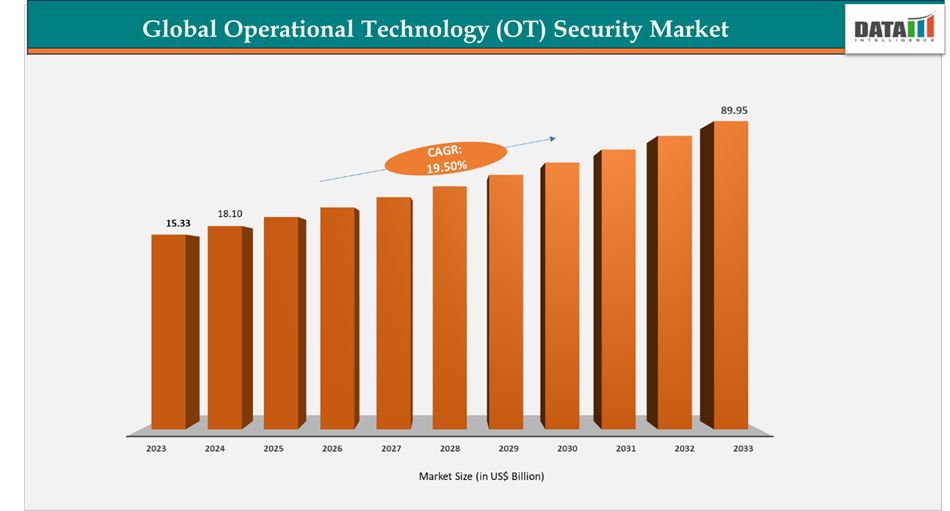
The Operational Technology (OT) Security Market will reach US$ 25.85 billion in 2026, up from US$ 21.63 billion in 2025, and is projected to reach US$ 128.43 billion by 2035, registering robust growth at a CAGR of 19.5% during the forecast period from 2026 to 2035.
Demand is being shaped by rapid Industry 4.0 deployment, smart factory expansion, and rising cyberattacks targeting industrial control systems (ICS) and supervisory control and data acquisition (SCADA) environments. For industrial operators and cybersecurity vendors, OT security is shifting from a compliance-driven expenditure to a core operational resilience strategy.
Investment timing is particularly strong as enterprises move from perimeter-based protection models toward continuous monitoring, zero-trust architectures, and AI-driven anomaly detection systems tailored for industrial environments.
Key Takeaways
- North America accounted for approximately 38-42% of the global OT Security Market share in 2025, driven by increasing investments in critical infrastructure protection, stringent cybersecurity regulations, and the widespread adoption of Industry 4.0 technologies across manufacturing, energy, and utilities sectors.
- The Manufacturing industry held nearly 28-32% of the total market share in 2025, making it the largest end-user segment owing to rapid smart factory deployments, increasing industrial automation, and rising cyberattacks targeting operational environments.
- Network Security solutions contributed approximately 30-35% of the global market revenue in 2025, supported by growing demand for industrial network segmentation, asset visibility, and real-time threat monitoring capabilities across OT infrastructures.
- Large enterprises represented approximately 65-70% of the total market demand in 2025, primarily due to higher cybersecurity spending, increasing regulatory compliance requirements, and substantial investments in securing critical industrial assets.
- Cloud-based OT security solutions accounted for nearly 35-40% of the market share in 2025 and are expected to witness significant growth during the forecast period due to increasing adoption of hybrid industrial environments and remote monitoring capabilities.
- Managed OT Security Services are projected to register a CAGR exceeding 18% during the forecast period, making them one of the fastest-growing segments as organizations increasingly outsource industrial cybersecurity management to address workforce shortages and evolving threat landscapes.
- More than 75% of industrial organizations globally are expected to implement Zero Trust security frameworks across their OT environments by 2030, significantly increasing investments in identity management, access controls, and continuous threat monitoring solutions.
- Industrial ransomware attacks accounted for approximately 40% of all reported cyber incidents targeting critical infrastructure sectors in 2025, accelerating investments in OT-specific cybersecurity technologies across manufacturing, utilities, transportation, and oil & gas industries.
- Asia-Pacific is projected to register the fastest market growth with an estimated CAGR of 17-19% through 2033, driven by increasing government investments in industrial modernization programs, expanding smart manufacturing initiatives, and growing cybersecurity awareness across emerging economies.
- Artificial Intelligence-enabled threat detection platforms are expected to capture approximately 20-25% of new OT security deployments by 2030, reflecting the increasing adoption of behavioral analytics, anomaly detection systems, and automated incident response capabilities across industrial environments.
Operational Technology (OT) Security Market Scope
| Metric | Details |
| Market Size (2025) | USD 21.63 billion |
| Market Size (2033) | US$ 128.43 billion |
| CAGR (2026-2033) | 19.50% |
| Historic Years | 2023-2024 |
| Base Year | 2025 |
| Forecast Period | 2026-2035 |
| Segments Covered | Solutions, Services |
| Deployment | On-Premises, Cloud-Based |
| Organization Size | Large Enterprises, SMEs |
| End-Users | Manufacturing, Energy & Utilities, Oil & Gas, Transportation, Government, Healthcare |
| Largest Region | North America |
| Fastest Growing Region | Asia-Pacific |
Operational Technology (OT) Security Market Dynamics
Expansion of IT-OT Convergence and Industrial Connectivity
The integration of IT systems with OT environments is fundamentally reshaping industrial cybersecurity requirements. Manufacturing execution systems, cloud-based analytics platforms, and remote operational tools are now directly connected to industrial control networks.
This convergence improves operational efficiency but significantly increases vulnerability to cyber intrusions. As a result, enterprises are prioritizing segmentation, access control, and real-time monitoring solutions designed specifically for industrial environments.
Rising Industrial Cyber Threat Landscape
OT environments are increasingly targeted by ransomware groups, state-sponsored attackers, and supply chain-based intrusion campaigns. Unlike traditional IT breaches, OT attacks can disrupt physical operations, damage equipment, and create safety risks.
Threat actors are focusing on SCADA systems, programmable logic controllers (PLCs), and industrial IoT endpoints due to their historical lack of built-in cybersecurity protections.
Zero-Trust Architecture Adoption in Industrial Networks
Zero-trust frameworks are becoming a foundational model for OT security deployment. Enterprises are shifting from perimeter-based defenses to continuous verification systems that authenticate users, devices, and machine communications.
This approach is particularly relevant for distributed industrial networks, where remote access and third-party vendor connectivity are common.
Legacy Infrastructure and Integration Barriers
A significant portion of industrial infrastructure still relies on legacy OT systems that were not designed for cybersecurity integration. These environments often lack encryption, authentication protocols, and real-time monitoring capabilities.
Upgrading these systems requires high capital investment and operational downtime, slowing adoption in sectors such as utilities, oil & gas, and transportation.
Regulatory and Compliance Pressure
Governments and regulatory bodies are tightening cybersecurity requirements for critical infrastructure operators. Frameworks such as industrial cybersecurity standards and national infrastructure protection programs are increasing compliance-driven OT security spending.
This is particularly evident in energy and government-controlled sectors, where auditability and operational resilience are becoming mandatory procurement criteria.
Operational Technology (OT) Security Market Trends & Insights
AI-Driven OT Threat Detection
Artificial intelligence is becoming an important component of OT security as industrial organizations seek faster identification of abnormal behavior, cyber threats and potential attacks. AI and behavioral analytics can help security teams distinguish normal industrial activity from suspicious changes across connected assets, networks and control environments. The adoption of AI-enabled monitoring is expected to increase as industrial environments generate larger volumes of security and operational data.
IT-OT Convergence
The increasing connection between enterprise IT systems and operational environments is expanding the industrial cybersecurity attack surface. Manufacturing execution systems, industrial IoT devices, cloud platforms, remote-access technologies and connected control systems are creating additional pathways that require continuous monitoring and protection.
Zero-Trust Security for Industrial Networks
Industrial organizations are increasingly moving from perimeter-based security toward continuous verification of users, devices and connections. Zero-trust architectures are particularly relevant to OT environments with remote workers, third-party vendors, distributed facilities and interconnected industrial assets.
Industrial Asset Visibility
Asset discovery and management is becoming a fundamental requirement because organizations cannot effectively secure industrial assets that they cannot identify or monitor. OT security platforms are increasingly incorporating asset inventory, device classification, vulnerability assessment and network visibility capabilities.
Cloud-Based OT Security
Cloud-based security solutions are gaining importance as organizations operate increasingly distributed industrial environments. Cloud platforms can support centralized monitoring, security analytics and management across multiple facilities, although critical industrial environments continue to maintain substantial on-premises infrastructure.
Protection of Legacy OT Infrastructure
Many industrial facilities continue to operate legacy PLCs, SCADA systems and other equipment that was designed before modern cybersecurity requirements became standard. Protecting these systems without interrupting production is creating demand for passive monitoring, network segmentation, compensating controls and specialized OT security technologies.
Managed OT Security Services
Industrial organizations face shortages of cybersecurity professionals with specialized OT knowledge. This is creating opportunities for managed security providers offering continuous monitoring, incident response, vulnerability management and threat detection for industrial environments.
Regulatory and Compliance Pressure
Increasing cybersecurity requirements for critical infrastructure are encouraging organizations to strengthen OT security programs. Compliance is increasingly being considered alongside operational continuity, cyber resilience and protection of safety-critical industrial assets.
Operational Technology (OT) Security Market Opportunities
Vendors focusing on AI-driven OT security platforms are gaining traction as enterprises seek predictive threat detection capabilities rather than reactive monitoring tools.
Managed security service providers are expanding in industrial cybersecurity due to talent shortages in OT-specific security expertise.
System integrators and automation vendors are also capturing value by embedding security directly into industrial control system deployments.
Emerging opportunities are concentrated in smart factory deployments, energy grid modernization, and transportation digitization programs, where security is now embedded at the design stage rather than added post-deployment.
Operational Technology (OT) Security Market Segmentation Analysis
Segmented by Offering (Solutions, Services), by Deployment (On-Premises, Cloud-Based), by Organization Size (Large Enterprises, SMEs), by End-User (Manufacturing, Energy & Utilities, Oil & Gas, Transportation, Government, Healthcare), and by Region - Market Share, Trends, and Forecast to 2033.
By Offering
The solutions segment dominates the market, driven by strong demand for network security, endpoint protection, IAM, encryption, and threat intelligence platforms tailored for industrial environments.
Services are gaining momentum as enterprises require consulting, integration, and managed security support to operationalize OT security frameworks across complex industrial networks.
Operational Technology (OT) Security Market Regional Analysis
Operational Technology (OT) Security Market North America
North America leads the global market due to strong cybersecurity infrastructure, regulatory enforcement, and early adoption of OT security frameworks. The United States is the primary growth engine, supported by government initiatives focused on critical infrastructure protection.
Industrial sectors such as energy, defense, and manufacturing are rapidly adopting zero-trust OT architectures and AI-based monitoring systems.
Operational Technology (OT) Security Market Asia-Pacific
Asia-Pacific is the fastest-growing region, driven by rapid industrialization and large-scale deployment of smart factories. Countries such as China, Japan, and South Korea are investing heavily in industrial cybersecurity to protect advanced manufacturing ecosystems.
Partnerships between automation vendors and cybersecurity providers are accelerating deployment across automotive, electronics, and energy sectors.
Operational Technology (OT) Security Market Europe
Europe is experiencing steady adoption driven by strict regulatory frameworks and increasing industrial digitization. Germany, France, and the UK are leading markets, particularly in manufacturing and energy infrastructure security.
Operational Technology (OT) Security Market Competitive Landscape and Vendor Strategy
The OT security ecosystem is dominated by global cybersecurity providers and industrial automation leaders.
Key companies include:
- Siemens
- Palo Alto Networks, Inc.
- Zscaler, Inc.
- Cisco Systems, Inc.
- Fortinet, Inc.
- SentinelOne
- Forcepoint
- Broadcom
- Qualys, Inc.
- Kyndryl Inc.
Market leaders are increasingly focusing on integrated OT security architectures that combine:
- AI-based threat detection and behavioral analytics
- Zero-trust network segmentation for industrial environments
- Secure access service edge (SASE) for distributed OT networks
- Deep industrial protocol inspection capabilities
- Cloud-managed security orchestration platforms
Competitive differentiation is shifting toward ecosystem integration, where cybersecurity vendors align with industrial automation providers to secure end-to-end production environments.
Operational Technology (OT) Security Market Recent Developments
- June 2026: Siemens AG strengthened its industrial OT cybersecurity capabilities by enhancing its Industrial Operations X portfolio with advanced threat detection, asset visibility, and secure industrial networking solutions for critical infrastructure and manufacturing environments.
- June 2026: Palo Alto Networks, Inc. expanded its OT security offerings through AI-driven threat prevention technologies and collaborative research focused on securing industrial control systems and critical infrastructure.
- May 2026: Zscaler, Inc. enhanced its Zero Trust security platform with new AI-powered capabilities that strengthen secure access and cloud-delivered protection for industrial and operational technology environments.
- May 2026: Fortinet, Inc. advanced its OT security portfolio by expanding industrial firewall, intrusion prevention, and real-time threat intelligence capabilities designed for converged IT/OT networks across manufacturing and energy sectors.
- April 2026: Cisco Systems, Inc. strengthened its industrial cybersecurity solutions through enhanced zero-trust network segmentation and secure connectivity technologies tailored for Industrial IoT and smart factory deployments.
- April 2026: Broadcom Inc. continued expanding its enterprise cybersecurity capabilities through investments in infrastructure software solutions that support secure hybrid cloud and industrial networking environments.
- March 2026: SentinelOne enhanced its AI-powered cybersecurity platform by strengthening autonomous threat detection and protection capabilities for OT endpoints and industrial workloads.
- March 2026: Kyndryl Inc. expanded its cybersecurity consulting and managed security services portfolio to help industrial organizations secure converged IT/OT infrastructures and accelerate digital transformation initiatives.
- February 2026: Qualys, Inc. strengthened its cyber risk management platform by expanding vulnerability management and asset discovery capabilities applicable to industrial and operational technology environments.
Why Choose DataM?
Technological Innovations: DataM evaluates advances in AI-driven threat detection, behavioral analytics, zero-trust architectures, industrial asset discovery, network segmentation, secure remote access, cloud-based security, industrial IoT protection, threat intelligence, vulnerability management, and OT-specific security platforms protecting ICS and SCADA environments.
Product Performance & Market Positioning: The report evaluates OT security solutions based on asset visibility, threat-detection capabilities, network monitoring, industrial protocol inspection, vulnerability management, identity and access control, endpoint protection, scalability, interoperability, deployment flexibility, incident-response capabilities, and operational continuity.
Real-World Evidence: DataM connects market developments with real-world applications across manufacturing plants, energy and utilities, oil and gas facilities, transportation networks, government infrastructure, healthcare facilities, and other industrial environments where cyber incidents can affect production, safety, service availability and operational continuity.
Market Updates & Industry Changes: The report tracks ransomware activity, IT-OT convergence, industrial IoT adoption, zero-trust implementation, AI-enabled security, cloud migration, critical-infrastructure protection, regulatory developments, cybersecurity investments, strategic partnerships, product launches, acquisitions, and managed-security-service adoption.
Competitive Strategies: DataM analyzes how leading cybersecurity and industrial technology companies strengthen their positions through AI-powered threat detection, industrial asset visibility, network segmentation, secure remote access, OT-specific platforms, strategic partnerships, acquisitions, system-integrator relationships, and expansion across critical infrastructure industries.
Pricing & Market Access: The report evaluates pricing and market access based on deployment model, number of protected assets, network size, security modules, monitoring requirements, software licensing, managed services, implementation complexity, integration requirements, support services, and total cost of ownership across industrial facilities and enterprise networks.
Market Entry & Expansion: DataM identifies opportunities created by industrial digitalization, smart factories, connected infrastructure, critical-infrastructure modernization, increasing ransomware exposure, regulatory requirements, cloud adoption, and the convergence of IT and OT environments. The report outlines expansion strategies involving technology partnerships, system integrators, industrial automation providers, managed security providers, local cybersecurity networks, and high-growth Asia-Pacific markets.
Target Audience
- OT Security & Cybersecurity Companies - For competitive positioning, technology trends and expansion opportunities.
- Industrial & Manufacturing Companies - For security investment, asset protection and technology adoption insights.
- Energy & Utilities Companies - For critical-infrastructure protection and regulatory intelligence.
- Oil & Gas & Transportation Companies - For OT risk management and cybersecurity planning.
- Investors & Financial Institutions - For market growth, emerging technologies and investment opportunities.
- Government & Critical Infrastructure Agencies - For cybersecurity strategy, resilience and regulatory planning.
- System Integrators & Consultants - For market-entry, partnerships and implementation opportunities.
Related Reports
- Industrial Cybersecurity Market
- Critical Infrastructure Protection Market
- Zero Trust Security Market
- Identity and Access Management (IAM) Market
- Network Security Market
The global operational technology (OT) security market report delivers a detailed analysis with 70 key tables, more than 63 visually impactful figures, and 195 pages of expert insights, providing a complete view of the market landscape.


























































