


Nanofilms Market Size
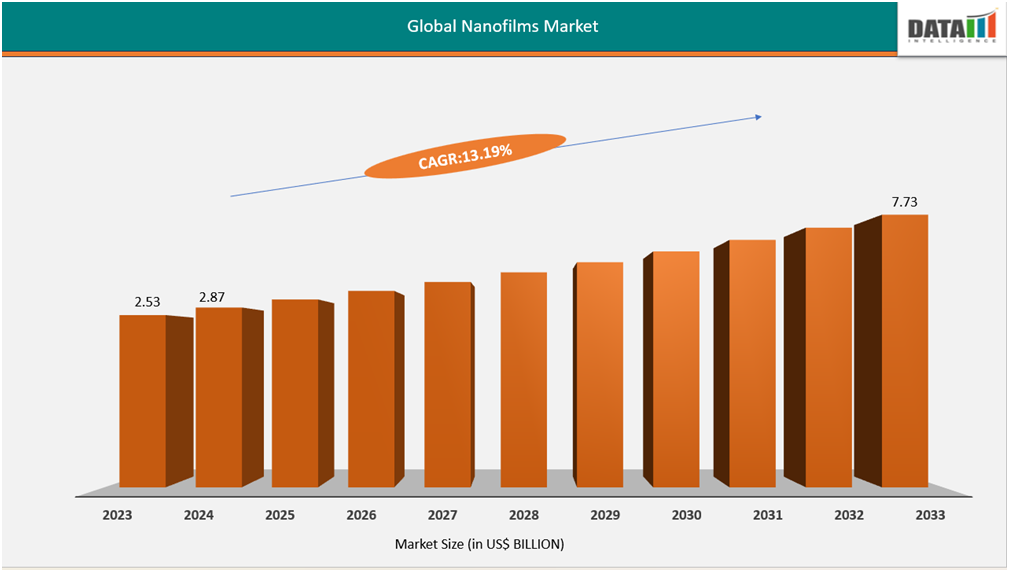
The Global Nanofilms Market reached US$ 3.25 billion in 2025 and is expected to reach US$ 8.75 billion in 2033, growing at a CAGR of 13.19% during the forecast period (2026–2033).
This growth is driven by rising demand across electronics, healthcare, and energy sectors, where nanofilms offer lightweight, durable, and high-performance solutions. Their role in miniaturized devices, medical diagnostics, and sustainable technologies continues to expand, making nanofilms a key enabler of next-generation innovation.
These ultra-thin coatings serve as protective layers resisting corrosion, minimizing surface damage, and filtering light with precision. In medical technology, both polymer-based and inorganic nanofilms are used to coat implants, helping reduce biofouling and improve biocompatibility. In solar panels, engineered oxide layers enhance light absorption and boost energy conversion efficiency. Meanwhile, in food packaging, antimicrobial nanofilm coatings help preserve freshness and extend shelf life, all while meeting safety and regulatory standards.
Global Nanofilms Industry Trends and Strategic Insights
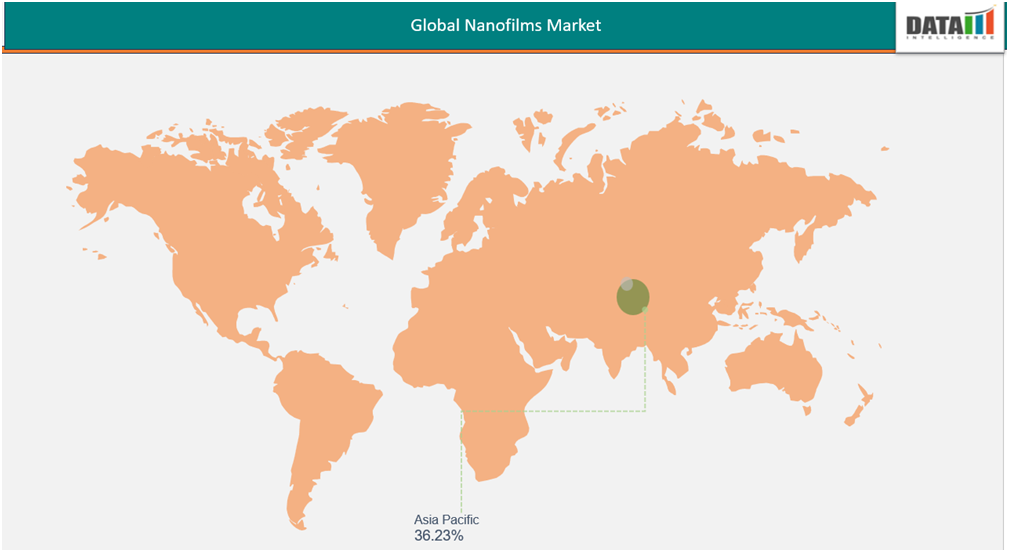
The Asia-Pacific region dominates the market in the market, capturing the largest revenue share of 36.23%in 2025.
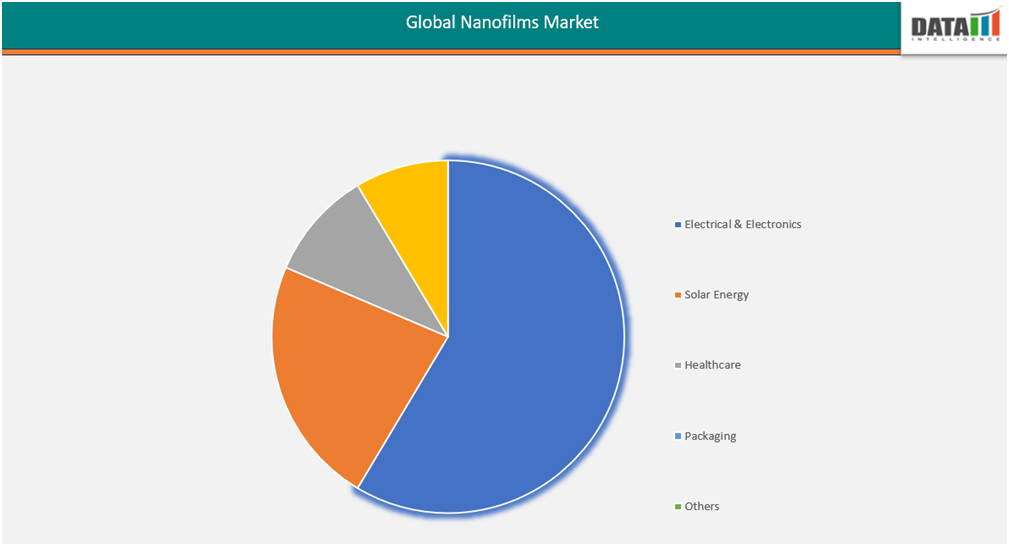
By end-user, the electronic segment has the largest share in the global nanofilms market
Market Size and Future Outlook
2025 Market Size: US$ 3.25 Billion
2033 Projected Market Size: US$ 8.75 Billion
CAGR (2025-2032):13.19%
Largest Market: Asia-Pacific
Fastest Market: North America
Market Scope
Metrics | Details |
By Type | Metal, Polymer ,Oxide, Semiconductors Others |
By End user | Packaging, Electrical & Electronics, Healthcare, Solar Energy, Automotive, Others
|
By Region | North America, South America, Europe, Asia-Pacific, Middle East and Africa |
Report Insights Covered | Competitive Landscape Analysis, Company Profile Analysis, Market Size, Share, Growth |
Market Dynamics
Surging Global Momentum in Nanofilms for Advanced Applications
Global demand for high-performance materials continues to rise, with nanofilms playing a central role in advancing technologies across solar energy, energy storage, optics, and microelectronics. Their integration into diverse end-use industries is driving innovation and expanding practical applications, especially in flexible electronics and sustainable systems. As research and development intensify, nanofilms are expected to become even more critical in shaping next-generation devices. The growing adoption of electronic technologies in emerging markets further amplifies this momentum, positioning nanofilms as a key enabler of future-ready solutions.
Elevated Manufacturing Cost
Despite their advanced functionality, nanofilms remain costly to produce due to complex raw materials and precision techniques like ALD and CVD. These methods demand high-end equipment and expert handling, driving up operational expenses. Such costs hinder scalability, especially in price-sensitive markets. This remains a key challenge for broader adoption.
Segmentation Analysis
The global nanofilms market is segmented based on type, end user and region.
Surging Demand for Ultra-Compact Electronics in Consumer and Industrial Markets
The demand for miniaturized electronics continues to accelerate, driven by growing consumer preference for compact, lightweight, and portable devices. Products such as smartphones, tablets, wearables, and IoT-enabled gadgets increasingly rely on smaller form factors without compromising functionality. This widespread shift toward device miniaturization is reshaping design and manufacturing priorities across the electronics industry. As this trend gains momentum, it is expected to significantly propel the growth of the global miniaturized electronics market, opening new opportunities for innovation and integration across consumer and industrial applications.
Accelerating Solar Adoption Through Nanofilm Innovation in Photovoltaics
Solar energy applications in the nanofilms market are rapidly expanding, driven by advanced materials, sustainability goals, and evolving energy systems. Nanofilms enhance solar cell efficiency and flexibility, enabling innovations like BIPV and portable solar solutions. Nanofilms are instrumental in boosting the performance and resilience of photovoltaic technologies by enhancing light capture, minimizing energy loss through reflection, and enabling the development of ultra-thin, flexible solar modules. As clean energy adoption accelerates, nanofilms are becoming essential to next-generation photovoltaic technologies.
For more details on this report - Request for Sample
Geographical Penetration
Asia-Pacific Dominates Global Nanofilm Market
The Asia-Pacific region is experiencing swift growth, fueled by rising demand across consumer electronics, automotive, and healthcare industries. Accelerated urbanization and widespread technological adoption in nations such as China, Japan, and South Korea are key contributors to this expansion. Moreover, the proliferation of smart devices and autonomous vehicles is spurring innovation and unlocking new market opportunities.
In 2025, Japan is directing substantial public investment toward advancing thin-film solar and energy storage solutions as part of its Green Innovation Fund initiative. This national effort supports the development of next-generation energy technologies aimed at accelerating decarbonization and enhancing household energy resilience.
China Global Nanofilms Market Outlook
The China nanofilms market is witnessing robust growth, fueled by rising demand across key industries such as electronics, solar energy, and optics. This expansion is driven by the growing adoption of nanofilms in the manufacturing of electronic components, solar cells, and advanced optical coatings, where their unique properties enable enhanced performance and efficiency.
For instance, In 2025, TCL Technology Group acquired Suzhou Nanowin Technology, a key player in oxide thin-film transistors and flexible display substrates used in OLED and micro-LED screens. This move enhances TCL’s control over its flexible electronics supply chain and strengthens its position in consumer tech. The merger also boosts China’s capabilities in transparent conductive films and ultra-thin substrates. Overall, this strategic consolidation directly supports innovation and scalability in nanofilm production across high-growth sectors.
India Nanofilm Market Trends
Although India is still developing its nanofilms sector relative to China and South Korea, the market is poised for substantial growth in the coming decade. The nation's emphasis on initiatives like Make in India, the advancement of sustainable technologies, and increased investment in research and development is laying a strong foundation for innovation and expanding domestic manufacturing capabilities. In, 2025, the Indian government launched the Vigyan Dhara scheme with a 10,579 crore (~$1.2 billion USD) investment to boost biomanufacturing and nanotech research. By strengthening R&D labs, promoting industry-academia partnerships, and accelerating tech deployment, the initiative directly supports innovation in nanofilm development—enhancing domestic capabilities in electronics, energy, and healthcare sectors.
North America Sees Fastest Growth in Nanofilm Innovation and Investment
The nanofilms market across North America is undergoing accelerated expansion, fueled by cutting-edge innovation and rising demand in industries such as electronics, automotive, and healthcare. At the forefront, the United States is making substantial strides, backed by both private sector momentum and robust federal investment.
U.S.A Nanofilms Market Industry Growth
U.S. thin films or nanofilms market is witnessing strong expansion, propelled by increasing applications in electronics, solar technology, medical devices, and smart packaging. This momentum is supported by breakthroughs in flexible electronics, advanced coatings, and multifunctional materials, alongside federal programs promoting clean energy and sustainable production. Enhanced deposition methods and deeper collaboration between research institutions and industry players are further driving widespread adoption across key sectors.
In 2023, the U.S. Department of Energy’s Solar Energy Technologies Office (SETO) awarded $44 million under the Advancing U.S. Thin-Film Solar Photovoltaics program. The initiative supports R&D in perovskite and CdTe PV technologies to boost domestic solar manufacturing. It strengthens the U.S. clean energy supply chain and reinforces national leadership in thin-film innovation.
Canada Nanofilms Market Industry Growth
Canada is becoming a key center for advanced materials, driven by strong research and clean energy goals. Local firms are investing heavily in smart coatings and flexible electronics to meet global sustainability standards. For instance in 2025 , A $100 million Canada government backed expansion with MDS Coating Technologies is boosting eco-friendly nano-coating production. These efforts are set to accelerate growth and innovation in Canada’s nanofilms market.
Sustainability Analysis
Nanofilms are increasingly being adopted across diverse industries due to their exceptional durability, adaptability, and eco-friendly properties. These ultra-thin layers enhance energy efficiency, prolong the operational life of electronic components, and significantly cut down on material usage. Their unique performance characteristics make them especially valuable in sectors such as renewable energy, medical technology, and advanced electronics.
For instance ,the European Union has reaffirmed its strong commitment to nanoscale innovation through the Horizon Europe framework. Under its 2025–2027 strategic plan, the European Commission has allocated €41 million (approximately USD 44 million) to fund projects aimed at advancing climate-neutral and smart city initiatives. A significant portion of this investment is directed toward the development and deployment of advanced materials, including nanofilms, which play a critical role in enhancing energy efficiency across infrastructure applications.
Competitive Landscape
The Global nanofilms market is highly competitive, driven by a mix of global and regional players striving for technological efficiency and cost leadership.
Key players include, Nanofilm, Nanofilm Technologies, Nano Foam Technology Pvt. Ltd, Nano Therapeutics Pvt. Ltd, Nano Lab India, Cosmo Films Limited, Smart Source Technologies, Nano Gram Corporation, MAT-VAC Technology, LOT-Oriel
Recent Developments
In March 2026, Nanofilm Technologies International Limited expanded its nanofilm coating solutions for electronics and industrial applications. The innovation focuses on ultra-thin, durable coatings with enhanced performance. This supports advanced manufacturing industries.
In February 2026, P2i Ltd. introduced next-generation liquid repellent nanocoatings for consumer electronics. The development improves water resistance and product durability. This benefits smartphones and wearable devices.
In January 2026, Applied Materials, Inc. strengthened its nanofilm deposition technologies for semiconductor manufacturing. The focus is on precision and scalability. This supports the growing demand for advanced chips.
Why Choose DataM?
Data-Driven Insights: Dive into detailed analyses with granular insights such as pricing, market shares and value chain evaluations, enriched by interviews with industry leaders and disruptors.
Post-Purchase Support and Expert Analyst Consultations: As a valued client, gain direct access to our expert analysts for personalized advice and strategic guidance, tailored to your specific needs and challenges.
White Papers and Case Studies: Benefit quarterly from our in-depth studies related to your purchased titles, tailored to refine your operational and marketing strategies for maximum impact.
Annual Updates on Purchased Reports: As an existing customer, enjoy the privilege of annual updates to your reports, ensuring you stay abreast of the latest market insights and technological advancements. Terms and conditions apply.
Specialized Focus on Emerging Markets: DataM differentiates itself by delivering in-depth, specialized insights specifically for emerging markets, rather than offering generalized geographic overviews. This approach equips our clients with a nuanced understanding and actionable intelligence that are essential for navigating and succeeding in high-growth regions.
Value of DataM Reports: Our reports offer specialized insights tailored to the latest trends and specific business inquiries. This personalized approach provides a deeper, strategic perspective, ensuring you receive the precise information necessary to make informed decisions. These insights complement and go beyond what is typically available in generic databases.
Target Audience 2026
Manufacturers/ Buyers
Industry Investors/Investment Bankers
Research Professionals
Emerging Companies





























































