


Mucopolysaccharidosis Treatment Size
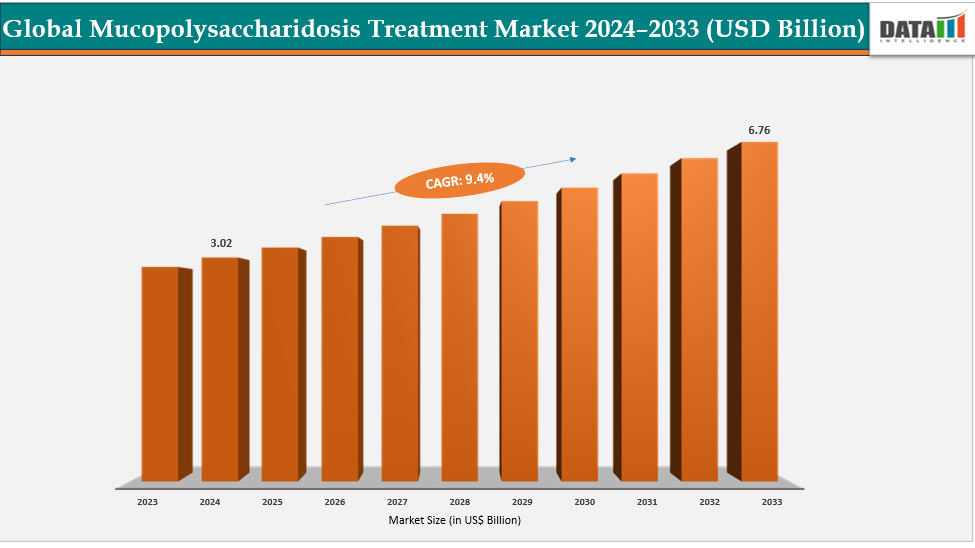
The global mucopolysaccharidosis treatment market size reached US$ 2.78 Billion in 2023 with a rise of US$ 3.02 Billion in 2024 and is expected to reach US$ 6.76 Billion by 2033, growing at a CAGR of 9.4% during the forecast period 2025-2033.
The market for treating mucopolysaccharidosis (MPS) is being driven by advancements in biomarker development and improved diagnostics. Timely action is made possible by an early and precise diagnosis. Biomarkers aid in tracking the course of a disease and the effectiveness of treatment. Certain MPS subtypes are identified via genetic testing for focused treatment. Programs for newborn screening improve patient identification rates. The detection of organ involvement is improved by sophisticated imaging and laboratory procedures. Regulatory approvals and clinical trial design are supported by trustworthy biomarkers. They enhance patient outcomes and cut down on treatment delays. Accurate diagnoses make personalized treatment plans possible. The progression of the disease is slowed by early intervention. Doctors can more precisely monitor the efficacy of therapy.
Key Highlights
- North America is dominating the global mucopolysaccharidosis treatment market with the largest revenue share of a 46.5% in 2024
- The Asia Pacific region is the fastest-growing region in the global mucopolysaccharidosis treatment market, with a CAGR of 7.8% in 2024
- The enzyme replacement therapy from treatment type is dominating the mucopolysaccharidosis treatment market with a 48.3% share in 2024
- The MPS Type 1 (Hurler syndrome) segment form disease type is dominating the mucopolysaccharidosis treatment market with a 32.3% share in 2024
- Top companies in the mucopolysaccharidosis treatment market include BioMarin Pharmaceutical Inc., Sanofi, Takeda Pharmaceuticals Inc., Clinigen Limited, and Ultragenyx Pharmaceutical Inc., and emerging players include REGENXBIO Inc., Sangamo Therapeutics, Abeona Therapeutics, and Orchard Therapeutics, among others.
Mucopolysaccharidosis Treatment Market Dynamics
Drivers: Increase in investment in research and development of novel drug therapies are accelerating the growth of the mucopolysaccharidosis treatment market
Growing research and development expenditures are propelling the market for treatments for mucopolysaccharidosis (MPS). Innovative strategies including gene therapy, genome editing, and sophisticated enzyme replacement medicines are the focus of pharmaceutical and biotech businesses. Stronger safety data, quicker clinical trials, and the creation of long-lasting, CNS-targeted therapies are all aided by these investments.
For instance, in February 2024, REGENXBIO Inc. announced positive results from its Phase I/II/III CAMPSIITE trial of RGX-121 for MPS II. Such advancements improve treatment outcomes, broaden therapeutic options, enhance patient access, and ultimately drive significant expansion in the global MPS treatment market.
Restraints: High treatment costs restrict adoption and slow growth of the mucopolysaccharidosis treatment market
The high expense of treating mucopolysaccharidosis (MPS) significantly limits uptake and slows market expansion. Stem cell transplants, gene therapies, and enzyme replacement treatments are all exceedingly costly. Many times, these treatments must be given for the rest of one's life. Patients and healthcare systems are severely impacted financially as a result. Access to patients is often restricted by high fees. Insurance companies and healthcare providers could be hesitant to use these treatments. Many people are not diagnosed or treated at an early stage.
Additionally, this leads to worse health results for them. Limited access lowers pharmaceutical companies' investment in novel treatments. The loop of prohibitive adoption and exorbitant expenses persists. As a result, the use of MPS therapy medications is still somewhat limited worldwide.
For more details on this report, see Request for Sample
Mucopolysaccharidosis Treatment Segmentation Analysis
The global mucopolysaccharidosis treatment market is segmented based on disease type, treatment type, end user and region
By Treatment Type: The enzyme replacement therapy from treatment type is dominating the mucopolysaccharidosis treatment market with a 48.3% share in 2024
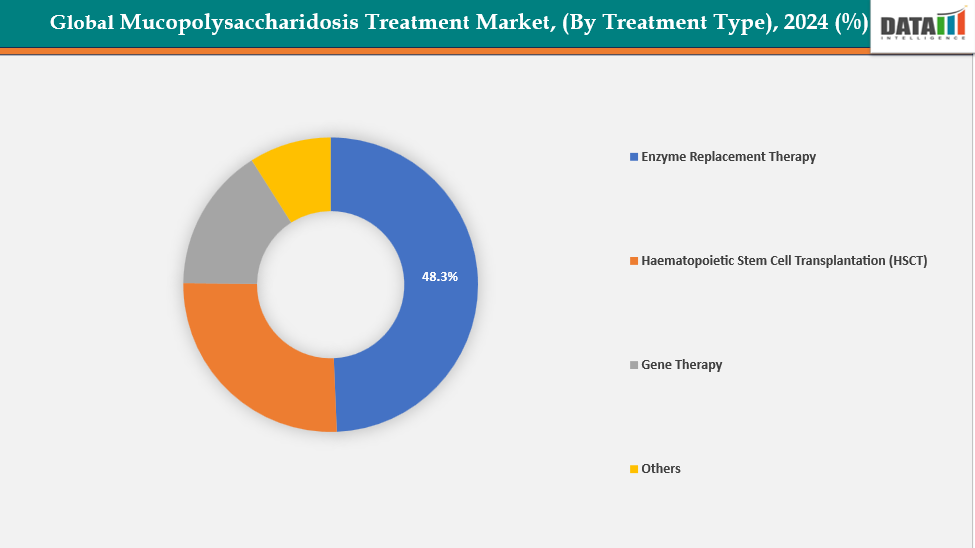
The market for treating mucopolysaccharidosis (MPS) is dominated by the Enzyme Replacement Therapy (ERT) sector. For a variety of MPS types, ERTs such as laronidase, idursulfase, galsulfase, and vestronidase alfa are commonly approved. These treatments successfully control the disease's systemic symptoms. Their efficacy and safety profile is well-established. For patients with non-neuronopathic MPS, ERTs are regarded as the gold standard of therapy. For manufacturers, chronic administration guarantees steady income. Access for patients is improved by the availability of several approved products.
Moreover, new product launches and product approvals make this segment dominant. For instance, in October 2025, Spruce Biosciences received U.S. FDA Breakthrough Therapy Designation for Tralesinidase Alfa Enzyme Replacement Therapy (TA-ERT) in Sanfilippo Syndrome Type B (MPS IIIB), supported by long-term clinical data showing CSF HS-NRE normalization as a surrogate biomarker likely to predict clinical benefit.
By Disease Type: The MPS Type 1 (Hurler syndrome) segment form disease type is dominating the mucopolysaccharidosis treatment market with a 32.3% share in 2024
The market for mucopolysaccharidosis treatments is dominated by MPS Type 1 (Hurler syndrome), which is the most severe type and necessitates immediate diagnosis and treatment. Hurler patients benefit most from effective therapies including hematopoietic stem cell transplantation (HSCT) and enzyme replacement therapy (ERT), which leads to a high demand for treatment. While government and insurance support increases access to therapy, strong clinician awareness increases detection rates.
Research and clinical trials focus heavily on MPS I due to its severity, leading to measurable treatment outcomes and encouraging adoption. For instance, in June 2025, Orchard Therapeutics successfully completed the Phase 3 HURCULES clinical trial, evaluating the efficacy and safety of OTL-203 in patients with MPS-IH (Hurler syndrome) compared with standard allogeneic HSCT care.
Mucopolysaccharidosis Treatment Geographical Analysis
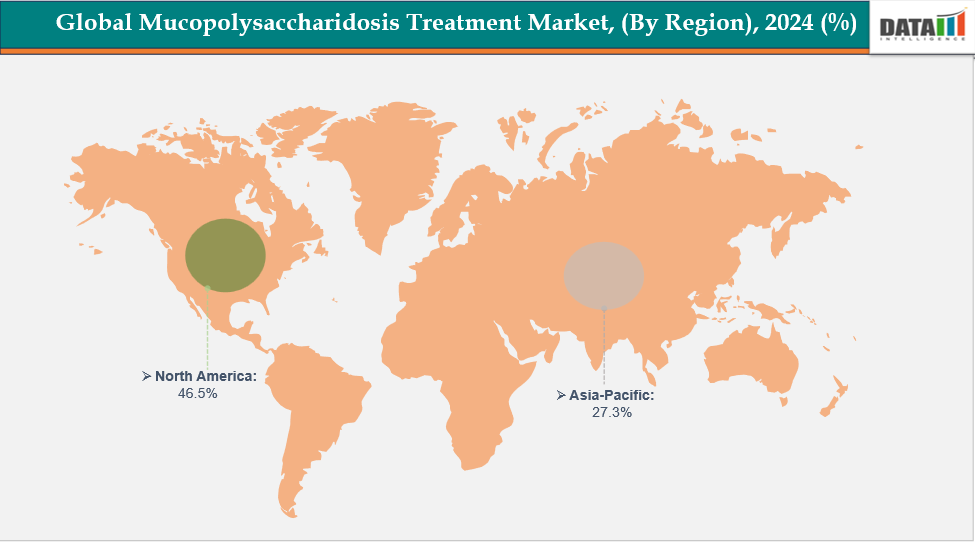
North America is dominating the global mucopolysaccharidosis treatment market with a 46.5% in 2024
The market for mucopolysaccharidosis treatments was dominated by North America because of its robust R&D investments, high illness awareness, and sophisticated healthcare infrastructure. Leading pharmaceutical companies and regular regulatory approvals encouraged the use of therapies and sustained global market expansion.
In the USA, growth in the mucopolysaccharidosis treatment market is driven by advanced healthcare infrastructure, rising disease awareness, and strong R&D investments. Frequent FDA fast-track and accelerated approvals further accelerate therapy adoption.
For instance, in May 2025, REGENXBIO announced that the FDA accepted and granted priority review for the Biologics License Application of clemidsogene lanparvovec (RGX-121) for treating MPS II (Hunter syndrome), seeking accelerated approval to address this rare genetic disorder.
Europe is the second region after North America which is expected to dominate the global mucopolysaccharidosis treatment market with a 37.5% in 2024
Europe's sophisticated healthcare system, rising awareness, and solid research partnerships are driving the market for mucopolysaccharidosis treatments. Technological developments, strategic alliances, and recent EU approvals are all contributing to the region's increased access to cutting-edge treatment options and speeding up therapeutic innovation.
Owing to factors like EU approvals, for instance, in June 2025, MEDIPAL Holdings Corporation and JCR Pharmaceuticals announced the approval by the European Commission granted Orphan Drug Designation (ODD) to JR-446, an investigational therapy for mucopolysaccharidosis type IIIB (Sanfilippo syndrome type B).
Germany’s mucopolysaccharidosis treatment market is driven by advanced healthcare infrastructure, strong research capabilities, and increasing disease awareness. Robust government support, active clinical trials, and collaborations with leading biotech firms further enhance innovation, therapy development, and market growth across the country.
The Asia Pacific region is the fastest-growing region in the global mucopolysaccharidosis treatment market, with a CAGR of 7.8% in 2024
The market for mucopolysaccharidosis treatments in Asia-Pacific, which includes China, India, Japan, and South Korea, is expanding quickly as a result of increased healthcare spending, better diagnostic tools, and growing awareness of uncommon illnesses. Regional market expansion is being propelled by growing research partnerships, government assistance for orphan medications, and developments in gene therapy and enzyme replacement.
Japan’s mucopolysaccharidosis treatment market is expanding rapidly, driven by advanced research in rare genetic disorders, strong government support, and PMDA approvals that promote innovation, gene therapy development, and improved access to advanced treatment options for patients nationwide. For instance, in September 2025, Japan’s Ministry of Health, Labour and Welfare granted Orphan Drug Designation to JR-446, an investigational therapy developed by MEDIPAL Holdings Corporation and JCR Pharmaceuticals for the treatment of mucopolysaccharidosis type IIIB (Sanfilippo syndrome type B), advancing rare disease research.
Mucopolysaccharidosis Treatment Competitive Landscape
Top companies in the mucopolysaccharidosis treatment market include BioMarin Pharmaceutical Inc., Sanofi, Takeda Pharmaceuticals Inc., Clinigen Limited, and Ultragenyx Pharmaceutical Inc., and emerging players include REGENXBIO Inc., Sangamo Therapeutics, Abeona Therapeutics, and Orchard Therapeutics, among others.
BioMarin Pharmaceutical Inc.: BioMarin Pharmaceutical Inc. is a global biotechnology leader focused on developing therapies for rare genetic diseases, including mucopolysaccharidosis (MPS). The company markets key treatments such as Aldurazyme for MPS I and Naglazyme for MPS VI. Through continuous R&D investment, BioMarin advances innovative enzyme replacement and gene therapies, reinforcing its leadership in improving outcomes for MPS patients worldwide.
Key Developments:
- In September 2025, JCR Pharmaceuticals presented long-term clinical data on Pabinafusp Alfa for treating Mucopolysaccharidosis Type II (MPS II) at ICIEM 2025 in Kyoto, showcasing results from its pipeline of brain-penetrant enzyme replacement therapies for rare and genetic diseases.
- In August 2025, Prime Therapeutics submitted an FDA application for Clemidsogene Ianparvovec (RGX-121). If approved, it would become the first one-time gene therapy for MPS II in boys aged 4 months to 5 years, offering a potential first-line alternative to weekly enzyme replacement therapy with idursulfase (Elaprase).
Mucopolysaccharidosis Treatment Scope
| Metrics | Details | |
| CAGR | 9.4% | |
| Market Size Available for Years | 2022-2033 | |
| Estimation Forecast Period | 2025-2033 | |
| Revenue Units | Value (US$ Bn) | |
| Segments Covered | By Disease Type | MPS Type 1 (Hurler syndrome), MPS Type 2 (Hunter syndrome), MPS Type 3 (Sanfilippo syndrome), MPS Type 4 (Morquio syndrome), MPS Type 6 (Maroteaux-Lamy syndrome), MPS Type 7 (Sly syndrome), MPS Type 9 (Natowicz syndrome) |
| By Treatment Type | Enzyme Replacement Therapy, Haematopoietic Stem Cell Transplantation (HSCT), Gene Therapy and Others | |
| By End User | Hospitals, Infusion Centers and Others | |
| Regions Covered | North America, Europe, Asia-Pacific, South America and the Middle East & Africa | |
The global mucopolysaccharidosis treatment market report delivers a detailed analysis with 47 key tables, more than 52 visually impactful figures, and 159 pages of expert insights, providing a complete view of the market landscape.



























































