


Metaverse in Healthcare Market Size & Industry Outlook
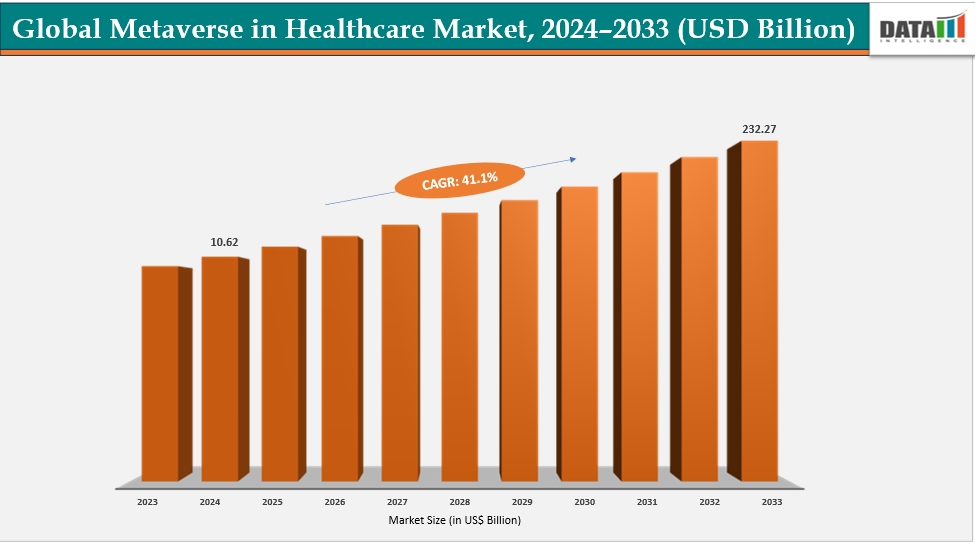
The global metaverse in healthcare market size reached US$ 7.70 Billion in 2023 with a rise of US$ 10.62 Billion in 2024 and is expected to reach US$ 232.27 Billion by 2033, growing at a CAGR of 41.1% during the forecast period 2025-2033.
The use of cutting-edge digital technologies including AR, VR, AI, blockchain, digital twins, IoT, and medical wearables propelled the metaverse's robust expansion in the healthcare industry. Adoption was accelerated by the growing need for virtual technologies to facilitate remote diagnostics, minimally invasive surgery, and medical training. AR/VR systems were employed by medical colleges and hospitals for staff training and surgical simulations. Blockchain made ensuring that health data was shared securely, while AI-powered digital twins enhanced decision-making.
With the use of remote monitoring and immersive 3D consultations, telemedicine technologies revolutionized doctor-patient relations. Virtual clinics increased accessibility and decreased travel time. Opportunities in remote care, digital collaboration, and virtual education continued to propel the market's explosive growth in spite of obstacles like data protection, expensive setup costs, and regulatory gaps.
Key Highlights
- North America is dominating the global metaverse in healthcare market with the largest revenue share of a 48.5% in 2024
- The Asia Pacific region is the fastest-growing region in the global metaverse in healthcare market, with a CAGR of 7.7% in 2024
- The software segment from component type is dominating the metaverse in healthcare market with a 55.3% share in 2024
- The virtual reality segment from technology type is dominating the metaverse in healthcare market with a 41.3% share in 2024
- Top companies in the metaverse in the healthcare market include Accuvein, Inc., Augmedics, Bioflightvr, Brainlab AG, CMR Surgical, Eon Reality, Google, Immersivetouch, Inc., Intuitive Surgical, Inc., and Medtronic Plc, among others.
Market Dynamics
Drivers: Increasing adoption of mixed reality for performing minimally invasive surgeries are accelerating the growth of the metaverse in healthcare market
The metaverse's expansion in the healthcare industry is being accelerated by the growing use of mixed reality (MR) technologies. Surgeons can execute minimally invasive procedures with greater accuracy and lower risk thanks to MR's ability to see complex anatomy in three dimensions. MR offers real-time guidance by merging virtual and real-world surroundings, which enhances surgical results and shortens patient recovery times.
According to industry estimates, by the middle of 2025, more than 30% of the best hospitals in the United States have integrated MR guidance in some capacity into their surgical procedures. This year, it is anticipated that the global MR healthcare market would be worth over US$5.6 billion, with surgical navigation and planning accounting for more than 60% of its use. To improve visibility for intricate procedures, top Japanese institutions like the University of Tokyo Hospital are working with medtech companies like CMR Surgical to integrate MR into robotic-assisted surgical suites.
An additional factor supporting the trend is the growing need for remote cooperation and real-time simulation technologies, especially in the fields of neurosurgery, orthopedics, and interventional cardiology. By drastically cutting down on treatment time, lowering the risk of complications, and increasing surgeon trust, this technology integration makes MR a vital enabler in the metaverse healthcare ecosystem.
Restraints: Data security and privacy concerns is hampering the growth of the metaverse in healthcare market
The delicate nature of medical data and stringent legal requirements have hindered the growth of the metaverse in the healthcare business due to data security, cyberattacks, and privacy issues. When healthcare data is shared online, it is extremely susceptible to hacking, breaches, and illegal access because AI, VR, and blockchain technologies are integrated, there are more data access points, which raises the possibility of hacks.
Owing to the factors like Data security, cyberattacks, and privacy concerns, For instance, in 2025, cyberattacks on healthcare systems are predicted to increase by 35% worldwide, with immersive platforms in the US and Japan being deemed high-risk because of their significant reliance on linked equipment and cloud storage. According to a 2025 HIMSS poll, 48% of US hospitals who used VR/AR experienced breaches, and audits conducted in Japan identified APPI legislation compliance issues.
These flaws present significant ethical, legal, and regulatory issues, particularly for global deployments. Widespread adoption of metaverse healthcare solutions is still significantly hampered by a lack of user authentication, strong data encryption, and legal frameworks.
For more details on this report, see Request for Sample
Metaverse in Healthcare Market, Segment Analysis
The global metaverse in healthcare market is segmented based on component type, technology type, application, end user and region
By Component Type: The software segment from component type is dominating the metaverse in healthcare market with a 55.3% share in 2024
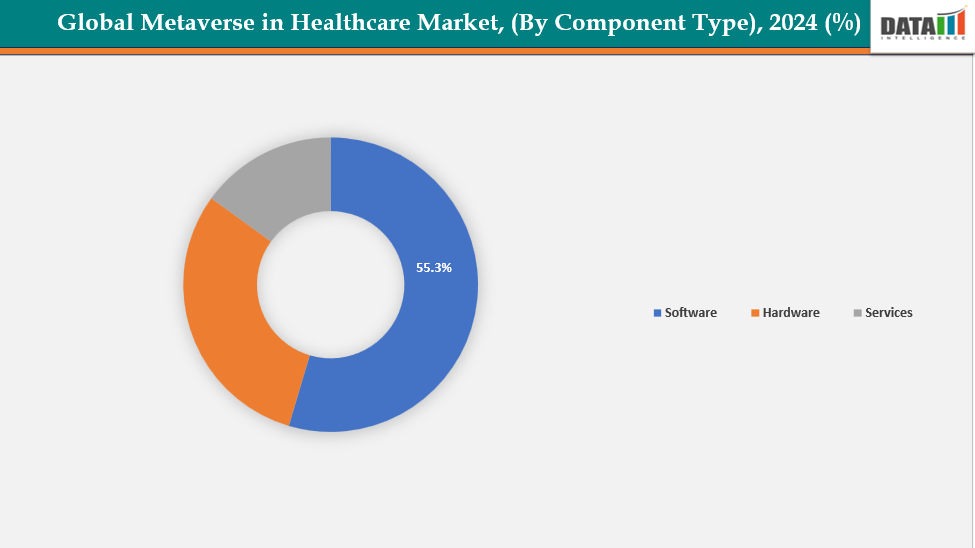
The software segment dominated the healthcare metaverse because of its critical function in facilitating data-driven, immersive, and interactive virtual experiences. By laying the groundwork for digital twins, telepresence, virtual training, and 3D simulation, it improved clinical teamwork and medical education. Advanced software solutions became more and more necessary as AR/VR platforms, AI-based analytics, and cloud-integrated health systems gained popularity. Customized metaverse apps have become more and more important for hospitals and other healthcare facilities for remote diagnostics, patient interaction, and operation preparation.
Furthermore, launches of new software in the metaverse in healthcare make it more dominant. For instance, in November 2024, Newbase, a leading innovator in metaverse-based medical education, announced the launch of its latest platform, ‘Medicrew,’ designed to deliver personalized VR training aligned with the clinical competencies of healthcare professionals.
By Technology Type: The virtual reality segment from technology type is dominating the metaverse in healthcare market with a 41.3% share in 2024
The virtual reality (VR) segment dominated the metaverse in healthcare market due to its widespread adoption in medical training, surgery simulation, and patient therapy. Virtual reality (VR) provided engaging, interactive 3D settings that increased diagnostic precision and medical education. By using virtual reality (VR) to practice risky procedures, surgeons and physicians were able to reduce errors in real-world surgeries.
Moreover, the technology also accelerated patient recovery through pain distraction therapy and mental health treatments. For instance, in September 2025, XRHealth, a leader in immersive therapeutics, introduced the XR CareCart, a mobile virtual reality rehabilitation station designed to deliver advanced therapy directly within clinics, hospitals, and community health centers. The multifunctional system enables immediate access to immersive VR-based rehabilitation, enhancing patient engagement and expanding the reach of digital therapeutic care.
Metaverse in Healthcare Market, Geographical Analysis

North America is dominating the global metaverse in healthcare market with a 48.5% in 2024
North America dominated the global metaverse in the healthcare industry due to its quick acceptance of technology, strong digital infrastructure, and early incorporation of AR/VR technologies in patient care and medical education. Leading IT firms and healthcare providers in the region, such as Microsoft, Meta, and GE Healthcare, have made large investments in virtual reality platforms, simulation systems, and telemedicine solutions. For instance, in March 2025, Microsoft and Intuitive Surgical extended their partnership to improve robotically assisted surgeries through the use of MR and cloud-based XR environments.
Furthermore, in the United States, GE Healthcare introduced a cutting-edge AI avatar system for virtual consultations that is being implemented throughout significant hospital networks. A virtual residency program featuring immersive anatomy lessons and collaborative surgery planning tools was developed by Meta (Oculus) in collaboration with Johns Hopkins University.
In Canada, a growing focus on blockchain integration and cross-border telehealth is evident. In February 2025, Wipro announced a partnership with Canadian firm Maple Health to co-develop a decentralized metaverse platform for secure data exchange and virtual chronic care monitoring. These collaborations are positioning North America as a global testbed for enterprise-grade virtual healthcare infrastructure.
Europe is the second region after North America which is expected to dominate the global metaverse in healthcare market with a 34.5% in 2024
In Europe, the growing use of digital health technology, robust government support for healthcare innovation, and growing investments in AR/VR applications all contributed to the metaverse in healthcare market's explosive growth. businesses' investments, initiatives, and innovations in the healthcare metaverse further sped up market expansion in the main European nations. For instance, in October 2024, the €7.8 million VR Health Champions project was launched to accelerate XR technology adoption in European healthcare. Co-funded by the European Regional Development Fund, the three-year initiative united 18 partners from eight EU nations to overcome regulatory barriers and advance VR/AR innovations in diagnostics, therapy, and surgery.
In Germany grew strongly because of growing investments in AR/VR applications, robust government backing for healthcare innovation, and growing use of digital health technology, the healthcare metaverse market expanded quickly. The healthcare market's metaverse activities, investments, and company innovations further sped up market expansion throughout the main European nations.
The Asia Pacific region is the fastest-growing region in the global metaverse in healthcare market, with a CAGR of 7.7% in 2024
The rapid growth of the metaverse in the Asia-Pacific healthcare market was facilitated by the growing digital transformation in healthcare, increased investments in AR/VR technology, and growing government support for smart health initiatives. The growth of the regional market was facilitated by a greater focus on telemedicine, virtual collaboration, and medical education in China, India, Japan, and South Korea.
In India, the metaverse in healthcare is being driven by the twin engines of necessity and innovation. In April 2025, XRHealth and Tata Elxsi partnered to create VR-based telemedicine kiosks for rural areas. Remote diagnostics and consultations in underserved areas are supported by the pilot deployment in states like Tamil Nadu and Maharashtra. Additionally, Oodles Technologies introduced the first metaverse-integrated mental wellness platform in India, fusing AI-powered behavioral analytics with immersive therapy sessions.
These developments underscore how Japan is scaling innovation through public-private partnerships, while India is leveraging the metaverse to address healthcare access gaps.
Metaverse in Healthcare Market Competitive Landscape
Top companies in the metaverse in healthcare market include Accuvein, Inc., Augmedics, Bioflightvr, Brainlab AG, CMR Surgical, Eon Reality, Google, Immersivetouch, Inc., Intuitive Surgical, Inc., and Medtronic Plc, among others.
Accuvein, Inc.:AccuVein, Inc. is a leading medical device company specializing in augmented reality solutions for healthcare. Its innovative vein visualization technology uses advanced imaging to enhance clinical accuracy, patient safety, and procedural efficiency. By integrating AR-based visualization tools, AccuVein supports the growing adoption of metaverse technologies in medical diagnostics, training, and real-time patient care applications.
Key Developments:
- In September 2025, Brainlab, a leading digital medical technology company, received FDA 510(k) clearance and launched its Spine Mixed Reality Navigation in the U.S. The advanced solution enabled surgeons to visualize critical anatomical data in real time, enhancing precision and ergonomics during pedicle screw placement and spinal surgeries.
- In March 2025, XRHealth, a leader in therapeutic VR, MR, and XR solutions, acquired RealizedCare, an immersive digital therapeutics company. This acquisition strengthened XRHealth’s position as the world’s largest AI-driven therapeutic XR platform, expanding its capabilities in chronic pain, behavioral health management, and personalized patient triage through advanced AI integration.
Market Scope
| Metrics | Details | |
| CAGR | 41.1% | |
| Market Size Available for Years | 2022-2033 | |
| Estimation Forecast Period | 2025-2033 | |
| Revenue Units | Value (US$ Bn) | |
| Segments Covered | By Component Type | Hardware, Software, Services |
| By Technology Type | Virtual Reality, Mixed Reality, Artificial Intelligence, Blockchain and Others | |
| By Application | Digital therapeutics, Medical diagnostics, Telehealth and Telemedicine, Drug Discovery, Others | |
| By End Users | Healthcare Providers, Payers, Pharma and Biopharma Companies and Others | |
| Regions Covered | North America, Europe, Asia-Pacific, South America and the Middle East & Africa | |
The global metaverse in Healthcare Market Report delivers a detailed analysis with 62 key tables, more than 56 visually impactful figures, and 159 pages of expert insights, providing a complete view of the market landscape.
Suggestions for Related Report
For more Healthcare IT-related reports, please click here



























































