


Market Size
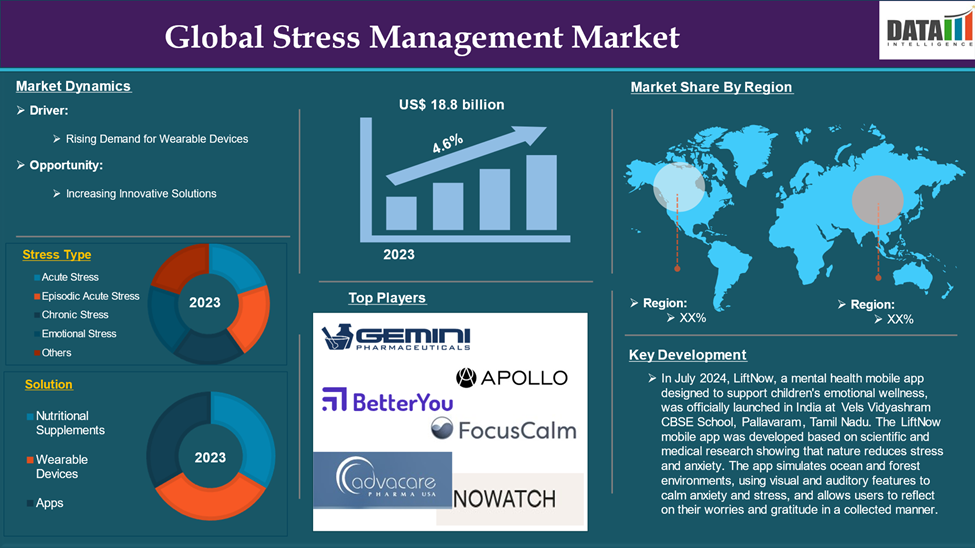
Global Stress Management Market reached US$ 20.6 billion in 2025 and is expected to reach US$ 29.3 billion by 2033, growing at a CAGR of 4.6% during the forecast period 2026-2033.
Stress is an automatic physical, mental and emotional response to a difficult event. Stress management involves using various techniques and coping strategies to improve the way an individual reacts to stressful things in life and build resilience. These techniques can prevent or ease stress-induced symptoms.
Stress management includes a wide range of techniques, therapies and devices that are intended for controlling a person's level of stress, especially chronic stress, to improve overall well-being and prevent adverse health effects. Stress management can be initiated by identifying the sources of stress. By adopting various strategies and techniques individuals can manage stress levels to reduce the adverse effects of stress on mental well-being.
There is a growing awareness among individuals of the rising stress levels in various places including educational institutes, workplaces and homes. Various strategies are being adopted for stress management. organizations are taking initiatives and are using advanced wearable technologies and apps to satisfy employees and reduce their stress levels.
Executive Summary
Source:- DataM Intelligence
Market Dynamics: Drivers & Restraints
Rising employee wellbeing initiatives
The rising employee well-being initiatives create a lucrative opportunity for market growth and are expected to drive the market growth. High levels of workplace stress can significantly affect productivity, job satisfaction, and employee retention. There is an increasing number of individuals across the globe suffering from stress and anxiety at workplaces.
With the increasing incidence of stress among employees, organizations are taking initiatives to prevent workplace stress and anxiety. As organizations strive to enhance employee performance, there is an increasing tendency to invest in stress management programs aimed at mitigating burnout and promoting overall well-being. This growing focus on employee health drives demand for various stress management tools, including digital wellness platforms, mobile applications, and wellness retreats.
The emergence of digital wellness tools and platforms has made stress management solutions more accessible and customizable than ever before. Applications that provide features such as stress tracking, mindfulness exercises, guided meditation, and relaxation techniques are increasingly being incorporated into employee well-being programs. The convenience and user-friendly nature of these digital resources encourage widespread adoption, further propelling the growth of the stress management solutions market. By integrating these tools, organizations can enhance their wellness initiatives and better support their employees' mental health needs.
By integrating these resources into their corporate wellness strategies, companies not only foster a healthier work environment but also enhance employee engagement and loyalty, ultimately leading to improved organizational performance.
Stigma around mental health
The stigma around mental health poses significant obstacles to the widespread adoption of stress management solutions. It often results in less utilization of available programs, reluctance to seek help, and resistance to corporate wellness initiatives. This stigma not only diminishes individuals' engagement with existing resources but also complicates efforts for organizations to effectively promote and implement stress management programs. These factors are expected to hinder the market growth.
To address these challenges and foster growth in the stress management market, it is essential to focus on reducing stigma, educating the public about the importance of mental health, and normalizing conversations around stress management in both personal and professional contexts. By creating an environment where mental health discussions are encouraged and supported, organizations can enhance participation in wellness programs and improve overall employee well-being.
For more details on this report – Request for Sample
Segment Analysis
The global stress management market is segmented based on stress type, age group, solution, distribution channel and region.
Type:
Wearable devices segment is expected to dominate the Stress Management market share
The wearable devices segment is expected to dominate the stress management market for several factors. This is because of technological advancements such as the introduction of artificial intelligence (AI) and machine learning algorithms. These technologies increase the accuracy of stress detection and allow for more sophisticated treatments suited to specific users' requirements and helps in stress management. For example, devices can analyze stress response patterns and recommend individualized coping strategies based on previous data.
Companies are advancing the solutions by integrating various sensors that track stressful events in the body.
Wearable devices allow to monitor physiological markers in real-time, such as heart rate, heart rate variability, skin temperature, and sleep patterns, all of which are directly related to stress. Wearables give users real-time feedback by continuously tracking these data, allowing them to recognize stress causes and take action to control them.
Geographical Analysis
North America is expected to hold a significant position in the Stress Management market share
North America holds a major portion of global stress management and is expected to hold a significant portion of the market. This is due to the rising number of individuals suffering from stress disorders, increasing technological advancements and the rising number of solutions in the region.
A large number of individuals who are working, studying and even older individuals are experiencing stress disorders.
Increasing demand for stress management in the region is expected to increase the requirement for stress management solutions including smart gadgets, supplements and apps that provide tips for managing stress. Companies are introducing smart solutions that could help in managing stress levels. There is a growing demand for these solutions as they provide real-time data of an individual.
Asia-Pacific is growing at the fastest pace in the stress management market
The Asia-Pacific (APAC) region is witnessing the fastest growth rate in the stress management market. Mental health and well-being are becoming increasingly important in the workplace. The increasing prevalence of stress-related health problems, such as anxiety and depression, is encouraging organizations to prioritize mental health care which can help in stress management among individuals. This is especially important in high-pressure work conditions found in many Asia-Pacific countries. These initiatives in the region are increasing the demand for stress management solutions.
There is a rising incidence of stress among individuals in the region which is raising the need for stress management solutions. For instance, according to the Global Organization for Stress, stress levels in the workplace are rising with 6 in 10 workers in major global economies experiencing increased workplace stress. With China (86%) having the highest rise in workplace stress
Key Industry Developments
March 2026: Headspace launched an advanced AI-driven stress analytics platform integrated with wearable biosensors, enabling real-time personalized mindfulness interventions and predictive stress pattern recognition for enhanced user outcomes.
January 2026: Calm introduced a neurofeedback-enabled meditation app featuring proprietary EEG-guided sessions, leveraging cutting-edge brainwave entrainment technology to accelerate deep relaxation states and long-term resilience building.
November 2025: Fitbit (Google) unveiled Stress Insights Pro, a next-gen firmware update for its wearables incorporating machine learning algorithms for granular cortisol trend analysis and automated biofeedback loops to optimize daily stress management protocols.
Competitive Landscape
The major global players in the stress management market include BetterTime, Co., Google, AdvaCare Pharma, Muse, FocusCalm, NOWATCH BV, Gemini Pharmaceuticals, Capro Labs., Apollo Neuroscience, Inc., and The TouchPoint Solution among others.
| Metrics | Details | |
| CAGR | 4.6% | |
| Market Size Available for Years | 2023-2033 | |
| Estimation Forecast Period | 2026-2033 | |
| Revenue Units | Value (US$ Mn) | |
| Segments Covered | Stress Type | Acute Stress, Episodic Acute Stress, Chronic Stress, Emotional Stress, Others |
| Age Group | Children, Adults, Seniors | |
| Solution | Nutritional Supplements, Wearable Devices, Apps | |
| Distribution Channel | Online Sales, Retail, Healthcare Providers | |
| Regions Covered | North America, Europe, Asia-Pacific, South America, and Middle East & Africa | |
Why Purchase the Report?
- Pipeline & Innovations: Reviews ongoing clinical trials, and product pipelines, and forecasts upcoming advancements in medical devices and pharmaceuticals.
- Product Performance & Market Positioning: Analyzes product performance, market positioning, and growth potential to optimize strategies.
- Real-World Evidence: Integrates patient feedback and data into product development for improved outcomes.
- Physician Preferences & Health System Impact: Examines healthcare provider behaviors and the impact of health system mergers on adoption strategies.
- Market Updates & Industry Changes: Covers recent regulatory changes, new policies, and emerging technologies.
- Competitive Strategies: Analyzes competitor strategies, market share, and emerging players.
- Pricing & Market Access: Reviews pricing models, reimbursement trends, and market access strategies.
- Market Entry & Expansion: Identifies optimal strategies for entering new markets and partnerships.
- Regional Growth & Investment: Highlights high-growth regions and investment opportunities.
- Supply Chain Optimization: Assesses supply chain risks and distribution strategies for efficient product delivery.
- Sustainability & Regulatory Impact: Focuses on eco-friendly practices and evolving regulations in healthcare.
- Post-market Surveillance: Uses post-market data to enhance product safety and access.
- Pharmacoeconomics & Value-Based Pricing: Analyzes the shift to value-based pricing and data-driven decision-making in R&D.
The Global Stress Management market report delivers a detailed analysis with 60+ key tables, more than 50 visually impactful figures, and 176 pages of expert insights, providing a complete view of the market landscape.
Target Audience 2026
- Manufacturers: Pharmaceutical, Medical Device, Biotech Companies, Contract Manufacturers, Distributors, Hospitals.
- Regulatory & Policy: Compliance Officers, Government, Health Economists, Market Access Specialists.
- Technology & Innovation: AI/Robotics Providers, R&D Professionals, Clinical Trial Managers, Pharmacovigilance Experts.
- Investors: Healthcare Investors, Venture Fund Investors, Pharma Marketing & Sales.
- Consulting & Advisory: Healthcare Consultants, Industry Associations, Analysts.
- Supply Chain: Distribution and Supply Chain Managers.
- Consumers & Advocacy: Patients, Advocacy Groups, Insurance Companies.
- Academic & Research: Academic Institutions.





























































