


Medical Drones Market Overview
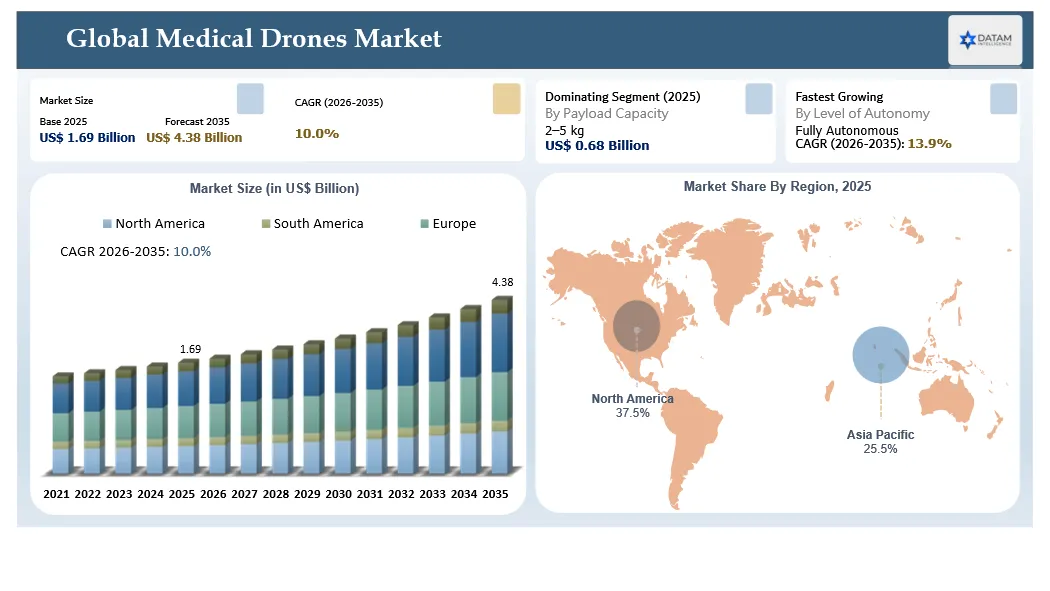
The global Medical Drones market reached US$ 1.69 billion in 2025 and is expected to reach US$ 4.38 billion by 2035, expanding at a CAGR of 10.0% during 2026-2035. The market is moving from grant-funded pilots and isolated healthcare routes toward autonomous logistics networks connected to hospitals, pharmacies, laboratories and consumer delivery platforms. Medical drones are increasingly evaluated as healthcare infrastructure because they can create scheduled, on-demand and emergency transport capacity without depending on road congestion or difficult terrain.
Zipline’s January 2026 financing marks a major commercial inflection point. The company raised more than US$ 600 million, reached a valuation of US$ 7.6 billion and surpassed two million commercial deliveries. The second million deliveries were completed in less than two years, showing that autonomous delivery networks are beginning to scale beyond small pilots. Zipline announced expansion into Houston and Phoenix in early 2026, followed by additional U.S. metropolitan markets. Houston operations launched with a limited Cypress program that included medical supplies and other essentials, creating a bridge between consumer delivery density and future healthcare logistics economics.
The market is also supported by public-sector network expansion. Rwanda signed an expanded agreement in February 2026 to move toward nationwide autonomous logistics coverage and Africa’s first urban Zipline network. The agreement is linked to a US$150 million pay-for-performance award from the U.S. Department of State, with additional funding expected from participating African countries. These developments show that the market is developing through two parallel models, large-scale public health networks in emerging markets and higher-density commercial platforms in the U.S. and other developed economies.
Future growth will depend on BVLOS approval, healthcare workflow integration, medical payload validation, network density and sustainable route economics. The strongest opportunities are hospital-to-laboratory specimen transport, blood and emergency medical delivery, direct-to-patient prescriptions, public health distribution and autonomous fleet software. Buyers need market intelligence on which use cases can move from pilot to recurring contracts, which operators have the capital and certification to scale and where regulation is becoming supportive.
| Metric | Details |
| 2025 Market Size | US$ 1.69 Billion |
| 2035 Projected Market Size | US$ 4.38 Billion |
| CAGR (2026-2035) | 10.0% |
| Largest Market | North America |
| Fastest Growing Market | Asia-Pacific |
| Largest Drone Type | Multi-Rotor and Hybrid VTOL Platforms |
| Fastest Growing Application | Diagnostic Specimens and Direct-to-Patient Medical Delivery |
| Forecast Period | 2026-2035 |
Medical Drones Market Key Takeaways
- The market reached US$ 1.69 billion in 2025 and is projected to reach US$ 4.38 billion by 2035, with a CAGR of 10.0% during 2026-2035.
- Zipline raised more than US$600 million in January 2026, increasing its valuation to US$7.6 billion and providing capital for expansion into Houston, Phoenix and additional U.S. markets.
- Zipline surpassed two million commercial deliveries, with the second million completed in less than two years, indicating accelerating network utilization.
- Rwanda’s 2026 expansion agreement aims to create nationwide autonomous logistics coverage and Africa’s first urban drone delivery network.
- A US$150 million U.S. State Department pay-for-performance award is supporting wider autonomous medical logistics deployment in Africa, with matching and complementary country funding expected.
- Houston’s Cypress launch initially targeted 5,000 customers and included groceries, medical supplies and other essentials, showing how mixed-category demand can support the economics of healthcare-ready networks.
- North America leads because of funding availability, FAA certification pathways, health-system partnerships and commercial last-mile demand.
- Asia-Pacific is the fastest-growing region because India, China, Japan and Australia are advancing healthcare logistics pilots, low-altitude economy programs and rural access use cases.
- Drone-as-a-Service is the most commercially scalable business model because healthcare buyers can purchase guaranteed delivery capacity without owning aircraft or flight operations.
- Diagnostic specimens, blood products and emergency medical payloads offer the clearest healthcare ROI because urgency, route frequency and service-level requirements are measurable.
Medical Drones Market Scope
| Scope Item | Coverage |
| By Drone Type | Fixed-wing, multi-rotor, single-rotor and hybrid VTOL drones |
| By Payload Capacity | Less than 2 kg, 2-5 kg, 5-20 kg and above 20 kg |
| By Application | Blood, vaccines, pharmaceuticals, diagnostic specimens, organs, AEDs, prescriptions and medical devices |
| By Level of Autonomy | Fully autonomous, semi-autonomous and remotely piloted |
| By End User | Hospitals, laboratories, blood banks, pharmaceutical companies, pharmacies, governments and NGOs |
| By Service Model | Drone-as-a-Service, owned networks, managed fleets, pay-per-delivery and public-private partnerships |
| By Operating Environment | Rural, urban, disaster, military, offshore and island communities |
| By Region | North America, Europe, Asia-Pacific, South America, Middle East and Africa |
Why Does This Report Matter in 2026?
Medical drone procurement is moving into a scale-validation period. Zipline’s US$600 million financing shows that capital providers expect autonomous delivery to move beyond demonstrations. Its two million deliveries provide operational evidence that fleets, distribution hubs and software can support repeat activity. The Houston and Phoenix expansions also show that operators are pursuing urban and suburban density, which can lower unit economics and create commercial infrastructure that can later support pharmacy and healthcare routes.
Healthcare buyers need to determine where drone delivery creates measurable value. The strongest cases are routes where medical urgency, traffic delay, terrain or inventory fragmentation create a clear cost of inaction. This report helps hospitals, laboratories, public health agencies and investors compare route economics, regulatory readiness, operator capability and integration requirements. It also identifies how consumer delivery networks can cross-subsidize or strengthen medical delivery coverage.
Medical Drones Market White Space and Investment Opportunities
- Autonomous specimen corridors connecting hospitals, satellite clinics and centralized laboratories.
- Blood and blood product networks serving trauma centers, maternity facilities and rural hospitals.
- Direct-to-patient prescription delivery integrated with telehealth and digital pharmacy platforms.
- Cold-chain payload containers with active condition monitoring and chain-of-custody records.
- BVLOS command-and-control systems, detect-and-avoid technologies and low-altitude traffic management.
- Public-private healthcare logistics networks where governments pay for coverage and service outcomes.
- Urban hub networks that combine medical, pharmacy, grocery and retail demand to improve asset utilization.
- Insurance, risk scoring and compliance platforms designed for autonomous healthcare logistics.
Medical Drones Future Market Transformation
The market will shift from individual aircraft procurement toward managed logistics networks. Hospitals will increasingly buy guaranteed route availability, delivery windows, payload integrity and digital tracking rather than drones. This favors operators with certified aircraft, local flight permissions, network software, maintenance capability and healthcare integration.
Urban commercialization will also change the market structure. Mixed-use networks can move restaurant, retail and healthcare orders through the same infrastructure, improving utilization outside peak medical demand. Public health networks in Africa and Asia will remain focused on essential medicines and national coverage. These models will converge around common technologies, including autonomous fleet control, dynamic routing, smart payload boxes and interoperable APIs.
Medical Drones Market Buyer Decision-Making Criteria
Healthcare buyers evaluate medical drone providers based on mission completion, regulatory approvals, payload integrity, chain of custody, route coverage, emergency response capability, service continuity and integration with laboratory or hospital systems. Procurement teams also examine insurance, cybersecurity, weather operating limits, maintenance processes and incident response. The key commercial shift is from evaluating aircraft specifications to evaluating network outcomes.
Medical Drones Market Economic and Investment Analysis
The US$600 million Zipline raise is the strongest recent indicator that investors expect autonomous delivery networks to scale. The capital supports manufacturing, fleet deployment, software infrastructure and new U.S. market launches. Zipline’s US$7.6 billion valuation also creates a benchmark for companies that combine aircraft, autonomy, logistics operations and recurring service revenue.
Investment opportunities extend beyond operators. Payload systems, battery technology, detect-and-avoid sensors, fleet orchestration, landing and loading infrastructure, insurance and healthcare software integration can develop as independent value pools. Investors should prioritize platforms with regulatory progress, recurring routes, measurable delivery volumes and partnerships that provide shipment density.
Medical Drones Investment Trends in the Market
- Large growth rounds for operators with proven delivery volume and certified autonomous systems.
- Government-backed healthcare corridors and pay-for-performance programs in Africa and emerging markets.
- Investment in hybrid VTOL aircraft capable of longer routes and precise delivery near hospitals or homes.
- Expansion of urban delivery hubs that can serve healthcare and consumer categories from shared infrastructure.
- Greater funding for autonomy software, fleet scheduling, detect-and-avoid and low-altitude traffic coordination.
- Partnerships between hospitals, laboratories, pharmacies, drone operators and telecom companies.
Strategic Indicators for Medical Drones Market
High Regulation Impact
BVLOS approval, aircraft certification, operator licensing, airspace coordination and medical payload rules determine whether pilots become commercial networks.
High Investment Activity
Zipline’s US$600 million financing and US$7.6 billion valuation demonstrate strong capital support for operators with proven scale.
Network Density Requirement
Route economics improve when operators aggregate hospital, pharmacy, retail and consumer demand across shared hubs.
Healthcare Integration Pressure
Providers must integrate ordering, specimen tracking, pharmacy systems and chain-of-custody records into existing workflows.
Public Sector Opportunity
Rwanda’s nationwide expansion and the US$150 million U.S. State Department award show that governments can act as anchor customers.
Technology Disruption
Autonomy, AI routing, hybrid VTOL platforms and smart payload monitoring are turning drones into managed logistics infrastructure.
Regional Expansion Opportunity
The U.S., India, Rwanda, Ghana, Kenya, Australia, Japan and selected European markets offer different combinations of regulatory support and healthcare demand.
AI Impact Analysis of Medical Drones Market
AI supports dynamic route planning, weather assessment, demand forecasting, battery management, object detection, landing-zone evaluation and fleet maintenance. Healthcare networks can use AI to prioritize urgent payloads, rebalance inventory and position drones before demand peaks. The strongest commercial value will come from integrating medical urgency with fleet scheduling rather than using AI only for autonomous flight.
Disruption Analysis of Medical Drones Market
Medical drones disrupt road courier models by separating critical healthcare logistics from traffic and terrain. They also enable centralized inventory because blood, medicines and specimens can move rapidly between facilities. The wider disruption is a shift from vehicle-based delivery contracts to software-managed aerial capacity. Operators that combine consumer and healthcare demand can create denser networks and lower unit costs, while public systems can use performance-based contracts to expand rural coverage.
Medical Drones Market Dynamics
Driver Impact Analysis
| Driver | Market Growth Impact (%) | Demand Concentration | Impacted Use Case | Strategic Impact |
| Autonomous logistics network expansion | 27% | U.S., Africa, Asia-Pacific | Hospital, pharmacy and consumer delivery | Creates repeat route volume and supports commercial scale |
| Healthcare access and rural logistics gaps | 23% | Africa, India, Latin America | Blood, vaccines and medicines | Supports public-sector and NGO procurement |
| BVLOS regulatory progress | 18% | North America, Europe, Asia-Pacific | Longer autonomous routes | Expands addressable service radius |
| Hospital and laboratory centralization | 16% | Urban health systems | Diagnostic specimens | Creates high-frequency scheduled corridors |
| Funding and manufacturing scale-up | 14% | Global leaders | Fleet expansion | Reduces deployment constraints and supports market entry |
Driver: Autonomous Medical Logistics Networks Are Moving Toward Scale
Zipline’s two million deliveries and US$600 million raise demonstrate that autonomous logistics can move from pilot programs to recurring commercial operations. Houston and Phoenix expansion will test whether dense U.S. networks can support healthcare deliveries alongside consumer orders. Rwanda’s nationwide program provides a different model where government-backed healthcare coverage anchors network utilization.
Restraint Impact Analysis
| Restraint | Drag on Growth (%) | Primary Impact Area | Impacted Use Case | Strategic Impact |
| BVLOS and airspace approval complexity | 24% | Commercial operations | Long-distance routes | Delays expansion and increases compliance cost |
| Weather and payload integrity risk | 18% | Clinical reliability | Blood, specimens and organs | Requires validated containers and operating limits |
| Low route density | 16% | Network economics | Rural and single-use routes | Raises cost per delivery |
| Public acceptance and noise concerns | 12% | Urban deployment | Home delivery | Can slow municipal approvals |
| Healthcare IT integration | 11% | Workflow adoption | Labs, pharmacies and hospitals | Creates implementation burden |
Restraint: Regulatory Approval and Route Economics Remain Uneven
Medical drone technology is mature enough for many missions, but commercial deployment depends on local approvals and consistent demand. Operators need BVLOS permissions, safe flight corridors, weather resilience and a clear process for incident management. Healthcare networks also need sufficient route volume to justify hubs, maintenance and operating staff. Mixed-use networks can improve economics, but they require stronger data governance and service prioritization.
Medical Drones Market Segment Analysis
By Drone Type: Hybrid VTOL Platforms Are Gaining Strategic Importance
Fixed-wing drones remain effective for long rural routes, while multi-rotor systems support precise urban delivery. Hybrid VTOL platforms combine range and vertical landing flexibility, making them attractive for mixed rural and suburban networks. Buyers evaluate range, payload, reliability, landing footprint and fleet maintenance rather than airframe type alone.
By Payload Capacity: The 2-5 kg Category Supports the Broadest Healthcare Use Case Base
The 2-5 kg category can serve blood products, vaccines, pharmaceuticals, diagnostic specimens and small medical devices. Smaller drones support prescriptions and urgent samples, while heavier platforms address larger hospital replenishment and disaster response. Payload selection must account for packaging, cold-chain equipment and return logistics.
By Application: Diagnostic Specimens Offer High-Frequency Route Economics
Specimen transport can create scheduled daily routes between satellite clinics and central laboratories. The use case is attractive because delays affect testing turnaround and ground courier costs are visible. Blood and emergency products offer higher urgency, while prescriptions create larger consumer volumes where regulation permits.
By Level of Autonomy: Fully Autonomous Networks Will Capture the Strongest Growth
Autonomous fleets reduce dependence on one pilot per aircraft and allow centralized supervision. Commercial scale depends on detect-and-avoid capability, reliable communication and approved operating procedures. Semi-autonomous systems will remain important where airspace or clinical risk requires more human oversight.
By End User: Hospitals and Public Health Agencies Are Anchor Customers
Hospitals create recurring routes, while public health agencies can fund broad coverage. Laboratories, blood banks and pharmacies add specialized demand. The most valuable contracts bundle several use cases across a regional health system rather than serving one department.
By Service Model: Drone-as-a-Service Reduces Buyer Adoption Risk
Healthcare organizations prefer contracted service levels over aircraft ownership because operators manage certification, pilots, maintenance, insurance and software. Pay-per-delivery models suit pilots, while multi-year capacity contracts support infrastructure investment. Public-private partnerships are important for nationwide and rural programs.
By Operating Environment: Urban Networks Are Becoming Commercially Important
Early medical drone success was concentrated in remote settings. Houston, Phoenix and other city launches show that suburban density can support shared delivery infrastructure. Urban operations create a larger addressable market but require stronger airspace coordination, noise management and landing-zone controls.
By Medical Payload Integrity: Smart Containers Are Becoming a Differentiator
Blood, vaccines, specimens and organs require validated temperature, vibration and chain-of-custody controls. Payload technology can become a separate premium segment. Providers that document environmental conditions throughout transport will be better positioned for regulated healthcare contracts.
By Network Architecture: Hub-and-Spoke Models Will Dominate Regional Deployment
Central hubs can connect blood banks, laboratories and distribution centers to multiple hospitals. Smaller neighborhood or hospital nodes can support the last mile. A 2026 optimization study found that multi-trip drone operations could be 142.8% more cost-efficient than single-trip configurations in a healthcare network case, reinforcing the value of fleet orchestration.
By Buyer Model: Outcome-Based Contracts Can Accelerate Adoption
Governments and health systems can pay for delivery availability, service coverage or clinical outcomes rather than aircraft hours. The U.S. State Department’s US$150 million pay-for-performance award provides a model for scaling national logistics while linking funding to results.
Medical Drones Market Geographical Penetration
| Region | 2025 Share | Strategic Position |
| North America | 37.5% | Largest market, supported by funding, FAA pathways and commercial network expansion |
| Europe | 23.0% | Strong hospital pilots, BVLOS reform and public healthcare demand |
| Asia-Pacific | 25.5% | Fastest growth through India, China, Japan and Australia |
| South America | 5.5% | Remote healthcare and difficult terrain create targeted opportunities |
| Middle East and Africa | 8.5% | Nationwide public health networks and humanitarian logistics remain important |
North America Medical Drones Market Outlook
North America is the largest market because it combines venture funding, advanced autonomous systems, healthcare spending and regulatory pathways. Zipline’s US$600 million raise, US$7.6 billion valuation and Houston and Phoenix expansion make the U.S. the central commercial test market. The Houston Cypress launch initially covered 5,000 customers and included medical supplies, showing that healthcare can operate within a mixed-use delivery platform. Canada offers opportunities in remote and northern communities, while Mexico can use medical drones for regional access and disaster response.
Europe Medical Drones Market Outlook
Europe is progressing through hospital pilots, NHS use cases, public healthcare procurement and regulatory work on BVLOS operations. The UK announced regulatory changes intended to support broader commercial and public-sector drone use, including NHS supply and specimen delivery. Germany, France and Italy offer hospital and laboratory corridors, while Nordic and island regions present strong remote logistics cases.
Asia-Pacific Medical Drones Market Outlook
Asia-Pacific is the fastest-growing region. India is developing urban specimen routes and rural healthcare logistics. A Bengaluru pilot reported around 700 flights in 54 days and transported up to 40 diagnostic samples per flight, showing the potential for high-frequency laboratory corridors. China’s low-altitude economy supports manufacturing and logistics experimentation. Japan, Australia and Southeast Asia offer remote, island and aging-population healthcare use cases.
South America Medical Drones Market Outlook
Brazil, Colombia, Peru and other markets have remote communities, difficult road access and large geographic coverage needs. Opportunities are strongest in vaccines, blood, diagnostics and public health distribution. Commercial progress will depend on aviation approvals, local maintenance capability and partnerships with ministries, hospitals and NGOs.
Middle East and Africa Medical Drones Market Outlook
Africa remains a reference market for medical drone logistics. Rwanda’s 2026 agreement aims to create nationwide autonomous coverage and an urban network. The US$150 million U.S. State Department award can support wider deployment, while Ghana, Kenya and Nigeria offer blood, vaccine and pharmaceutical delivery opportunities. GCC countries can use drones for hospital networks, emergency services and remote industrial communities.
Medical Drones Market Competitive Landscape
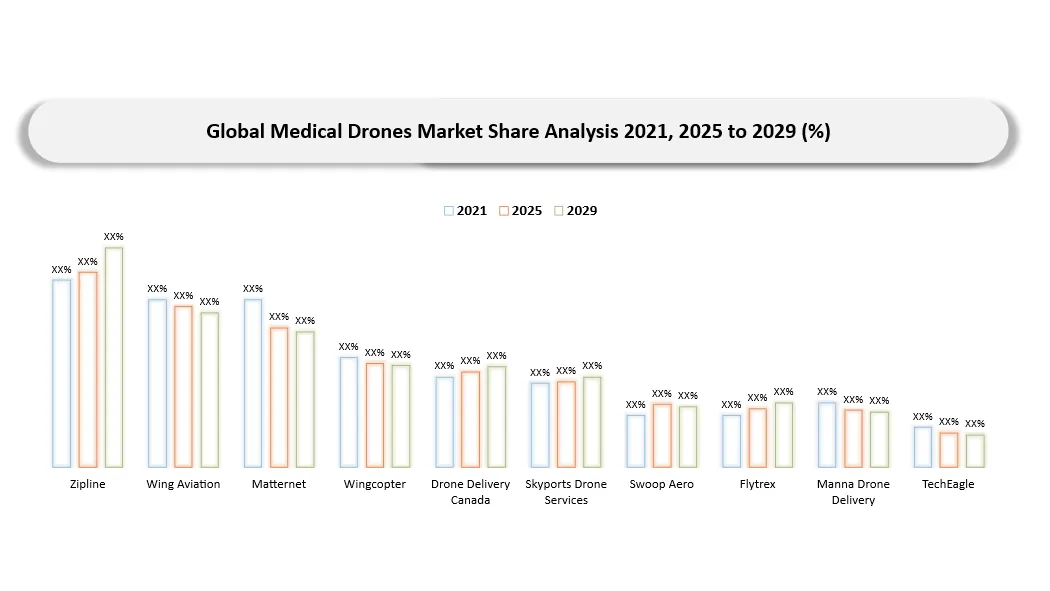
- Competition is shifting from aircraft performance toward network scale, regulatory certification, delivery volume and recurring service contracts.
- Zipline leads in demonstrated commercial volume, capital access and healthcare heritage, supported by more than two million deliveries and a US$7.6 billion valuation.
- Wing competes through integration with major retailers and dense suburban networks that can support pharmacy and healthcare items.
- Matternet, Swoop Aero, Skyports, Apian and specialist operators compete through hospital, laboratory and public-sector use cases.
- Healthcare software integration, payload validation and chain-of-custody documentation are becoming stronger differentiators.
- Operators with mixed-use networks can improve utilization, while healthcare-only providers may build stronger clinical specialization.
Key Companies of Medical Drones Market
- Zipline
- Wing Aviation
- Matternet
- Swoop Aero
- Drone Delivery Canada
- Skyports Drone Services
- Apian
- Spright
- Wingcopter
- Flytrex
- Manna Drone Delivery
- TechEagle
- Redwing Labs
- Airbound
- Volansi
- EHang
- DJI
- Elroy Air
- Avy
- Dronamics
Medical Drones Market Major Pain Points
- Lengthy and country-specific BVLOS approval processes.
- Weather-related service interruption and limited operating envelopes.
- Need to validate temperature, vibration and security for clinical payloads.
- Route density challenges in remote areas and low-volume hospital networks.
- Integration burden with hospital, laboratory, pharmacy and inventory systems.
- Public concern around noise, privacy, safety and low-altitude traffic.
- Insurance and liability uncertainty for autonomous healthcare delivery.
- Dependence on funding or anchor contracts during early network development.
Medical Drones Market Recent Developments
- January 2026: Zipline raised more than US$600 million, reached a US$7.6 billion valuation and announced expansion into Houston and Phoenix after surpassing two million commercial deliveries.
- February 2026: Rwanda signed an expanded agreement with Zipline to move toward nationwide autonomous logistics coverage and Africa’s first urban autonomous delivery network.
- April 2026: Zipline launched a Cypress, Houston pilot initially limited to 5,000 customers, covering food, groceries, medical supplies and essential items.
- May 2026: Zipline completed its first Houston-area flight and announced plans to expand to additional neighborhoods.
- 2026: A Bengaluru healthcare pilot reported around 700 drone flights in 54 days for diagnostic sample transport, demonstrating repeat urban medical logistics demand.
- 2025-2026: UK regulatory reforms and NHS-linked trials continued to advance the case for BVLOS delivery of medical supplies and diagnostic specimens.
Analyst View / Opinion on Medical Drones Market
- The market is entering a network scale phase where capital, certification and route density matter more than isolated drone demonstrations.
- Zipline’s financing validates autonomous logistics as an investable infrastructure platform, with healthcare remaining a high-value use case.
- Diagnostic specimens, blood products and public health distribution offer the strongest near-term healthcare economics.
- Urban mixed-use networks can improve medical delivery economics by sharing infrastructure with retail and food demand.
- Public-private partnerships will remain essential for nationwide and rural coverage where commercial density is limited.
- Long-term market leadership will depend on healthcare integration, payload validation, regulatory relationships and proven delivery volumes.
Medical Drones Market Target Audience
| Industry | Who Should Buy This Report? | Reason to Buy This Report |
| Drone Operators | CEOs, strategy heads, network planners | To identify healthcare routes, regional expansion and service models |
| Hospitals and Health Systems | Supply chain, laboratory and innovation teams | To evaluate route economics, providers and integration requirements |
| Blood Banks and Laboratories | Operations and logistics leaders | To assess urgent and scheduled aerial delivery corridors |
| Pharmaceutical Companies | Distribution, market access and digital health teams | To identify vaccine, specialty medicine and direct-to-patient opportunities |
| Governments and NGOs | Public health, transport and procurement agencies | To design national or regional healthcare logistics programs |
| Investors | Private equity, venture capital and infrastructure funds | To screen operators, software platforms and enabling technologies |
| Technology Providers | Autonomy, payload, telecom and airspace software firms | To identify integration and partnership opportunities |
Why Choose DATAM?
- Data-driven insights covering market sizing, route economics, operator scale, regulation, funding, healthcare integration and competitive positioning.
- Post-purchase analyst support for market entry, partnership selection, route prioritization and investment screening.
- Country-level coverage across developed and emerging medical drone markets.
- White-space analysis across hospital corridors, blood networks, prescriptions, cold-chain payloads and autonomy software.
- Buyer-focused analysis that connects drone technology with healthcare procurement and operational outcomes.
What DATAM Uniquely Provides
- Detailed 10-year market predictions by drone type, payload, application, autonomy, end user, service model, operating environment and region.
- Operator benchmarking based on delivery volume, funding, certification, partnerships and network expansion.
- Healthcare buyer criteria covering payload integrity, chain of custody, mission reliability, integration and regulatory compliance.
- Strategic analysis covering AI impact, disruption, pricing intelligence, investment trends and regional white spaces.
- Country-level recommendations for operators, hospitals, governments, investors and technology suppliers.
Questions This Report Answers
- How will the Medical Drones market evolve from US$1.69 billion in 2025 through 2035?
- Which applications offer the strongest route economics and healthcare ROI?
- How will Zipline’s US$600 million raise and U.S. expansion affect competitive intensity?
- Which countries are most ready for BVLOS medical drone networks?
- How should hospitals evaluate Drone-as-a-Service providers?
- Where are the strongest investment opportunities in payload systems, autonomy software and network infrastructure?
- Which companies are best positioned to scale medical drone operations?



























































