


Medical Aesthetics Market Size and Growth
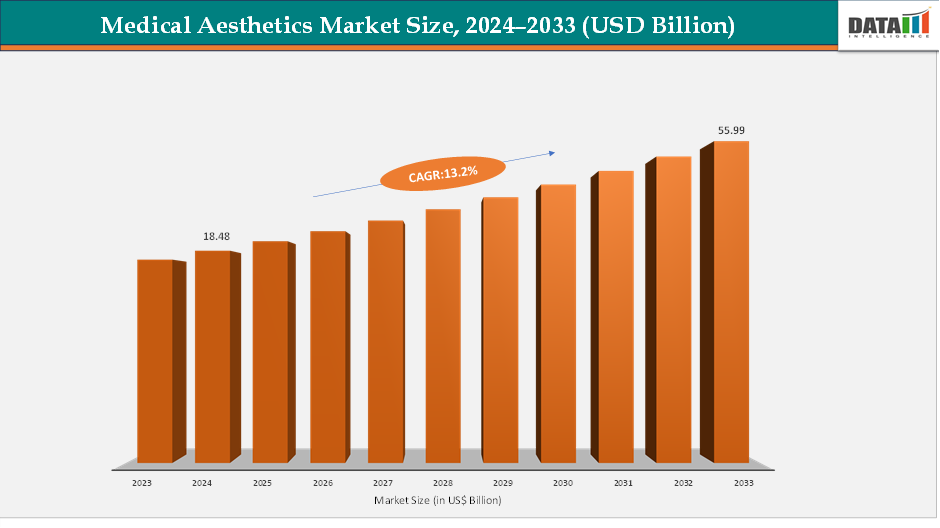
The global medical aesthetics market reached US$ 20.91 billion in 2025 and is expected to reach US$ 55.99 billion by 2033, growing at a CAGR of 13.2% during the forecast period 2026-2033.
The global medical aesthetics market is experiencing robust growth, fueled by the rising demand for minimally invasive and non-invasive procedures, technological advancements in energy-based devices, and increasing consumer awareness of aesthetic enhancements. Aesthetic solutions such as botulinum toxins, dermal fillers, body contouring devices, and Medical Aesthetics are witnessing strong adoption across diverse age groups, driven by lifestyle changes, growing acceptance of cosmetic procedures, and social media influence.
North America dominates the medical aesthetics market due to advanced healthcare infrastructure, leading companies like AbbVie, Revance, Merz, and Galderma, early product adoption, high consumer spending power, skilled practitioners, and favorable regulatory frameworks. This makes it the largest revenue contributor to the global medical aesthetics landscape.
Medical Aesthetics Market Summary
Medical Aesthetics Market Dynamics
Drivers - Rising Demand for Minimally Invasive and Non-invasive Procedures
The medical aesthetics market is driven by a growing preference for minimally invasive and non-invasive treatments. Patients are seeking visible results with reduced pain, fewer complications, and minimal downtime compared to traditional surgical procedures. Treatments like botulinum toxin injections, dermal fillers, chemical peels, and energy-based skin rejuvenation are becoming mainstream, offering natural-looking enhancements at a fraction of surgery recovery time.
For instance, the popularity of Allergan Aesthetics’ Botox and Galderma’s Restylane fillers highlights how minimally invasive procedures are reshaping consumer demand. Similarly, energy-based technologies like Ultherapy by Merz Aesthetics and CoolSculpting by AbbVie demonstrate how non-surgical options are gaining traction, as patients increasingly opt for treatments that fit seamlessly into their daily routines without extended recovery periods.
Restraints: High Treatment Costs
The medical aesthetics market faces a significant challenge due to the high cost of treatments, particularly in price-sensitive regions. Popular injectable procedures like Botox and dermal fillers can cost between USD 400-800 per session, while energy-based facial rejuvenation or laser treatments can cost between USD 1,000-2,500 per cycle. In developed markets, more invasive options can cost over USD 6,000-10,000. These high costs, driven by advanced device costs, consumables, and practitioner expertise, make aesthetic procedures unaffordable for a significant portion of the global population, leading to delayed or avoided treatments.
Opportunities: Expansion in Emerging Markets
The medical aesthetics market is experiencing growth due to expansion in emerging markets like Asia-Pacific, Latin America, and the Middle East. Rising disposable incomes, a growing middle-class population, and increased awareness of aesthetic procedures are creating a fertile environment for market growth. Medical tourism hubs like South Korea, Thailand, Brazil, and Turkey attract international patients with affordable yet high-quality treatments.
Moreover, global players are entering these regions through partnerships, distribution agreements, and local manufacturing, ensuring wider access to advanced injectables, implants, and energy-based devices. This expansion broadens the customer base for established brands and fosters innovation in cost-effective products tailored to regional needs.
Medical Aesthetics Market Regional Insights
North America Medical Aesthetics Market Trends
North America dominates the global medical aesthetics market due to advanced healthcare infrastructure, high purchasing power, and industry leaders like Allergan Aesthetics, Revance, and Evolus. The region's widespread awareness of cosmetic procedures and cultural acceptance of aesthetic enhancements have led to a rise in demand for minimally invasive treatments like Botox, dermal fillers, chemical peels, and laser-based skin rejuvenation.
Moreover, product launches, strong R&D investments, early adoption of cutting-edge technologies, and favorable reimbursement coverage further drive market penetration. Media influence, celebrity endorsements, and a focus on personal wellness and anti-aging sustain long-term demand across the region's diverse age spectrum.
For instance, in February 2025, Allergan Aesthetics, an AbbVie company, has announced the opening of three new U.S. training centers by Allergan Medical Institute (AMI), which will provide high-quality, tailored training to licensed aesthetics providers. AMI's unique curriculum and product portfolio will enable providers and business owners to deliver desired patient outcomes.
Asia-Pacific Medical Aesthetics Market Trends
The Asia-Pacific region is the fastest-growing market for medical aesthetics, driven by rising disposable incomes, healthcare access, and beauty standards. The region is a hub for medical tourism, offering high-quality cosmetic and reconstructive procedures at lower costs. South Korea is a leader in aesthetic technology adoption. Governments are investing in healthcare infrastructure and supporting international partnerships, while younger demographics are embracing minimally invasive treatments.
Medical Aesthetics Market Competitive Landscape:
The following are the major companies operating in the Medical Aesthetics market. These players hold a significant share and play an important role in shaping market growth and trends.
Allergan Aesthetics (AbbVie Inc.)
Revance Therapeutics, Inc.
Evolus, Inc.
Candela Medical
Merz Aesthetics
Cynosure, LLC
Tiger Aesthetics Medical
Alma Lasers
Sciton
Venus Concept Inc
The medical aesthetics market is dominated by multinational corporations and specialized companies, with leading players like Allergan Aesthetics, Revance Therapeutics, Evolus, Candela Medical, Merz Aesthetics, Cynosure, Tiger Aesthetics Medical, Alma Lasers, Sciton, and Venus Concept Inc. driving growth in surgical and non-surgical segments. Their portfolios include botulinum toxins, dermal fillers, laser systems, body contouring, and skin rejuvenation technologies. Their leadership is reinforced by investments in R&D, regulatory approvals, and strategic collaborations. These players address rising consumer demand for minimally invasive treatments and cater to diverse end-user needs in established and emerging markets.
Recent Developments in the Medical Aesthetics Market
August 2026: Revance & Teoxane received FDA approval for RHA Redensity® Eye, a hyaluronic-acid filler specifically indicated for moderate-to-severe infraorbital hollowing, using Preserved Network Technology designed for the dynamic under-eye area and results lasting up to 12 months.
- July 2026: Allergan Aesthetics (AbbVie) received European Commission approval for Boey® (trenibotulinumtoxinE), introducing a rapid-onset, short-duration botulinum neurotoxin serotype E for glabellar lines, with effects potentially appearing within eight hours and lasting approximately 2–3 weeks.
- April 2026: Galderma launched Alastin Regenerating Skin Nectar with TriHex+™, a next-generation regenerative skincare platform designed to support skin preparation, recovery and aesthetic-procedure outcomes through advanced peptide-based technology.
- March 2026: Allergan Aesthetics (AbbVie) presented new clinical evidence on investigational trenibotulinumtoxinE, with Phase 3 research showing rapid improvement in glabellar lines and a favorable safety profile, advancing development of next-generation neuromodulators.
- January 2026: Revance & Teoxane announced FDA approval and the upcoming launch of RHA® Dynamic Volume, an HA injectable for cheek augmentation and age-related midface contour deficiencies, incorporating Preserved Network Technology for dynamic facial movement.
Why Choose DataM?
- Technological Innovations: Explores advancements in medical aesthetics technologies, including laser and light-based systems, radiofrequency and ultrasound platforms, cryolipolysis, microneedling, injectables, body-contouring technologies, and energy-based aesthetic devices, highlighting innovations that improve treatment precision, patient comfort, safety, and clinical outcomes.
- Product Performance & Market Positioning: Evaluates medical aesthetics products and procedures based on factors such as treatment efficacy, safety profile, precision, treatment duration, recovery time, durability of results, versatility, and usability, while examining how leading companies differentiate their portfolios across facial aesthetics, skin rejuvenation, hair removal, body contouring, and other aesthetic applications.
- Real-World Evidence: Highlights the adoption of medical aesthetics procedures and technologies across dermatology clinics, plastic surgery practices, medical spas, hospitals, and specialized aesthetic centers, demonstrating applications in wrinkle reduction, skin rejuvenation, acne and scar treatment, hair removal, body contouring, and facial and body enhancement.
- Market Updates & Industry Changes: Tracks key developments such as new product launches, regulatory clearances, clinical studies, technology advancements, strategic partnerships, acquisitions, geographic expansion, and investments across major medical aesthetics markets, providing insights into evolving treatment preferences and competitive dynamics.
- Competitive Strategies: Analyzes how leading companies strengthen their market presence through product innovation, clinical research, regulatory approvals, strategic collaborations, acquisitions, physician training programs, portfolio expansion, and direct investments in emerging aesthetic technologies and treatment categories.
- Pricing & Market Access: Examines pricing variations across medical aesthetics procedures and technologies based on treatment type, device sophistication, consumable requirements, treatment area, number of sessions, clinical setting, and geographic market, alongside distribution and market-access strategies involving direct sales, distributors, aesthetic clinics, hospitals, dermatology practices, and medical-spa networks.
- Market Entry & Expansion: Identifies growth opportunities driven by increasing demand for minimally invasive and non-invasive aesthetic procedures, technological advancements, expanding aesthetic clinic networks, rising consumer interest in appearance-enhancing treatments, and broader adoption of energy-based devices and injectable products, while assessing strategies such as regulatory compliance, local partnerships, physician education, product localization, and geographic expansion.
Target Audience
- Medical Aesthetics Device Manufacturers
- Pharmaceutical & Injectable Aesthetics Companies
- Dermatology & Plastic Surgery Clinics
- Medical Spas & Aesthetic Centers
- Hospitals & Healthcare Providers
- Laser & Energy-Based Device Manufacturers
- Injectable & Dermal Filler Manufacturers



























































