


Japan Electronic Medical Records Market Overview
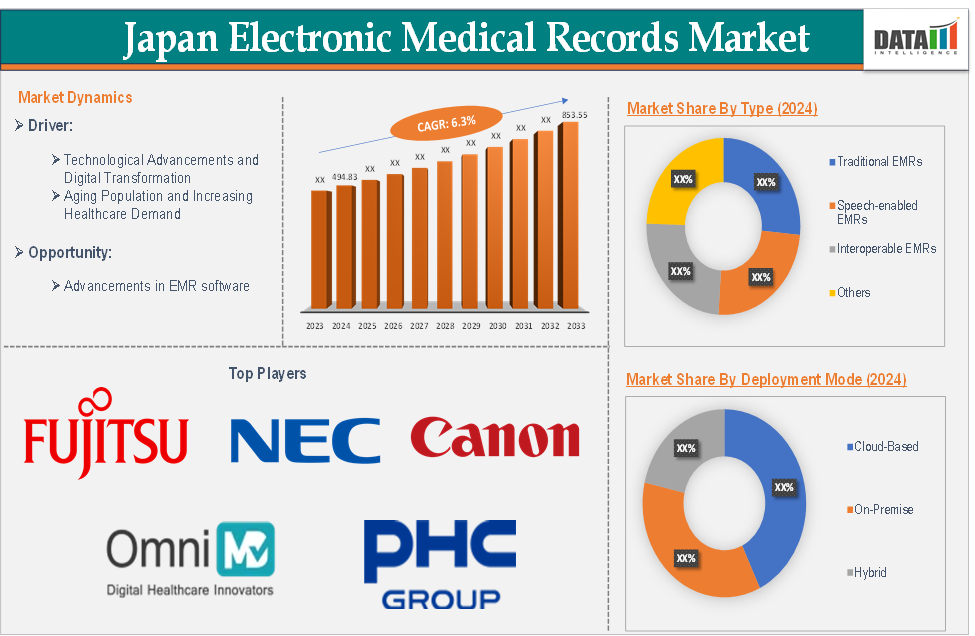
The Japan Electronic Medical Records Market size reached US$ 2.15 Billion in 2025 and is expected to reach US$ 3.48 Billion by 2033, growing at a CAGR of 5.41% during the forecast period 2026-2033.
The Japan electronic medical records market includes digital platforms and software solutions used by healthcare providers to store, manage, and exchange patient health information. The market is witnessing steady growth driven by the increasing need for healthcare digitalization, rising patient volumes, and the demand for efficient clinical workflows. Government initiatives promoting health IT adoption and data standardization are encouraging hospitals and clinics to transition from paper-based systems to electronic records. The integration of advanced technologies such as cloud computing, artificial intelligence, and data analytics is further enhancing system capabilities, enabling improved diagnosis, decision-making, and patient outcomes. Large hospitals in Japan have shown higher adoption rates, while small and medium-sized facilities are gradually adopting EMR systems, creating additional growth opportunities. However, challenges such as high implementation costs, interoperability issues, and strict data privacy regulations continue to impact market expansion. Overall, the market is evolving toward more connected, scalable, and patient-centric digital healthcare ecosystems.
Executive Summary
For more details on this report – Request for Sample
Japan Electronic Medical Records Market Dynamics: Drivers & Restraints
Technological advancements and digital transformation are significantly driving the Japan electronic medical records market growth
Cloud computing has revolutionized the healthcare industry by providing cost-effective, scalable, and secure data storage solutions. EMR systems, which traditionally required large on-premise infrastructure, can now be hosted in the cloud, reducing costs for healthcare providers, especially smaller hospitals and clinics. Thus, the market players in Japan are advancing the EMRs into cloud-based systems, which is driving the market over the forecast period.
For instance, in April 2023, Wemex Corporation, a wholly owned subsidiary of PHC Holdings Corporation, launched an integrated electronic medical record (EMR) system, Medicom-HRf Hybrid Cloud, for clinics in Japan. The newly released Medicom-HRf Hybrid Cloud is a high-end EMR model that can quickly and flexibly respond to the digital transformation in healthcare, such as online insurance eligibility verification and e-prescriptions. The product retains the high operability and user-friendly input speed of the previous models, and the addition of cloud technology means it can be used from many locations without dedicated devices.
AI-powered EMR systems enhance decision-making by providing insights from vast amounts of healthcare data. These systems can analyze patient data to offer clinical decision support, suggest treatment plans, and even predict patient outcomes. One of the significant challenges in Japan's healthcare system has been data fragmentation across various hospitals, clinics, and pharmacies. Recent technological advancements have led to the development of interoperable EMR systems that allow the seamless sharing of patient information across different healthcare providers.
Data privacy and security concerns hampering market growth
Despite the increasing adoption of digital health solutions, these concerns remain a major barrier for healthcare providers, patients, and technology developers. The sensitive nature of medical data, coupled with stringent regulations, creates obstacles to the widespread adoption of EMRs in Japan. Japan has some of the strictest data protection laws, which require EMR systems to comply with the Personal Information Protection Act (PIPA). These regulations ensure the security of personal data but also make the process of adopting EMRs more complex for healthcare providers.
The rise in cyberattacks and data breaches in healthcare globally has heightened concerns in Japan as well. Healthcare systems are often targeted by cybercriminals due to the sensitive nature of medical data, which is highly valuable in the black market. Japan’s healthcare data security systems have faced attacks that compromise patient data, causing healthcare providers to hesitate in fully adopting EMRs. The need for cybersecurity solutions that can protect sensitive medical information is vital for the acceptance of EMRs.
Japan Electronic Medical Records Market Segment Analysis
The Japan electronic medical records market is segmented based on type, deployment mode, application, and end-user.
by Deployment Mode:
The cloud-based EMRs segment is expected to dominate the Japan electronic medical records market with the highest market share
Cloud-based EMR systems offer significant cost advantages compared to traditional on-premise systems. Healthcare providers, especially smaller hospitals and clinics, face lower upfront costs because they don't need to invest in expensive hardware infrastructure or worry about its maintenance and upgrades. Instead, cloud-based systems operate on a subscription model, allowing healthcare providers to scale up or down based on their needs. Thus, novel cloud-based launches are further driving the segment growth.
For instance, in April 2023, Fujitsu launched a cloud-based platform that allows users to securely collect and leverage health-related data to promote digital transformation in the medical field. The new platform enables the automatic conversion of medical data from medical institutions’ electronic medical records to conform to the next-generation standards framework, HL7 FHIR, and secure aggregation of health-related data. Based on their consent, patients can securely store personal health information such as vital data, step counts, and calorie consumption converted into non-personally identifiable information on the platform.
Cloud-based EMRs in Japan are designed with advanced security protocols, ensuring that sensitive health data is protected in line with Japan's stringent data protection laws, such as the Personal Information Protection Act (PIPA). Major cloud service providers also offer data encryption, multi-factor authentication, and regular system updates, ensuring high security and compliance with national and international standards.
Japan Electronic Medical Records Market Top Companies
Top companies in the Japan electronic medical records market include Fujitsu Limited, NEC Corporation, OmniMD, CANON MEDICAL SYSTEMS CORPORATION, PHC Holdings Corporation, Nihon Kohden Corporation, Juvonno, ESO Solutions, Inc., and among others.
Japan Electronic Medical Records Market Key Development
July 2026: Japan’s Ministry of Health, Labour and Welfare continued implementation preparations for the Electronic Medical Record Information Sharing Service, supporting nationwide exchange of clinical information, health-check results, referral documents, and patient summaries across healthcare institutions and pharmacies.
- May 2026: Fujitsu and IBM Japan formalized a healthcare collaboration to develop a Japan-based sovereign cloud platform for medical use. Their initiative will operate both companies’ electronic health record solutions on Fujitsu’s cloud infrastructure while supporting secure medical data integration and AI utilization across healthcare institutions.
- May 2026: SMBC Group, Fujitsu, and SoftBank agreed to establish a Japan-developed healthcare data platform designed to securely manage and connect medical and personal health information. The alliance also plans to develop AI agents and interoperable data infrastructure supporting Japan’s healthcare digital transformation.
- April 2026: Medical AI Promotion Institute (MAPI) and Segmed formed a strategic partnership to expand access to global medical data for AI development in Japan, supporting medical data utilization and the development of AI-driven healthcare applications.
- In March 2026, Fujitsu Japan Limited and Teikyo University Hospital launched a joint proof of concept to strengthen regional medical collaboration using medical administration systems and electronic health record data. The initiative is aimed at developing new information analysis and patient management mechanisms, reflecting the market’s shift toward more connected, data-driven, and interoperable EMR ecosystems in Japan.
- February 2026: Fujitsu Japan and JMDC began a collaboration combining Fujitsu Japan’s healthcare technology and EMR market presence with JMDC’s anonymized medical data and prediction-model capabilities to advance data-driven healthcare management in Japan.
- January 2026: Japan’s healthcare digitalization program progressed with updates to the Electronic Medical Record Information Sharing Service, including FHIR-related data standards and operational materials, supporting greater interoperability and nationwide medical information exchange.
- In December 2025, Medley, Inc. started providing a pilot version of a new AI-assisted medical document creation feature for its hospital electronic medical record system “MALL.” The new function is designed to improve physician workflow efficiency by supporting medical document preparation within the EMR environment, highlighting the market’s shift toward AI-enabled clinical documentation and smarter hospital information systems in Japan.
Japan Electronic Medical Records Market Scope
| Metrics | Details | |
| CAGR | 5.41 % | |
| Market Size Available for Years | 2023-2033 | |
| Estimation Forecast Period | 2026-2033 | |
| Revenue Units | Value (US$ Bn) | |
| Segments Covered | Type | Traditional EMRs, Speech-enabled EMRs, Interoperable EMRs, and Others |
| Deployment Mode | Cloud-Based, On-Premise, and Hybrid | |
| Application | Clinical EMR, Administrative EMR, Reporting EMR, and Others | |
| End-User | Hospitals, Specialty Clinics, Ambulatory Care Centers, Diagnostic Centers and Others | |
Why Purchase the Report?
- Pipeline & Innovations: Reviews ongoing clinical trials, product pipelines, and forecasts upcoming advancements in medical devices and pharmaceuticals.
- Product Performance & Market Positioning: Analyzes product performance, market positioning, and growth potential to optimize strategies.
- Real-World Evidence: Integrates patient feedback and data into product development for improved outcomes.
- Physician Preferences & Health System Impact: Examines healthcare provider behaviors and the impact of health system mergers on adoption strategies.
- Market Updates & Industry Changes: Covers recent regulatory changes, new policies, and emerging technologies.
- Competitive Strategies: Analyze competitor strategies, market share, and emerging players.
- Pricing & Market Access: Reviews pricing models, reimbursement trends, and market access strategies.
- Market Entry & Expansion: Identifies optimal strategies for entering new markets and partnerships.
- Supply Chain Optimization: Assesses supply chain risks and distribution strategies for efficient product delivery.
- Sustainability & Regulatory Impact: Focuses on eco-friendly practices and evolving regulations in healthcare.
- Post-market Surveillance: Uses post-market data to enhance product safety and access.
- Pharmacoeconomics & Value-Based Pricing: Analyzes the shift to value-based pricing and data-driven decision-making in R&D.
The Japan electronic medical records market report delivers a detailed analysis with 36 key tables, more than 33 visually impactful figures, and 198 pages of expert insights, providing a complete view of the market landscape.
Target Audience 2026
- Manufacturers: Pharmaceutical, Medical Device, Biotech Companies, Contract Manufacturers, Distributors, Hospitals.
- Regulatory & Policy: Compliance Officers, Government, Health Economists, Market Access Specialists.
- Technology & Innovation: AI/Robotics Providers, R&D Professionals, Clinical Trial Managers, Pharmacovigilance Experts.
- Investors: Healthcare Investors, Venture Fund Investors, Pharma Marketing & Sales.
- Consulting & Advisory: Healthcare Consultants, Industry Associations, Analysts.
- Supply Chain: Distribution and Supply Chain Managers.
- Consumers & Advocacy: Patients, Advocacy Groups, Insurance Companies.
- Academic & Research: Academic Institutions.



























































