


Japan cooling as a service Market Overview
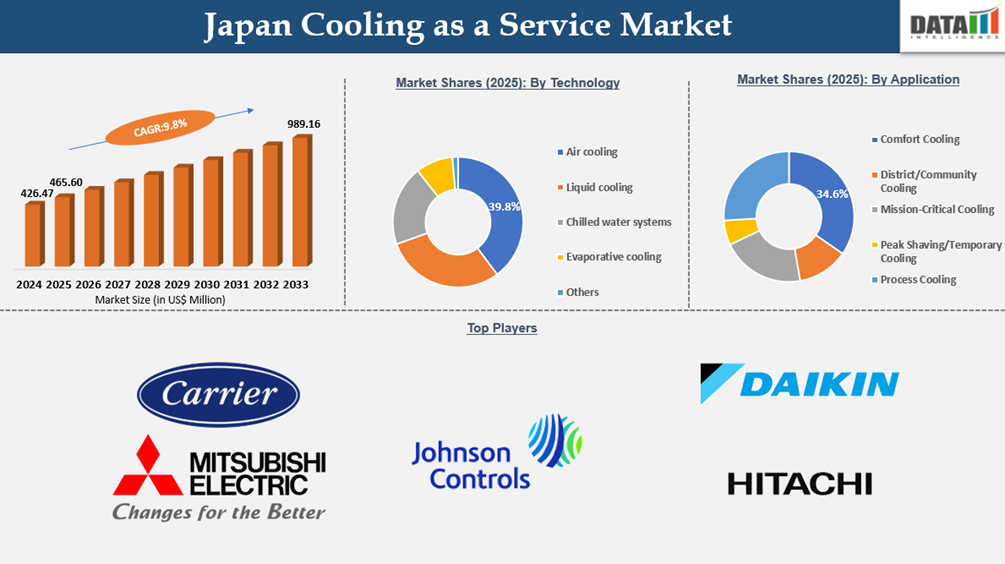
Japan cooling as a service market reached US$ 465.60 million in 2025 and is expected to reach US$ 989.16 million by 2033, growing with a CAGR of 9.8% during the forecast period 2026-2033. As Japan aims to be carbon by 2050 it needs more energy-efficient cooling systems that are pay-per-use. Companies are moving away from spending a lot of money upfront. Are instead opting for models that let them pay for operations, maintenance and have a lower carbon footprint.
The cooling as a service concept is helping Japan Green Transformation program. It lets businesses upgrade their inefficient cooling systems without having to buy them outright. With electricity costs going up and a push for cities, telecom and data center companies are using Cooling, as a Service to keep their new AI and 5G systems cool.
Cooling as a Service Industry Trends and Strategic Insights
- Companies running data centers in Tokyo and Osaka, which have than 80% of Japans data center capacity are using high-density cooling solutions because they are short on space and power.
- Liquid cooling methods, like direct-to-chip and immersion cooling are likely to be the technology choice. By 2025 these liquid cooling solutions are expected to take up an bigger share of the market.
Japan cooling as a service Market Size and Future Outlook
- 2025 Market Size: US$ 465.60 billion
- 2033 Projected Market Size: US$ 989.16 billion
- CAGR (2026-2033): 9.8%
For More Detailed information Request for sample
Market Scope
| Metrics | Details |
| By Technology | Air Cooling, Liquid Cooling, Chilled Water Systems, Evaporative Cooling, Others |
| By Service | Installation, Maintenance (Corrective Maintenance, Preventive Maintenance), Monitoring (Onsite Monitoring, Remote Monitoring), Support |
| By Application | Comfort Cooling, District/Community Cooling, Mission-Critical Cooling, Peak Shaving/Temporary Cooling, Process Cooling |
| By End-User | Residential, Commercial, Industrial |
| Report Insights Covered | Competitive Landscape Analysis, Company Profile Analysis, Market Size, Market Share, Market Growth |
Market Dynamics
Rising Adoption of AI-Optimized Data Centers
Japans cooling as a service business is getting really big fast. This is because a lot of data centers that use artificial intelligence are being built all over the country. Big companies like NTT, SoftBank and Fujitsu are spending a lot of money on intelligence infrastructure. So there is a need for cooling systems that work well and can be changed easily. The government of Japan is also helping to make this happen with programs to update the computer systems used by the government. This is making a lot of data centers get built in big cities, like Tokyo and Osaka and also in other parts of the country. Japans cooling as a service business is expanding because of all these data centers.
Japan's data center sector is one of Asia's most mature, but the change to high-density GPU clusters for generative AI workloads is making traditional in-house cooling solutions increasingly ineffective. It is encouraging businesses to shift toward CaaS models, which provide operational flexibility while reducing capital expenditure, an especially appealing prospect in Japan's cost-conscious corporate culture. The country's well-established colocation ecosystem also provides an obvious path for CaaS companies to bundle cooling infrastructure with managed services offers.
Security Concerns Around Legacy Infrastructure
A significant number of Japan's enterprise data centers were built in the 1990s and 2000s, with traditional air-cooling systems that are unsuited to the thermal demands of modern AI hardware. Retrofitting older facilities requires significant capital investment and operational interruption, prompting many firms to postpone modernization decisions.
Japan's tight construction rules and seismic safety laws add a another layer of complication, as cooling infrastructure adjustments must meet earthquake resistance criteria, increasing both the cost and lead time for renovations. Furthermore, regulatory fragmentation between city governments and national standards bodies can impede the approval process for large-scale facility upgrades, posing a significant obstacle for CaaS companies seeking rapid market penetration.
Segmentation Analysis
The Japan cooling as a service market is segmented based on the technology, service, application and end-user.
Balancing Legacy Air Tech with Net-Zero Data Center Demands
The core technology category in Japan's Cooling as a Service market is still air cooling, which supports the operational foundation of commercial buildings, industrial facilities, and legacy and mid-tier data centers nationwide.
To meet Japan’s goal of being carbon neutral by 2050 and its renewable energy targets for 2030 as outlined in the Sixth Strategic Energy Plan, air-based systems that use a lot of energy need to become more efficient. Technology needs to show gains that match the rise in electricity demand expected from data centers and semiconductor plants. According to Japan Organization for Cross regional Coordination of Transmission Operators (OCCTO), this demand is predicted to more than fourteen times over the next ten years.
Japan's GX 2040 Vision and the $150 Trillion Opportunity Reshaping the Cooling as a Service Market
Japan's industrial segment is the most technically challenging and quickly developing frontier in the Cooling as a Service landscape. It is driven by three powerful macroeconomic forces: the government's semiconductor revival strategy, the exponential growth of AI-driven data center infrastructure, and the GX (Green Transformation) policy framework, which is fundamentally rethinking industrial energy economics.
Japan's GX 2040 Vision, which was adopted by the Cabinet in January 2025, further institutionalizes this trend. Public-private cooperation is expected to reach 150 trillion yen in investment over the next ten years to achieve GX, with the semiconductor, steel, chemicals, and data infrastructure sectors specifically designated as priority decarbonization sectors under METI's Sector-Specific Investment Strategies.
Sustainability Analysis
The industry deals with the massive energy consumption of data centers, which account for a growing percentage of the country's electricity use. Leading companies in this space are working to move towards carbon neutrality by offering solutions that dramatically reduce Power Usage Effectiveness (PUE). For instance, switching from air-based to liquid cooling can reduce the energy dedicated to cooling by up to 40%, directly contributing to the decarbonization of the IT sector.
Competitive Landscape
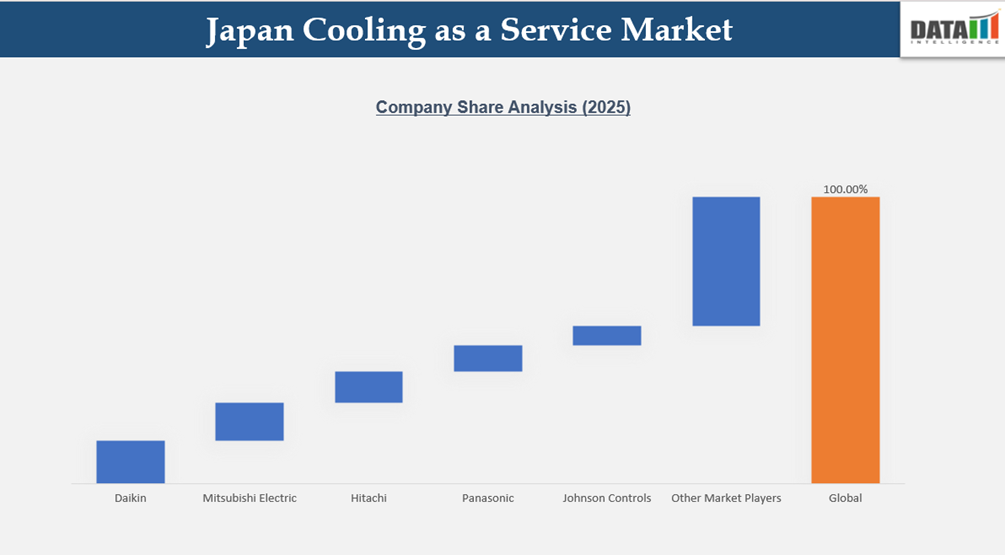
- The Japanese Cooling as a Service market features a competitive landscape blending global industrial giants and specialized domestic technology leaders. Companies compete on energy efficiency metrics, technological sophistication (e.g., liquid vs. air cooling), and the ability to provide end-to-end lifecycle management.
- Service providers are even integrating the reuse of waste heat captured from data centers to warm nearby buildings or for industrial processes, a concept gaining traction in urban redevelopment projects.
Key Developments
- In April 2026: Daikin is set to launch the "FIVE STAR ZEAS" in Japan, a flagship energy-saving model featuring a new "Condensation Suppression Sensing Kit." This product will be integrated into Daikin’s subscription-based "Air as a Service" (AaaS) offerings to handle Japan’s increasingly humid summers.
- In February 2026, Carrier Japan is scheduled to unveil its latest high-efficiency HVAC technologies at HVAC&R JAPAN 2026, specifically focusing on "connected services" that integrate AI-driven predictive maintenance into their Japanese service-based contracts.
- In January 2026, Johnson Controls Japan reported a 25% increase in the adoption of its OpenBlue CaaS model. The development focuses on "Agentic AI" which automates operational decisions for large-scale Japanese commercial facilities, moving beyond simple data insights to autonomous cooling management.
- In January 2026, Hitachi Systems, in collaboration with Yashima Electric, launched a direct liquid cooling system (DLC) service for data centers. This new offering combines product sales with installation and 24/7 maintenance, providing a complete "stable operation" service to clients struggling with the complexity of cooling high-performance AI servers
- In January 2026, Trane launched its first Asia-Pacific-specific DCDA series Cooling Distribution Unit (CDU) for data centers. This move into liquid cooling offers a "green overall solution" that guarantees high energy efficiency (low PUE) and reliable performance, effectively selling thermal management as a service to the AI-driven market.
- In November 2025, Mitsubishi Electric’s subsidiary, MEHITS, established a joint venture to develop next-generation compressors. These are designed to power their 2026 CaaS portfolio for Japanese data centers, targeting a significant reduction in Power Usage Effectiveness (PUE) via AI-optimized cooling.
- In September 2025, Daikin's subsidiary, Daikin Airtech, collaborated on the "Pitcube," a dedicated power receiving unit for garages. iT directly supports the "Air Conditioning Flat-Rate Service," a subscription model that removes initial cost barriers for customers facing new legal heat countermeasures
Why Choose DataM?
- Data-Driven Insights: Dive into detailed analyses with granular insights such as pricing, market shares and value chain evaluations, enriched by interviews with industry leaders and disruptors.
- Post-Purchase Support and Expert Analyst Consultations: As a valued client, gain direct access to our expert analysts for personalized advice and strategic guidance, tailored to your specific needs and challenges.
- White Papers and Case Studies: Benefit quarterly from our in-depth studies related to your purchased titles, tailored to refine your operational and marketing strategies for maximum impact.
- Annual Updates on Purchased Reports: As an existing customer, enjoy the privilege of annual updates to your reports, ensuring you stay abreast of the latest market insights and technological advancements. Terms and conditions apply.
- Specialized Focus on Emerging Markets: DataM differentiates itself by delivering in-depth, specialized insights specifically for emerging markets, rather than offering generalized geographic overviews. This approach equips our clients with a nuanced understanding and actionable intelligence that are essential for navigating and succeeding in high-growth regions.
- Value of DataM Reports: Our reports offer specialized insights tailored to the latest trends and specific business inquiries. This personalized approach provides a deeper, strategic perspective, ensuring you receive the precise information necessary to make informed decisions. These insights complement and go beyond what is typically available in generic databases.
Target Audience 2024
- Manufacturers/ Buyers
- Industry Investors/Investment Bankers
- Research Professionals
- Emerging Companies
Suggestions for Related Report


























































