


Japan Compounded Sterile Preparations Market Overview
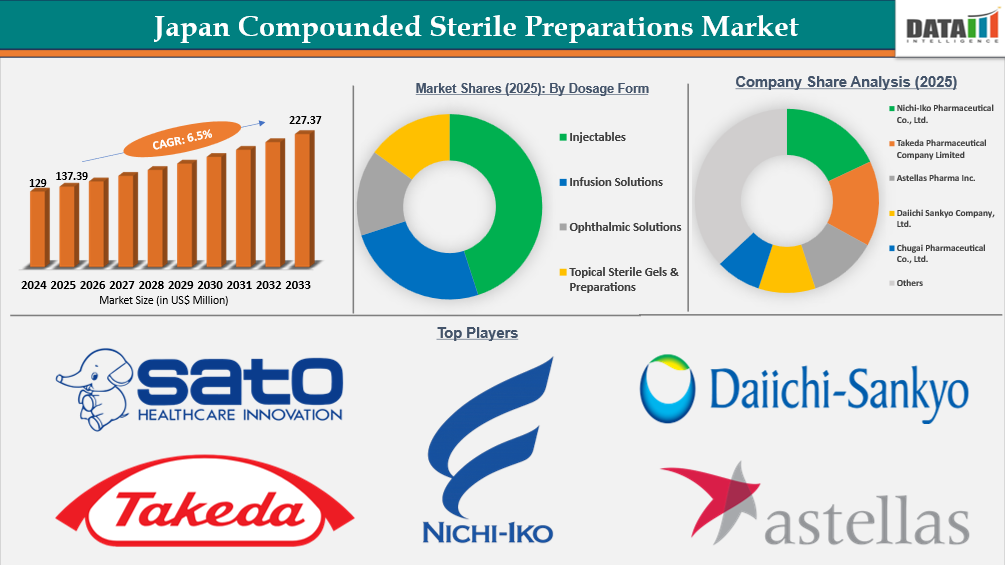
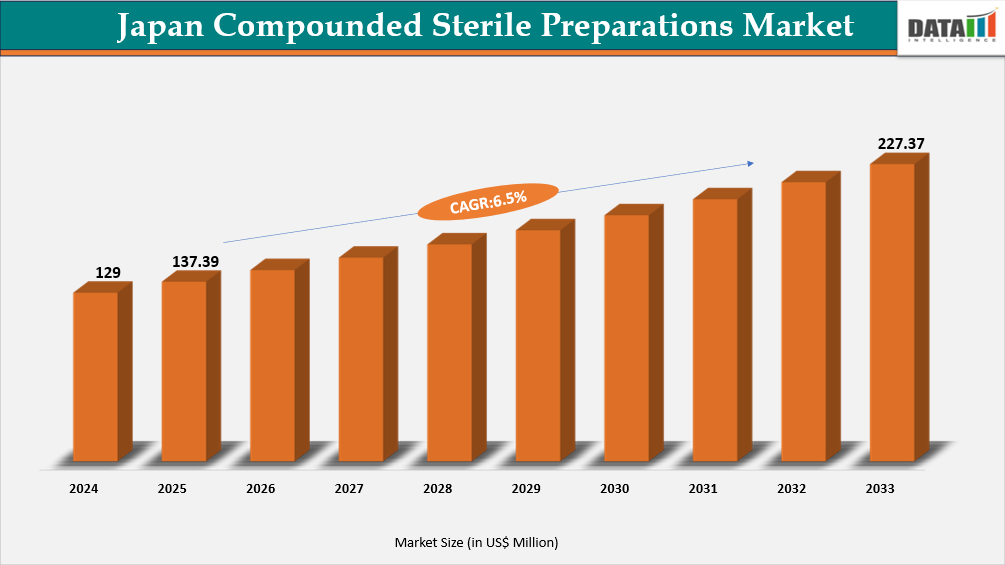
The Japan Compounded Sterile Preparations Market reached to 137.39 million in 2025 and is expected to reach US$227.37 Million by 2033, growing at a CAGR of 6.5% from 2026 to 2033.
The market for compound sterile preparations in Japan is growing steadily due to the country's high hospital dependence on sterile dosage forms and ongoing cost-containment measures put in place by the Ministry of Health, Labour, and Welfare. Since injectables are used so widely in cancer, anti-infectives, anesthesia, and critical care, they have the greatest proportion of the market, which includes important dosage categories such as injectables, infusion solutions, ophthalmic solutions, and topical sterile gels & preparations. Almost 1 million new instances of cancer are reported in Japan each year, which greatly increases the need for supportive sterile injectables and compounded chemotherapy preparations used in inpatient and regulated clinical settings.
Infusion solutions and IV compounded products play an important role in hydration treatment, complete parenteral nutrition (TPN), and ready-to-administer (RTA) drugs, helping hospitals improve pharmaceutical safety, minimize preparation time, and increase workflow efficiency. Ophthalmic sterile solutions profit from high surgical volumes, notably cataract surgeries, which surpass 1.5 million per year, whilst topical sterile gels and preparations are increasingly used in wound treatment and dermatological interventions that need aseptic conditions. With over 29% of the population aged 65 and older and generic pharmaceuticals accounting for nearly 90% of prescription volume, the need for cost-effective, high-quality sterile compounded formulations remains strong. The Pharmaceuticals and Medical Devices Agency also monitors market activity to ensure strict compliance with safety, quality, and aseptic production requirements.
Compounded Sterile Preparations Market Industry Trends and Strategic Insights
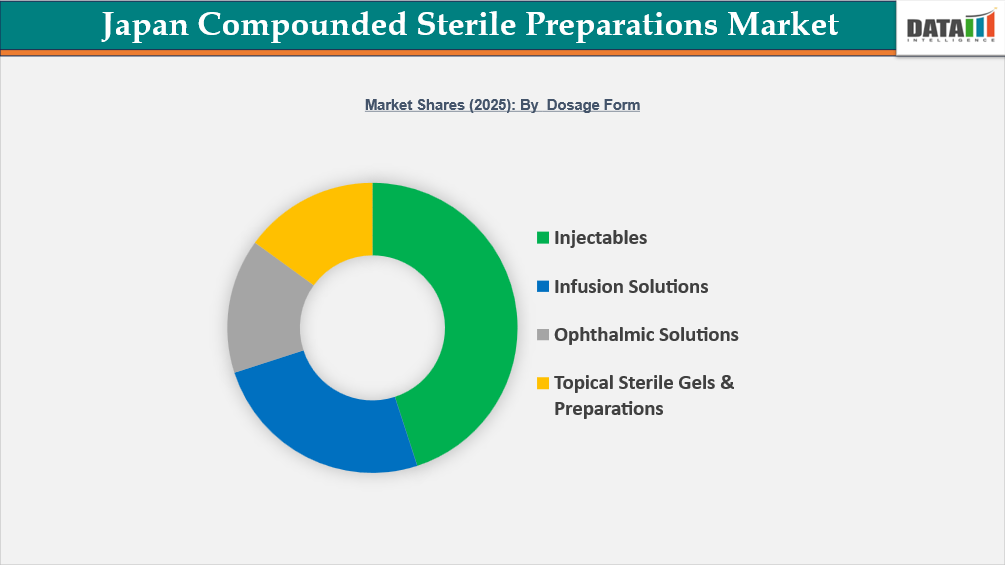
- By Dosage Form segment, Injectables led the Japan Compounded Sterile Preparations Market, capturing the largest revenue share of 45% in 2025.
Japan Compounded Sterile Preparations Market Size and Future Outlook
- 2025 Market Size: US$137.39 Million
- 2033 Projected Market Size: US$227.32 Million
- CAGR (2026–2033): 6.5%
For More Detailed Information, Request for Sample
Market Dynamics
Strong Demand for Ready-to-Administer (RTA) Sterile Injectables
The high demand for Ready-to-Administer (RTA) sterile injectables in Japan is largely due to hospitals' increased emphasis on patient safety, workflow optimization, and medication mistake prevention. RTA products are pre-diluted and aseptically manufactured in controlled conditions, so nursing workers do not need to reconstitute or dilute them at the bedside. This considerably minimizes the likelihood of dosage mistakes, contamination, and occupational exposure, particularly for dangerous medications like chemotherapeutic treatments. Furthermore, RTA solutions reduce nursing time, increase ICU and oncology unit efficiency, and promote consistent treatment regimens. As Japanese hospitals modernize their pharmacy operations and emphasize quality assurance, the use of RTA sterile compounded medications grows rapidly.
Segmentation Analysis
The Japan Compounded Sterile Preparations Market is segmented based on dosage form, route of administration, therapeutic compound risk level, end-user, compounding facility type, and preparation type.
Injectables Dosage Form Sustains Structural Growth in Japan Compounded Sterile Preparations Market
Injectables are the largest and most critical area of operation in the Japan Compounded Sterile Preparations market. This segment is well-supported by databases on hospitals' use of injectables, as well as demographics. As reported by the Ministry of Health, Labour, and Welfare National Patient Survey, Japan's approximately 1.2-1.3 million inpatients on any given day receive a significant portion of their medication through injectable routes, predominantly intravenous, in both acute care and tertiary care hospitals. Further, almost 29% of the population of Japan is over 65 years old. This demographic is the largest consumer of hospitalization and provides the largest volume of intensive intravenous therapy, emphasizing that sterile injectable preparations will continue to be necessary.
Cancer remains the leading cause of death in Japan. The number of cases of cancer is approximately 1 million annually in Japan, and intravenous chemotherapy is usually the first option for treatment. Generally, in addition to anticancer medications, injectable medications can include, but are not limited to, intravenous antibiotics, antiemetics, growth factors, and parenteral nutrition, which will continue to grow the size of injection volume capacity.
The Japanese Society of Hospital Pharmacists' professional survey results reveal that the majority of big acute-care hospitals have centralized aseptic compounding facilities that specialize primarily in injectable pharmaceuticals, including high-risk and cytotoxic drugs. These centralized procedures improve pharmaceutical safety while also reflecting Japanese healthcare organizations' structural reliance on sterile injectable preparation.
Overall, government healthcare statistics and professional survey evidence show that injectables are the most widely used sterile dosage form in Japan's hospital system, firmly retaining their leading and structurally embedded position in the country's Compounded Sterile Preparations market.
Competitive Landscape
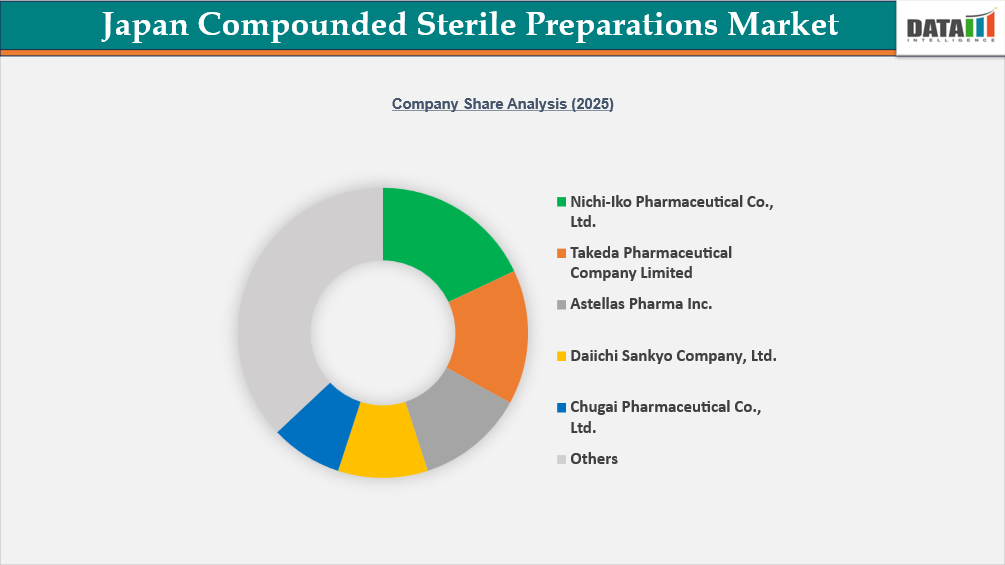
The market for compounded sterile preparations in Japan is moderately consolidated and has both domestic and international pharmaceutical manufacturers actively involved. The major companies in the hospital injectable (IV) product segment offer competitively priced sterile formulations of injectable medications that can be administered directly to patients by physicians. Three companies dominate the hospital injectable (IV) market: Nichi-Iko Pharmaceutical Co., Ltd, Sato Pharmaceutical Co., Ltd, and Takeda Pharmaceutical Co., Ltd. The companies offer a wide array of competitive sterile formulations of injectable medications at competitive prices and ready-to-use products. Astellas Pharma Inc., Daiichi Sankyo Co., Ltd., and Chugai Pharmaceutical Co., Ltd. participate in specialty injectables, biosimilars, and high-complexity compounded products utilizing their significant expertise in regulatory processes and established distribution networks. The Global companies, including Fresenius Kabi AG, Baxter International, and Vetter Pharma-Fertigung GmbH & Co KG, participate in the market through their contract manufacturing capabilities and advanced sterile compounding technology platforms targeted to either domestic hospitals or export markets. Additionally, strategic initiatives through partnerships, technology licensing agreements, and portfolio expansion related to liposomal drug formulations, depot injections, and biosimilar injectable drug formulations are some of the key competitive strategies influencing the market structure in Japan.
Key Developments
- On April 2026, Japan’s compounded sterile preparations market witnessed increasing adoption of ready-to-administer (RTA) sterile injectables across hospitals and oncology centers. Healthcare providers intensified focus on medication safety, contamination prevention, and workflow optimization, driving demand for aseptically prepared injectable formulations in critical care and chemotherapy applications.
- On March 5, 2026, industry analyses highlighted strong growth prospects for Japan’s compounded sterile preparations market, supported by rising cancer incidence, expanding hospital utilization of sterile formulations, and increasing demand for customized injectables, ophthalmic solutions, and infusion therapies. The market is projected to expand steadily through 2033 with increasing emphasis on sterile compounding compliance and hospital efficiency.
- On February 27, 2026, Japanese government working groups and industry stakeholders emphasized strengthening domestic pharmaceutical manufacturing capabilities, including CDMO and sterile production infrastructure. The initiative aims to improve supply chain resilience, support advanced drug manufacturing, and enhance domestic production of biologics and sterile pharmaceutical products.
- On January 2026, industry reports indicated accelerated modernization of hospital pharmacy operations in Japan, including increased investment in pharmacy automation, robotic dispensing systems, and AI-enabled medication management technologies. These advancements are supporting sterile compounding accuracy, inventory control, and medication safety in hospital settings.
- On November 6, 2025, Nipro Corporation and Nichi-Iko Pharmaceutical Co., Ltd. announced collaboration plans to consolidate manufacturing facilities for injectable antibiotic products beginning in 2026. The partnership aims to strengthen stable supply of sterile injectable medications and improve production efficiency within Japan’s healthcare sector.
- On October 2025, Japan’s healthcare sector continued expanding adoption of sterile injectable preparations in oncology, anesthesia, and anti-infective therapies, driven by rising hospital demand for customized and pre-prepared sterile medications. Hospitals increasingly prioritized contamination control and reduction of bedside medication preparation risks.
- On July 28, 2025, the Japanese government and major pharmaceutical manufacturers announced investments exceeding ¥100 billion to strengthen domestic production of advanced pharmaceuticals and regenerative medicines. The initiative is expected to support long-term expansion of sterile manufacturing infrastructure and enhance pharmaceutical supply chain security in Japan.
- Latest Data & Forecasts – Comprehensive and up-to-date market intelligence with forecasts through 2033, covering Japan demand by key segmentation, with country analysis.
- Regulatory Intelligence – In-depth assessment of Japan pharmaceutical regulatory frameworks impacting market development and commercialization, including FDA, EMA, NMPA, PMDA, and CDSCO requirements, clinical trial pathways, labeling standards, patent exclusivity, and post-marketing surveillance.
- Competitive Benchmarking – Structured benchmarking of leading innovator and generic manufacturers based on Dosage Form portfolios, pipeline strength, geographic reach, pricing strategies, clinical differentiation, and partnerships in the market.
- Actionable Strategies & Cost Dynamics – Strategic insights into lifecycle management, generic entry risks, combination therapy positioning, pricing pressures, and manufacturing cost structures, supported by expert perspectives from various specialists, regulatory advisors, and pharmaceutical executives.


























































